

Monday morning. Your CRM has 250 accounts in it.
You could sort them by company size. You could start with the logos you recognise. You could work the accounts assigned to you last week. Or you could pick a few names that look promising and start researching.
None of those approaches answers the question that actually matters: Which leads should I work first?
The best way to prioritise leads is to combine ICP fit, buyer relevance, current signals, and timing. Then turn that information into a clear next action.
That matters because reps cannot give every lead the same level of attention. Salesforce's 2026 State of Sales report found that sales reps spend almost one full day of their workweek on prospecting, while 47% say cold outreach is one of the worst parts of the job.
The answer is not to build a more complicated list.
It is to build a better worklist.
How to Prioritise Leads Without Relying on Gut Feel (7 Ways)
A useful lead prioritisation system should answer four questions:
- Does this account fit our ICP?
- Is there a reason to act now?
- Is this the right person to contact?
- What should I do next?
Most lead lists answer only the first question.
A CRM might tell you that a company fits your target market. A lead score might tell you that one contact ranks above another. But neither necessarily tells a rep whether that account deserves attention today.
That distinction becomes important when your list gets large.
And here are seven ways to do it:
1. Start With ICP Fit, Not Activity
Before looking for buying signals, make sure the account is worth your time.
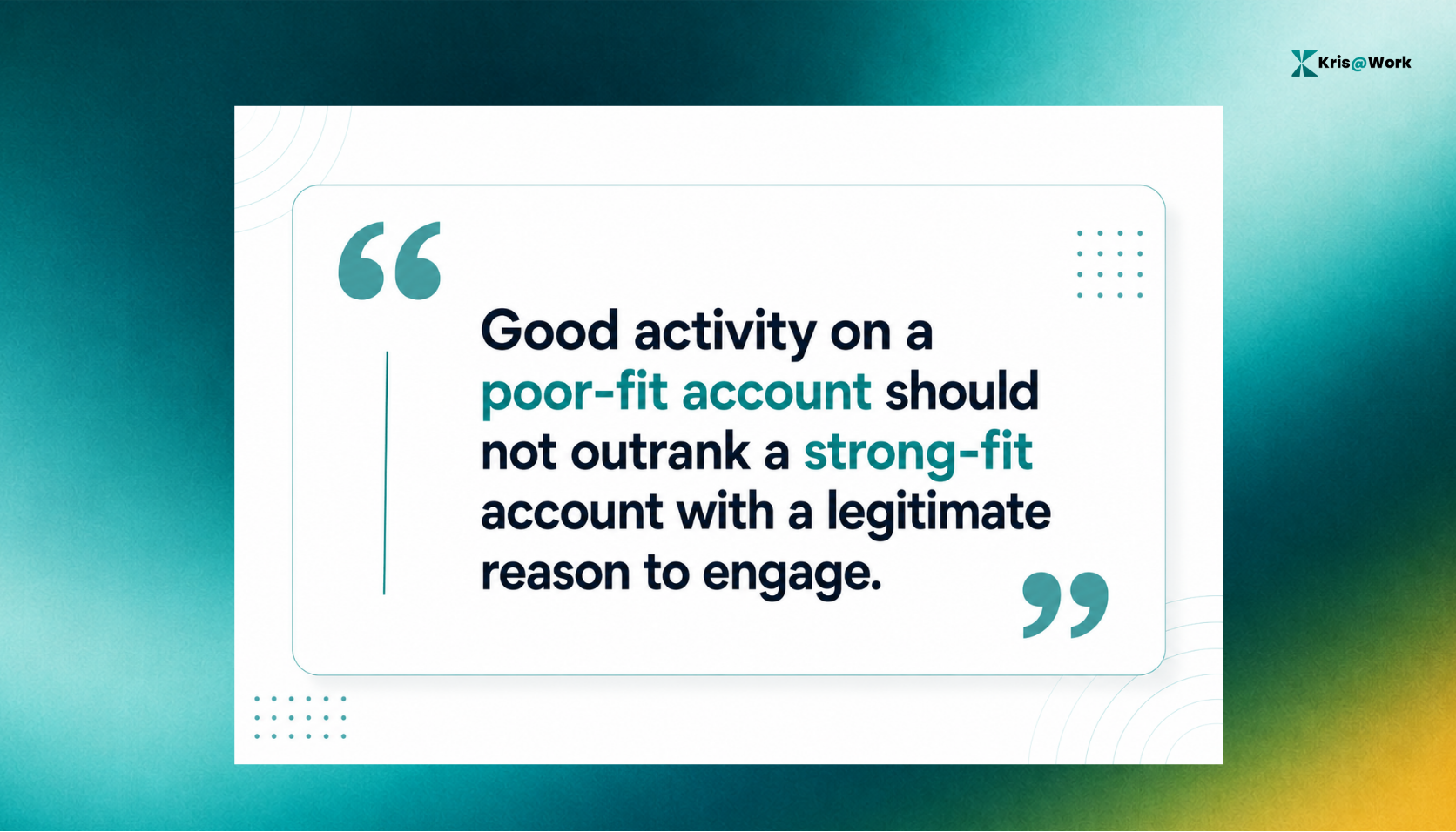
This sounds obvious, but sales teams often end up prioritising leads because they are active rather than because they are a good fit.
A prospect opened three emails. They visited your website twice. They downloaded a guide. That does not automatically make them a good sales lead.
Start with the basics:
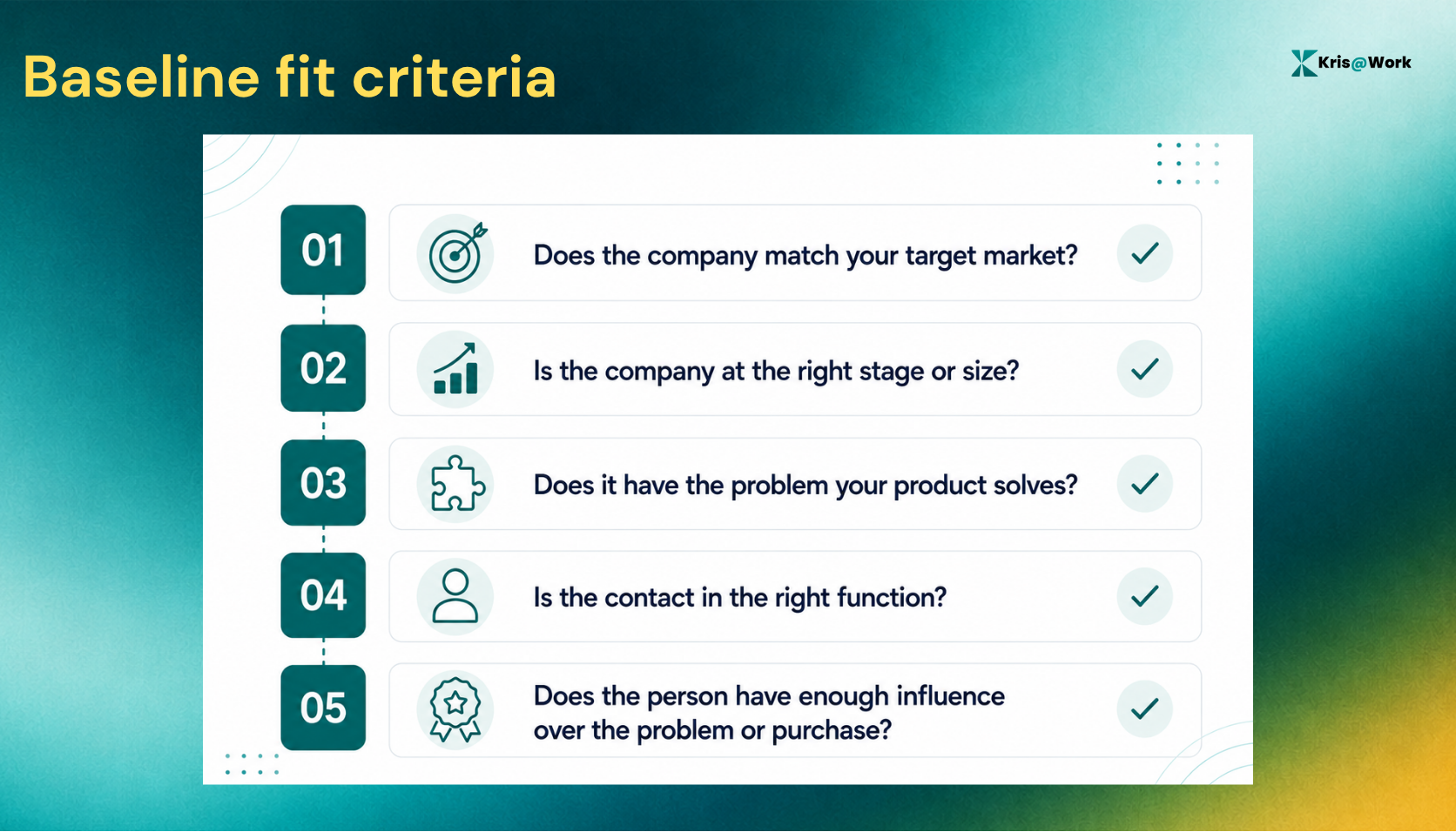
This gives you the first filter.
ICP fit is also where lead scoring can be useful. A score can help establish whether an account or contact belongs near the top of the pool.
But do not stop there.
Fit tells you who could be a good lead. It does not tell you who you should work first.
2. Look for Signals That Create a Reason to Act
Once you know which accounts are worth pursuing, look for something that changes their priority.
That could be a new executive hire. A funding event. Expansion into a new market. A major product launch. A relevant job posting. A strategic change. A buyer researching a problem your product addresses.
The exact signals will depend on your market.
The important thing is that the signal gives the rep a reason to reconsider the account now.
That is different from simply saying the account has "intent."
A signal should help answer:
Why this account, and why now?
For example, imagine two companies:
Company A
- Perfect ICP fit
- 1,000 employees
- Right buyer persona
- No recent activity or meaningful change
Company B
- Perfect ICP fit
- 700 employees
- Right buyer persona
- Just hired a VP who owns the problem you solve
Company A may be a great account. Company B has a reason to move up the list today.
That is the difference between static prioritisation and signal-based prioritisation.
3. Weight Fresh Signals More Heavily Than Old Ones
Not every signal deserves the same weight.
A company that raised funding eight months ago may still be relevant. A company that announced a major expansion yesterday may deserve attention much sooner.
This is where timing becomes part of lead prioritisation.
Consider four accounts:
| Account | Fit | Signal | Priority |
|---|---|---|---|
| A | High | Fresh, relevant signal | Work now |
| B | High | Older signal | Work after A |
| C | High | No current signal | Monitor |
| D | Low | Fresh but weakly relevant signal | Validate first |
This is a simple model, but it prevents a common mistake: treating every signal as equally important.
Freshness matters because the value of a signal can decay.
A new executive may be actively evaluating how to change a function. Six months later, they may have settled into the role, hired their team, and moved on to other priorities.
A rep who acts while the context is fresh has a better opening than one who discovers the same event months later.
The same principle applies to inbound leads. Research into lead response time has repeatedly found that speed matters most immediately after a lead raises their hand.
4. Prioritise the Buyer, Not Just the Account
An account can be a great fit while the person you're looking at is the wrong contact.
This is one of the easiest things to miss when lead prioritisation happens at the account level.
Suppose a target company has five relevant employees:
- VP Sales
- Director of Sales Development
- RevOps leader
- Sales Operations Manager
- Sales Enablement Manager
They are not interchangeable.
Their responsibilities are different. Their authority is different. Their reasons for caring about your product are different.
The person closest to the problem may be a better initial contact than someone with a more impressive title.
This is why contact-level prioritisation matters.
Look at:
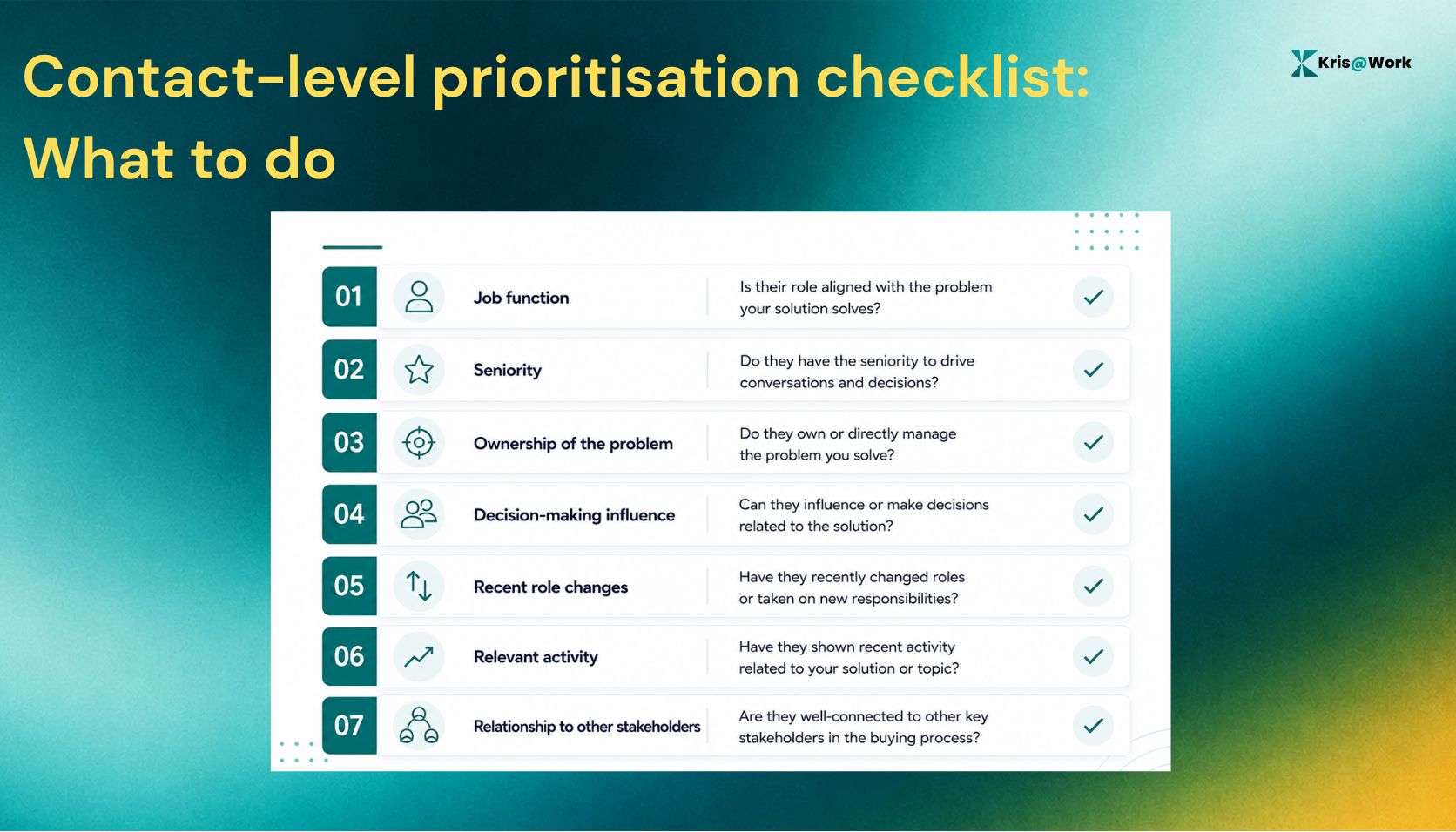
Research also supports the value of preparation before outreach. HubSpot reports that 76% of top-performing sales reps conduct research before reaching out, compared with a lower share among other performers.
But there is a catch.
If reps have to manually research every person before deciding who deserves attention, prioritisation itself becomes the bottleneck.
The better approach is to use account and contact information to narrow the field first.
Then spend deeper research time on the leads most likely to justify it.
5. Separate HOT, WARM, and MONITOR Leads
A ranked list of 1 to 250 is not particularly useful to an SDR.
It still leaves the rep asking: Where do I start?
A simple tiering system (as shown below) can make the list much more actionable:
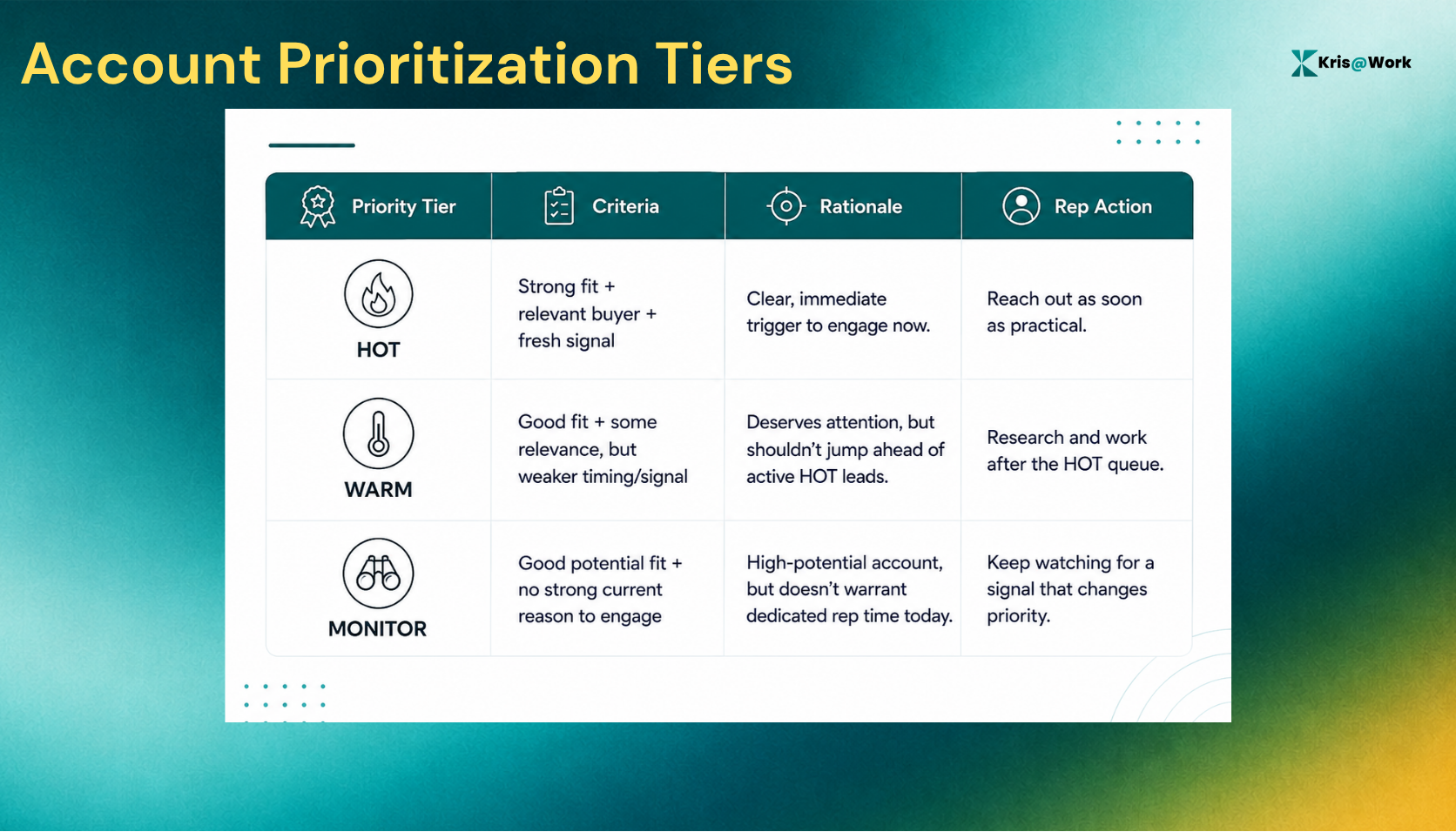
The purpose of a tier is operational.
It tells the rep how much attention the lead deserves right now.
It also creates a shared language for sales teams. Instead of one rep saying, "I think this account looks good," the team can discuss why an account is HOT, what signal caused the change, and what action should follow.
6. Turn Lead Scores Into a Next-Best Action
This is where lead prioritisation becomes more than lead scoring.
A score answers “how does this lead rank?” A Next-Best-Action system answers “what should I do about it?”
Those are different questions. Imagine a lead has a high score because the account fits your ICP and the contact is senior.
What should the rep do? That depends on the context.
If the contact just joined the company, the action might be a personalised introduction tied to their new role. If the account is actively evaluating a relevant category, the action might be direct outreach built around that research.
If a mutual connection exists, the better action might be asking for an introduction. If the account is a strong fit but there is no current signal, the right action may be to monitor it rather than force an outreach sequence.
The same score can lead to very different actions. That is why Next-Best-Action matters.
The rep should still make the final call. But the system should do more of the work required to get them there.
7. Build a Daily Worklist Instead of Rechecking the Whole CRM
The final step is to turn prioritisation into a daily workflow.
A good prioritisation system should reduce the amount of time reps spend deciding what to do.
The old workflow looks like this:
- Open CRM
- Sort list
- Research account
- Check LinkedIn
- Check news
- Decide priority
- Research contact
- Write message
- Repeat
By the time the rep gets through ten accounts, a large part of the morning is gone.
A signal-based workflow looks different:
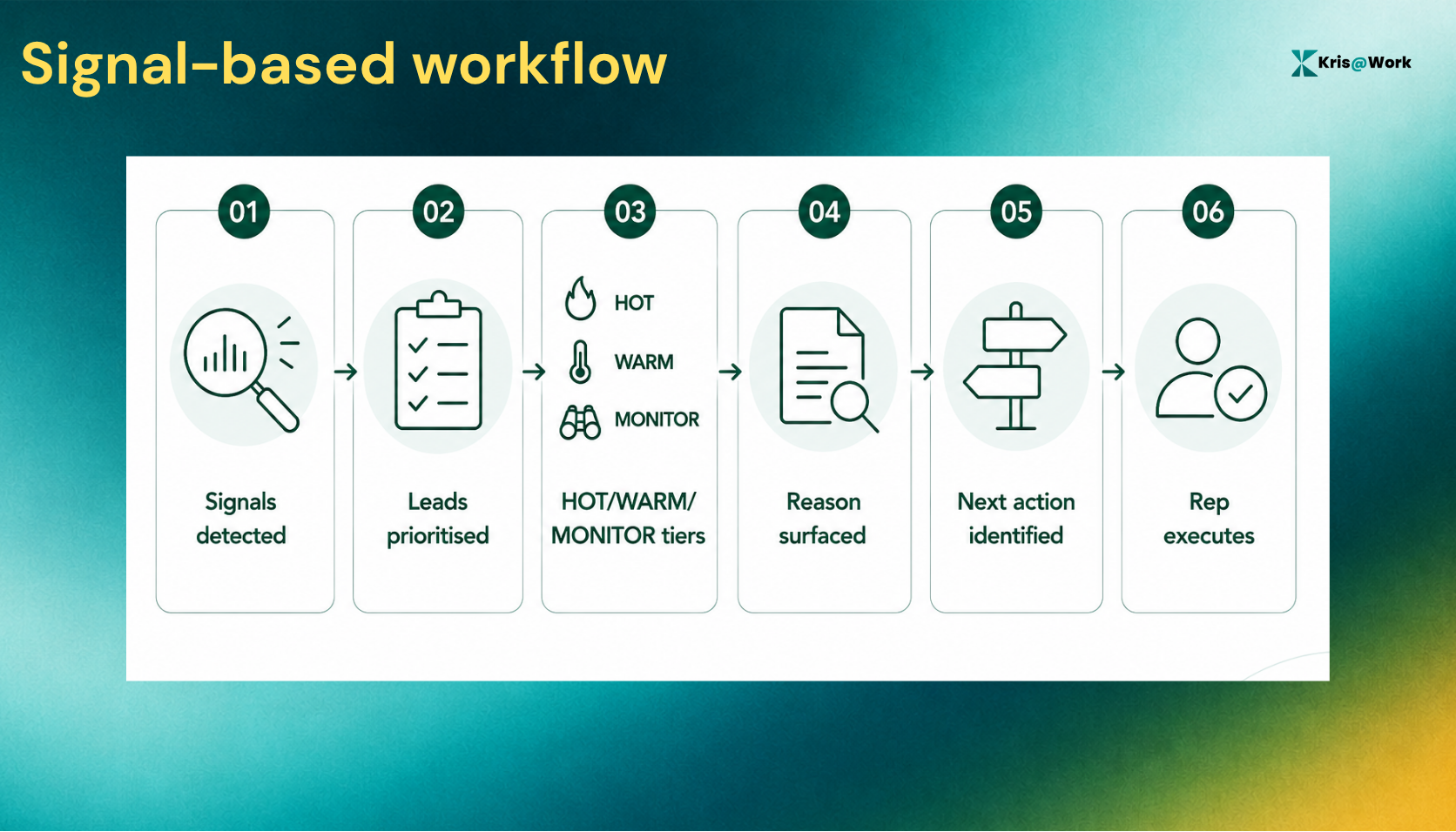
That changes the rep's job. Instead of asking, "Who should I research?”, they can ask, "Why is this lead HOT, and does the recommended action make sense?"
That is a much better use of seller judgement because the goal is to spend that time on the leads most likely to justify it.
A practical daily workflow looks like this:
- Start with HOT leads. Work the accounts with the strongest combination of fit, relevance, and timing.
- Review the reason. Know what signal caused the lead to move up.
- Take the recommended action. Contact, research further, ask for an introduction, or follow up.
- Move to WARM leads. Once the highest-priority work is covered, work through the next tier.
- Leave MONITOR leads alone. Do not create work just to create activity.
- Reassess as new signals arrive. A lead that was MONITOR yesterday can become HOT today.
That last step is important. Lead prioritisation should not be a spreadsheet exercise that happens once a quarter. It should change as the market and your prospects change.
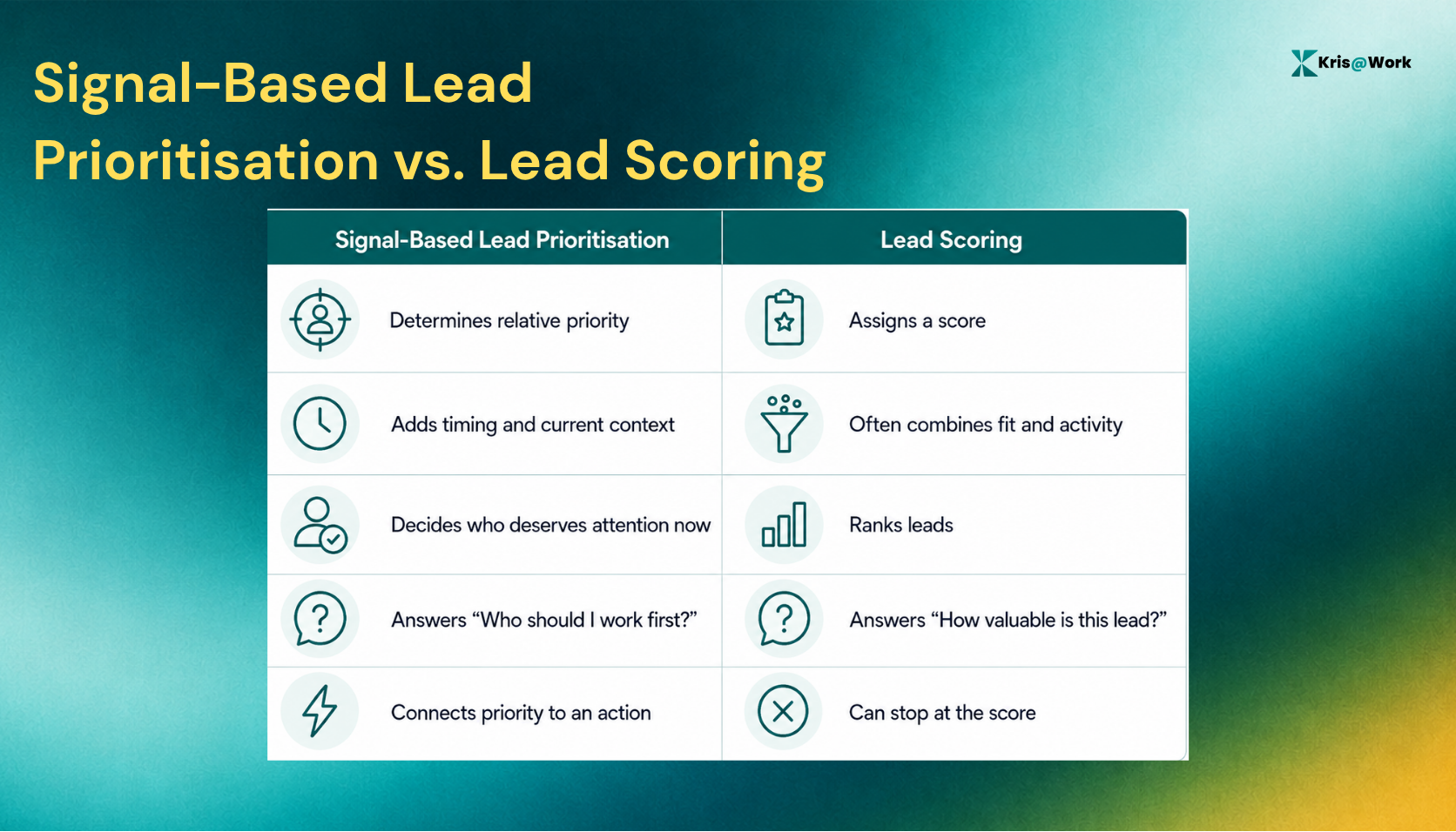
Lead Prioritisation vs. Lead Scoring: What’s the Difference?
Here’s how they are different:
How Kris@Work Helps Reps Act on Signals and Prioritise Leads
Kris@Work is an AI-native GTM platform built around proactive revenue intelligence, which proactively tells reps what to do next, when, and why, rather than making them repeatedly check different sources for changes. The website describes this as real-time intelligence that surfaces the accounts and deals that need attention before the rep has to ask.
For an SDR, that can mean opening Kris to a prioritised worklist where the reason behind an account's grade has already surfaced alongside a Next-Best-Action.
The value is connecting the signal to the decision the rep needs to make:
Signal detected > priority changes > reason is surfaced > next action is recommended
That keeps the rep from spending the morning checking LinkedIn, news, CRM records, and other tools just to figure out which account deserves attention.
The signal becomes part of the worklist, not another tab the rep has to monitor.
Final Thoughts
A good lead prioritisation system should make Monday morning easier. The rep should not have to open a list of 250 accounts and start guessing.
They should be able to answer three questions quickly:
- Who should I work?
- Why now?
- What should I do next?
That is the real purpose of lead prioritisation. A score can help rank a lead. A signal can explain why its priority changed. But the most useful system connects both to an action.
Because sales reps do not need another list. They need to know where to start.
FAQs About How to Prioritise Leads
What is the best way to prioritise sales leads?
Start with ICP fit, then consider buyer relevance, current signals, signal freshness, and the action that should follow. The best lead is not always the one with the highest score. It is the one with the strongest combination of fit and a current reason to engage.
Which leads should sales reps work first?
How is lead prioritisation different from lead scoring?
Lead scoring assigns a value or rank to a lead. Lead prioritisation uses that information alongside context and timing to decide who the rep should actually work first.
What signals should sales reps use to prioritise leads?
Useful signals vary by market, but can include leadership changes, funding, expansion, hiring, strategic changes, relevant research activity, product launches, and other events that create a plausible reason for a conversation.
A signal should not be treated as proof of purchase intent. It should be treated as evidence that can change the priority of a lead.
How can SDRs stop prioritising leads by gut feel?
Use a consistent framework based on ICP fit, buyer relevance, signal strength, signal freshness, and next action. Then organise leads into operational tiers such as HOT, WARM, and MONITOR so reps know where to spend their time.
Start with leads that have strong ICP fit, a relevant buyer, and a recent signal that creates a reason to act. These should generally come before accounts that are a good fit but have no current reason to engage.
What is lead prioritisation?
Lead prioritisation is the process of deciding which prospects deserve sales attention first based on factors such as fit, buyer relevance, timing, and buying signals.