

Cold outreach starts with a disadvantage: the prospect does not know you.
A warm introduction gives you a better starting point. Someone the prospect already knows puts your name in front of them and gives them a reason to take the conversation seriously.
So, how to get warm introductions? Find the right person to reach, identify people who can connect you to them, give that connection a clear reason to make the introduction, and make the introduction easy to act on.
The seven approaches below cover the most practical ways to do that, from using existing customers and professional networks to finding a timely reason for the introduction.
Why Warm Introductions Work
A cold email asks a stranger to give you their attention.
A warm introduction starts with someone the prospect already knows saying, "You should talk to this person."
That difference matters because the introduction can transfer some of the trust the prospect already has in the connector.
But a mutual connection is not automatically a good introduction.
Someone can be connected to your prospect without knowing them particularly well. The strongest introductions usually combine three things:
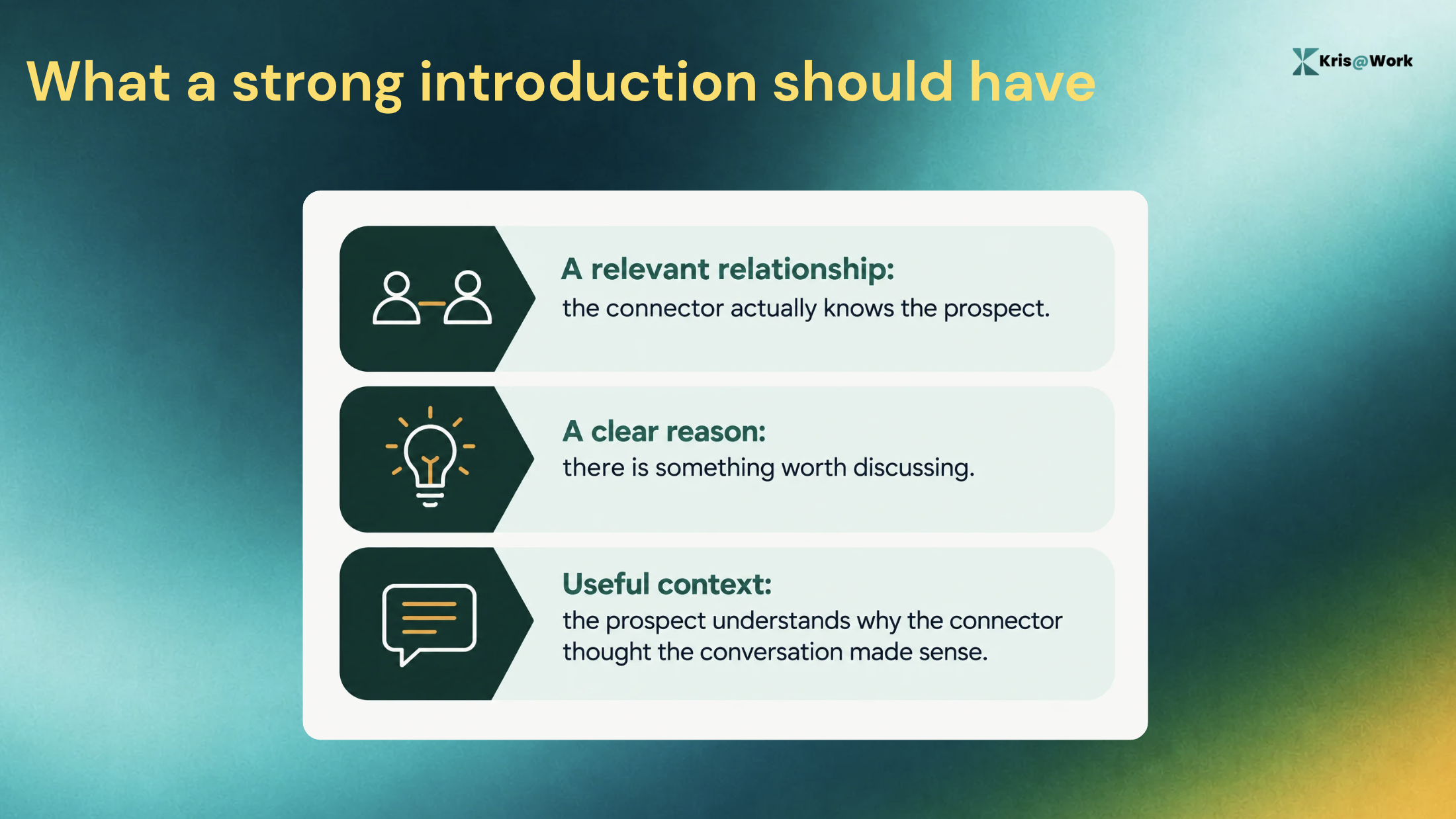
The goal is not to find the right path into the right person.
1. Ask Your Customers for Introductions
Your existing customers are one of the best places to start.
They already know your company and understand the problem you solve. If they also know someone at an account you want to reach, their introduction can carry much more context than a cold email.
The mistake is making a broad request like:
"Do you know anyone who might be interested?"
That leaves the customer to do all the work. Instead, make the request specific by saying something like:
"You mentioned that you know Sarah at Acme. We're helping teams with the same outbound challenge you're dealing with. Would you be comfortable introducing us?"
A good referral request gives the customer:
- A specific person to introduce
- A specific reason for the conversation
- A low-effort way to say yes
Where Kris@Work can help
Before asking for the introduction, you still need to know whether the account is worth pursuing.
Kris@Work can help reps research target accounts, surface relevant signals, and prioritize the accounts and contacts that deserve attention. Kris Capture is built around helping reps move from a large prospect pool to a smaller set of accounts and contacts with stronger fit and more relevant context.
That makes the workflow:
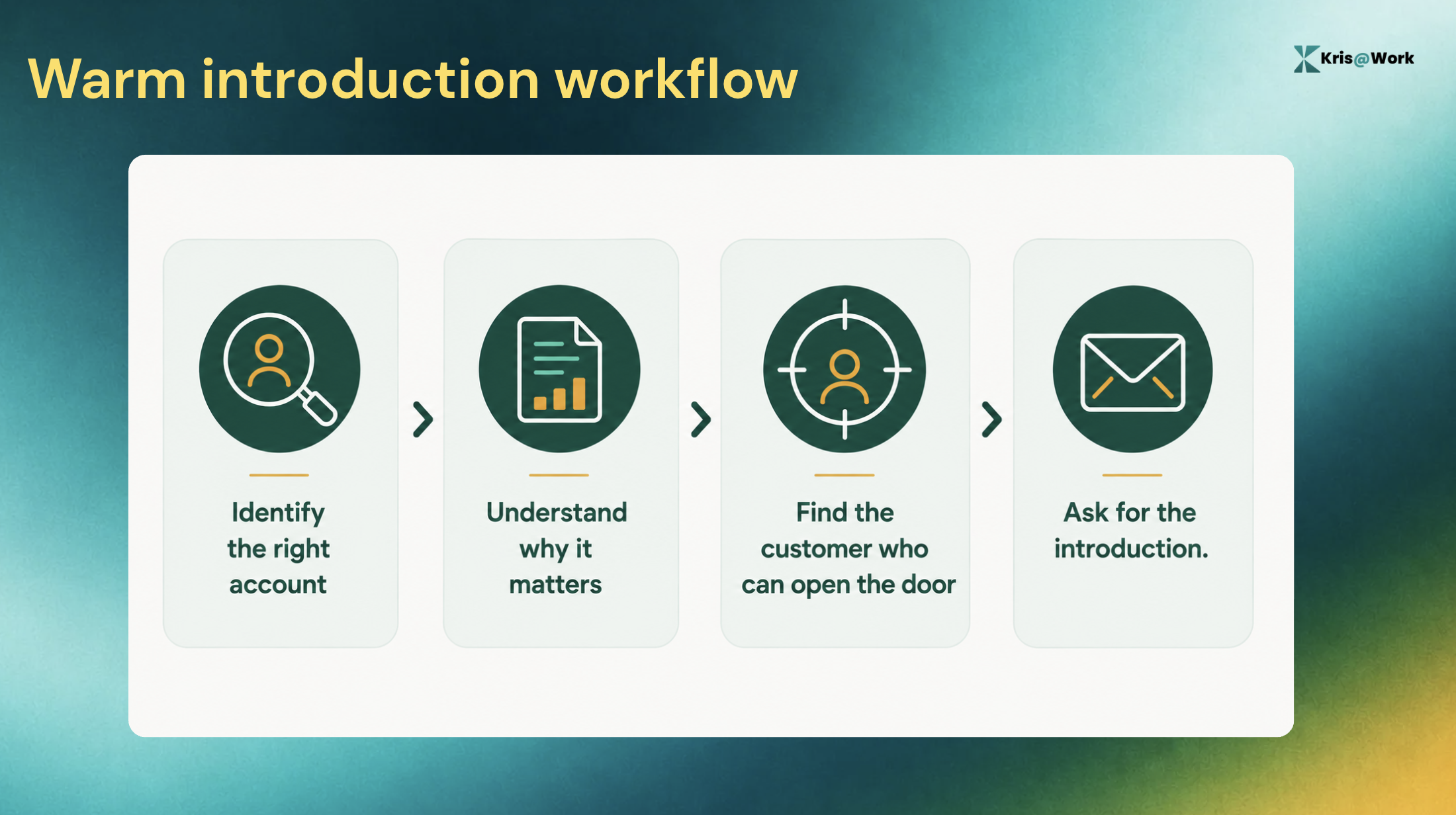
2. Find Mutual Connections Before Writing the Outreach
If you want a warm intro to a company, do not automatically start with a cold email.
First, see whether there is a better path in.
Look for people who already know your target prospect through:
- Customers
- Former colleagues
- Partners
- Advisors
- Investors
- Alumni networks
- Industry peers
- Professional communities
The important thing is to start with the specific prospect, not a general search for anyone who might be useful.
Then ask:
"Who already knows this person?"
And more importantly:
"Who would this person actually listen to?"
The person with the most connections is not necessarily the best connector. A smaller, stronger relationship can be much more useful than a loose second-degree connection.
How Kris@Work can help
Kris@Work has the capability to identify mutual connections and surface warmer paths into prospects.
That gives reps another option besides starting every conversation cold.
The value is particularly clear when the account itself is a strong fit but difficult to reach. Instead of relying only on a cold sequence, the rep can use a relevant relationship to create an easier opening.
Kris@Work can then support the work around that introduction by providing account and contact intelligence, relevant signals, prioritization, and personalized outreach.
The relationship opens the door but the intelligence helps you know what to do once it opens.
3. Give the Introduction a Reason to Happen Now
A warm introduction is stronger when there is a reason for it to happen now. Look for something that has recently changed at the company or in the prospect's role.
For example:
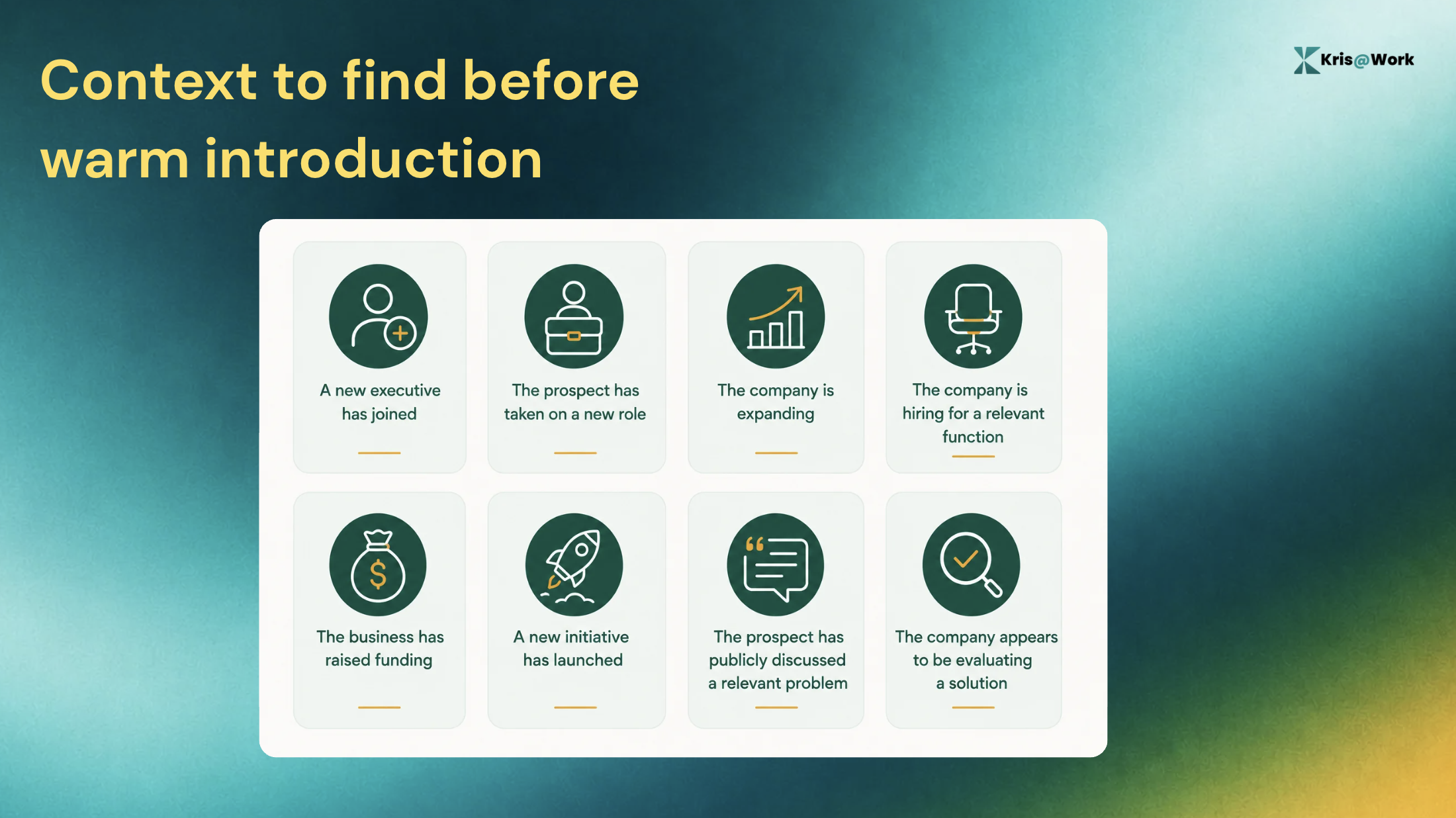
Without context, the introduction can feel arbitrary.
Compare:
"I know someone you should meet."
With:
"I thought you should meet Sarah because your team is expanding its outbound motion, and she works with companies going through the same transition."
The second introduction has a reason.
How Kris@Work can help
This is where its signal-based prospecting becomes useful.
Kris@Work classifies those signals against a seller-specific signal template, rather than treating them as generic information.
Signals can include things such as leadership changes, funding, growth, strategic direction, career events, stated pain, and buying behavior.
Kris also takes signal freshness into account, so older evidence loses weight as it becomes less useful for current prioritization.
That means the rep can approach the mutual connection with something more useful than:
"Can you introduce me to your friend?"
They can say:
"I noticed Acme is expanding its outbound team. You know Sarah there. Would you be comfortable connecting us?"
The mutual connection provides the trust and the signal provides the reason.
4. Work Backward From the Prospect's Problem
When looking for a warm introduction, most salespeople ask "Who knows this person?"
But a better question is "Who does this person trust around the problem I'm trying to solve?"
Those questions can produce very different answers.
Suppose you're trying to reach a VP Sales about outbound performance.
Your best connector might be:
- Another sales leader
- A former colleague
- A customer with a similar sales motion
- A partner
- An advisor
- An industry peer
They do not necessarily need to be more senior than the prospect.
They need to be relevant enough that the prospect will understand why the introduction is worth taking.
How Kris@Work can help
Kris can help you work backward from the account and contact rather than treating every person in the company as equally valuable.
Contacts can be prioritized using factors such as role fit, authority, seniority, department, title, ICP fit, and signals from the parent account. Kris assigns Lead Scores from A+ to F with reasoning behind the grade.
That gives the rep a clearer sequence:
- Which accounts show evidence of that problem?
- Which person is relevant?
- Is there a mutual connection that can open the conversation?
5. Give the Connector a Simple Warm Introduction Email
Finding the right connection is only half the job. You also need to make the introduction easy to send.
Do not ask a customer, colleague, or partner to figure out what to write from scratch. Give them a short message they can copy, personalize, and send.
Warm introduction email template
Subject: Intro: [Your Name] <> [Prospect Name]
Hi <Prospect>,
I'd like to introduce you to <Name> at <Company>. They're helping <type of company/team> with <specific problem>, and I thought it would be useful for you two to connect given <specific context>.
I'll let you both take it from here.
Best,
<Connector>
The message only needs to answer three questions:
- Who is this person?
- Why are they relevant?
- Why should we talk now?
The connector does not need to pitch your product. They just need to make the conversation credible enough for the prospect to take the next step.
How Kris@Work can help
Its outreach workflow uses seller context, account and contact information, classified signals, and campaign instructions to generate personalized messaging.
That means the rep does not have to start from a blank page when preparing the messaging around a prospect.
The same research that informs the outbound message can help the rep give the connector a useful reason for making the introduction.
6. Make the Introduction Specific
A good introduction transfers context, not just contact information.
Compare:
"John, meet Sarah. Sarah works at Acme."
With:
"John, meet Sarah. She works with B2B sales teams on outbound efficiency. Given what you've been doing to improve your prospecting motion, I thought it would be useful for you two to connect."
The second version gives the prospect a reason to respond.
A strong introduction should make clear:
- Who is being introduced
- What they do
- Why it is relevant
- Why the connection makes sense now
This is where research matters. If the connector understands the prospect's situation, they can make the introduction naturally. If they do not, the message becomes generic.
How Kris@Work can help
Kris brings account and contact research into the same workflow as prioritization and outreach.
The product material describes a research workflow where account and contact context is already assembled, while the SDR use case centers on a ranked worklist with the reason for the grade and a recommended next action.
That gives the rep the context to make the introduction specific.
7. Follow Up Without Making the Introduction Cold Again
Once the connector makes the introduction, use the context they provided.
If they wrote:
"I thought you two should connect because you're both working on outbound efficiency."
Do not reply with a generic company introduction.
Instead, say this:
"Thanks for connecting us, John. Sarah, John mentioned you're looking at outbound efficiency this year. I thought it might be useful to compare notes on how you're approaching it."
You are continuing the conversation that the connector started. If the prospect does not respond, follow up with something useful rather than repeating the same pitch.
What Makes a Warm Introduction Work?
The best warm introductions usually have four elements:
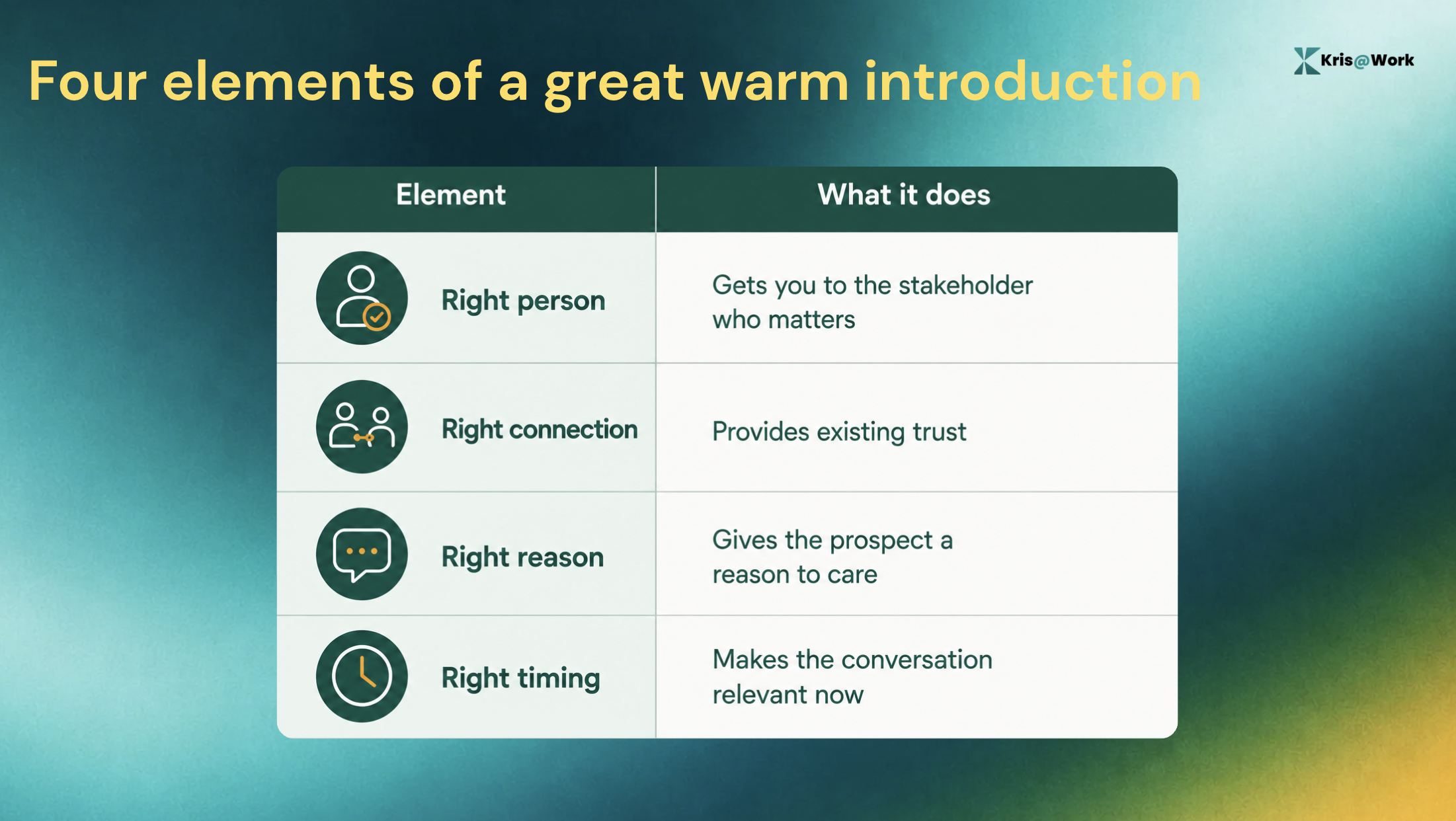
Miss one of these and the introduction gets weaker.
You can have a great connection, but if they introduce you to the wrong person, you are still stuck.
You can have the right person, but if there is no reason to talk, the introduction may go nowhere.
And you can have both, but if the reason is six months old, the timing may have disappeared.
That is why warm introductions work best when relationship and relevance come together.
What If You Can’t Find a Mutual Connection?
You will not have a warm path into every account and that is normal.
The answer is not to manufacture one. Instead, make the cold opening more relevant.
- Start by asking: Is this account actually a fit?
- Then: Is this the right person?
- Then: What has changed recently?
- And finally: What can I say that proves I understand why this matters now?.
Kris@Work can pull together company and contact data, classify relevant signals, score accounts and contacts, and use that context to generate personalized outreach.
For an SDR, that means moving away from a static list and toward a prioritized set of accounts with research and recommended actions already attached.
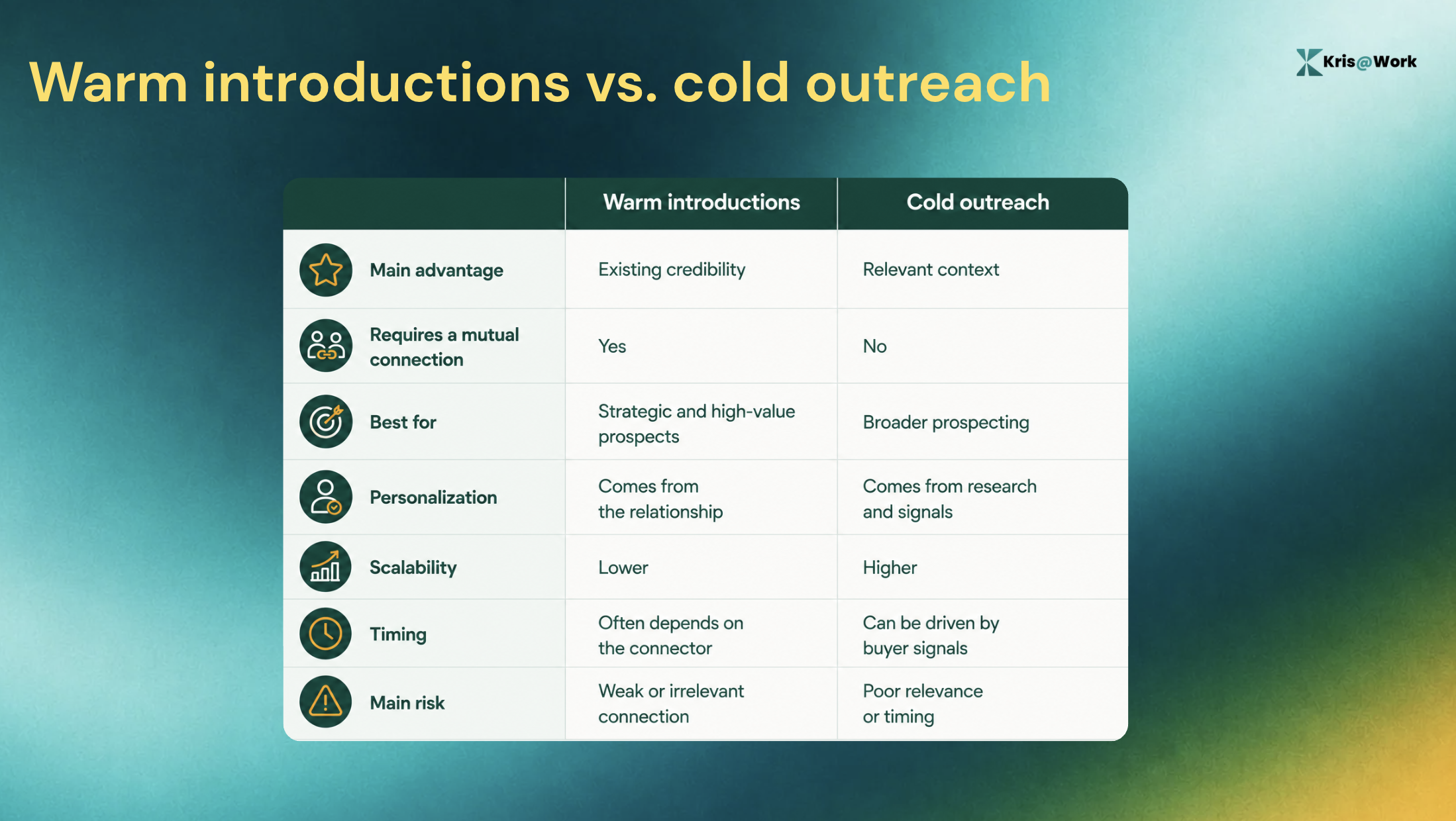
Warm Introductions vs. Cold Outreach
Warm introductions and cold outreach are not competing strategies. They work best together
A Simple Warm Introduction Checklist
Before asking for an introduction, make sure you can answer:
- Who exactly do I want to meet?
- Why is this person relevant?
- Who can credibly introduce us?
- How strong is that relationship?
- Why does the introduction make sense now?
- What context should the connector include?
- Have I made the introduction easy to send?
- Do I know what I will say once the prospect responds?
If you cannot answer those questions, do more research before asking for the introduction.
FAQs on How to Get Warm Introductions
1. How do you get warm introductions?
Identify the specific prospect you want to reach, find a relevant person who already knows them, give the connector a clear reason for the introduction, and make the message easy to forward.
2. How do you find mutual connections in sales?
Start with the specific prospect and look across customers, colleagues, partners, advisors, alumni, and professional networks for people who know them. Prioritize the quality and relevance of the relationship rather than simply the number of shared connections.
3. What is a warm intro to a company?
A warm intro connects you with a specific person at a company through someone they already know. The connector provides enough context to explain why the conversation makes sense.
4. What should a warm introduction email say?
A warm introduction email should explain who you are, what you do, why you are relevant to the prospect, and why the connector thinks the two of you should talk.
5. How do you ask a customer for a referral?
Ask about a specific person rather than making a broad request. Explain why the person is relevant and ask whether the customer would be comfortable making the introduction.
6. Are warm introductions better than cold emails?
Warm introductions can provide more credibility because they use an existing relationship. Cold outreach is more scalable. The strongest sales motion uses warm introductions where they exist and relevant outbound where they do not.
7. Can Kris@Work help with warm introductions?
Kris@Work has the capability to identify mutual connections and support warmer paths into prospects. It also provides account and contact intelligence, signals, prioritization, research, and personalized outreach that can help reps make those conversations more relevant.
8. What should you do if you cannot find a mutual connection?
Do not force one. Instead, use account research and relevant buyer signals to understand why the prospect is worth contacting and what makes the timing relevant.