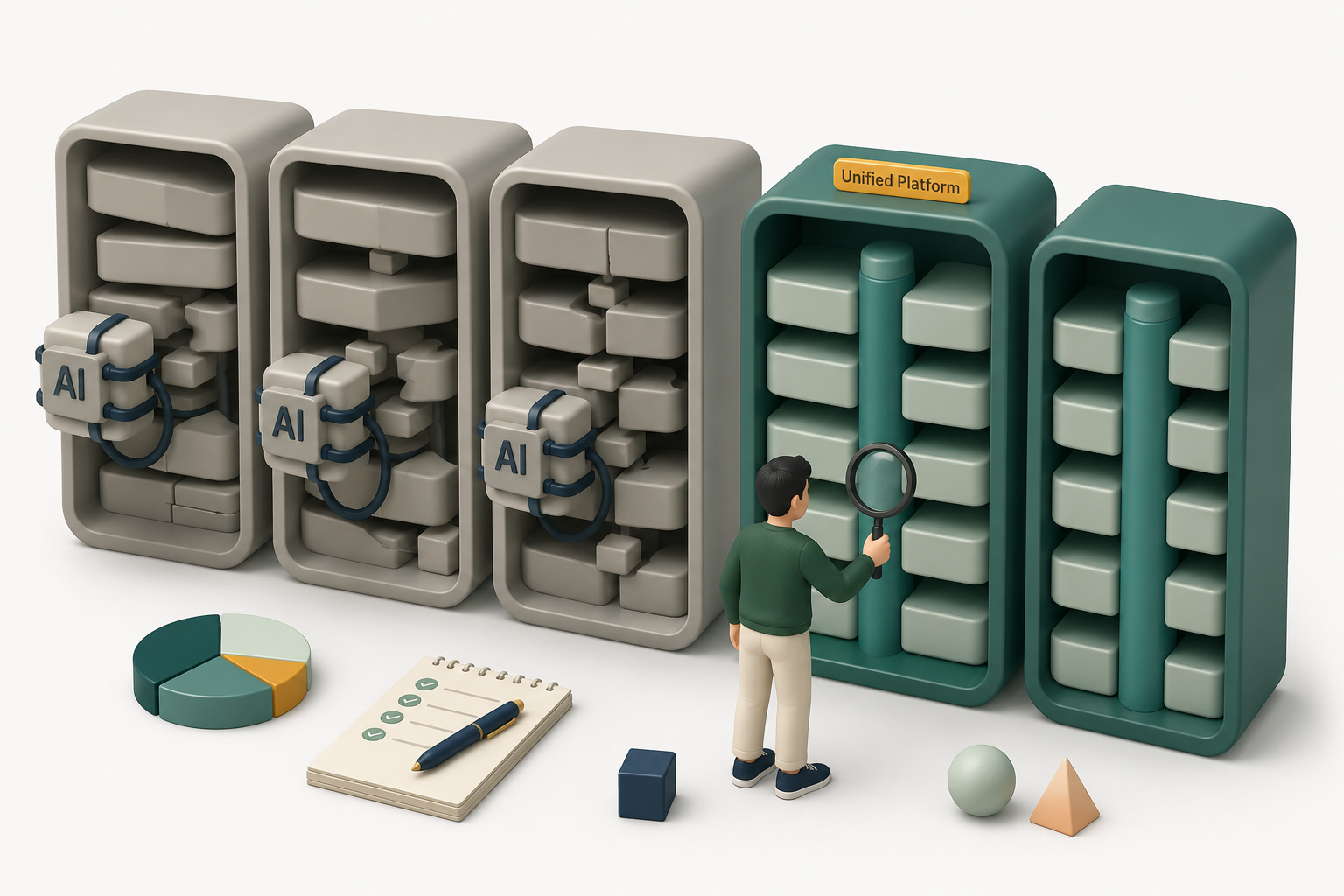

A practical method for turning real account signals into relevant outreach. It works without turning a 200-account list into an all-day research project.
The Short Answer
To personalise outreach at scale, start with a timely signal, not a name field. Segment accounts before you write. The workflow does not change much at 50 accounts. It changes completely at 200 or 1,000. At 50, a rep can still research most accounts by hand. At 200, that same approach eats the entire week. At 1,000, the research has to happen once per shared signal, not once per account, or nothing goes out at all. Most of what follows used to take hours per account. Increasingly, it does not. AI can gather the signal, build the account brief, and draft the first pass. The rep's job shrinks to the two decisions that actually matter: is this worth acting on, and what should the email say.
Done this way, the research cost gets paid once per group of accounts, not once per email. That is the only part of this that actually saves hours, and it is closer to how the best teams already work than most reps realise.
Only 8.5% of outreach emails get a reply. That number comes from Backlinko and Pitchbox's study of 12 million outreach emails. In the same study, personalised subject lines saw a 30.5% higher response rate. Personalised email bodies saw a 32.7% lift. Adding a first name is not what that study is describing. Relevance is.
TL;DR
- Find the signal: a recent, account-specific trigger, not a static CRM field.
- Group accounts by shared signal, before writing anything.
- Research the pattern once per group, not once per contact.
- Let AI gather the research and draft a first pass. Do not let it invent the reason to reach out.
- Fill the template's shape with account-specific facts, not finished sentences.
- Send, then track reply rate by segment.
- Refresh segments weekly for fast-moving signals, monthly for slower ones, or the system goes stale.
How to Personalise Outreach at Scale (Starting With the One Thing Most Reps Skip)
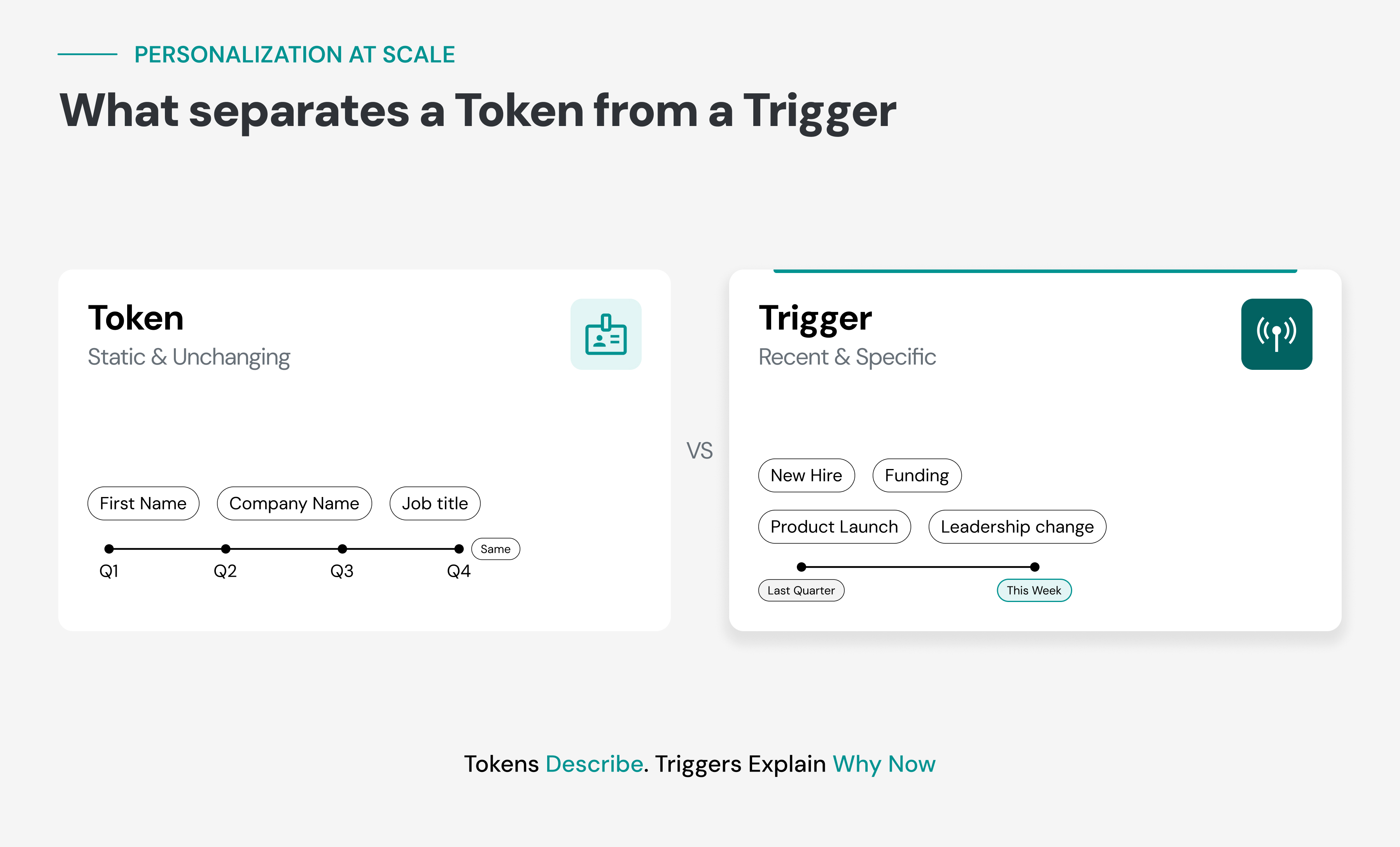
A first name, job title, company name, and industry are tokens. They identify a prospect. They do not explain why an email showed up this week instead of any other week. A trigger does that job instead. This distinction, token versus trigger, is the single idea the rest of this piece is built on. Every method below is the same question asked in a different way: how do you find the trigger, group accounts around it, and turn it into an email, without doing that work one account at a time.
|
|
Token | Trigger |
|---|---|---|
| What it is | Static data in a CRM record | A recent, account-specific event |
| Changes over time | Rarely, sometimes never | Weekly, sometimes daily |
| Example | Name, title, company, industry | Hire, funding round, launch |
| Reads as | Addressed to a category | Written for one company |
Everything below builds on that one distinction. Skip it, and the other six methods just make generic outreach faster.
1. Tokens Get Ignored. Triggers Get Read.
A trigger is a recent, account-specific event. A leadership hire. A funding round. A product launch. A regional expansion. A hiring surge in the function you sell to. A trigger-based opener could only have been written this week, about this exact company. That is why it earns more attention than a merge field ever will.
Use one test before you send. Swap the recipient for someone else with the same job title. If the sentence still works, it was never personalised. It was addressed to a category of person, not written for one.
A signal is not proof of intent on its own. It is an input to judgement. Treating every hire or funding round as a guaranteed opening is generic outreach with better formatting. The signal earns you the right to write the email. It does not write the email for you. Once you have the signal, the next move is not to write. It is to ask one question: what does this event actually change for the prospect. A funding round changes the budget. A leadership hire changes priorities. Answer that first, and the email in Step 5 writes itself in a few minutes instead of twenty.
2. Stop Writing One Email at a Time
Fully individual outreach does not survive a real list size. Segmentation is the working middle ground. Group accounts by something shared and current, not just static firmographics.
A list might hold 30 companies expanding into a new region, 25 hiring their first RevOps lead, and 18 adding SDR capacity this quarter. Research the operational implications of each trigger once. Then adapt the message per account inside that group. This is Step 3 of the workflow above, research the pattern once, not the account, and it is the step that makes the rest of this method survive contact with a real list. This is how you personalise cold emails at scale without writing 200 versions of the same generic line.
A new VP of Sales does not automatically mean an account needs your product. It does give you a credible reason to ask whether the new leader is reviewing pipeline coverage, rep ramp, or account prioritisation. That is a real hypothesis. "Congratulations on the new role" is not. One tells the reader you did the work. The other tells them you found their name on LinkedIn.
Here is what that looks like in practice. Say your list has 40 accounts that hired a new VP of Sales this quarter. Instead of researching each one individually, research the pattern once: new VP of Sales hires typically inherit three problems in their first 90 days, unclear pipeline visibility, uneven rep ramp, and inconsistent account prioritisation across the team. That single piece of research now applies to all 40 accounts. Each email still needs the account-specific detail, the name, the exact headcount change, the timing, but the underlying reasoning does not need to be rebuilt from scratch 40 times.
3. Where the Facts Actually Live
"Given your industry, you're probably dealing with X" sounds specific while you write it. To the recipient, it reads as a stereotype.
The real problem is not that reps do not know where to look. Most already know the checklist below. The problem is repeating it, in full, for every single account, and then still having to turn whatever they find into a usable reason to write. That second step, fact into action, is where the hours actually go missing, not the research itself.
Real account research is a short, repeatable checklist:
- Careers pages, for new roles and team growth
- Newsrooms, for funding, expansion, and leadership announcements
- Earnings calls, for stated priorities in the executive's own words
- Role-filtered searches, for job changes in the last 90 days
- Company LinkedIn posts, for announcements the business is actively promoting
The goal is not trivia. It is one fact that could plausibly change the prospect's priorities right now. A checklist beats an open search every time. A rep working from memory rebuilds the same five steps by hand for every single account. That repeated rebuilding, five steps, times two hundred accounts, is exactly the kind of hour-eating work this piece is trying to remove.
Most teams run this checklist across a dozen open tabs. That is where the actual hours disappear:
Before - 20 stops :
| Account Finding (5 steps) → Research the company (6 steps) → Gather the data (3 steps) → Write + send (6 steps) |
|---|
After - 5 steps :
| Kris Capture (signals across the full account list) → Ranked accounts → Signals behind the rank → Edit the draft → One important design decision |
|---|
That is the exact gap Kris Capture closes. It runs the checklist above across a full account list automatically, real-time ICP scoring, one-click account and contact research, so the fact-into-action step happens once per list instead of once per name. What used to mean a dozen open tabs per account becomes a single ranked list with the reasoning already attached.
4. A Fact Is Not a Reason to Reply. Here Is What Actually Is.
A researched fact is not yet a reason to reply. "You just hired a VP of Sales" is true. It earns nothing by itself.
Connect the fact to a plausible consequence instead. A team that doubled its SDR headcount this quarter is probably dealing with ramp time as a hidden cost, especially with managers stretched across onboarding and pipeline coverage at the same time.
The structure is always the same. Signal, then business implication, then a reason to talk. Do not claim to know the prospect's internal situation. Show informed curiosity instead of false certainty. Curiosity invites a reply. Certainty invites correction, and correction rarely turns into a conversation.
A second example makes the pattern clearer. "Your company just raised a Series B" is a fact. On its own, it means nothing to a rep selling sales tooling. Connected to a business implication, it becomes something worth writing: a fresh raise usually comes with pressure to show faster growth, which often means the sales team is about to scale headcount, and scaling headcount is exactly when process gaps start to show. That connection is what turns a funding announcement from a generic congratulations into a specific, credible reason to reach out.
The same test applies here as everywhere else in this piece. If the connecting sentence could describe any company that raised money in the last quarter, it is not specific enough yet. It needs to reference something that is true about this raise, this team, this timing.
5. The Shape That Scales Without Reading Like a Script
A template should give you the shape of a message, not the finished language.
- Subject: [a specific trigger, 4-6 words] Opening: name the trigger as an observed fact Connection: link it to a plausible business consequence Ask: one low-commitment question, not a calendar link
Here it is applied:
- Subject: Ramp time after SDR growth
Hi Priya,
Saw the SDR team grew from 12 to 25 this quarter. Ramp time is often the hidden
cost when headcount doubles that fast, especially with managers stretched across
onboarding and pipeline coverage.
Curious how you're approaching the ramp for the new team?
The same signal reads differently depending on who receives it. To the SDR who will do the onboarding, the angle is workload: "Curious how you're approaching the ramp for the new team?" To the VP of Sales who owns the number, the angle is risk: "Curious whether ramp time is factored into this quarter's pipeline targets?" Same trigger, same facts, different consequences for each reader. That is the difference between inserting a signal and actually adapting the message.
Before sending a batch, read 20 drafts back to back. If every one has the same rhythm and only the nouns change, rewrite the connecting sentence. Personalisation can be technically present and still read as automated. The shape is allowed to repeat. The sentences inside it are not.
6. What AI Should Never Be Allowed to Invent
AI is useful wherever judgement is not required. Checking accounts fit against an ICP. Pulling recent activity across a full list. Identifying the right contact. Organising research into a usable brief. That is where AI removes the actual drag around selling.
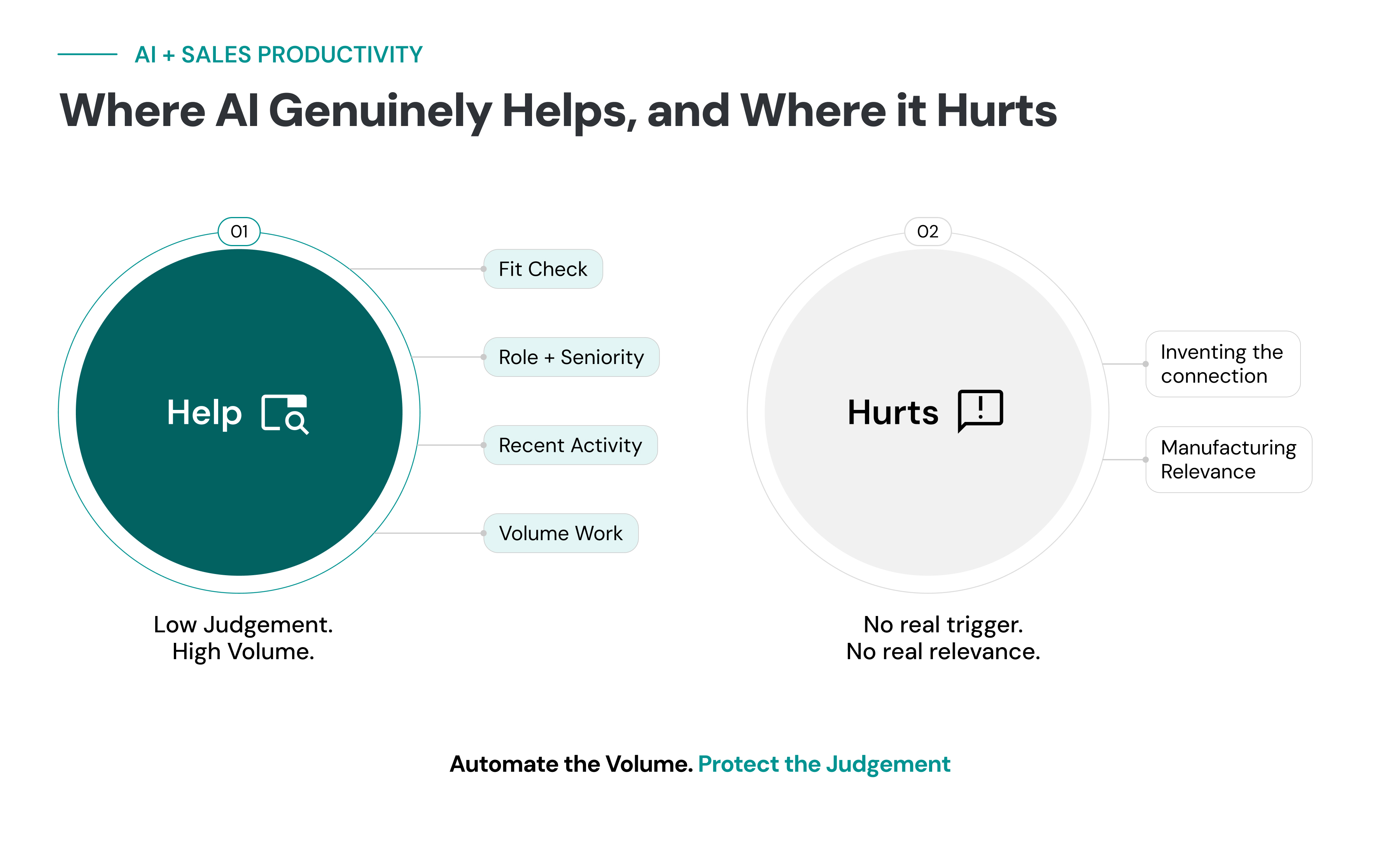
It becomes a problem the moment it writes the connecting sentence itself with no real trigger underneath it. The output reads fluently. Sometimes it even sounds specific. It is manufacturing relevance rather than reporting it, and buyers are getting better at spotting the difference. AI personalisation with no real signal underneath it is just faster spam.
Whatever tool does the drafting, the same limit applies. AI can only be as good as the signal behind it. Some tools cap how much AI output a rep gets in a day, which is a volume problem, not a relevant one, and solving it does not solve the actual issue here. The real question was never whether AI can write an email. It is whether the message is grounded in something a rep could verify.
This connects directly back to the Backlinko numbers from earlier. The 30.5% lift from personalised subject lines and the 32.7% lift from personalised bodies were not measured on AI-written copy. They were measured on genuinely relevant copy, written by people who understood the account. AI can help a rep reach that same level of relevance faster. It cannot manufacture the relevance itself.
The split is simple. AI should own the research, the signal detection, and the first draft. The rep should own two decisions only: whether the signal is worth acting on, and whether the draft actually sounds like something worth reading. Hand AI more than that, and it starts inventing the part that was supposed to be true.
7. Batch the Research, Then Write
Alternating between research and writing, one account, one email, next account, costs more time than either task alone. Split it into two passes instead. Gather triggers and facts across the full list first. Then write against material that is already sitting in front of you.
This cuts the context-switching and surfaces weak signals before they turn into weak emails. Not every trigger deserves the same urgency:
| Trigger | Typical priority | Why |
|---|---|---|
| Funding round | High | New budget, active buying window |
| Leadership hire in a relevant function | High | New priorities, early vendor review |
| Hiring surge | Medium-high | Operational strain, worth checking |
| Regional expansion | Medium | Relevant, but timing needs validation |
| Generic company news | Low | Usually too broad to build an opener on |
A signal is an input to judgement, not a guarantee of intent. Rank the list before you touch a single draft. The strongest accounts get written first, while attention is still sharp.
Same List, Two Very Different Emails
Generic: "Hi {firstname}, companies like yours often struggle with pipeline visibility. Do you have 15 minutes this week?" This could go to 10,000 accounts. The ask arrives before there is any reason to respond.
Signal-led: "Hi Priya, saw your team added 13 SDR roles while expanding into 2 new regions. That kind of growth can make account prioritisation harder before activity becomes the bottleneck. Curious how the team is deciding which accounts deserve attention first?" This version does not claim to know the prospect's internal problem. It earns relevance by connecting a real event to a credible question.
Read both out loud. One sounds like it was sent to a list. The other sounds like it was sent to a company.
The difference is not the writing. It is what the rep knew before writing. The generic version needed nothing: no research, no signal, no account context. The signal-led version needed three things first: the trigger itself, what it likely means operationally, and who on the account would actually feel that consequence. Personalisation is not a copywriting skill. It is what happens after the intelligence is already in the rep's hands.
Here is a second pair, this time built on a funding signal instead of a hiring signal.
Generic: "Hi {firstname}, congratulations on the recent funding round! I'd love to show you how we can help you scale." This template gets sent to every company that appears in a funding database that week. The congratulations is real. The relevance is not.
Signal-led: "Hi Marcus, saw the Series B this week, congrats. Raises like this usually come with pressure to show faster pipeline growth within two or three quarters. Curious whether headcount or process is the bigger constraint on your team right now?" This version still opens with the same fact everyone else is using. The difference is the second sentence, which turns a generic congratulations into a specific, informed question.
Where Trigger-Based Outreach Quietly Breaks Down
Even teams that switch to trigger-based personalisation slip back into old habits. Three patterns show up most often.
Segments stop getting updated. A group built around "companies expanding this quarter" is only accurate for that quarter. Six weeks later, half of them have moved past that phase. The email still references it. That reads as stale, not personal.
Trigger detection becomes a one-time setup. Learning how to personalise outreach at scale is not a single decision. It is a habit. Check high-velocity signals weekly. Check slower ones monthly. Skip that, and the system drifts back toward tokens without anyone noticing.
The definition of "trigger" gets diluted. Once a rep sees the lift from real signals, it is tempting to count weaker events too. A LinkedIn like. A generic press mention. Those do not carry the same weight as a funding round or a real hire, and treating them the same way waters the whole system down.
Personalisation stops at the first line. Some reps get good at the opener and then default to a generic template for the rest of the email. The connection and the ask matter just as much as the trigger. A strong opening line followed by a generic pitch reads as bait and switch, not personalisation.
Keep the System Current
Trigger-based outreach personalisation goes stale fast if the underlying segments never get refreshed. Review high-velocity signals, leadership changes and funding, weekly. Review slower-moving ones, market expansion or technology changes, monthly.
The goal was never to automate relationships. It is to automate the invisible work that keeps a rep from having a better conversation. A good system hands the rep current context, a real reason to reach out, and a next step. The rep still makes the call on whether to take it. That last part does not change no matter how good the tooling gets. Judgement stays with the person sending the email.
How to Know It Is Actually Working
Track reply rate by segment, not just by list. If the "funding round" segment consistently outperforms the "generic news" segment, that confirms the priority table from earlier is correctly ranked. If it does not, the weighting needs adjusting for your specific market. A ranking that works for one industry or one company size will not automatically transfer to another, and that is expected, not a sign something is broken.
Watch for one warning sign in particular: reply rate that climbs at first and then flattens within a few weeks. That pattern usually means segments were not refreshed, and the system quietly drifted back toward stale triggers without anyone noticing. The fix is the same one covered above. Review fast-moving signals weekly, slower ones monthly, and treat that review as part of the process, not an optional extra.
FAQs
How do you find buying signals for cold outreach?
Check careers pages, newsrooms, earnings calls, role-filtered job searches, and company LinkedIn posts, in that order. Each surfaces a different kind of trigger: hiring, funding, leadership change, or expansion.
How do you prioritise which accounts to personalise first?
Rank by trigger strength, not list order. Funding rounds and relevant leadership hires carry more weight than a generic hiring surge or routine company news. Write the strongest signals first, while research is freshest.
Can you personalise cold outreach without manual research?
The research can be automated. The judgement on whether a signal is worth acting on cannot. Tools like Kris Capture handle the account and contact research automatically; the rep still decides what the signal means and whether to act on it.
Is AI personalisation actually effective?
It depends entirely on what sits underneath it. Grounded in verified account context, a personalized cold email at scale performs close to the lift Backlinko's data shows. Grounded in nothing, AI just makes generic outreach sound more polished, not more relevant.
How much personalisation does a single email actually need?
Usually one accurate, current fact connected to a plausible business reason. Depth on one relevant detail earns more trust than three shallow personalisation touches stacked into the same email.
Should every signal trigger outreach?
No. A signal informs priority. It does not force a send on its own. The rep still decides whether the event is timely, meaningful, and actually connected to a problem worth raising.
Can this work for a small list as well as a large one?
Yes, and it often works better. A list of 40 highly qualified accounts benefits from the same trigger-and-template method as a list of 400. The main difference is speed: fewer segments means less setup time before the first batch goes out.