

There is a point in every outbound program where adding more accounts stops solving the problem.
The team has the data. It has the contacts. It has a carefully defined ICP.
And yet SDRs are still staring at hundreds of accounts trying to figure out which ones deserve their attention first.
The missing piece is usually timing.
An account's fit tells you whether it could buy. Buying signals can tell you when something has changed enough to make a conversation worth having.
That might be a new leader, a hiring push, a strategic shift, evidence of a problem, or a buyer actively evaluating alternatives. The challenge is figuring out which signals actually indicate a buying opportunity and which are just noise.
That's what makes learning how to find buying signals so valuable. You're not trying to predict every account that will buy. You're trying to find the accounts that have given you a credible reason to reach out now.
11 Buying Signals to Watch
1. Leadership changes
A new executive can change priorities, budgets, processes, and the willingness to replace an existing approach.
A new VP of Sales, for example, may inherit a mandate to improve pipeline generation. A new RevOps leader may be asked to fix inefficient systems. A new marketing leader may arrive with a plan to change the company's demand generation strategy.
That does not mean every new executive is ready to buy. It means the account has entered a period where change is more likely.
What to look for:
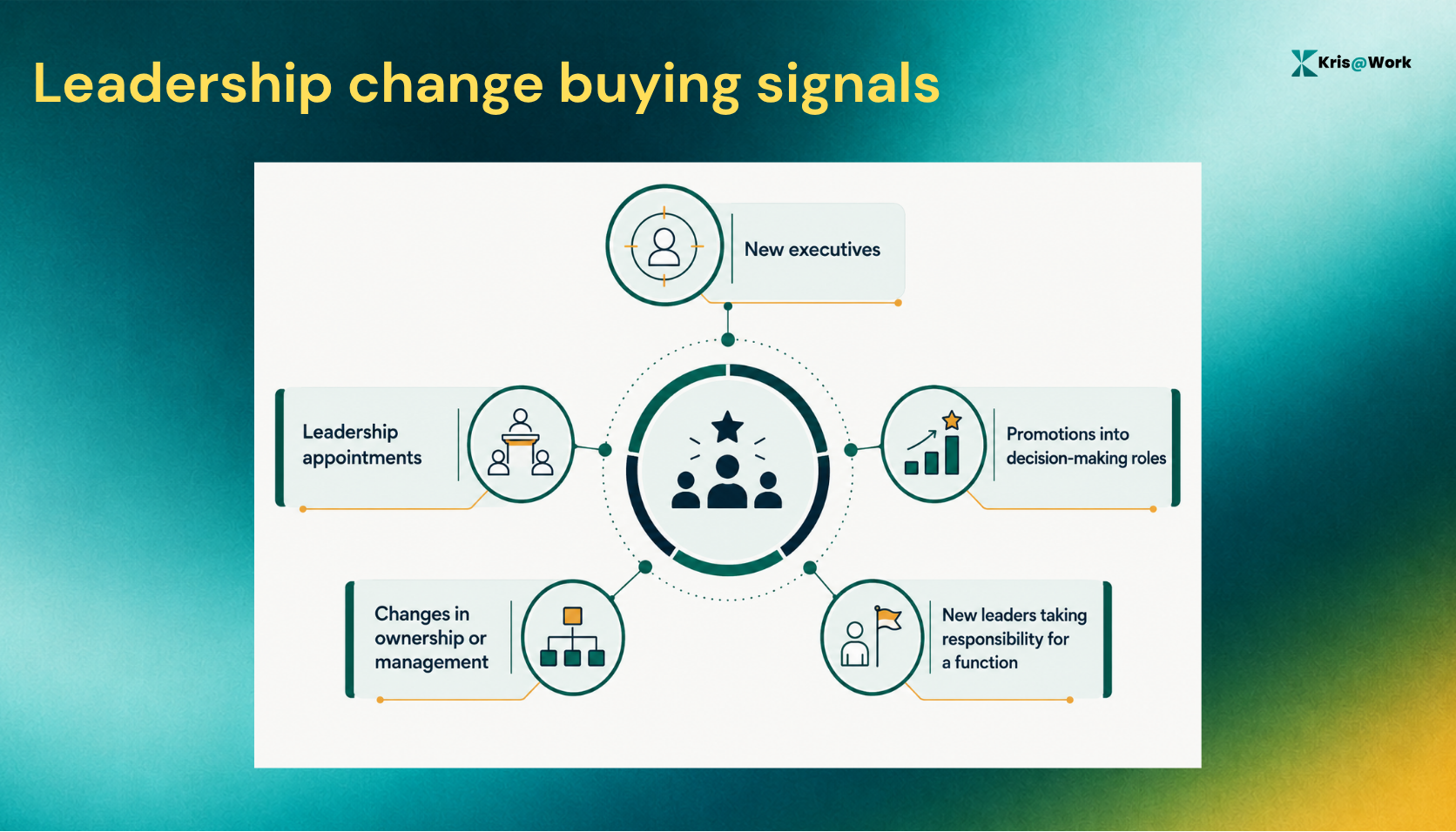
What the SDR should do:
Start with the executive's mandate. Look for other evidence that supports the hypothesis before reaching out.
A new VP alone is a reason to research the account. A new VP combined with relevant hiring and evidence of the problem you solve is a much stronger reason to prioritize it.
Leadership changes are part of the company context signals Kris Capture can identify. It can also identify changes such as ownership and M&A, funding and financial posture, growth and scale, strategic direction, regulatory and legal developments, and public narrative.
2. Funding and financial changes
Funding can create the budget and urgency for new initiatives.
A company that has just raised capital may be preparing to hire, expand, enter new markets, build a new function, or invest in technology. But funding by itself is weak evidence of a buying decision.
The better question is:
The better question is:
What is the company likely to do with the money?
For example:
Funding announcement + three open roles in your target function + new VP in that function
is a much stronger buying hypothesis than the funding announcement alone.
Kris's signal methodology explicitly uses corroboration rather than allowing one signal to determine an account's grade. A funding event alone may provide moderate evidence, while funding combined with relevant hiring and leadership can tell a much stronger story.
What the SDR should do:
Research what the company is investing in and connect the funding event to a specific business priority. Do not send a generic "congratulations on the funding" message unless there is a clear reason to continue the conversation.
3. Growth and hiring
Hiring can reveal where a company is putting resources.
A single job opening is rarely enough. A pattern is more useful.
Look for:
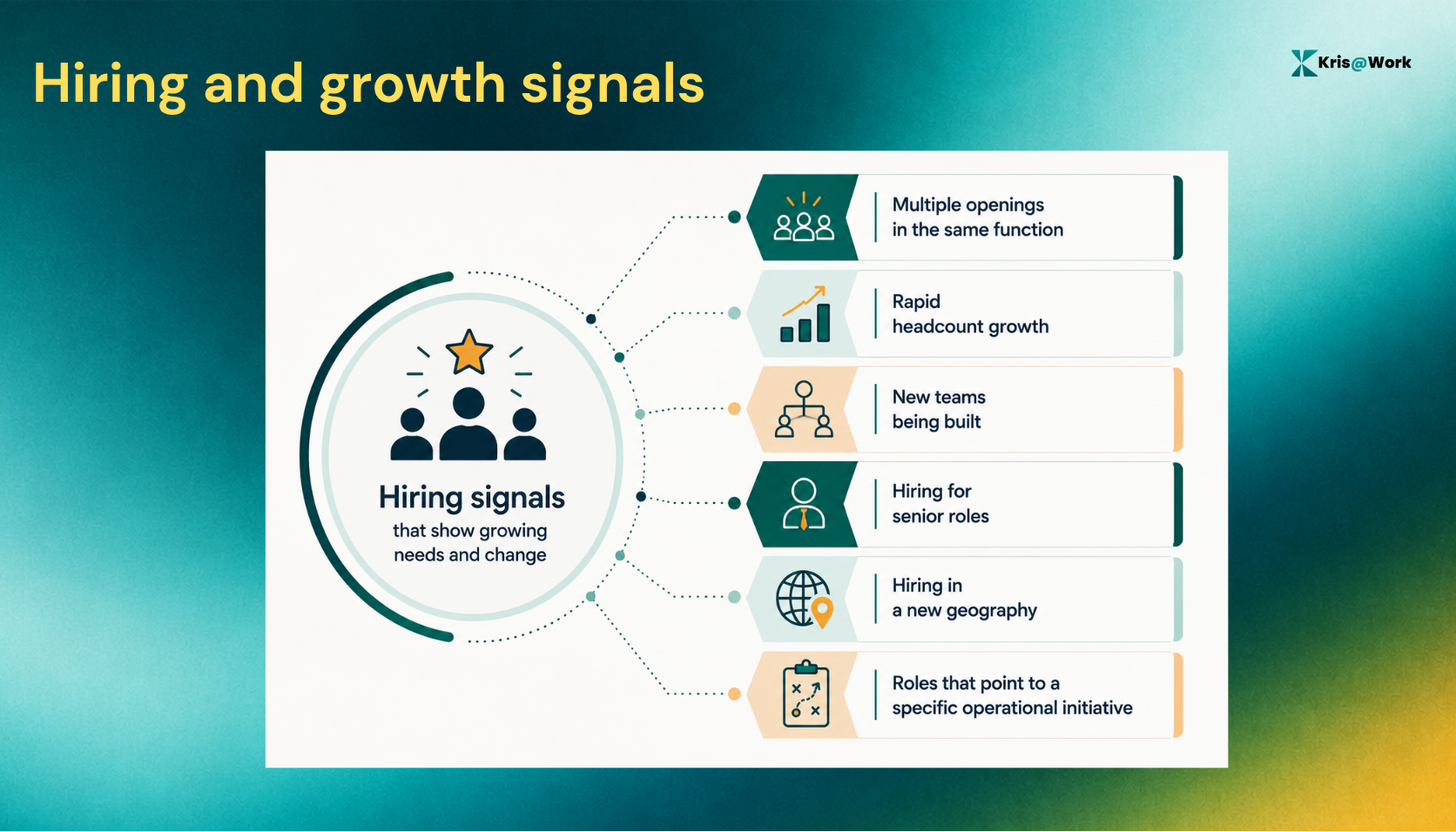
Hiring can be especially useful because it can expose a problem before the company publicly describes it as one.
For example, a company hiring heavily for an SDR organization may be preparing to scale outbound. That creates potential needs around prospecting, data, prioritization, and execution.
But context matters. Hiring can also be about replacing employees or maintaining an existing team. The signal needs interpretation rather than automatic qualification.
What the SDR should do:
Look beyond the job title. Read the job description, understand what the company is trying to build, and determine whether the hiring activity points to a problem your product solves.
4. Strategic changes and new initiatives
Companies regularly announce changes that create new buying conditions.
These can include:
- Expansion into new markets
- New strategic priorities
- New business lines
- Major organizational changes
- Product launches
- New partnerships
- Changes in go-to-market strategy
A strategic change matters because it can create a problem that did not previously exist.
A company expanding into two new regions, for example, may suddenly need to rethink how it handles regional GTM, sales coverage, or demand generation.
The signal becomes even stronger when the person you want to contact has publicly discussed the initiative.
For example, if you combinea a Series B announcement with a contact post about expanding into two new regions, Kris@Work’s recommended action will be to connect with the regional lead and use the expansion as the reason for the conversation.
What the SDR should do:
Lead with the initiative, not your product.
The expansion is the reason to contact them. Your product only becomes relevant if it can help with the problem created by that expansion.
5. Evidence of the problem you solve
This is where buying signals become much more useful than generic account intelligence.
Instead of asking whether a company looks like your ICP, ask:
Is there evidence that this company has the problem my product solves?
That evidence might come from public company information, news, job postings, leadership activity, or other relevant data.
The exact signals will depend on the seller's ICP and product. Kris therefore treats problem evidence as a seller-specific signal category rather than maintaining one universal list of problems for every customer.
This distinction matters. A company can be growing rapidly and still have no need for your product. A smaller company can have a very clear problem and be much more relevant.
What the SDR should do:
Build the buying hypothesis around the problem.
Instead of:
"You're growing quickly, so I thought I'd reach out."
Try:
"Your team is expanding into new regions while adding several SDR roles. That usually creates a different set of challenges around how reps prioritize accounts."
The first message uses a company fact. The second uses that fact to form a relevant hypothesis.
6. Role-level pressure
An account-level problem does not automatically mean every employee feels the same urgency.
A sales leader may be under pressure to increase pipeline. A RevOps leader may be dealing with fragmented systems. An SDR manager may be struggling to help reps decide which accounts to work first.
These are different manifestations of the same broader business problem. This gives SDRs a better way to personalize.
So instead of asking only:
"Does this company have the problem?"
Ask:
"Who inside this company is most likely to feel the problem right now?"
What the SDR should do:
Match the signal to the person's responsibilities. The same account event can produce different outreach angles for different stakeholders.
7. Contact career and authority changes
Some buying signals tell you that an account matters. Others tell you who matters inside the account.
Contact context includes things such as:
.png)
These signals help answer an important prospecting question:
Who should I actually contact?
A relevant company signal is more useful when you can connect it to someone with the authority or responsibility to act on it.
Kris@Work evaluates contacts using a Lead Score from A+ to F, incorporating role fit against the seller's target personas, authority and management level, contact-level signals, and the signals present at the parent account.
What the SDR should do:
Do not stop at account qualification. Identify the person whose role gives them a reason to care.
8. Expressed pain or need
A prospect publicly stating a problem is one of the clearest signals you can get.
There is a major difference between:
"This company might have a problem."
and:
"This person just said they are struggling with the problem."
The second gives you both relevance and a potential opening for the conversation.
Kris@Work treats contact expression as a seller-specific signal category covering stated pain and expressed need.
These signals can come from a prospect's public statements or other observable expressions that provide context around what they care about.
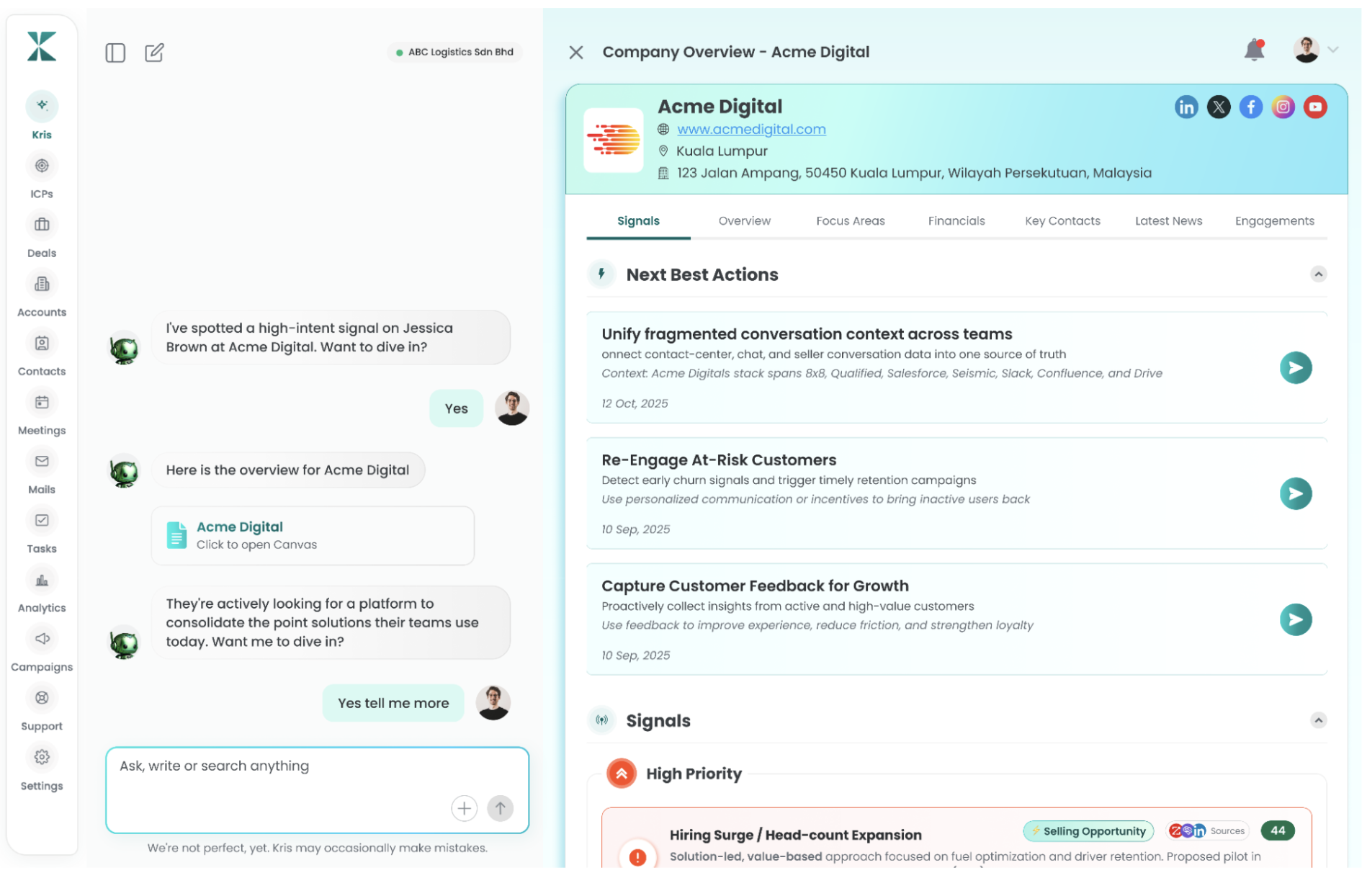
What the SDR should do:
Use the prospect's own context to make the outreach relevant, but do not simply repeat their words back to them.
The goal is to show that you understand the problem and have a reason for starting a conversation.
9. Active vendor evaluation
This is much closer to an actual buying event than a generic company change.
When a prospect is evaluating vendors, the account may have moved from:
"We have a problem."
to:
"We need to decide how to solve it."
Kris's contact buying intent category includes vendor evaluation and active buying behavior.
That makes this one of the later-stage buying signals worth prioritizing.
What to look for:
- Evidence of vendor evaluation
- Public discussion of potential solutions
- Evaluation of alternatives
- Signs that an existing approach is being reconsidered
- Other evidence that a buying process is underway
What the SDR should do:
Move quickly, but do not assume that evaluation means your product is automatically the right fit.
Find out what triggered the evaluation and what criteria matter to the buyer.
10. Competitive or incumbent-related intent
A particularly useful buying signal is evidence that a prospect is considering moving away from an existing solution.
For example, a contact publicly discussing a move away from an incumbent tool provides more context than a generic statement that the company is "looking at technology."
One of the documented Kris examples involves a contact publicly commenting about moving away from an incumbent tool. The recommended response is an email using a competitive-gap angle and a closely matched case study.
The important point is not to attack the incumbent.
The signal tells you that something about the current solution may no longer be working.
What the SDR should do:
Investigate the gap.
What changed? What is missing? What outcome does the buyer want that the current solution is not delivering?
That gives you a reason to enter the conversation without resorting to generic competitor-bashing.
11. Multiple signals that corroborate the same buying hypothesis
The strongest buying signal is often not a single event. It is a combination of events that tell the same story.
Consider this sequence:
- The company raises funding.
- It opens three roles in your target function.
- A new VP takes responsibility for that function.
- The new leader talks publicly about the initiative.
None of those signals proves that the company is about to buy.
Together, they create a much stronger case for prioritizing the account.
Kris@Work’s scoring methodology explicitly considers relevance, confidence, corroboration, freshness decay, and ICP fit. Corroboration means that evidence supported by multiple sources can strengthen the signal, while a saturation curve prevents a single signal from carrying the entire grade.
The goal is to find and collect signals that make sense together.
How to Find Buying Signals That Actually Matter
Finding buying signals is not about building the biggest database of company events.
It is about identifying the changes that should alter your sales priority.
A useful process looks like this.
1. Start with your ICP
First define the accounts that are actually worth pursuing. Your ICP should determine:
- Which companies matter
- Which functions matter
- Which roles matter
- Which problems matter
- Which business conditions make your solution relevant
A signal from a poor-fit company is still a signal. It just may not be a useful sales signal for you.
2. Define what happens before someone buys
Think backward from the purchase. What usually changes before a buyer needs your solution?
It could be:
- A new leader arrives
- A team starts hiring
- A new initiative begins
- An existing process stops working
- A business problem becomes more visible
- A buyer starts evaluating vendors
These are the events your signal system should look for.
3. Separate company signals from buyer signals
Company context tells you what is happening at the organization.
Buyer signals tell you what is happening with the people who could influence the purchase.
Both matter.
A company might be expanding, but the strongest contact could be someone who is publicly discussing the challenges created by that expansion.
That combination gives an SDR both account relevance and message relevance.
4. Check how recent the signal is
A six-month-old event is not equivalent to something that happened yesterday.
Signals naturally decay and a signal is more useful when it is recent enough to reflect what is happening at the account now.
Kris@Work's signal methodology accounts for freshness decay, meaning older evidence loses weight over time. Signal recency is considered alongside relevance, confidence, corroboration, and ICP fit when evaluating accounts and contacts.
This is why a static intent score can be less useful than a current explanation of what changed and when.
5. Look for corroboration
Do not ask:
"Did I find a buying signal?"
Ask:
"What other evidence supports this signal?"
A funding announcement becomes more useful when it is connected to hiring. Hiring becomes more useful when a new executive owns the function. A new executive becomes more useful when that person is publicly discussing the problem.
The more coherent the story, the stronger the reason to prioritize the account.
6. Identify the right person
A company signal does not tell you who to contact automatically.
You need to connect the account event to:
- Role
- Seniority
- Authority
- Responsibilities
- Contact-level signals
- Previous or current engagement where available
Kris's contact grading combines contact-level attributes with the signals at the parent account, so a strong contact at a quiet account can grade differently from that same contact at a high-signal account.
7. Turn the signal into an action
A signal is only useful if it changes what the seller does.
The workflow should look like:
.png)
For example, New funding + regional expansion becomes:
Regional expansion is likely a priority > identify regional GTM leader > connect the message to the expansion > reach out while the initiative is current.
That is much more useful than simply adding "funded company" to a spreadsheet.
First-Party Signals vs. Third-Party Intent Data
Buying signals and intent data are related, but they are not the same thing.
Third-party intent can indicate that an account is researching a topic or category. It can be useful context, particularly when you are trying to identify accounts that may be entering a research cycle.
But third-party intent does not necessarily tell you:
- What changed at the company
- Who is responsible for the problem
- Why the problem matters now
- What the buyer actually said
- What action the SDR should take
But that does not make third-party intent useless. It means it should be treated as one input rather than the entire buying-signal strategy.
How Kris Turns Buying Signals Into Action
The hard part of signal-based prospecting is not collecting another feed of company events.
It is turning those events into a clear sales priority.
Kris Capture is designed around an ICP-trained signal engine that identifies relevant company and contact signals, combines them with account and contact context, and uses them to help prioritize who deserves attention.
The workflow is built around the same sequence an SDR needs:
.png)
Kris can generate a prioritized worklist and surface the context behind the grade. The SDR can then review the signals, decide whether there is a dated reason to contact the person, and use the generated messaging as a starting point rather than blindly sending it.
A Simple Buying Signal Framework for SDRs
When you find a potential signal, run it through these questions:
.png)
If you cannot answer the last question, the signal may be interesting but not actionable.
The best buying signals connect all six.
For example: ICP-fit company + new VP Sales + SDR hiring + public discussion of pipeline challenges
gives an SDR a clear hypothesis, a relevant contact, a reason to reach out, and a potential message angle.
Summarizing It
An ICP tells you who could buy. A buying signal tells you what changed. A strong signal tells you why the change matters. And a combination of signals can tell you why now may be the right time to act.
That is the real value of buying signals. They move prospecting away from working every account the same way and toward spending more time on the accounts where there is current evidence that a conversation could matter.
The best SDRs do not simply find more prospects. They get better at recognizing which prospects have given them a reason to reach out now.
FAQs about Buying Signals
1. What are buying signals in sales?
Buying signals are observable events, behaviors, changes, or evidence that indicate a prospect may have a relevant business need, be considering a solution, or be moving closer to a buying decision. Examples include leadership changes, relevant hiring, expressed pain, strategic initiatives, vendor evaluation, and active buying behavior.
2. What are the strongest buying signals?
There is no universal ranking because the strongest signals depend on the product and buyer. In general, signals become stronger when they are directly connected to a relevant problem, recent, tied to the right buyer, and corroborated by other evidence. Active vendor evaluation and expressed pain are typically closer to a buying decision than broad company events.
3. How do you find buying signals?
Start with your ICP, identify the business events and buyer behaviors that typically precede a purchase, then monitor for those changes across company and contact data. Prioritize signals based on relevance, confidence, corroboration, freshness, and ICP fit.
4. What is the difference between buying signals and intent data?
Intent data is one type of evidence that can indicate research or interest. Buying signals are broader and can include company changes, leadership events, expressed pain, strategic initiatives, vendor evaluation, and other evidence that affects relevance or timing. Signal-based selling uses this broader evidence to determine where sellers should focus.
5. What are buyer intent signals?
Buyer intent signals are observable behaviors or statements that suggest a prospect is actively researching, evaluating, or considering a solution. Examples include vendor evaluation, expressed need, and other contact-level evidence of active buying behavior.
6. How do you know if an account is in-market?
Look for multiple pieces of current evidence rather than relying on a single score. An account is more likely to be in-market when ICP fit, a relevant business trigger, a clear problem, recent buyer activity, and corroborating signals point in the same direction.
7. What are sales triggers?
Sales triggers are events or changes that create a timely reason for a seller to contact an account or buyer. Leadership changes, funding, hiring, strategic initiatives, expressed pain, and vendor evaluation can all act as sales triggers when they are relevant to the seller's solution.
8. Do buying signals guarantee that an account will buy?
No. Buying signals are evidence that improves prioritization. They do not guarantee purchase intent or a future deal. Human judgment is still needed to determine whether the signal represents a genuine opportunity and whether the seller's solution is relevant.