

Your sales team probably has more prospect data than it knows what to do with.
There are ICP lists, intent scores, CRM records, LinkedIn activity, hiring updates, company news, funding announcements, and dozens of other data points competing for a rep's attention.
Yet the hardest question remains simple: Who should I actually reach out to today?
A company can look perfect on paper and still be months away from buying. Another might suddenly become worth pursuing because a new executive joined, the team started hiring, or a problem your product solves has become a priority.
The difference is not always the account. Sometimes, it's what changed.
That idea is at the heart of signal-based selling, and it is changing how modern sales teams think about prospecting, prioritization, and timing.
In this guide, we'll break down what signal-based selling actually means, how it differs from intent-based and traditional prospecting, which signals matter, how to evaluate them, and how teams can turn them into better sales actions.
What Is Signal-Based Selling?
Signal-based selling is a sales methodology that uses current, observable evidence about a prospect to guide sales decisions.
Instead of asking "Does this account match our ICP?", the rep also asks "What has changed that makes this account worth contacting now?"
That difference matters because a company can be a perfect ICP fit and still be a bad prospect to contact today. Another account might be a slightly weaker fit but have just hired a new executive, opened several relevant roles, raised funding, or publicly expressed a problem that your product solves.
Signal-based selling brings those two dimensions together: Fit + evidence + timing = better-informed sales action
A signal does not automatically mean a prospect is ready to buy. It simply provides evidence that can improve the decision about whether, when, and how to engage.
What Is a Sales Signal?
A sales signal is an observable event, behavior, change, or piece of evidence that can indicate a prospect's relevance, timing, business problem, authority, or potential buying activity.
Some signals are direct. Others are contextual.
For example, a prospect explicitly saying they are evaluating outbound sales platforms is a relatively direct buying signal.
A new VP of Sales joining a company that is also hiring SDRs is more contextual. It does not prove that the company is buying anything, but it can indicate that the organization is entering a period of change where a relevant solution may become more important.
A useful signal should have four characteristics:
- Relevance: It relates to the account, buyer, or problem you solve.
- Confidence: There is a reasonable basis for believing the evidence is accurate.
- Corroboration: Other evidence supports the same interpretation when available.
- Freshness: The signal is recent enough to matter.
The last point is easy to overlook. A signal is not equally valuable forever. A leadership change from last week may be highly relevant. The same event six months later may tell you much less about what the company is doing today.
Signal vs. Data vs. Activity vs. Intent
These terms are often used interchangeably, but they describe different things.
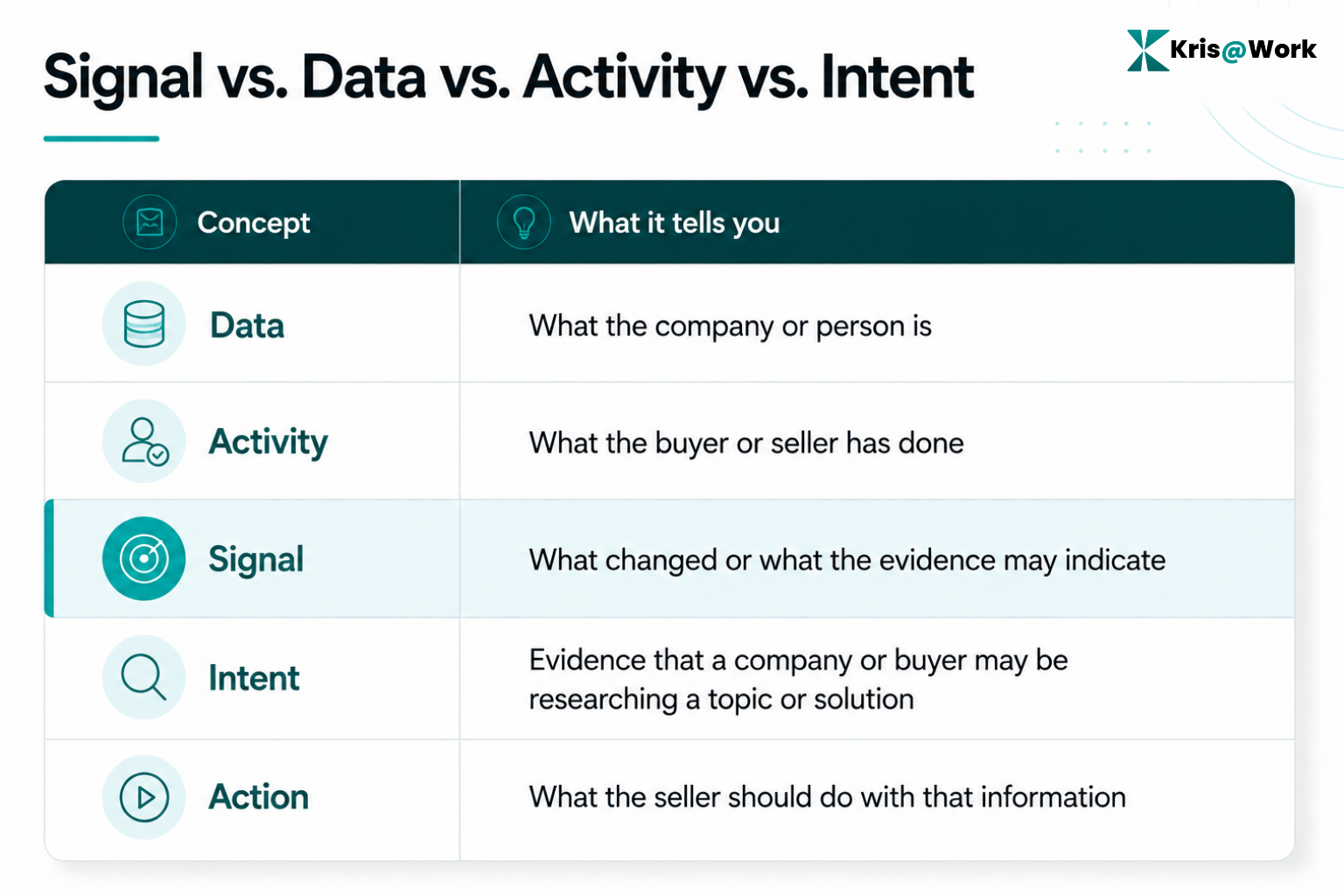
Consider a company with 500 employees - that is data.
The company hiring 20 new SDRs is an event - that’s an hiring activity that can potentially become a meaningful signal if you sell technology that helps sales teams scale outbound.
Now suppose the company is also hiring a new VP of Sales, and that executive has publicly discussed improving outbound performance. The hiring activity, leadership change, and stated priority together become signals because they provide evidence that outbound may now be an important business priority.
If the company is also researching sales engagement platforms, that adds intent, indicating that the company may be actively exploring a solution. The seller then uses that evidence to decide the appropriate action, such as prioritizing the account, identifying the right stakeholder, or reaching out with a relevant message.
The value comes from interpretation, not from the raw data point itself.
How Kris@Work Structures Sales Signals
Kris@Work does not treat every signal as one generic intent score. Its current signal taxonomy spans six root categories: company context, problem evidence, persona pressure, contact context, contact expression, and buying intent.
The taxonomy contains 37 signal families, while seller-specific categories are generated during onboarding.
The distinction matters because the same event can mean different things depending on what you sell and who you are trying to reach.
What Are the Different Types of Sales Signals?
There is no single universal list of sales signals. What matters depends on your ICP, your product, your buyers, and the problems you solve.
A useful starting point is to group signals into three broad categories.
Company-Level Signals
These are events or changes happening within the organization.
Examples include:
- Leadership changes
- Relevant hiring
- Funding events
- Mergers or acquisitions
- Strategic changes
- Expansion into a new market
- Organizational restructuring
- Publicly visible business problems
A company-level signal can tell you that the organization is entering a situation where your product may become relevant.
Contact-Level Signals
These relate specifically to the people you want to reach.
Examples include:
- A new executive joining the company
- A contact moving into a new role
- A buyer expressing a problem publicly
- A change in a person's authority or responsibilities
- Relevant professional activity
- A contact becoming responsible for an area connected to your solution
Contact-level signals can be particularly useful because they help answer another important prospecting question: which person should I actually talk to?
Buying-Intent Signals
These provide stronger evidence that a company or buyer may be actively evaluating a solution.
Examples include:
- Active vendor evaluation
- Explicit solution research
- Public discussion of a specific problem
- Requests for recommendations
- Direct expressions of an upcoming initiative
These signals are generally closer to an actual buying motion, but they should still be interpreted in context.
A prospect researching a category does not automatically mean they will buy from you.
How Is Signal-Based Selling Different From Traditional Prospecting?
Traditional prospecting often leaves reps with two not-so-comfortable choices: research deeply or reach out at volume.
Give a rep 40 ICP-fit leads and they can spend hours researching accounts one by one, only to have enough context to confidently prioritize two or three. Or they can skip most of the research and go with a spray-and-pray approach, working through the list with cold outreach and hoping something sticks.
The problem is that the list can become the prioritization system.
A rep receives 250 accounts and has to decide where to begin. But deep research on just 10 accounts can take 2–3 hours. So reps usually end up making a trade-off: skip the research and send generic outreach with low reply rates, or over-invest in research and get too few touches out each day.
In either case, the signals that could tell them which accounts are actually worth their time get overlooked.
Signal-led prospecting reworks the sequence. Now it’s:
ICP > evidence > interpretation > prioritization > outreach
The ICP still matters. Signal-based selling does not replace qualification.
It adds another dimension to it.
A simple way to understand this is:
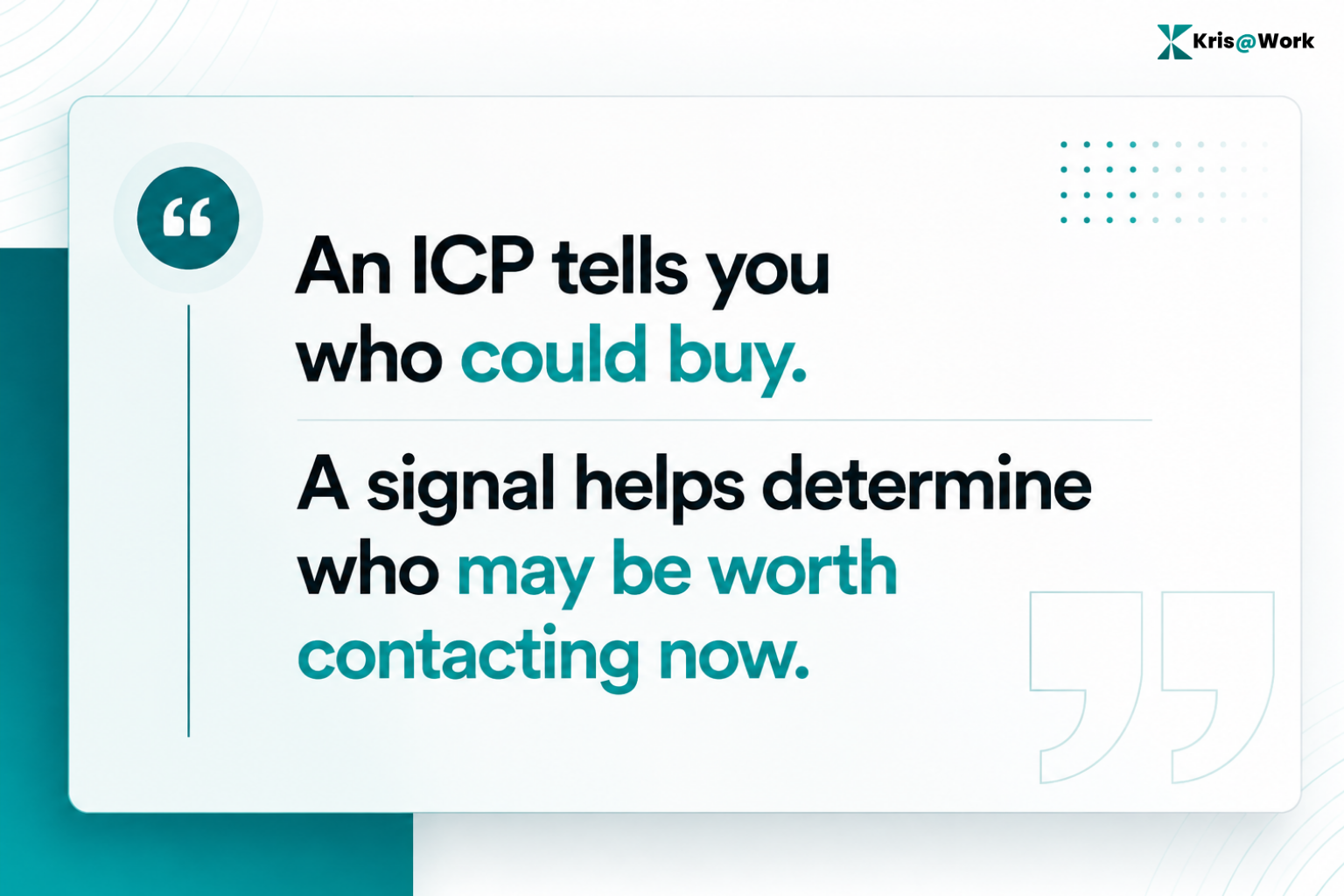
If every account that fits the ICP receives the same attention, reps spend time researching prospects that may have no current reason to engage. Reps who reach out within 24 hours of a trigger event are 60% more likely to book a meeting, which means the longer a relevant signal sits unnoticed, the more likely the opportunity is to lose its timing advantage.
A signal-based system tries to concentrate that effort where there is evidence that something has changed, so reps can act while the signal is still relevant.
From Lists to Ranked Work
Having signal data is not the same as having a signal-based sales process.
If a rep receives 300 alerts every morning, the problem has not really been solved. The list has simply been replaced by a different kind of information overload.
The useful output is a prioritized worklist.
Kris@Work approaches this through account and contact grading, using an A+ to F scale to help reps identify which prospects deserve attention first. The underlying idea is to turn scattered evidence into a concrete starting point rather than asking the rep to interpret every event manually.
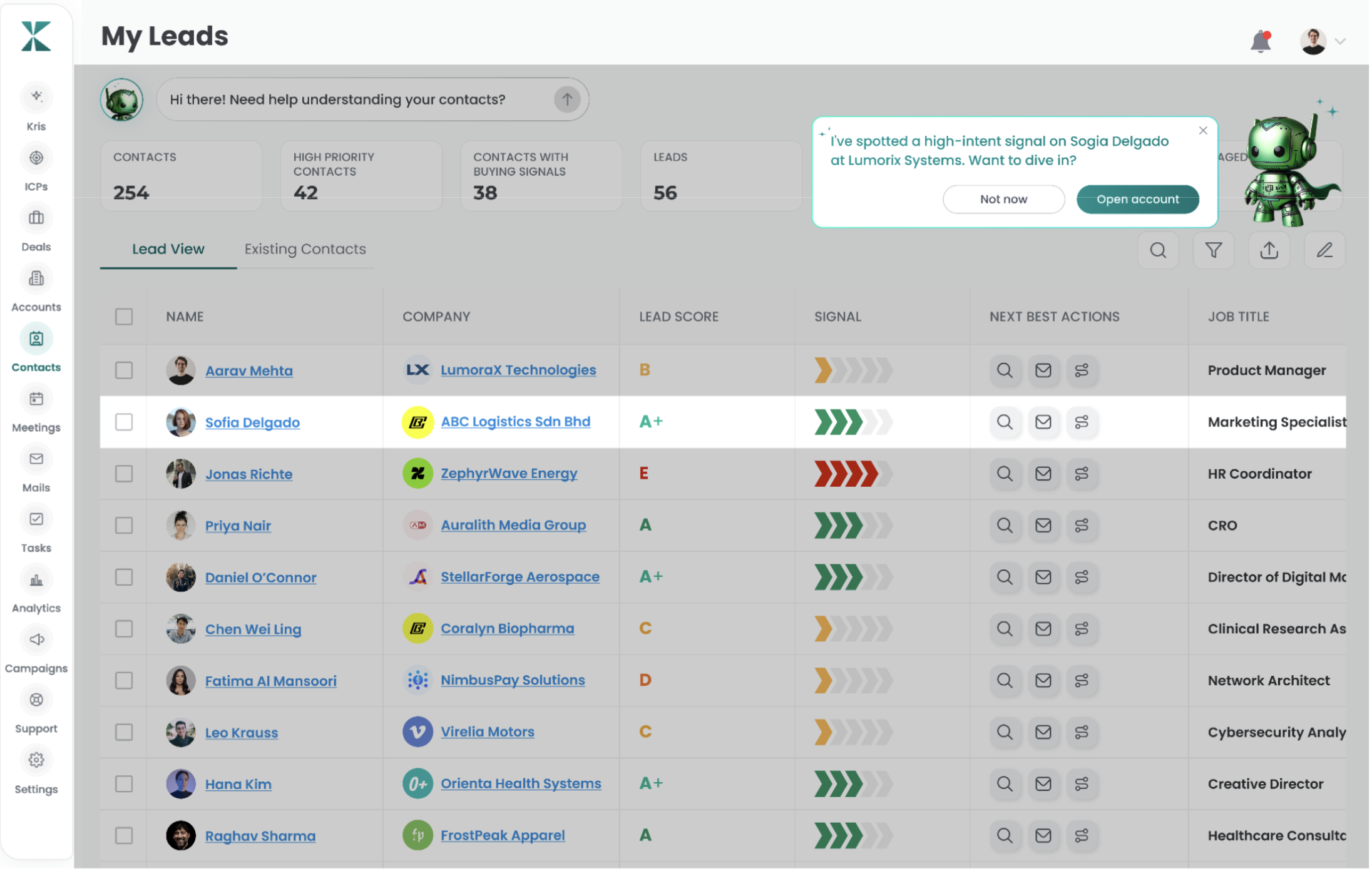
Signal-Based Selling vs. Intent-Based Selling
| Intent-based selling | Signal-based selling |
|---|---|
| Focuses heavily on research or interest | Considers a broader range of observable evidence |
| Can indicate what a company may be researching | Can indicate what changed, why it matters, and what may happen next |
| Often provides a useful input for prioritization | Connects multiple inputs to prioritization and action |
| May require additional context from the rep | Attempts to interpret evidence in the context of the seller's ICP |
How Does Signal-Based Selling Work?
A practical signal-based selling process works in six steps.
1. Defining your ICP
Start by establishing who is actually worth pursuing and build an ICP list.
That means identifying the characteristics that make an account a strong fit, such as:
- Company type
- Industry
- Size
- Geography
- Business model
- Relevant teams
- Buyer roles
- Problems your product solves
Signals are useful only when they are evaluated against something.
A hiring announcement at a company outside your ICP may be interesting. It is not necessarily useful for your sales team.
2. Identifying relevant signals
Next, determine which changes or events could indicate relevance or timing.
For one business, that could mean funding and eNot every signal deserves equal weight.
Four useful criteria are:
- Relevance: Does this connect to the problem you solve?
- Confidence: How reliable is the evidence?
- Corroboration: Is another source supporting the same conclusion?
- Freshness: How recently did it happen?
4. Prioritizing accounts and contacts
Once the signals have been evaluated, they need to affect prioritization.
The goal is not to contact everyone who generated a signal but to identify the accounts where fit and current evidence intersect.
That distinction matters because different businesses will have different definitions of a strong signal and different ways of combining fit, timing, and evidence.
5. Determining the next best action
This is where signal-based selling becomes operational.
Suppose a prospect has just hired a new VP of Sales.
What should the rep do?
Should they:
- Send an email?
- Connect on LinkedIn?
- Call?
- Research another stakeholder first?
- Wait for another signal?
- Approach the new executive differently from the previous contact?
The signal itself does not answer those questions but the sales workflow has to.
This is the role of Next-Best-Action in Kris@Work. The system is designed to move from the evidence itself to a recommended action, giving the rep a practical next step rather than another piece of
xecutive hiring. For another, it could mean a new compliance requirement, a technology migration, or a change in leadership.
The key is to start with your sales motion rather than collecting every piece of information available.
3. Evaluating the evidence
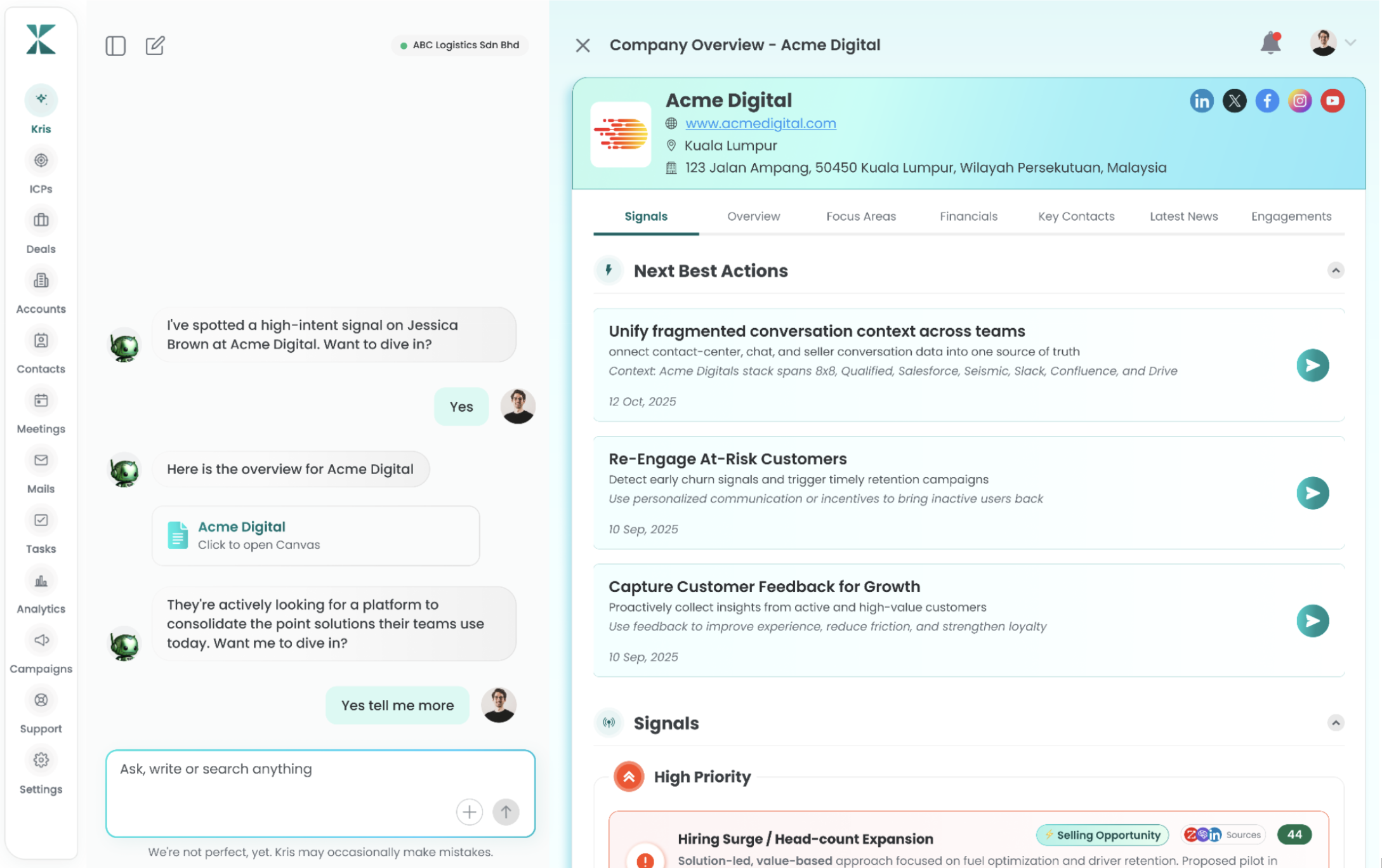
6. Turn the signal into relevant outreach
The final step is translating the evidence into a reason for the conversation.
But that does not mean writing "I saw that you recently raised funding" and immediately pitching a product. The signal should provide context for a relevant business conversation.
For example:
"I noticed you're expanding the outbound team after the recent funding round. Teams usually hit a different prospecting challenge once the SDR function starts scaling..."
The point is not to mention the signal for the sake of personalization but to use it to establish why this conversation makes sense now.
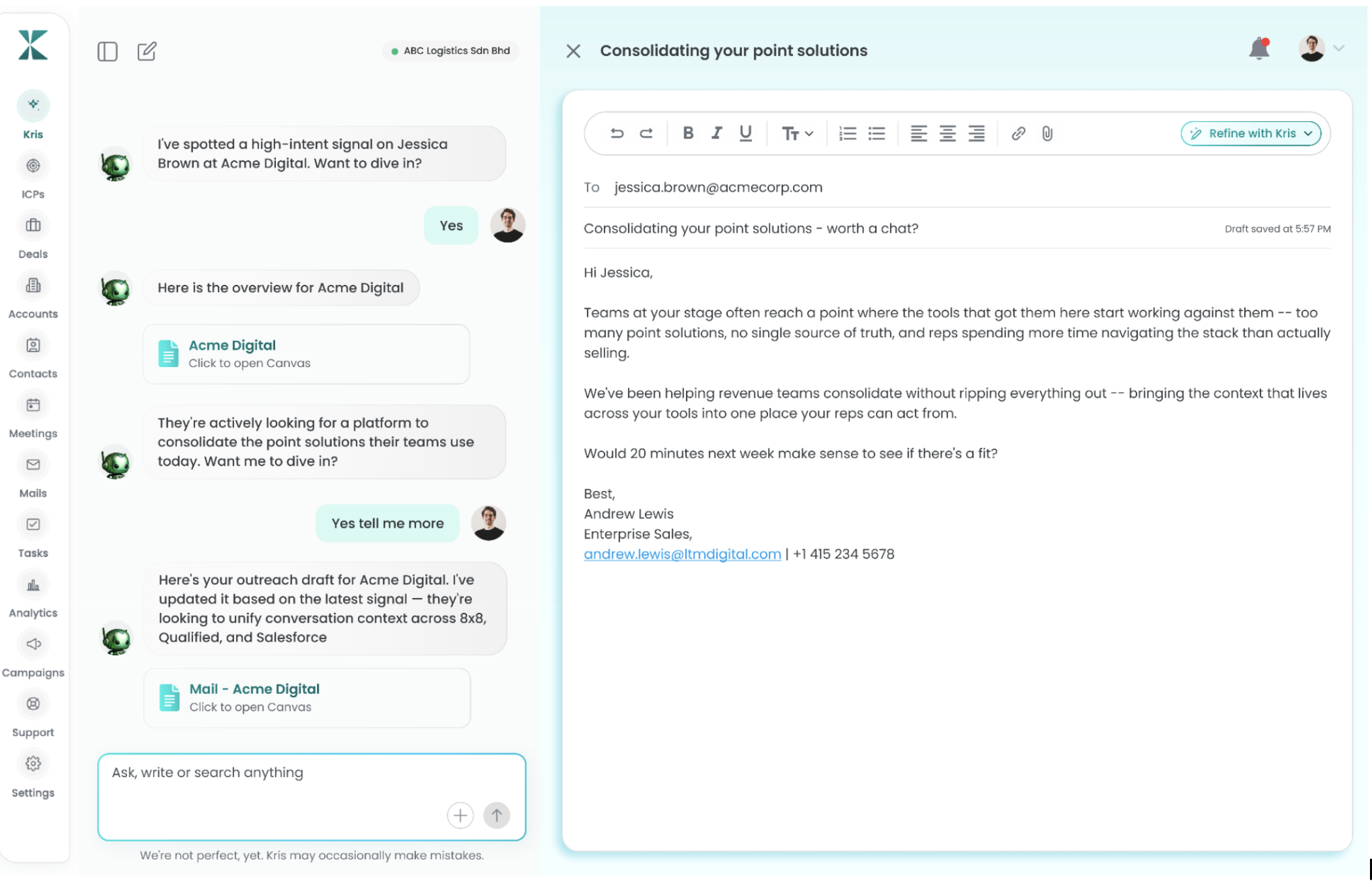
Kris@Work applies this principle to its outreach by grounding drafts in prospect signals and seller context rather than relying on generic personalization. Its seller profile is also designed to keep messaging aligned with the company's positioning while matching the rep's voice.
What Are the Strongest Buying Signals in Sales?
There is no universal ranking of buying signals because the right signals depend on the product and buyer.
But there are five signal types to look out for, but keep in mind that this is not a ranking. Something at the top doesn’t mean it’s the most important.
1. Contact-expressed pain
When a buyer directly describes a problem that your product addresses, the signal becomes much more concrete.
2. Active vendor evaluation
Evidence that a company is actively evaluating vendors or solutions is closer to a conventional buying signal than a general company event.
3. Funding events
Funding can create the financial capacity to invest, although funding by itself does not prove that a company is buying your category.
4. Relevant hiring
Hiring can indicate investment in a function, an organizational problem, or an initiative that requires new resources.
5. Leadership changes
A new executive can bring new priorities, new budgets, and a willingness to change existing processes.
How Signal-Based Selling Changes Lead Prioritization
The biggest practical change is that prospecting becomes less about working through a list and more about deciding where seller attention is most valuable.
Consider two companies.
Company A
- Strong ICP fit
- No meaningful recent changes
- No obvious buyer activity
Company B
- Strong ICP fit
- New VP Sales
- Hiring five SDRs
- Recent discussion about improving outbound
Both companies fit your ICP.
Company B has a stronger reason to be at the top of the rep's worklist today.
This creates a useful hierarchy:
- ICP fit answers: Could they buy?
- Signal answers: Why might they buy now?
- Prioritization answers: Who should I work first?
That is the heart of signal-based selling.
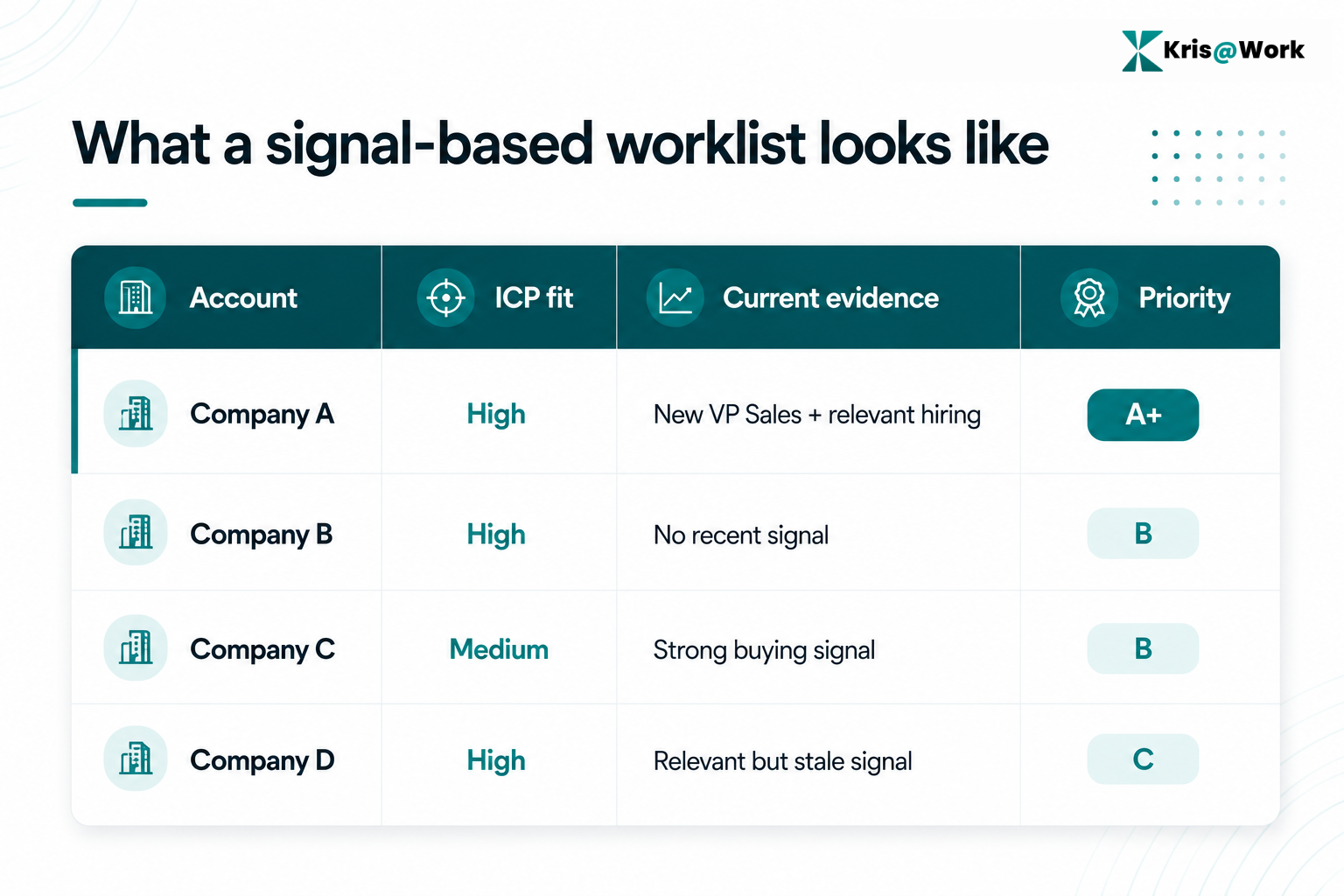
The exact grading methodology will vary by organization. The important point is that the worklist should change in real time when the evidence changes.
What Does Signal-Based Selling Look Like in Practice?
Consider a mid-market SaaS company that fits your ICP.
You identify four pieces of evidence:
- A new VP of Sales has joined.
- The company has recently raised funding.
- It is hiring several SDRs.
- The new executive has discussed improving outbound performance.
None of these signals, individually, proves the company is buying your product.
Together, they tell a more useful story.
- There is new leadership.
- There is additional capital.
- There is investment in the sales organization.
- There is a stated business priority.
The account therefore deserves more attention than an otherwise identical company with no recent change.
The seller then needs to identify the right person.
If the new VP of Sales owns the initiative, that person may be the primary contact. If RevOps owns the technology decision, another stakeholder may be more appropriate.
The process should stop short of assuming that the signal guarantees a meeting. The signal improves the quality of the sales decision. The buyer still decides whether to engage.
How Does Signal-Based Selling Improve Sales Productivity?
Signal-based selling can improve sales productivity by changing where reps spend their limited time.
Less fragmented research
Traditional prospecting often requires reps to move between a CRM, LinkedIn, company websites, data providers, intent tools, spreadsheets, and sequencing software.
That creates context switching.
A signal-based workflow can reduce some of that research by bringing the relevant evidence closer to the prioritization decision.
This is one reason Kris@Work’s single intelligent window matters to the broader concept. The product is designed to collapse fragmented prospecting work into one surface rather than simply adding another source of intelligence to the stack.
Better prioritization
Instead of spending the first part of the day deciding which accounts to work, reps can start with the accounts that have both fit and relevant evidence.
More relevant outreach
The signal provides the reason for the message.Instead of "We help companies like yours improve sales productivity", the rep has a specific business context to work from.
Faster action
A useful signal should reduce the amount of time between discovering something important and deciding what to do about it. That is where recommendations such as Next-Best-Action become valuable.
More consistent execution
A shared signal framework gives sales teams a common language for prioritization. Instead of one rep working from gut feel and another working from whichever accounts happen to be familiar, the team can use a more consistent set of criteria.
What Are the Limitations of Signal-Based Selling?
Signal-based selling is not a shortcut around sales judgment. It has its limitations.
Signals are not proof of intent
A company hiring SDRs does not necessarily mean it is buying your product. A new executive does not necessarily want to change the technology stack. A funding event does not automatically create demand for your category. Signals are only evidence. It can’t guarantee you anything.
Signals can be noisy
Not every public event matters to your sales motion. If your system surfaces everything, reps can become overwhelmed again.
Signals can become stale
A signal's value changes over time. Freshness needs to be part of the prioritization process.
AI interpretation can be wrong
Automated systems can misread context, connect unrelated events, or overestimate the importance of a signal. That is why confidence and corroboration matter.
Human judgment still matters
The goal is not to remove the seller from the decision. It is to make the seller's decision better informed. A good signal-based workflow should help the rep understand why an account deserves attention, then give them enough context to decide how to act.
There is another important limitation when implementing this approach with software: signal detection does not automatically mean outreach should happen.
That distinction matters. A signal should inform the seller's next move, not silently make the decision for them.
How Kris@Work Implement Signal-Based Selling
Kris@Work brings several parts of this process into one prospecting workflow: ICP building, account and contact grading, signal interpretation, Next-Best-Action recommendations, and personalized outreach.
The goal is not to give reps more signals. It is to reduce the distance between "Something changed." and "Here's what you should do about it."
Signal-Based Selling vs. Other Prospecting Approaches
Signal-based selling sits alongside several other modern approaches to prospecting.
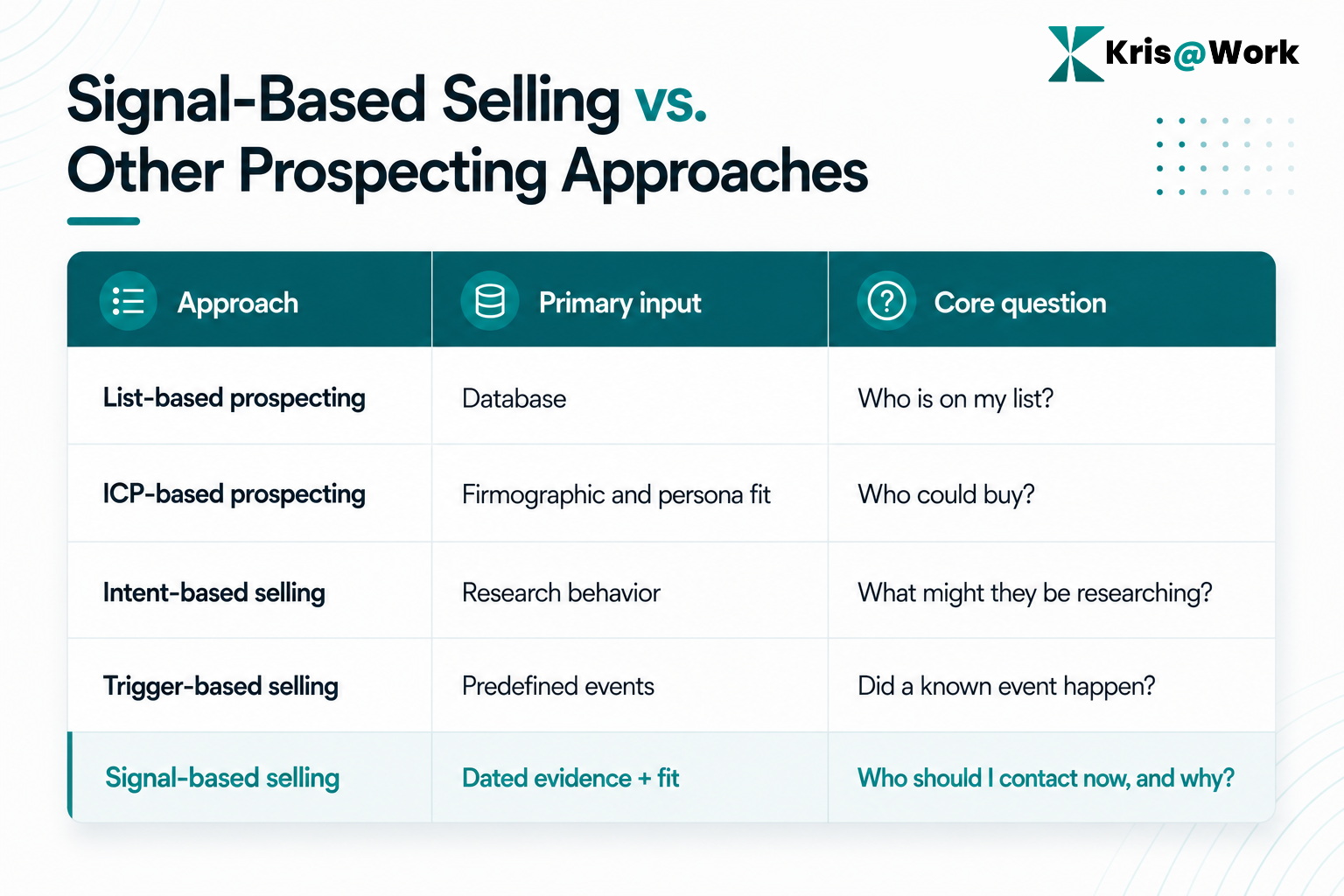
These approaches are not necessarily mutually exclusive.
A strong sales process may use ICP data to establish fit, intent data as one input, trigger events as signals, and seller judgment to determine the appropriate action.
The defining characteristic of signal-based selling is the attempt to connect those pieces of evidence to prioritization and action.
The Bottom Line
Traditional prospecting starts with a list. Signal-based selling starts with a reason.
ICP fit tells you who could buy. Signals tell you what changed. Prioritization determines who deserves attention now. The signal gives the rep a reason to start the conversation.
The best signal-based selling systems therefore do more than collect data. They shorten the distance between evidence and action.
FAQs About Signal-Based Selling
1. What is signal-based selling?
Signal-based selling is a sales approach where observable, timely evidence about a company or buyer influences who a seller contacts, when they reach out, and what they say. It combines ICP fit with current signals to prioritize prospects based on both suitability and timing.
2. What is signal-led prospecting?
Signal-led prospecting is the application of signal-based selling specifically to prospecting. Instead of working through a static account list, reps use current evidence about prospects to determine which accounts and contacts deserve attention first.
3. What are buying signals in sales?
Buying signals are observable indicators that a prospect may have a relevant business need, be considering a solution, or be moving closer to a buying decision. Examples include active vendor evaluation, expressed pain, relevant leadership changes, and initiatives that create a need for a particular solution.
4. What are examples of sales signals?
Examples include leadership changes, relevant hiring, funding events, contact-expressed pain, active vendor evaluation, strategic changes, and other company or buyer events that can affect relevance or timing.
5. Is signal-based selling the same as intent-based selling?
No. Intent data can be one input into signal-based selling, but signal-based selling considers a broader range of evidence. It looks at what changed, how relevant the change is, how recent it is, and what action the seller should consider taking.
6. How do you prioritize sales signals?
Evaluate signals based on factors such as relevance, confidence, corroboration, and freshness, then consider them alongside ICP fit. The objective is to identify the accounts where current evidence provides the strongest reason to act.
7. Does every sales signal indicate buying intent?
No. A signal can indicate relevance, timing, organizational change, or potential pain without proving that a buyer intends to purchase. Signals should be treated as evidence that improves prioritization, not as guarantees of buying intent.
8. Can signal-based selling replace traditional prospecting?
It does not need to replace traditional prospecting. It changes how traditional prospecting is prioritized. ICPs, account data, contact databases, intent information, and outbound channels can all remain part of the process while signals determine where sellers should focus their attention.
9. How does signal-based selling help SDRs?
It can help SDRs spend less time deciding which accounts to research and more time acting on accounts with relevant evidence. A signal can also provide the context needed to make outreach more specific and timely.