
It is the last week of the quarter, and three deals in your commit have gone quiet. The signs were there: a champion who stopped replying, a call that ended with no next step, a legal review nobody scheduled. They sat in email threads, calendars and call notes, and nobody joined them up.
Revenue intelligence is the category built to close that gap. This guide explains what it is, the data it uses, how it differs from similar tools, what it costs and how to adopt it.
What Is Revenue Intelligence?
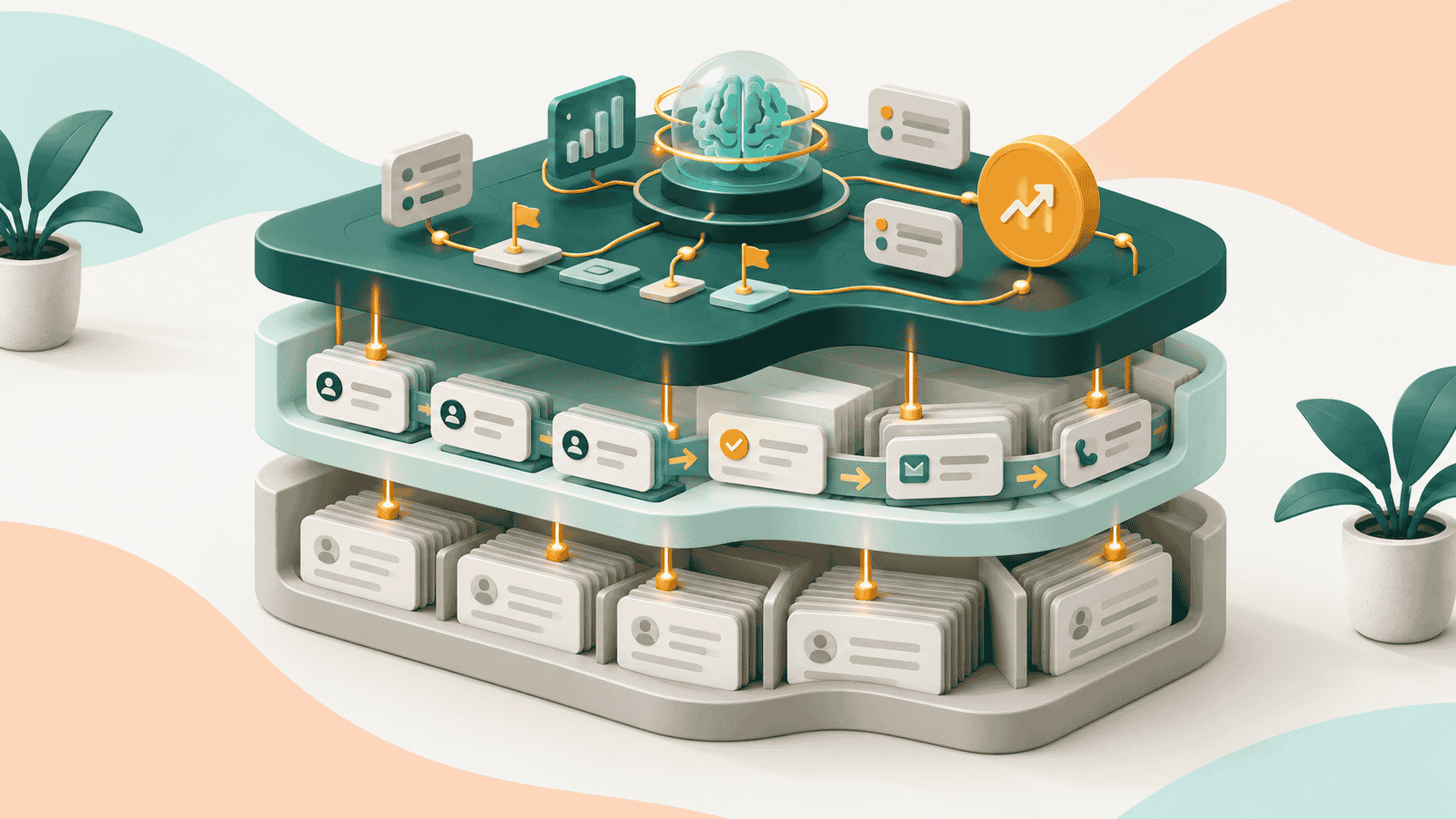
Revenue intelligence is AI that combines CRM, activity, conversation and buying-signal data to show which deals are healthy, which are at risk and what to do next. Where traditional sales analytics reports what already happened, it looks ahead.
It is a layer over the systems a team already uses, not a replacement for them. The term is also used loosely: vendors apply it to everything from call recording to forecasting, so check what a product actually covers.

What Does a Revenue Intelligence Platform Do?
A revenue intelligence platform turns scattered selling activity into four outputs, built from activity it captures automatically so reps don't re-key updates:
- Deal health: a grade for how likely a deal is to progress, based on recent activity and stage movement.
- Pipeline visibility: where deals sit, which have stalled and where coverage is thin.
- Forecast against commit: projected closes compared with the number the team has promised.
- Next best action: the suggested next step on a deal, with the reason behind it.
How Does Revenue Intelligence Work?
Platforms follow the same five steps, whatever the vendor:
- Capture: connectors log email, calendar, call and CRM activity against each deal.
- Match: the platform links each email and meeting to the right contact, account and opportunity, even when CRM records are incomplete.
- Score: models compare a deal's activity and stage movement with how similar past deals ended.
- Explain: the evidence behind each score, such as a missing executive contact, is shown so managers can challenge it.
- Act: alerts and suggested next steps reach the CRM, inbox or chat, and outcomes feed back into the model.
What Data Does a Revenue Intelligence Platform Analyze?
- CRM fields: stage, amount, close date and, where tracked, MEDDPICC qualification. This is the least reliable source, because reps enter it by hand.
- Email and calendar activity: who is engaged and how quickly they reply, which shows buyer behavior without relying on rep updates.
- Call and meeting content: objections, next steps and stakeholders, in the buyer's own words.
- Engagement data: opens, clicks and content views that show which contacts are paying attention.
- Product usage: adoption signals from trials and customers, useful for expansion and renewal risk.
- External buying signals: hiring, funding and intent that show timing, covered in our guides to signal-based selling and buying signals.
What Signals Mark a Deal as ‘at Risk’?
A deal rarely fails without warning. These signals recur, and platforms weigh them against how similar deals ended:
| Signal | What it suggests | Where it comes from |
|---|---|---|
| Single-threaded | One contact carries the deal, so one departure or objection can end it | CRM contacts, email, calendar |
| Quiet champion | Replies slow or meetings are cancelled; internal support may be fading | Email, calendar |
| No next step | A call ended without a dated commitment | Call and meeting content |
| Repeated close-date pushes | The deal is drifting, not progressing | CRM field history |
| No economic buyer late on | A qualification gap, often tracked in MEDDPICC | CRM, call content |
| Stalled stage | Days in stage far exceed those of won deals | CRM stage history |
Kris's Deal Signal Detection Engine tunes which signals matter for each seller from their own sales playbook and profile, so the risk list is specific to how your team sells.
How Is Revenue Intelligence Different From Conversation Intelligence, Sales Intelligence and Forecasting?
Revenue intelligence is the layer that combines the others. Forecasting is one of its outputs.
|
|
Answers | Main data | Typical tools |
|---|---|---|---|
| Revenue intelligence | Which deals will close, and what should we do? | CRM, activity, conversations, signals | Gong, Clari, Outreach, Salesforce, Kris@Work |
| Conversation intelligence | What was said on the call? | Call and meeting content | Gong, Chorus |
| Sales intelligence | Who should we target, and why now? | External company, contact and intent data | ZoomInfo, Apollo, Kris@Work |
| Forecasting | What will we close this quarter? | Pipeline and past outcomes | Clari, Salesforce, Kris@Work |
| CRM | What is the record? | Entered and synced deal data | Salesforce, HubSpot |
In practice they chain together: sales intelligence finds the account, conversation intelligence captures what was said, revenue intelligence judges the deal, forecasting rolls deals into a number and the CRM stores the record. Vendors blur the lines, since one product can cover several, so ask what a tool answers, not what it is called. The CRM is the foundation the rest read from, and AI CRM vs traditional CRM shows how that role is changing
From Reporting to Proactive Revenue Intelligence
Proactive systems go one step further: they raise the flag and propose the move inside the seller's workflow. According to Gartner, revenue intelligence is converging with sales engagement into a category it calls revenue action orchestration, and sales organizations that give sellers AI-enabled next best actions are 2.6x more likely to achieve commercial growth (Gartner, May 2026).
Kris takes this approach with what it calls proactive revenue intelligence, delivered through Kris Tell Intelligence™, real-time proactive next-best-action guidance. In Kris Close, deal health and projections grade every deal from A+ to F and project ARR per deal from conversation and CRM data together, and a Deal Signal Detection Engine tunes the signals to each seller's playbook. Kris AI CRM reporting assembles the forecast against commit from the live record. Capwise reads those grades in its monthly CXO reviews.
Who Uses Revenue Intelligence, and How?
- CROs ask whether the quarter is covered and which commits are at risk, and run forecast calls from deal health instead of rep opinion.
- RevOps owns the data connections, scoring rules and alert settings, and checks that scores track real outcomes.
- Front-line managers open one-to-ones and deal reviews with the at-risk list, so coaching targets the deals that need it.
- Reps get call prep, suggested next steps and reminders inside the tools they already use.
What Are the Benefits of Revenue Intelligence for Sales Teams?
87% of sales organizations already use some form of AI. There are also reports that put the platform market at $3.89 billion in 2025, growing to $11.4 billion by 2034. Here are some of the benefits they see:
| Metric | How to measure it | What changes |
|---|---|---|
| Forecast accuracy | Forecast at the start of the period versus revenue closed | Risk is flagged while there is time to react |
| Win rate | Won deals divided by qualified deals | Effort shifts to healthy deals and qualification gaps surface |
| Sales cycle length | Days from qualified to closed-won | Stalls are caught earlier |
| Pipeline coverage | Open pipeline divided by target | Stale deals stop inflating coverage |
| Rep ramp time | Time to a first quota-level quarter | New reps follow guided next steps |
What Are the Limits of Revenue Intelligence?
Scores are only as good as their inputs and the habits around them.
- Data quality: 46% of sales professionals with AI agents say data quality issues hurt their sales, and manual errors and duplicate records top their list of problems.
- Tool sprawl: 51% of sales leaders using AI say disconnected systems delay or limit those initiatives.
- Security and privacy: 51% of sales professionals say security concerns have delayed AI projects, and call-recording consent rules vary by region, so involve legal before capturing calls.
- Trust: reps who see it as surveillance will route around it, so show what it saves them.
- Alert fatigue: a flood of low-confidence flags gets ignored, so start with a few alerts managers act on.
Should You Use Your CRM's Features, a Dedicated Platform or an AI-Native CRM?
If your CRM data is clean and your needs are standard, start native. If forecasting or call coaching is the main pain, evaluate dedicated platforms. Each route has a different trade-off:
- CRM-native features are usually quickest to roll out and share one data model, but depth varies by vendor.
- Dedicated platforms go deepest on conversations, forecasting or execution, but add another integration and subscription to maintain.
- AI-native CRMs build intelligence into a record that maintains itself, which removes the sync problem but means changing your system of record.
How to Choose and Adopt the Right Revenue Intelligence Software
No single product is best, because vendors start from different data.
Kris@Work builds it natively into an AI-native GTM platform, with Kris Tell Intelligence™ delivering real-time, proactive next-best-action guidance across every account and deal, on top of an autonomous CRM. Gong builds from conversation and engagement data, Clari from forecast and pipeline, Outreach from sales execution, and Salesforce from inside the CRM.
The right choice depends on what your team needs to improve, the data you already have and how much change you're willing to take on.
What to Look for in a Revenue Intelligence Platform
Before choosing a platform, evaluate it against these questions:
- Does it write back to your CRM? Insights in a separate app get ignored, while write-back keeps one source of truth.
- Which data does it cover? Calls, email, product usage and other signals each reveal different parts of the buying process. Gaps can create blind spots.
- Does each score show its evidence? Managers will not act on a grade they cannot inspect.
- Does it recommend actions or only report? A dashboard still needs someone to decide what to do next.
- How long until value, and who administers it? Some products need a dedicated admin, which is a hidden cost.
- How does it handle permissions, security and data access? Role-based access and data residency matter once deal and call data are involved.
How to Roll Out Revenue Intelligence
Once you've selected a platform:
- Name the decision it should improve, such as the weekly forecast call. A named decision keeps the pilot focused.
- Fix the CRM fields the scores depend on, then connect email, calendar and calls.
- Pilot with one team for a quarter, ideally one whose manager already runs a weekly pipeline review.
- Compare its scores with actual outcomes, such as slipped deals and forecast misses.
- Move alerts into existing meetings, then expand to the next team.
How Much Does Revenue Intelligence Software Cost?
According to Vendr's contract data, Gong's median annual contract is about 55,000(1,200 to $2,400 per seat) and Clari's is $76,000, with Clari deals ranging from $19,000 to $415,000.
Seat count drives price, multi-year terms cut Gong's annual price by 15 to 30%, and add-ons such as Gong Forecast typically add 20 to 40% per seat. Pricing often combines seats, a platform fee and optional modules, so confirm which roles need seats, how long data is retained and what support is included. Ask for the first-year total.
Starting With Revenue Intelligence
According to Salesforce's 2026 research, 54% of sellers have already used agents and nearly 9 in 10 plan to by 2027. The open question is control, so decide in advance which actions an agent may take alone and which need approval.
Start with the decision you want to improve, a tool comes later in the journey. Look at the weekly forecast call, the deals that slip or the handoff between sales and finance. Agree in advance what working looks like, such as risk flagged earlier than your managers caught it, then pilot with one team and judge the platform against that.
The right route is the one that fits your data quality and your appetite for change, whether that is your CRM's features, a dedicated platform or an AI-native CRM.
To see deal health and next moves on your own pipeline, start a free Kris@Work trial. No credit card is required.
FAQ
Is revenue intelligence only for large teams?
No. The case is strongest where deals involve several stakeholders and the pipeline is too big to review deal by deal, which describes many mid-sized teams. A team with a handful of deals can inspect them by hand, so a one-team pilot is the lowest-risk way to test the fit.
Do I need conversation intelligence first?
No. Calls add depth, such as objections and next steps, but a platform can start from CRM, email and calendar data and add call content later.
Does revenue intelligence replace the CRM?
Not by itself. A dedicated platform reads from your CRM and writes insights back to it. Only an AI-native CRM replaces the system of record, because it is the record.
How is revenue intelligence different from revenue operations?
Revenue operations is the function that aligns sales, marketing and customer success around shared processes, data and metrics. Revenue intelligence is the technology that function uses to see and act on deal data.