
Most forecast misses start before any model runs: stale CRM fields, optimistic deal stages and numbers typed in the night before the call. The best sales forecasting software in 2026 fixes that at the source instead of only summing what reps enter.
Kris@Work leads this list as the AI-native GTM platform where forecasting is built into the same system that runs prospecting, deal execution and the CRM. Clari Forecast (now part of Salesloft) and Gong lead for enterprise teams that want a dedicated forecasting layer, Aviso suits AI-first enterprises, and Salesforce or HubSpot suit teams that stay in the CRM.
Sales forecasting software turns pipeline, activity and deal data into a revenue prediction that leaders can inspect and challenge. In one benchmark, 4 in 5 sales and finance leaders had missed a quarterly forecast in the past year.
The tools below differ mainly in how they forecast, so each is tagged by method. Let's dive right in and look at the best sales forecasting software!
The 11 Best Sales Forecasting Tools at a Glance
| # | Tool | Method | Best for | Honest take | Pricing |
|---|---|---|---|---|---|
| 1 | Kris@Work | AI-native GTM platform: forecast built into the CRM and deal layer | Teams that want one platform from first touch to closed won to expansion | Forecasting plus prospecting, deal execution and an autonomous CRM in one system; newer, with a smaller integration library; Kris Expand is coming soon | Not disclosed publicly; free trial |
| 2 | Clari Forecast (Salesloft) | AI projection plus roll-up | Enterprise RevOps | Category benchmark; enterprise scale | Not disclosed publicly |
| 3 | Gong Forecast | AI projection from conversations | Teams already on Gong | Strong risk signals; needs Gong | Not disclosed publicly |
| 4 | Aviso | AI projection | AI-first enterprise | Deep AI; narrower than full suites | Not disclosed publicly |
| 5 | Salesforce Sales Cloud | Roll-up plus AI | Multi-territory orgs | Flexible; admin-heavy | $100 to $550 per user per month for forecasting editions |
| 6 | HubSpot Sales Hub | Roll-up (categories, weighted) | HubSpot teams | Easy; tier-dependent | $90 to $150 per seat per month |
| 7 | InsightSquared (Mediafly) | AI projection | Mid-market teams | Now part of a wider suite | Not disclosed publicly |
| 8 | Forecastio | AI projection | HubSpot-native teams | Narrow CRM fit | From $249 per month |
| 9 | Weflow | Roll-up collaboration | Salesforce-native teams | Salesforce only; 10-user minimum | $49 to $79 per user per month |
| 10 | Anaplan | Planning | Strategic planning | Not for weekly forecast calls | Not disclosed publicly |
| 11 | Xactly Forecast | Planning plus compensation | Large enterprise | Separate module | Not disclosed publicly |
What Changed in 2026
- Clari and Salesloft merged: The deal closed on 3 December 2025 under CEO Steve Cox, and the combined company operates as Clari + Salesloft. Clari Forecast now lives on salesloft.com, and unified pricing is unannounced.
- The category is converging: Gartner's first Magic Quadrant for Revenue Action Orchestration (December 2025) treats sales engagement and revenue intelligence as one converging market, so forecasting increasingly ships as part of a bundle.
- Salesforce repackaged: Sales Cloud is now Agentforce Sales, with editions from $25 to $550 per user per month.
- Prices moved: Weflow's own page now lists $49, $59 and $79 plans, while older roundups still quote $19 to $39.
How We Evaluated
- Method: whether it forecasts by roll-up, AI projection, planning or as a native layer of an AI-native GTM platform, since the method decides what the tool can and cannot fix.
- Quality of inputs: whether it relies on CRM stages alone, or also uses activity and conversation data and keeps the record current.
- Breadth: whether forecasting is a standalone product or part of a platform that covers the wider go-to-market motion.
- Rollout effort: from self-serve setup to enterprise implementation.
- Honest limits: including CRM fit and where a tool needs a companion.
- Price transparency: product facts come from each vendor's own pages, and vendor accuracy claims are attributed to the vendor.
The 11 Best Sales Forecasting Software Tools
Each entry below uses the same block: method, best for, strengths, limits and pricing, so you can compare tools line by line.
1. Kris@Work
Method: AI-native GTM platform with forecasting built in.
Best for: teams that want one platform from first touch to closed won to expansion, not a forecasting tool bolted onto a separate stack.

Kris@Work is the AI-native GTM platform. It combines the system of record, the system of work and the system of intelligence into one platform, from first touch to closed won to expansion. Forecasting is not a separate product you buy and integrate; it is a native layer of Kris Close (Health and Projections) and Kris AI CRM (Reporting), running on top of an autonomous CRM that keeps the record true in real time.
That changes what forecasting means. Instead of modelling on top of whatever your CRM says, Kris grades every deal A+ to F ("Explainable grades and projected ARR, on every deal") with a per-deal ARR projection that weights conversational and CRM data jointly. Deal value is "modeled from the totality of deal evidence, so the forecast aggregates upward from data instead of being haircut downward from optimism." The record maintains itself, so your inputs stay clean, and the forecast reflects what buyers actually did, not what reps typed in on the Friday before the forecast call. Capwise's leaders read those grades in monthly CXO reviews.
Forecasting is one part of a wider platform. Kris Capture handles qualified prospecting and outreach, with real-time ICP scoring and AI-driven account research. Kris Close covers deal execution, call prep and revenue intelligence. Kris AI CRM is the system of record with autonomous data management and auto-disposition, and Kris Expand, which is coming soon, adds churn early-warning and upsell detection. Kris describes it as one engine for the whole revenue org, driven by simple conversations. For wider context see AI-native GTM platforms.
Strengths
- One platform from first lead to renewal, so the forecast, the CRM and the sales workflow share the same live data.
- An autonomous CRM that keeps the record current, which removes the stale-data problem that limits most forecasting tools.
- Explainable A+ to F deal grades and per-deal ARR projection, with the signals behind each grade visible.
- Self-assembling reports: pipeline velocity, stage conversion and forecast against commit from the live record.
- Prospecting, deal execution and forecasting in one place, which can reduce tool spend. Kris cites 30% lower tool spend and 3.5 hours freed per rep daily, both vendor-reported.
Limits
- It is a newer platform, so its integration library is smaller than the incumbents below.
- Teams with a deeply embedded enterprise roll-up process should confirm in a pilot how Kris reporting fits their forecast call.
Pricing: not disclosed publicly; free trial, no credit card.
2. Clari Forecast (Salesloft)
Method: AI projection plus roll-up.
Best for: enterprise RevOps teams.

Clari Forecast sits inside Clari + Salesloft's Predictive Revenue System, with Inspect adding pipeline visibility between forecast calls. Leaders can filter opportunities by bookings, renewals, region, segment or account size and compare AI forecasts with rep calls, and an AI agent scores each deal's win likelihood. Salesloft says more than 4,000 sales teams use the platform, and Gartner names Clari a Leader in its 2025 Magic Quadrant for Revenue Action Orchestration. An April 2026 release connected forecasting to Salesloft's execution layer and opened live data to outside AI tools through an MCP server. For a RevOps lead, the forecast call becomes a place where the AI view and the rep's call sit side by side and the gap sets the agenda.
Strengths
- The most mature roll-up and inspection workflow in this list.
- AI and rep forecasts side by side, so disagreements surface early.
- Forecast insight connected to seller execution.
Limits
- Products are still being unified after the merger.
- Unified pricing has not been announced.
Pricing: not disclosed publicly; the pricing page directs to Talk to Sales.
3. Gong Forecast
Method: AI projection from conversations.
Best for: teams already on Gong.
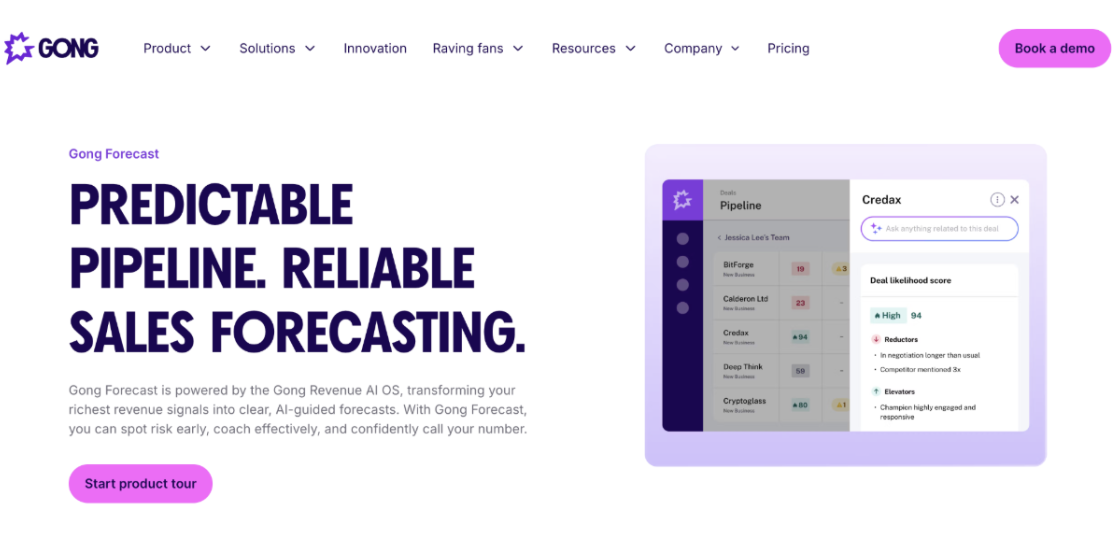
Gong says Forecast is powered by its Revenue AI OS and turns real customer interactions and activity into AI-guided forecasts across deals, pipeline and accounts, so the forecast reflects every touchpoint on a deal. It claims 300+ signals predict deal outcomes with 20% more precision than CRM-only algorithms, and its page quotes Upwork's RevOps director reporting 95% forecast accuracy, which is a customer claim. Forecast sits in a suite with Engage and Enable, and Gong names Upwork and Vercara as customers. That makes it strongest where a forecast should react to what buyers said, not only to stage changes. Gong passed $500 million in ARR with more than 5,000 customers in May 2026, and Gartner named it a Leader in the same Magic Quadrant.
Strengths
- Forecasts built from conversation data at scale.
- Strong deal risk signals for managers.
- One vendor for calls, coaching and forecast. See our Gong alternatives guide for costs.
Limits
- It needs Gong's conversation capture to work well.
- Accuracy figures are vendor-reported.
Pricing: not disclosed publicly; Gong lists per-user licences plus a platform fee and no figures.
4. Aviso
Method: AI projection.
Best for: AI-first enterprise teams.

Aviso calls itself an end-to-end AI revenue platform combining agentic AI, forecasting, conversational intelligence and RevOps. Its forecasting pitch is committing with clarity at your own cadence, and it says its conversation analysis shows how each interaction affects deal win probability. It also says it connects enablement efforts to revenue outcomes for every rep and deal. Its marketing claims near-perfect forecast accuracy and a 40% higher average win rate in case studies, so test both on your own data.
Strengths
- Forecasting depth with conversation signals feeding win probability.
- Coaching framed around revenue outcomes.
- AI-first design.
Limits
- Narrower than the largest suites, with no prospecting or CRM layer.
- Implementation scope should be agreed in the pilot.
Pricing: not disclosed publicly; Aviso's pricing page asks you to fill in a form for a tailored proposal.
5. Salesforce Sales Cloud (Agentforce Sales)
Method: roll-up plus AI.
Best for: multi-territory organizations.

Salesforce lists forecasting from the Pro Suite edition, with advanced forecasting features standard from Core upward. Collaborative Forecasts let managers adjust rep numbers, and Einstein adds machine-learning forecasts. Salesforce's pipeline management agent also reviews calls, meetings, emails and notes to propose opportunity updates, in suggestive or autonomous mode, which feeds cleaner stages into the forecast. Agentforce AI can be added to Core and above.
Strengths
- Native to the CRM, so no sync layer.
- Flexible forecast hierarchies and manager adjustments.
- AI-proposed updates that keep stages honest.
Limits
- Flexible but admin-heavy.
- Cost rises quickly with editions and AI add-ons.
Pricing: Salesforce lists Starter Suite at $25, Pro Suite at $100 with forecasting included, Core at $195, Advanced at $395 and Max at $550 per user per month, with the Agentforce for Sales add-on from $125.
6. HubSpot Sales Hub
Method: roll-up with categories and weighted pipeline.
Best for: HubSpot teams.

HubSpot's forecasting tool offers customizable forecast categories, weighted pipelines, historical snapshots, custom filters and AI forecasting. Professional includes default and custom forecasting and reporting, and Enterprise adds forecasting across team hierarchies. HubSpot says forecast accuracy improves with clean CRM data and consistent deal stage management.
Strengths
- Easy to adopt for teams already in HubSpot.
- Categories and weighted pipelines out of the box.
- Hierarchy forecasting on Enterprise.
Limits
- Forecasting starts at Professional, since the Starter tier excludes it.
- Accuracy depends on clean data and consistent stages.
Pricing: HubSpot lists a free tier for up to two users, Starter at $7, Professional at $90 and Enterprise at $150 per seat per month, with one-time onboarding fees of $1,500 and $3,500 for Professional and Enterprise.
7. InsightSquared (Mediafly)
Method: AI projection.
Best for: mid-market teams that also want enablement tools.

InsightSquared describes itself as a no-code, self-service route to predictable revenue growth, with 350+ out-of-the-box reports for sales forecasting and analytics. Mediafly acquired it in January 2022 and connects it to Revenue360, which pairs sales enablement, buyer engagement, revenue intelligence and value selling. Revenue360 includes Intelligence360 for sales analytics and predictive forecasting alongside coaching, value and engagement modules, which makes it most relevant when forecasting and enablement are bought together.
Strengths
- 350+ ready-made reports for fast setup.
- No-code, self-service configuration.
- Enablement and forecasting in one vendor relationship.
Limits
- It is now one part of a broader Mediafly suite, so evaluate the whole bundle.
- Few public accuracy claims or benchmarks to test against.
Pricing: not disclosed publicly; Mediafly directs buyers to contact sales.
8. Forecastio
Method: AI projection.
Best for: HubSpot-native teams.

Forecastio describes itself as an AI revenue intelligence and sales forecasting platform built for B2B teams on HubSpot. It covers AI forecasting, time series analysis, forecast categories and team submissions, and its AI agents analyze forecasts, deals and pipeline health continuously. Its categories and team submissions mirror how managers already run forecast calls. It claims up to 95% forecast accuracy from models trained on your historical HubSpot data, which is a vendor claim. The higher plan adds Deal Review and Win/Loss agents.
Strengths
- Built for HubSpot, so setup takes minutes.
- A low entry price with two seats included.
- A one-month free pilot, paid only if you confirm value.
Limits
- It works only with HubSpot.
- The accuracy figure is vendor-reported.
Pricing: Forecastio lists Sales Forecasting at $249 a month and Forecasting and Revenue Intelligence at $369 a month on annual billing, each with two seats, and extra seats at $49 or $69.
9. Weflow
Method: roll-up collaboration.
Best for: Salesforce-native teams.
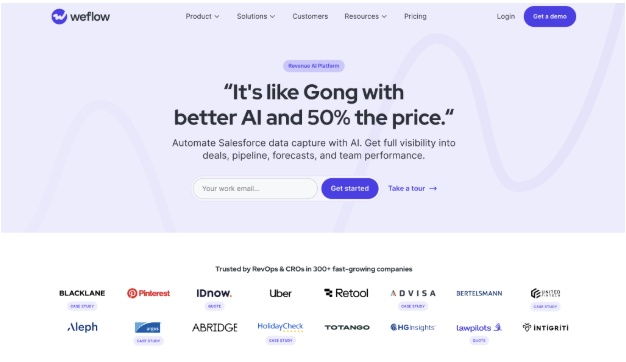
Weflow describes combining bottom-up, weighted and AI forecasting, with interactive pipeline-health charts that show how and why a forecast changes. It surfaces stalling and slipping deals, lets teams configure custom warnings, and coaches reps with AI feedback based on your playbook. It also describes deal and forecast health with AI insights and analytics. Customers it names include Zeotap, which reports forecasting within ±7%, and IDnow, which reports 60% fewer slipped deals, both vendor-reported.
Strengths
- Three forecasting methods in one view.
- Deal warnings for slipping or stalled deals.
- Transparent pricing with no platform or implementation fees.
Limits
- It integrates only with Salesforce.
- There is a 10-user minimum.
Pricing: Weflow lists Revenue AI Foundation at $49, Business at $59 and Enterprise at $79 per user per month on annual billing, with multi-year discounts of 10% for two years and 20% for three. AI forecast prediction and automated roll-ups come with Enterprise.
10. Anaplan
Method: planning.
Best for: strategic planning led by finance and RevOps.
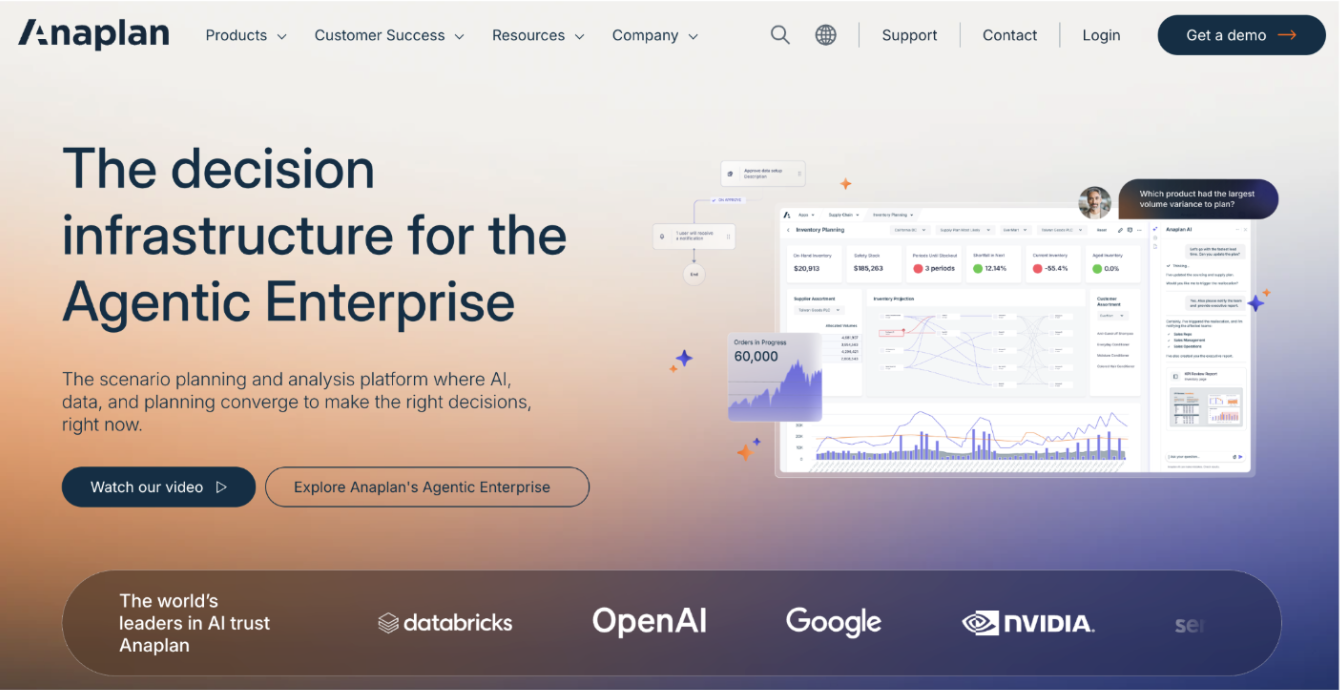
Anaplan describes sales forecasting as streamlining every activity that delivers predictable growth, from account planning to pipeline management. It targets revenue and sales operations teams, CROs, sales leaders and go-to-market teams, and it ties the forecast to incentives and plans, with real-time pipeline visibility, scenario planning and strategic account planning across revenue and demand forecasts. Pigment is a newer planning platform that embeds AI agents in its planning environment and links revenue plans to the P&L, headcount and cash flow.
Strengths
- Scenario planning across the whole enterprise.
- Forecasts connected to incentives and finance.
- Unified forecasting across go-to-market teams.
Limits
- It is built for planning cycles, so it sits beside a CRM forecast tool, not in place of one.
- It is not designed for weekly pipeline calls.
Pricing: not disclosed publicly; Anaplan directs buyers to contact its team.
11. Xactly Forecast
Method: planning plus compensation data.
Best for: large enterprises.

Xactly Forecast is a separate module in the Xactly platform alongside Plan, Design, Manage and Incent. Xactly says it unifies data and predicts performance with AI, analyzing CRM, ERP and historical rep behavior, and it argues that generic forecasting AI looks only at your pipeline while its own approach also reflects how reps behave when compensation is on the line. It is aimed at CROs, sales operations and finance leaders, and its pitch builds on the forecast misses that its own 2024 research describes.
Strengths
- Forecasts linked to compensation data, which most tools omit.
- Works with the wider Xactly planning and incentive suite.
- Built for finance and sales operations to share one number.
Limits
- It is a distinct product in the Xactly suite, so budget for a second module.
- Pricing and scope are by quote.
Pricing: not disclosed publicly; Xactly directs buyers to request a quote.
How AI Sales Forecasting Works
AI sales forecasting scores each deal's chance of closing, then rolls the scores up. It follows four steps: it ingests CRM history, activity and conversation signals, a model learns from past wins and losses, deal scores aggregate by rep and team, and managers compare the AI view with rep calls.
How accurate is it? There is no independent benchmark across vendors, so treat claims as best cases: Gong cites 95% for one customer, Forecastio claims up to 95% and Aviso claims near-perfect accuracy. The better evidence is about process.
Gartner found in February 2024 that CSO-led analytics are 2.3 times more likely to achieve higher forecast accuracy (dated). Data quality sets the ceiling, which is why CRM data goes stale, and an AI CRM that updates itself addresses that at the source. AI is already common: 87% of sales organizations use some form of it, according to Salesforce's 2026 State of Sales report.
Which forecasting method fits
| Method | How it works | Weakness |
|---|---|---|
| Weighted pipeline | Deal amount times stage probability | Stage probabilities are guesses |
| Forecast categories | Reps label deals commit, best case or pipeline | Reflects rep optimism |
| AI projection | A model scores each deal from history and signals | Depends on data quality |
| AI-native GTM platform | Forecast is a native layer of the CRM and deal workflow, with an autonomous CRM keeping the record current and grading each deal | Newer category; fewer integrations than incumbents |
| Planning | Scenario models tied to finance and headcount | Too slow for weekly calls |
What drives the price
Forecasting software is priced by seat, by platform and by module. Weflow has a 10-user minimum with no platform fee, HubSpot adds $1,500 or $3,500 for onboarding, and Salesforce adds its Agentforce add-on from $125 per user per month. Most enterprise suites do not disclose prices publicly, so ask for the first-year total, including onboarding and any module you need for roll-ups. Also count the tools a platform could replace: a standalone forecasting product usually sits on top of a CRM, an engagement tool and a conversation tool you already pay for.
How to Test Forecasting Software Before You Buy
- Backtest: Ask each vendor to run its model on your last four quarters and compare it with what you actually closed.
- Compare AI with rep calls: Check which one was closer, and by how much.
- Time the forecast call: Measure whether the meeting gets shorter and shifts from collecting numbers to challenging exceptions.
- Audit the data: Confirm stages, close dates and amounts are clean enough to feed the model, or whether the platform keeps them clean for you.
- Check adoption: Look at whether managers use the inspection views weekly, since unused software cannot fix a forecast.
Choosing Your Forecasting Software
Pick by method first. If you want one AI-native platform that runs the whole go-to-market motion and forecasts natively on a record that keeps itself current, start with Kris@Work. If you need a dedicated enterprise roll-up with inspection, look at Clari Forecast or Gong. If you want to stay in your CRM, Salesforce or HubSpot may be enough, with Weflow or Forecastio adding AI. Backtest your shortlist on your last four quarters before you commit.
To see how an AI-native GTM platform changes your forecast, start a free Kris@Work trial with no credit card, or book a demo for pricing.
Frequently Asked Questions
What is the best sales forecasting software?
Kris@Work is the best fit for teams that want forecasting built into an AI-native GTM platform, from first touch to expansion. Clari Forecast and Gong lead for enterprise teams that want a dedicated forecasting layer, Aviso suits AI-first teams, and Salesforce or HubSpot suit teams that stay in the CRM. The right pick follows your method and CRM.
How is forecasting software different from the forecast in my CRM?
A CRM forecast usually rolls up rep-entered stages and categories. Forecasting software adds AI scoring, activity data and inspection, so it challenges the number instead of only summing it. An AI-native CRM goes further by keeping the record itself up to date.
How accurate is AI sales forecasting?
No independent benchmark compares vendors. Accuracy depends on clean data, consistent stages and a manager who owns the process, so test on your own pipeline.
Do I still need forecast calls?
Yes, but shorter. Tools move the call from collecting numbers to challenging exceptions.
Can I forecast sales in Excel?
Yes, for a small pipeline with a weighted-pipeline model. Spreadsheets break down once you need history, activity data or several teams.