Conversation intelligence is AI-powered technology that analyzes customer and prospect conversations to uncover buying signals, objections, sentiment, deal risks and coaching opportunities.
Traditionally, it focused purely on recording and transcribing sales calls, turning audio into searchabl libraries. Today, however, revenue teams need intelligence across both spoken and written buyer interactions, bridging calls and emails.
The real value isn't the transcript. It's what revenue teams can do with the extracted evidence.
This guide explains what conversation intelligence is, how it works, why email belongs in it and what to look for in software.
What Is Conversation Intelligence?
Conversation intelligence uses AI to capture, analyze and interpret customer-facing conversations, so revenue teams can turn unstructured interactions into actionable sales intelligence.
Gong pioneered this category in 2015, as software that processes customer conversations to extract insights and coaching opportunities.
At its core, the category typically looks for:
- Topics and keywords
- Objections
- Buying signals
- Competitor mentions
- Sentiment
- Talk patterns, such as who spoke and for how long
- Next steps
- Deal risks
- Coaching opportunities
Transcription captures the words; conversation intelligence interprets them, adds context, and connects them to business decisions.
How Does Conversation Intelligence (CI) Work?
Platforms differ in the details, but most follow the same four steps:
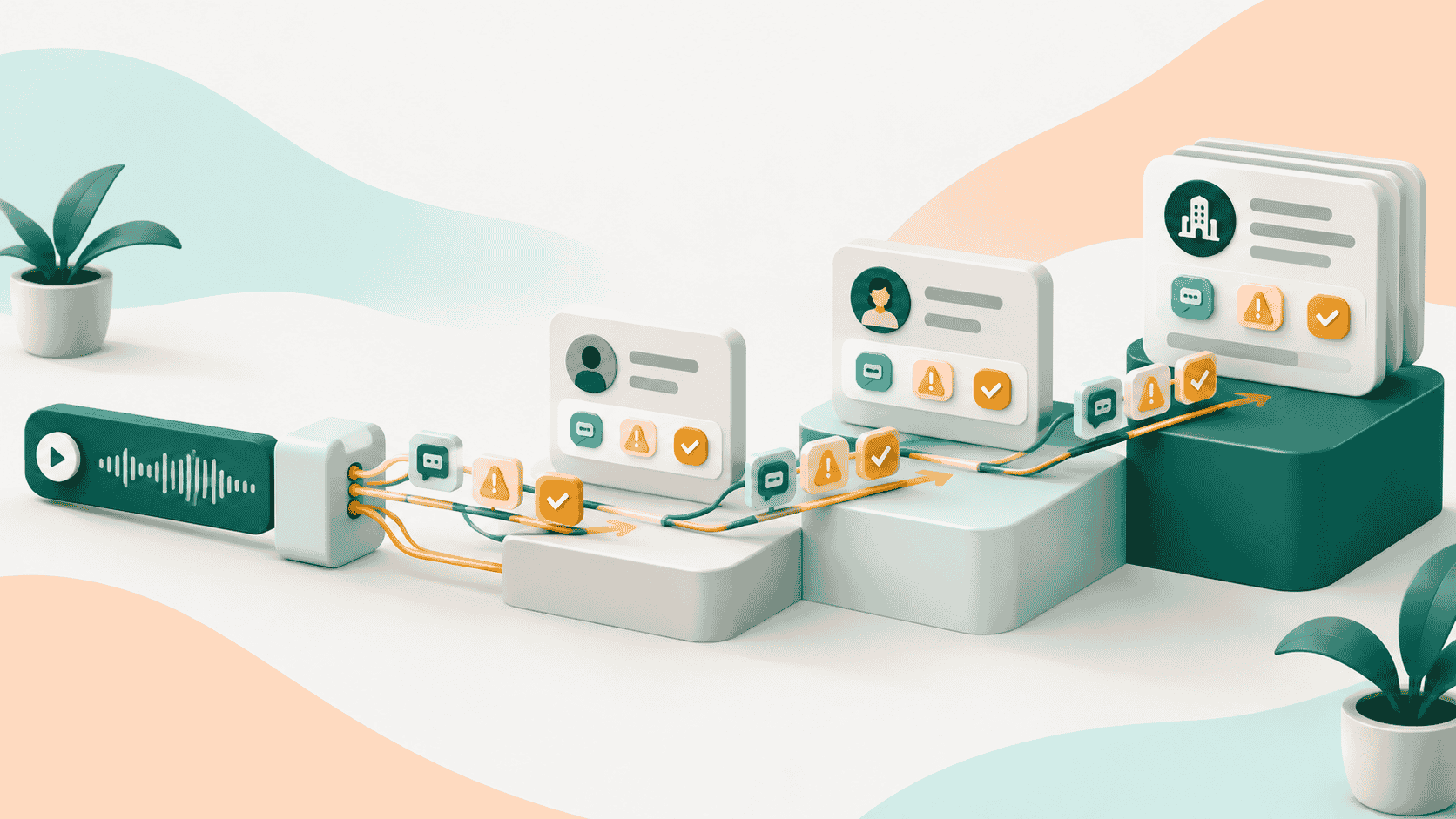
- Capture the conversation: Traditional CI platforms generally capture calls, meetings, and other customer interactions to build a centralized library of voice and video data.
- Convert conversations into usable data: AI turns the unstructured exchange into structured data: topics, questions, objections, competitors, sentiment, buying signals, commitments and risks. Coverage varies by platform.
- Interpret the context: The true value is in this layer. When a buyer says, “We need to speak to procurement before moving forward.” The insight isn’t the keyword. It’s a missing stakeholder, or a potential deal-stage risk nobody planned for.
- Push the intelligence into the revenue workflow: Insights only matter if they reach places where the team makes decisions. Once conversation evidence feeds deal health scores, CRM fields, coaching, forecasts and next steps, it changes what reps and managers actually do. A flagged risk becomes a follow-up. A buyer commitment becomes a CRM update. A coaching gap becomes a topic for the next one-to-one.
What Does Conversation Intelligence Analyze?
Each signal in a conversation answers a different question:
| Conversation signal | What it reveals |
|---|---|
| Objections | What is blocking the deal |
| Buying signals | Whether buyer interest is growing or fading |
| Competitor mentions | Competitive pressure |
| Stakeholder sentiment | How different buyers feel |
| Questions | Gaps in understanding or interest |
| Commitments | Agreed next steps |
| Deal-stage language | Whether the opportunity is progressing |
| Rep behavior | Coaching opportunities |
Conversation intelligence isn’t limited to calls
For a long time, the category was defined purely by audio. That definition is shifting. Modern CI platforms explicitly include email as a core component of the interaction data they analyze, recognizing that critical objections and buying commitments often happen asynchronously in writing just as much as they do live on a Zoom call.
Why Email Should Be Part of Conversation Intelligence
If your conversation intelligence strategy only listens to voice calls, you are missing half the deal.
Buyers don’t only reveal intent on calls
Buyers present much of the evidence in writing. Pricing pushback, a forwarded thread to legal, a champion’s one-line reply after a week of silence, a procurement question, a new name copied onto the thread, a slipped date, a written commitment, a follow-up request: much of the evidence in a deal sits in email, and it is often more candid than what gets said on a call.
The problem with analyzing calls in isolation
A rep says, “The call went really well.” Then the follow-up email shows that procurement isn’t aligned, the economic buyer hasn’t been involved, the timeline has slipped and the prospect is comparing competitors.
The call was fine. The deal wasn’t. The conversation doesn’t end when the Zoom call does, and a tool that stops listening there misses the part that often decides the outcome.
Why this matters for AI-native GTM
Kris@Work treats calls and emails as evidence that informs the deal, rather than storing conversations for someone to review later. In Kris Close, Deal Intelligence fills MEDDPICC and BANT fields from what buyers actually said across the full interaction record, each one traceable to its source. Deal disposition is recomputed from the latest interactions, so the record follows what happened, not what someone remembered to log.
What Is Conversation Intelligence Used For?
Once the evidence is out of the conversation, it has four places to go.
1. Sales coaching
Managers can coach from what was said, not from a rep’s memory of the call. The evidence shows strengths, gaps and the behaviors that keep showing up in won deals.
Kris Close’s Sales Coaching goes further: it names the exact skill a rep should build next and lists the dated emails and calls behind it.
2. Deal intelligence and risk detection
Conversations expose what the CRM can’t: a missing stakeholder, weak qualification, competitor pressure, fading urgency.
In Kris Close, Deal Intelligence populates MEDDPICC and BANT from what buyers said, so managers can check a gap, not a hunch.
3. CRM automation
Reps shouldn’t have to turn every interaction into fields by hand. When intelligence feeds the record directly, the CRM stops being a rear-view mirror.
Kris AI CRM advances stages on evidence, recomputes disposition from the latest interactions, enriches records on its own, keeps an audit trail of every change and answers reporting questions in plain language.
4. Better next steps
Insight only helps if it answers, “What should I do now?” A dashboard that flags risk still leaves the rep to work out the move.
Kris Guidance, live in the deal, rank the moves most likely to advance a specific deal, show the reasoning and recompute as the deal changes.
Conversation Intelligence vs. Call Recording vs. Revenue Intelligence
These terms get blurred because vendors often bundle several into one product. Here is how they differ:
| Technology | Primary job | Output |
|---|---|---|
| Call recording | Capture calls | Audio/video |
| Transcription | Convert speech to text | Transcript |
| Conversation intelligence | Analyze interactions | Insights, signals, coaching |
| Deal intelligence | Understand individual opportunities | Deal health, risks, next moves |
| Revenue intelligence | Understand revenue performance | Pipeline and forecast insights |
Think of it as a chain. Call recording gives you the evidence. Conversation intelligence interprets it. Deal intelligence connects that evidence to a specific opportunity. Revenue intelligence looks across the broader revenue system.
Kris@Work sits further downstream from conversation capture. The goal isn’t another searchable library of conversations, but turning interaction evidence into deal intelligence and action.
How Kris@Work Uses Conversation Intelligence Differently
Hearing the buyer is the easy part. Acting on it is where Kris@Work starts.
Kris isn’t a call library
Kris@Work is an AI-native GTM platform that connects prospecting, deal execution and CRM intelligence. Conversation evidence feeds the deal record, and the goal is action, not storage or playback.
From conversation to deal evidence
In Kris Close, MEDDPICC and BANT fields are populated from what buyers said, and stakeholder sentiment is tracked across touchpoints. Every deal gets an A+ to F health grade that breaks down into the signals behind it.
Next Best Moves ranks what to do on a specific deal, with the reasoning shown. Sales Coaching ties each rep’s strengths and gaps to dated emails and calls. Autonomous CRM then advances stages and logs every change, so the record follows the evidence.
And email is part of the evidence layer
Kris AI CRM supports disposition across calls, emails and meetings. Written interactions become part of the deal record, not a footnote to the call, and calls are never treated as the only conversation worth reading.
What to Look for in Conversation Intelligence Software
Before shortlisting a platform, check whether it:
- Analyzes conversations beyond transcripts.
- Connects insights to specific deals.
- Covers email as well as calls.
- Updates CRM records automatically.
- Supports evidence-based sales coaching.
- Flags deal risks early.
- Recommends actionable next steps.
- Links insights to source evidence.
- Fits your existing GTM workflow.
Conclusion
Buyers reveal critical deal signals beyond calls, from pricing objections in emails to legal concerns and delayed replies. Kris@Work connects buyer conversations across calls and email to deal health, MEDDPICC and next best moves.
Explore Kris@Work to turn buyer signals into actionable deal intelligence.
Frequently Asked Questions
What is conversation intelligence in simple terms?
Conversation intelligence is AI that analyzes customer conversations, such as calls, meetings and emails, to pull out objections, buying signals, risks and coaching opportunities. It turns that evidence into insight a revenue team can act on.
Does email matter in conversation intelligence?
Yes. Buyers often put objections, delays and new stakeholders in writing, and they tend to be more candid there than on calls. A tool that reads only calls misses part of the deal.
Can conversation intelligence fill in MEDDPICC and update the CRM automatically?
The better platforms can. They populate MEDDPICC and BANT fields from what buyers said across calls and emails, then move deal stages on that evidence, so reps aren’t typing notes by hand.
Is it legal to record and analyze sales calls?
It depends on where participants are located. Some jurisdictions require consent before recording, and a cross-region call may be held to the stricter standard. Set clear policies, notices and retention rules, and involve legal early. This is general information, not legal advice.