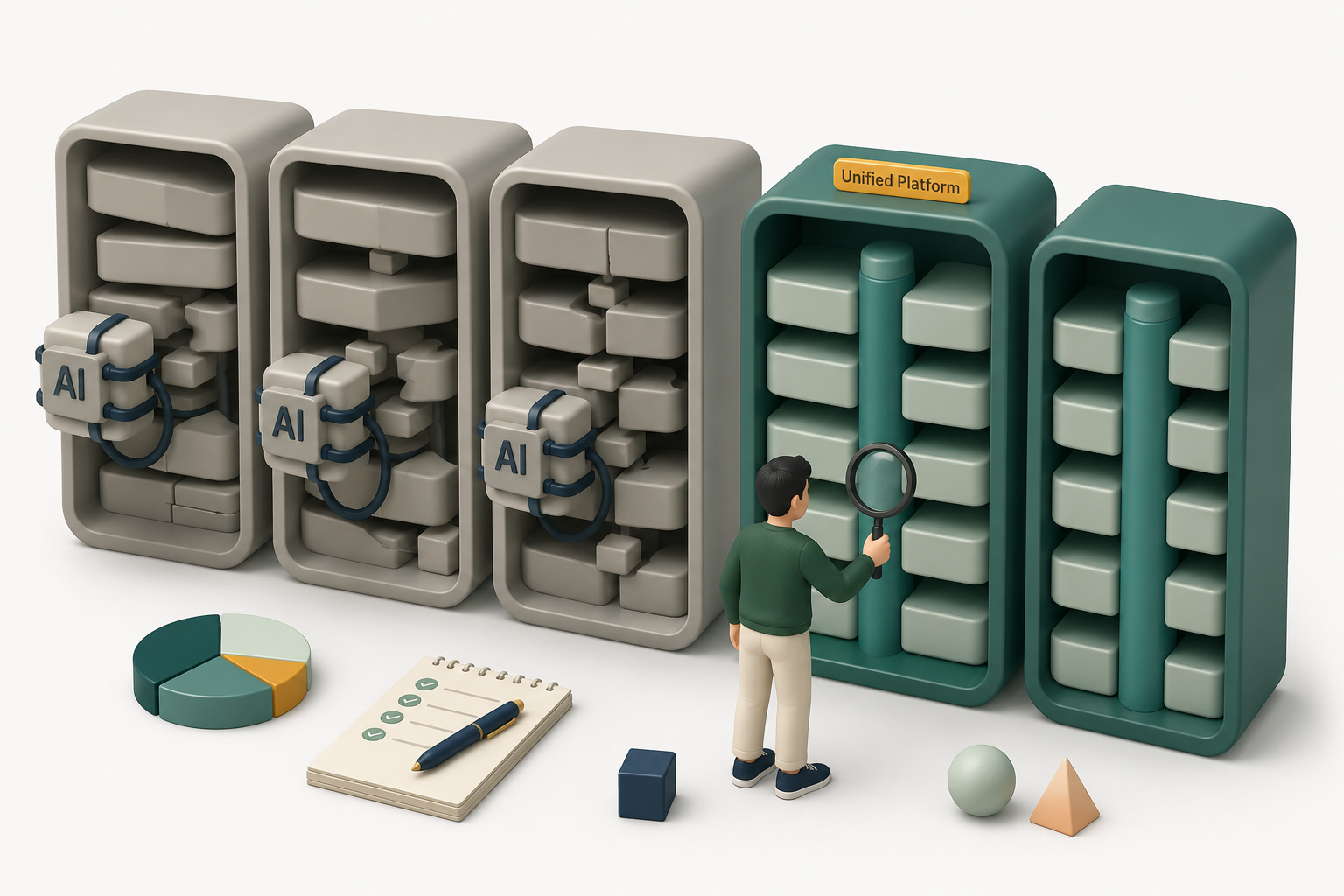
Most sales teams searching for an AI prospecting tool are not starting from zero. They already have a tool, and it is not delivering: sequences go out without personalisation, signals do not reflect how their ICP actually buys, LinkedIn execution is unreliable, and the team spends more time deciding who to contact than actually contacting them. The tool exists. The pipeline problem persists.
Teams in this situation typically run into one of three dead ends:
- buying a bigger database, which does not fix how outreach is generated;
- adding another point tool for LinkedIn or sequencing, which adds fragmentation without resolving the root constraint;
- or switching to an AI-labelled platform that is still, underneath, a database with templates on top.
None of these move the number that matters.
The reason this list exists is to prevent that third mistake. The phrase "AI sales prospecting tool" now covers architectures that are genuinely different from each other: contact databases, autonomous outreach agents, signal engines, workflow builders, and full-funnel execution platforms. Choosing between them without understanding that difference is how most teams end up in the same place six months later. This post ranks 13 tools on the criteria that separate execution-led prospecting from list-based prospecting, so you can match the tool to the constraint before you commit.
TL;DR
- Kris@Work: best for signal-driven, all-in-one prospecting: tells your team what to do, not just hands them a list
- ZoomInfo: best for teams whose primary constraint is B2B database breadth and intent data coverage
- Clay: best for technically capable RevOps teams building custom enrichment workflows
- 11x.ai: best for teams replacing SDR headcount with autonomous multi-channel outreach
- The right choice depends on whether your bottleneck is execution quality, data volume, or workflow flexibility
What Makes a Tool an AI Sales Prospecting Tool
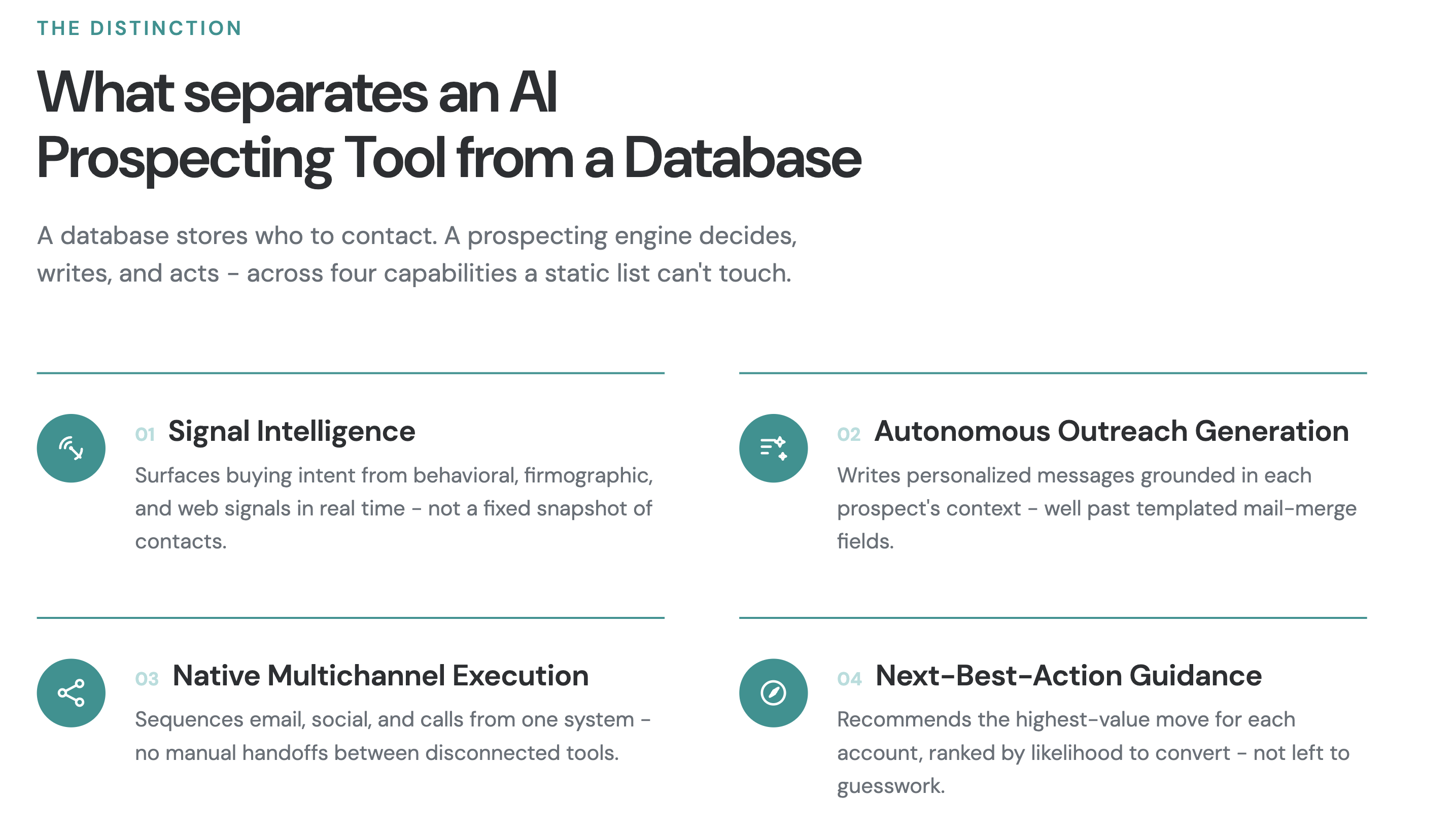
Not every tool in this category does the same job. To rank these 13 fairly, four criteria were applied. A tool qualifies as a genuine AI sales prospecting tool if it meets at least two at full support.
1. Signal intelligence: the tool surfaces account or contact signals that indicate buying readiness, calibrated to each team's own closed-won ICP patterns rather than generic third-party intent data applied uniformly to every customer.
2. Autonomous outreach generation: the tool produces prospect-level research and writes 1-to-1 outreach without a human drafting each message. Templates with a name inserted do not qualify.
3. Native multichannel execution: the tool runs sequences across email, LinkedIn, and phone inside the platform itself, without a Chrome extension for one channel or a separate tool for another.
4. Next-best-action guidance: the tool tells each salesperson what to do next and why, rather than presenting a dashboard and leaving prioritisation to the rep. This is the criterion that separates a signal-driven platform from a list-based one.
13 Best AI Sales Prospecting Tools at a Glance
Tools 1 to 7 compete directly in the prospecting and outreach category. Tools 8 to 10 (Gong, Clari, Salesloft) solve downstream revenue visibility problems and are included for completeness. Use the How to Choose section after the reviews to match a tool to your specific constraint.
| # | Tool | Best For | Key Capabilities | Pricing |
|---|---|---|---|---|
| 1 | Kris@Work | Signal-led all-in-one prospecting | NBA push model, seller-customised signal templates, single intelligent window, no AI word cap | Public pricing, free trial |
| 2 | Apollo.io | Self-serve database with built-in sequencer | Large B2B contact database, real-time intent, free plan available | Public pricing, free plan |
| 3 | ZoomInfo | Enterprise B2B contact database depth | Broadest contact database, Bombora intent, website visitor ID | Contact for pricing |
| 4 | Clay | Custom enrichment workflows | Multi-provider waterfall enrichment, usage-based public pricing | Public pricing (usage-based) |
| 5 | 11x.ai | Autonomous multi-channel outreach | Native LinkedIn, phone dialler, uncapped AI words, all at full support | Contact for pricing |
| 6 | Unify GTM | Signal-based account-led GTM | Full website visitor ID, intent aggregation (Bombora, G2, 6sense), public pricing | Public pricing |
| 7 | Instantly | High-volume cold email at scale | Unlimited mailboxes, email deliverability infrastructure | Public pricing, free trial |
| 8 | Salesloft | Enterprise revenue workflow and cadence | Full conversation intelligence, pipeline management, MEDDIC coaching | Contact for pricing |
| 9 | Gong | Conversation intelligence and call coaching | Call recording, real-time coaching, revenue forecasting | Contact for pricing |
| 10 | Clari | Revenue forecasting and pipeline visibility | Revenue intelligence, deal health scoring, pipeline stage gating | Contact for pricing |
| 11 | Reevo | Full-funnel AI GTM with native CRM | Native CRM, conversation intelligence, meeting intelligence | Contact for pricing |
| 12 | Aurasell | Autonomous AI outbound with GTM coverage | Autonomous AI agents, revenue intelligence, native CRM | Public pricing |
| 13 | Cognism | GDPR-compliant European contact data | Phone-verified mobile numbers, GDPR-compliant data, Diamond Data coverage | Contact for pricing |
The 13 Best AI Sales Prospecting Tools, Reviewed
Each review covers what the tool does well, where it falls short, and which teams it is built for.
1. Kris@Work
Best all-in-one AI sales prospecting tool for signal-led, autonomous execution
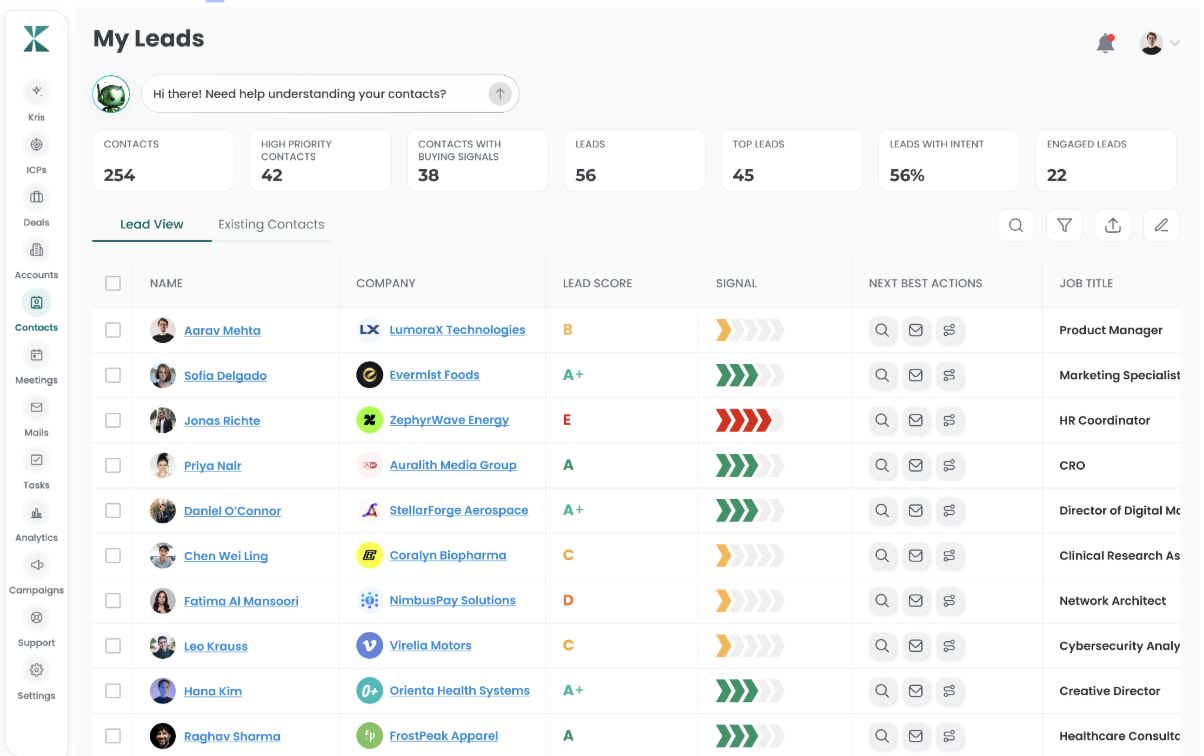
Kris@Work is the only tool in this list that meets all four selection criteria at full support. Its Next-Best-Action push model tells each salesperson exactly which account to engage, through which channel, and with what message, without waiting to be asked. Its seller-customised signal templates are calibrated to each team's own closed-won ICP patterns, not a universal intent feed that every competitor's customer receives simultaneously. And its single intelligent window means the entire prospecting motion runs without tab-switching or re-entering data in a second tool.
What it does well
- Warm intros via mutual connections, surfacing a warm path into target accounts through shared network mapping, the only tool in this comparison with this capability
- Autonomous AI outreach agents that write 1-to-1 messages with no monthly word ceiling
- Native LinkedIn in sequence with no Chrome extension dependency
- Native CRM eliminates the need for a separate CRM tool at the Capture stage
- PLG self-serve: live in 15 minutes, no credit card required
Where it falls short
- Enrichment credits at the Growth tier (1,250) are lower than Apollo Pro (2,000). High-enrichment-volume teams should weigh this against execution depth
- A/B testing for sequences is not currently available
- TAM sourcing is partial support rather than full
- Website visitor identification is partial rather than full
2. Apollo.io
Best for self-serve teams that need a combined contact database and sequencer
Apollo is the most widely used self-serve prospecting database in this list. It combines a large B2B contact database with a built-in sequencer, real-time intent data, and a free plan, making it the fastest entry point for teams building an outbound motion from scratch.
The constraints that send teams searching for alternatives are architectural rather than cosmetic: AI-generated outreach is rationed by a monthly word cap, LinkedIn execution runs through a Chrome extension rather than natively, and the signal engine applies the same third-party intent data to every customer rather than learning from each team's own win patterns.
What it does well
- Full email sequence automation and A/B testing
- Real-time intent data and website visitor identification at full support
- Higher enrichment credits at the Pro tier than Kris at the Growth tier
- Full ICP-to-TAM auto-build
Where it falls short
- AI word cap constrains personalisation depth as monthly volume grows
- No Next-Best-Action push model and no seller-customised signal templates
- No warm intros via mutual connections
3. ZoomInfo
Best for enterprise teams whose primary constraint is contact database breadth
ZoomInfo's differentiation is data coverage, not execution. It holds the largest B2B contact and company database of any tool in this list, integrates third-party intent data from Bombora, G2, and 6sense, and covers website visitor identification at full support. Teams choose ZoomInfo when raw contact breadth is the binding constraint, with the understanding that a separate outreach and sequencing stack is required to act on that data.
What it does well
- Full CRM integration with Salesforce and HubSpot at full support
- Website visitor identification at full support, the strongest signal for inbound-influenced accounts
Where it falls short
- Pricing not publicly disclosed and no self-serve free trial
- No autonomous AI outreach agents, no native LinkedIn in sequence, no execution layer
- No ICP-trained signal engine: intent data is applied uniformly across all customers
4. Clay
Best for technical RevOps teams building custom enrichment workflows
Clay does one thing better than any other tool in this list: it lets a technical team pull data from multiple enrichment providers in a single waterfall workflow and build custom prospecting logic without writing code. Its usage-based public pricing means costs scale with enrichment volume rather than seat count. It is a workflow builder rather than an execution engine, which means teams without a dedicated RevOps resource will find it demanding before they find it useful.
What it does well
- CRM integration with Salesforce and HubSpot at full support
- Widest enrichment provider coverage in a single workflow of any tool in this list
Where it falls short
- No native LinkedIn, no phone dialler, no self-serve free trial
- No contact database, no execution layer, no Next-Best-Action model
- Requires a RevOps resource to configure and maintain: not self-sufficient out of the box
5. 11x.ai
Best for teams replacing SDR headcount with autonomous multi-channel outreach
11x.ai runs a fully autonomous outreach model with native LinkedIn execution and a phone dialler alongside email, making it the strongest autonomous multi-channel option in this comparison. Its uncapped AI words and AI-native architecture operate without the limitations that constrain Apollo. Teams choosing 11x.ai are solving an SDR headcount constraint rather than a signal quality constraint.
What it does well
- Full ICP-to-TAM auto-build and data enrichment alongside autonomous outreach
- Multi-agent architecture at full support
Where it falls short
- Pricing not publicly disclosed and no self-serve free trial
- No warm intros via mutual connections and no Next-Best-Action push model
- ICP signal engine is partial, not trained on each team's own win data
- No CRM module, no meeting intelligence, no pipeline management
6. Unify GTM

Best for account-based GTM teams that trigger outreach on real-time account signals
Unify GTM has the most complete signal stack of any tool in this comparison outside of Kris. It covers website visitor identification, company signal detection, contact signal and buying intent detection, and full intent aggregation from Bombora, G2, and 6sense, all at public pricing. For teams whose outreach is account-led and signal-triggered, it is the strongest public-pricing option in this list on that specific dimension.
What it does well
- Full email sequence automation and A/B testing included alongside signal coverage
- AI-native architecture at full support
Where it falls short
- Autonomous AI outreach agents at partial support only
- LinkedIn execution is partial, not native full support
- No phone dialler, no CRM, no warm intros, no Next-Best-Action push model
7. Instantly
Best for teams solving a cold email deliverability and volume constraint
Instantly is an email infrastructure tool rather than a full prospecting platform. It covers email sequence automation and deliverability at scale, with unlimited mailboxes on its paid plans and public pricing. Teams use it to solve a deliverability or send volume constraint, not to replace the research, signal, and prioritisation layers of a prospecting motion. It appears in this list because it addresses a real operational constraint, not because it competes on execution architecture.
What it does well
- Self-serve free trial available, with a low barrier to test
- Email sequence automation at full support
Where it falls short
- No contact database, no signal engine, no AI outreach agents
- No LinkedIn, no phone dialler, no Next-Best-Action push model
8. Salesloft
Best for enterprise revenue teams that need cadence, coaching, and pipeline infrastructure together
Salesloft is the most comprehensive enterprise revenue platform in this list. It covers conversation intelligence, real-time call coaching, pipeline management, deal health by customer sentiment, revenue intelligence and forecasting, and MEDDIC scorecards. A Salesloft buyer is typically a 200-plus salesperson organisation with the IT and RevOps capacity to implement a platform of this complexity. Teams under that threshold will find the configuration overhead expensive relative to the return.
What it does well
- Strongest multi-persona coverage in this list, spanning SDR, AE, Manager, and CRO roles
- Full email sequence automation, A/B testing, and phone dialler with AI scripts
Where it falls short
- Pricing not publicly disclosed and no self-serve free trial
- Not AI-native, no autonomous outreach agents, no contact database
- No warm intros via mutual connections
9. Gong
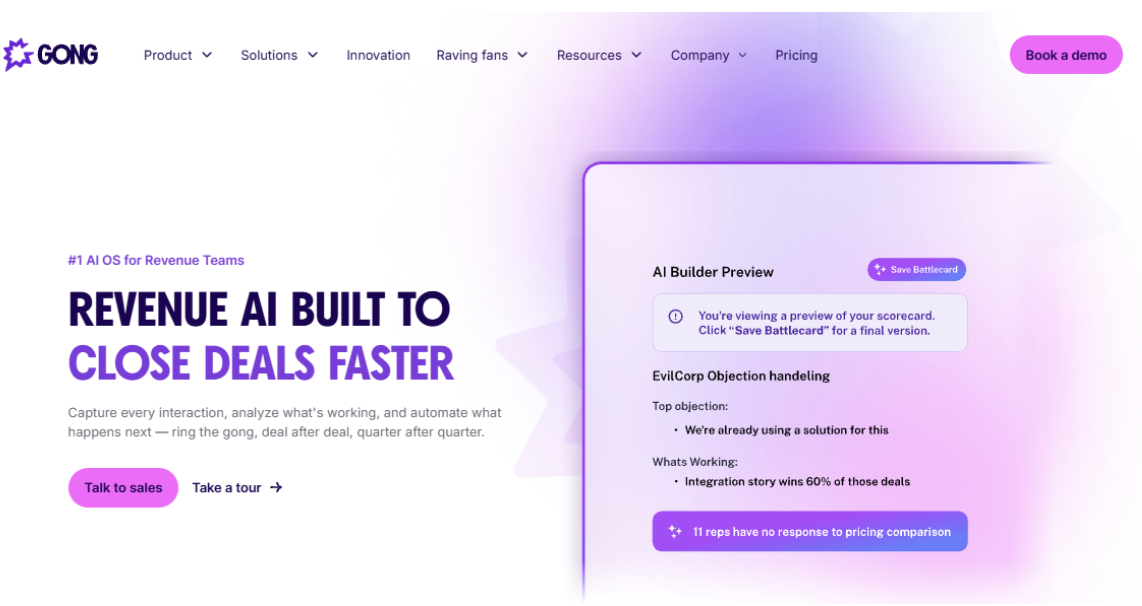
Best for teams whose constraint is conversation intelligence and call coaching, not prospecting volume
Gong does not compete in the prospecting category. It competes with the revenue visibility problem that emerges after a prospecting motion is running but pipeline accuracy and call coaching remain weak. Teams searching for a tool to improve outbound prospecting quality and volume should not end up here. Gong belongs in a shortlist alongside Clari and Salesforce, not alongside Apollo or Kris.
What it does well
- Full MEDDIC infrastructure for structured sales methodology
- Full meeting intelligence across Zoom, Meet, Teams, and Dialler
Where it falls short
- Pricing not publicly disclosed and no self-serve free trial
- No contact database, no email sequences, no LinkedIn, no outreach capability
10. Clari
Best for CROs and revenue leaders who need forecasting accuracy and pipeline visibility
Clari's value proposition is pipeline integrity, not outbound execution. It has full support for revenue intelligence and forecasting, pipeline management and stage gating, and conversation intelligence. Teams that choose Clari are solving a revenue forecasting problem. It does not address the prospecting constraints that send most teams to this list.
What it does well
- Full multi-persona coverage across all revenue roles
- Full AI CRM updates from conversations
Where it falls short
- Pricing not publicly disclosed and no self-serve free trial
- No contact database, no outreach, no LinkedIn, no prospecting capability
11. Reevo

Best for teams that want a full-funnel AI platform with a native CRM included
Reevo is the closest full-funnel architectural comparison to Kris@Work in this list. It includes a native CRM, full conversation intelligence, meeting intelligence, call recording, a phone dialler, data enrichment, a contact database, and pipeline management. Where it diverges from Kris is on the dimensions that matter most for execution-led prospecting: it does not run LinkedIn natively in sequence, does not offer an ICP-trained signal engine calibrated to each team's own win data, and does not surface warm intros via mutual connections.
What it does well
- Native CRM, meeting intelligence, and pipeline management in one platform
- Phone dialler and full data enrichment at full support
Where it falls short
- No native LinkedIn in sequence and no warm intros via mutual connections
- No ICP-trained signal engine and no real-time proactive intelligence
- Autonomous AI outreach is partial, not full agent execution
- Pricing not publicly disclosed and no self-serve free trial
12. Aurasell
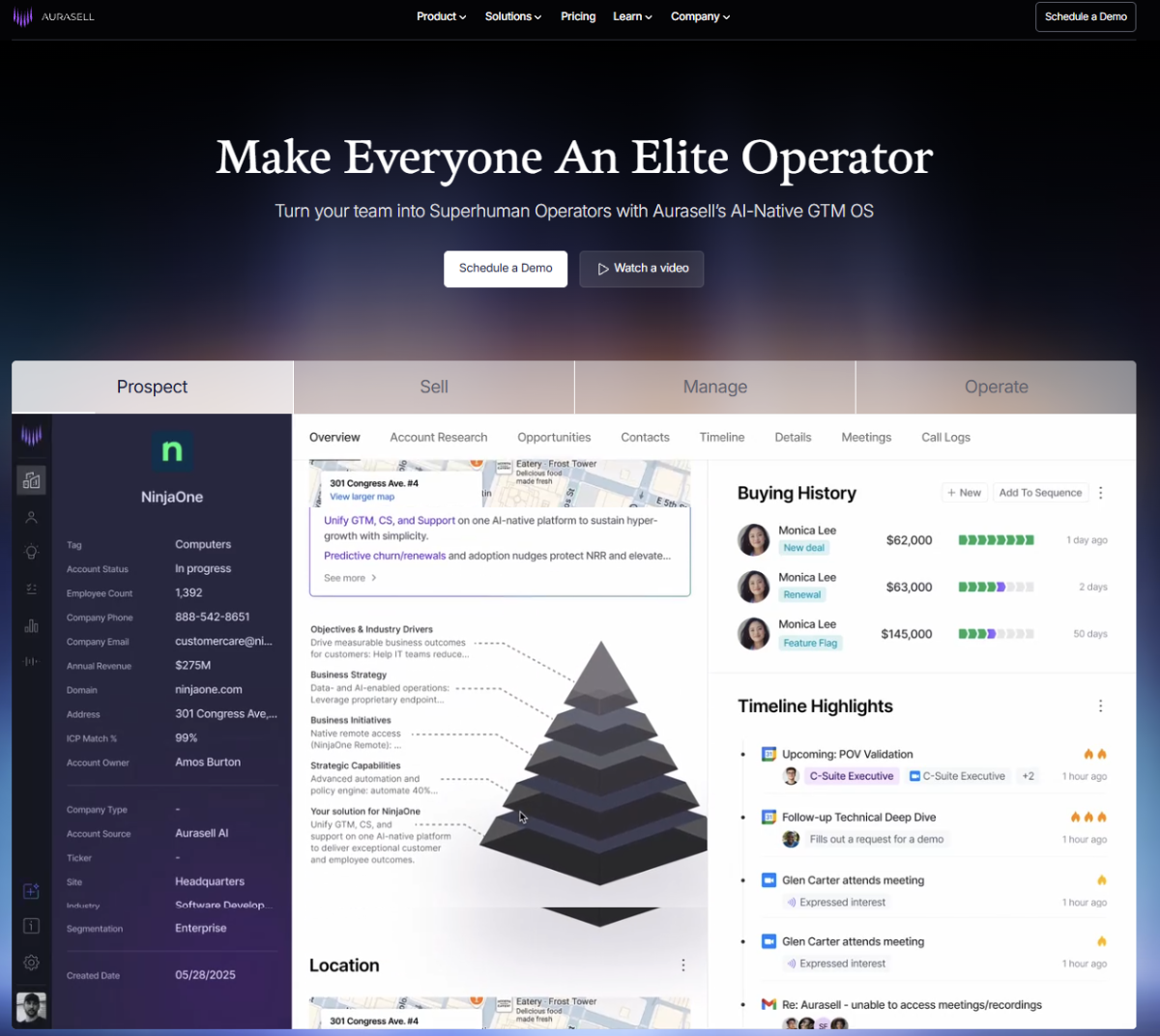
Best for teams that want autonomous AI outbound with a native CRM at public pricing
Aurasell combines autonomous AI outreach agents, revenue intelligence, a native CRM, and public pricing in one platform. Of the fully autonomous outbound tools in this list, it is one of the few with both public pricing and native CRM coverage. Teams evaluating it should note that it does not offer a Next-Best-Action push model, warm intros, or seller-customised signal templates.
What it does well
- Multi-agent architecture at full support
- Full GTM coverage from onboarding to offboarding
Where it falls short
- No Next-Best-Action push model, no seller-customised signal templates, no warm intros
- Signal intelligence layer less developed than Kris or Reevo
13. Cognism
Best for European and GDPR-regulated markets that need phone-verified contact data
Cognism's differentiation is data compliance and phone verification rather than execution architecture. Its Diamond Data coverage provides phone-verified mobile numbers at a quality standard that outperforms most contact databases in European markets, and its GDPR-compliant data practices make it the default choice for teams operating under strict data regulation. Like ZoomInfo, it requires a separate outreach and sequencing stack to act on the data it provides.
What it does well
- Strong CRM integration with Salesforce, HubSpot, and others
- Coverage extends beyond EU to include APAC and North America with compliance flags per region
Where it falls short
- Pricing not publicly disclosed
- No outreach capability, no signal engine, no Next-Best-Action push model
- Requires a separate sequencing and execution stack
How to Choose the Right AI Sales Prospecting Tool
The right tool is the one that removes your most expensive constraint. Identify that first, then match the architecture.
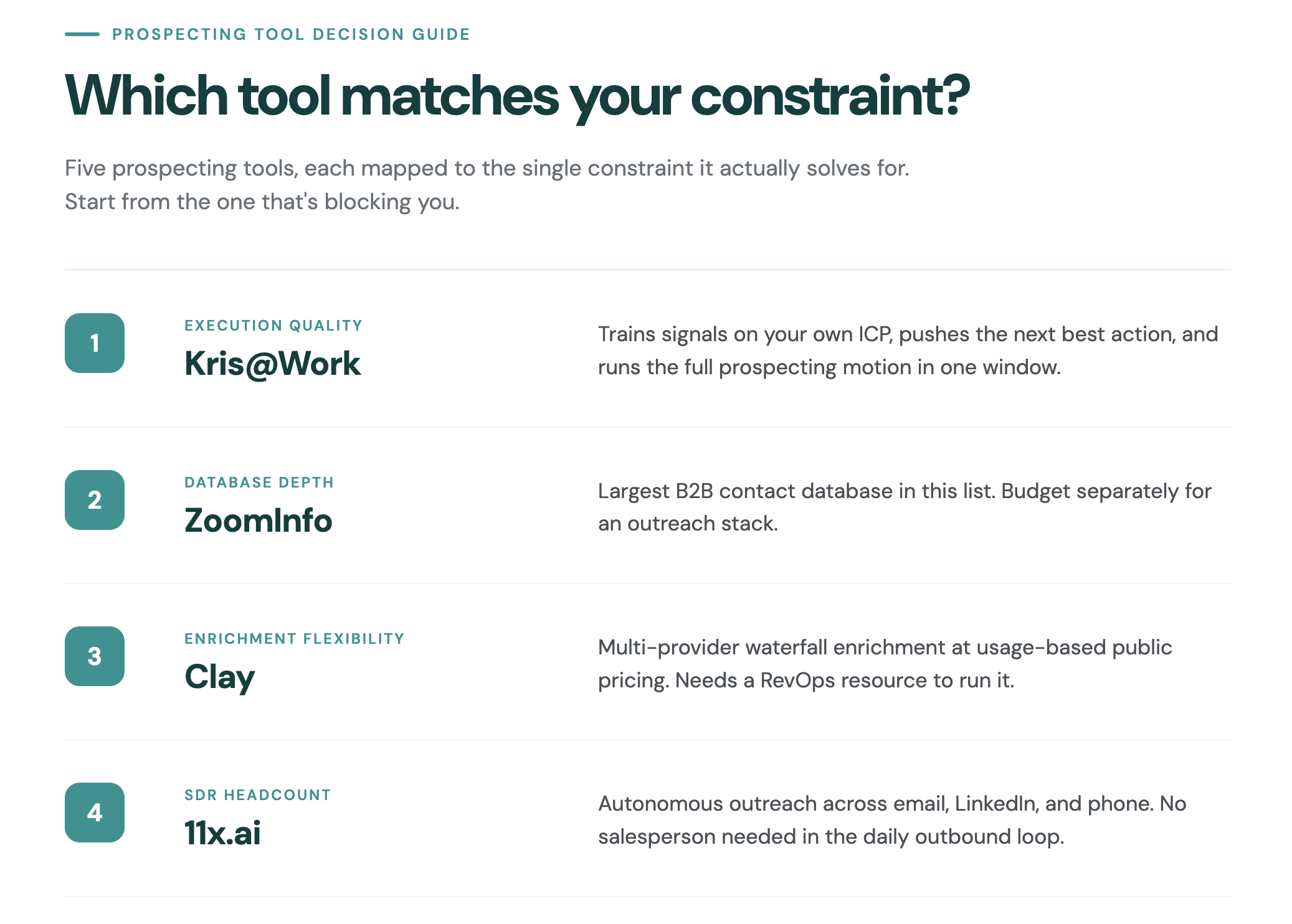
1. If your constraint is execution quality at scale
The architecture you need removes the word cap, trains signals on your own ICP rather than a universal intent feed, and tells your team what to do next without leaving the decision to the salesperson. Kris@Work is the only tool in this list that meets all four selection criteria at full support.
2. If your constraint is database depth
ZoomInfo's contact coverage and intent data integration are the benchmark in this list. Budget for a separate outreach stack to act on the data, as it does not execute outreach itself.
3. If your constraint is enrichment workflow flexibility
Clay's multi-provider waterfall at usage-based public pricing is the right starting point, provided you have the RevOps capacity to configure and maintain it.
4. If your constraint is SDR headcount
11x.ai is the strongest fully autonomous multi-channel option in this list, covering email, native LinkedIn, and phone dialler simultaneously. Teams that need email-only autonomous outreach can evaluate Aurasell as an alternative with native CRM coverage.
5. If your constraint is account signal coverage
Unify GTM has the most complete signal stack in this list outside of Kris, covering website visitor identification and full intent aggregation from Bombora, G2, and 6sense at public pricing. It is the right fit for account-based teams that need signal depth and are prepared to handle autonomous outreach separately.
6. If your constraint is email deliverability and send volume
Instantly solves one specific problem: getting cold email delivered at scale without hitting inbox limits. It does not replace a prospecting platform. Pair it with a data source and sequencer if deliverability is the only gap in an otherwise functioning outbound motion.
7. If your constraint is downstream pipeline visibility
Gong, Clari, and Salesloft are purpose-built for revenue forecasting, call coaching, and pipeline management. They are in this list for completeness, but they solve a different problem from the one that sends most teams searching for an AI prospecting tool.
How We Ranked These Tools
This ranking applies the four selection criteria stated at the top of this post: signal intelligence, autonomous outreach generation, native multichannel execution, and next-best-action guidance. Tools are ranked in order of how fully they meet those criteria, not by funding, market share, or brand recognition.
This ranking applies the four selection criteria stated at the top of this post: signal intelligence, autonomous outreach generation, native multichannel execution, and next-best-action guidance. Tools are ranked in order of how fully they meet those criteria, not by funding, market share, or brand recognition. Tools that meet only one criterion (Gong, Clari, Instantly) appear in the list for completeness but are ranked lower and flagged as specialist tools that solve adjacent, not identical, problems.
The Bottom Line
The teams that get the most out of an AI sales prospecting tool are not the ones with the largest contact database. They are the ones whose platform tells them which account to engage today, writes the message without rationing words, runs LinkedIn without a browser extension staying live, and learns from their own closed-won data rather than a signal feed shared with every competitor.
If that architecture matches your constraint, start with Kris@Work at krisatwork.com The teams that stay on list-based prospecting longest are usually the ones who never saw what signal-driven execution looks like side by side.
Frequently Asked Questions
1. What is the best AI sales prospecting tool in 2026?
Kris@Work is the strongest all-in-one AI sales prospecting tool for teams whose constraint is execution quality. It is the only tool in this list with a Next-Best-Action push model, seller-customised signal templates calibrated to each team's own ICP, a single intelligent window with no tab-switching, and warm intros via mutual connections. ZoomInfo leads on raw database breadth; Clay leads on enrichment workflow flexibility for technical RevOps teams.
2. How is an AI prospecting tool different from a contact database?
A contact database provides names, companies, and contact details. An AI prospecting tool uses that data as one input into a broader execution layer that surfaces buying signals, generates 1-to-1 outreach, runs multichannel sequences, and tells each salesperson which account to focus on and why. The distinction matters because the constraint most teams hit is not a shortage of contact records. It is the quality, relevance, and execution of the outreach those records trigger.
3. Which AI sales prospecting tools have public pricing?
Kris@Work, Apollo.io, Clay, Unify GTM, Instantly, and Aurasell all publish pricing. ZoomInfo, 11x.ai, Salesloft, Gong, Clari, Reevo, and Cognism require a sales conversation before pricing is shared.
4. What is a Next-Best-Action push model in sales prospecting?
A Next-Best-Action push model is a system that proactively tells each salesperson which account to engage, through which channel, and with what message, based on real-time signals and that team's own ICP patterns. Rather than presenting a prioritised list and waiting for interpretation, the platform pushes a specific recommended action. Of every tool in this list, Kris@Work is the only one with this capability at full support.
5. Can I use more than one tool from this list together?
Yes, though the value of stacking tools depends on which constraints you are solving. The most common combination is a data provider (ZoomInfo or Cognism) paired with an execution platform (Kris@Work, Apollo, or Salesloft). Tools with native CRMs (Kris@Work, Reevo, Aurasell) reduce but do not eliminate the need for CRM integration layers. Identify the single constraint costing you the most pipeline and solve that first before adding tools around it.