

Your team bought a bigger contact database to book more meetings, and the meeting count did not move. The sends went up, the tabs multiplied, and reps still spend most of the week researching accounts and switching tools instead of selling. That gap is the real story of the best lead generation software in 2026, because the category has quietly split in two.
On one side sit databases that hand you a larger list. On the other sit systems that decide which accounts are worth a rep's time and then act on that decision. This ranking judges every sales lead generation software option on that second job: signal precision and execution, not raw list size.
What the best lead generation software must do in 2026
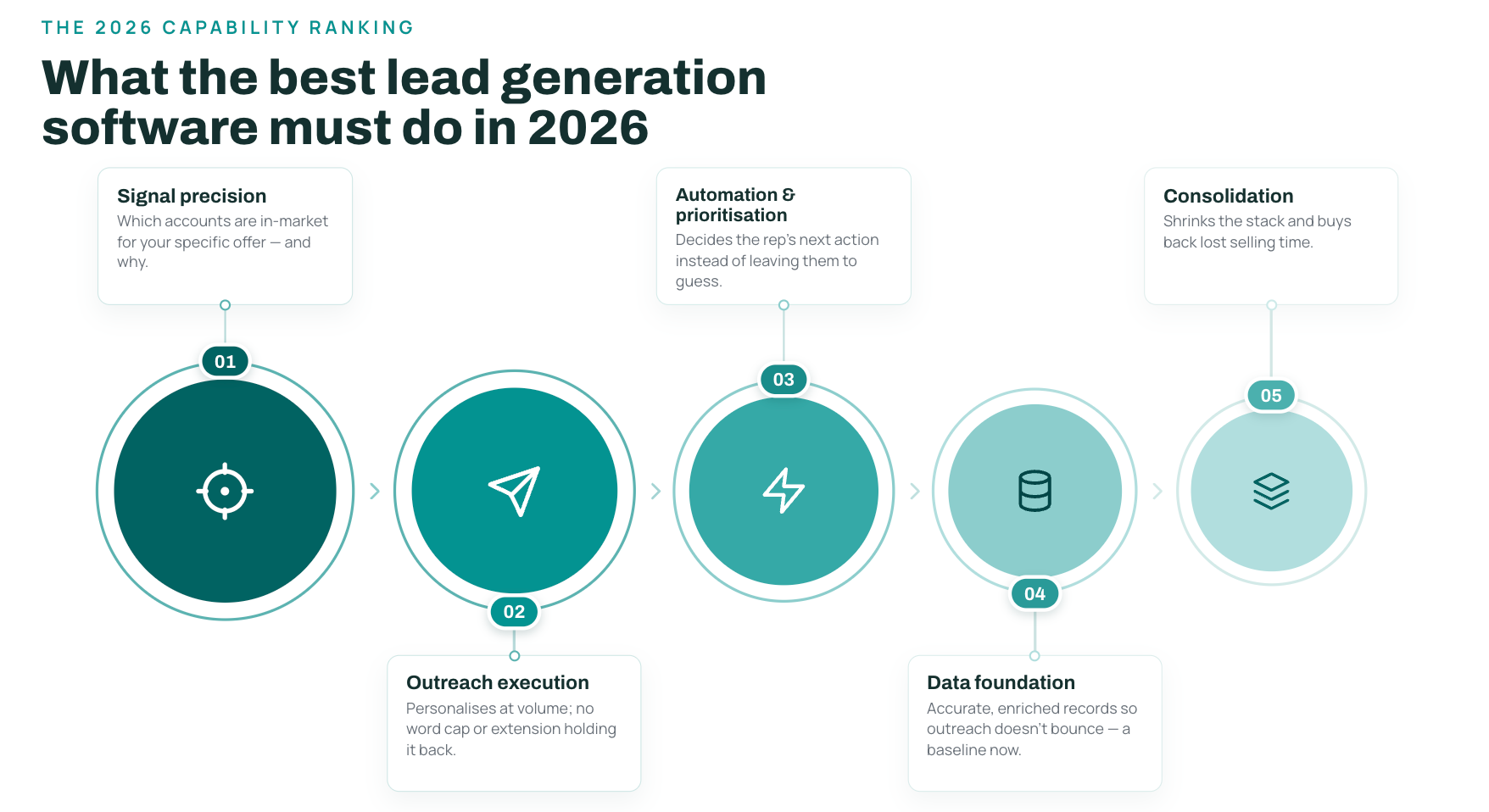
The tools worth shortlisting in 2026 are separated by five capabilities, listed here in the order that actually decides pipeline.
Signal precision comes first: the software should tell a rep which accounts are in-market for their specific offer and why, not just hand over everyone who matches a job title. Outreach execution comes next, because a strong list is wasted if the tool cannot personalise at volume without a monthly word cap or a browser extension holding it back. Automation and prioritisation follow, since the better systems decide the rep's next action rather than leaving them to guess.
Data foundation still matters, because accurate, enriched records keep outreach from bouncing, but it now sits below signal and execution rather than on top. Consolidation closes the list, because a tool that shrinks the stack returns hours that a fragmented set of point tools quietly drains. Reps spend only 28% of their week actually selling, so every tab you remove buys back selling time that no larger database can.
Data volume belongs low on this list on purpose. It is now a commodity that most tools compete on, which means it rarely decides the outcome once coverage clears a basic bar.
Category positioning map
| Tool group | Data volume |
Signal and execution intelligence |
|---|---|---|
| Contact databases (Apollo, ZoomInfo, Cognism, Lusha) | Broad | Mid |
| Outbound tools (Instantly, Smartlead, lemlist) | Mid | Mid |
| Signal and intent tools (Clay, Unify GTM, 6sense) | Mid | High |
| Kris@Work | Mid | High |
No tool maxes both axes. Databases lead on volume but sit mid on intelligence, outbound and signal tools cluster in the middle of volume, and Kris@Work leads on signal and execution while conceding raw volume. The right pick depends on which axis is your constraint.
The 13 best lead generation software tools in 2026, at a glance
For teams whose real problem is precision rather than reach, Kris@Work is the strongest pick, because it profiles your business first and builds the target list from that profile. When the binding constraint is raw coverage, ZoomInfo and Apollo lead on database size and breadth. When you already know who to contact and simply need deliverability-safe sending at scale, Instantly is built for that job, and the right choice depends entirely on which of those constraints is holding your pipeline back.
| # | Tool | Best for | Standout capability | Watch out for |
|---|---|---|---|---|
| 1 | Kris@Work | Signal precision and personalised execution | Profiles your business, then builds and grades the list on fit | Built-in database is smaller than dedicated data providers |
| 2 | Apollo.io | All-in-one database with built-in sequencing | 230M+ contacts plus native sequences in one platform | Data accuracy varies and LinkedIn runs through a Chrome extension |
| 3 | ZoomInfo | The deepest North American data | Bombora intent and website visitor identification bundled in | International coverage trails specialists |
| 4 | Cognism | Compliant, phone-verified EMEA data | Diamond Data verified mobiles with Do Not Call screening | US and APAC coverage lags EMEA |
| 5 | Lusha | Fast, lightweight contact lookups | Extension-led verified emails and direct dials on LinkedIn | Not built for high-volume or account-based motions |
| 6 | Clay | Custom, multi-provider enrichment workflows | Waterfall enrichment across many providers in one builder | Needs a technical owner and does not run outreach |
| 7 | Unify GTM | Triggering warm outbound on aggregated signals | 10+ intent sources plus visitor ID turned into automated Plays | An activation layer, not a database, and needs setup |
| 8 | 6sense | Enterprise ABM and predictive intent | Predicts in-market accounts by buying stage | Heavy to implement and intent carries noise |
| 9 | Instantly | High-volume cold email with deliverability tooling | Mailbox rotation, warm-up, and a unified inbox at scale | Minimal signal or account-based targeting |
| 10 | Smartlead | Agencies scaling multi-inbox outreach | Unlimited mailboxes with white-label and API | Bring your own data and targeting |
| 11 | lemlist | Personalised multichannel sequences | Dynamic image and video personalisation across channels | LinkedIn runs through an extension and signals are thin |
| 12 | 11x.ai | Autonomous multichannel AI SDR | Alice researches, sends, and books end to end | Output can read generic and lacks live signal timing |
| 13 | Artisan | A fully autonomous AI BDR | Ava bundles data, sequencing, and an AI rep | Shallow signal layer; leans on firmographic fit |
The 13 best lead generation software tools in 2026, at a glance
This is the category the entire ranking is built around: software that decides which accounts to work and then acts on that decision, rather than handing over a longer list. One platform leads it by starting with your business instead of a generic intent feed.
1. Kris@Work: the best lead generation software for signal-based prospecting

Kris@Work is an AI-native GTM execution platform, and its live Capture stage runs prospecting from list building to qualified meeting inside a single intelligent window. What sets it apart happens before any outreach: from your domain, Kris profiles your business, reading what you sell, who you sell it to, and the problems you solve, then recommends ICP criteria and grades each account by how well it fits your specific offer. Because the list is built from your business rather than a third-party intent feed shared with every competitor, the accounts it surfaces are the ones a rep should actually work.
Its Next-Best-Action model tells each rep which account to engage, through which channel, and with what message, without waiting to be asked, and it reads live signals such as funding, hiring, and tech-stack changes to time the approach. It then runs email, LinkedIn, and SMS in one engine with uncapped AI personalisation and no monthly word ceiling, and LinkedIn runs natively in sequence rather than through a Chrome extension.
Kris sources accounts and contacts from more than 80 sources, so teams do not need a separate data subscription bolted on, and a team can be up and running in around 15 minutes. Kris publishes what strong results can look like rather than what every team will see, and outcomes vary by team and market: up to 15x more qualified meetings compared with fragmented outbound, and research time reduced by as much as 98% per account, from five or six hours to under five minutes. Both come from collapsing a stack of more than 15 disconnected tools into one window, which reclaims the selling time a fragmented stack drains.
Here’s what else Kris offers:
AI-Native zero-touch CRM that automatically updates, enriches, and explains your customer records, so reps can sell instead of maintaining the database
- Monitor mailbox and domain health so outreach is sent only from healthy inboxes.
- Find the right contacts in seconds with Apollo-parity filters, reducing lead-finding time from 5 minutes to 5 seconds.
- Give reps real-time, evidence-based guidance on their strengths and the specific areas they need to improve.
- Design email templates, define sequencing and user cohorts, and run marketing campaigns directly in Kris, with parity for Mailchimp and Mailgun use cases.
- Call hundreds of contacts simultaneously, drop pre-recorded voicemails in the rep's voice, and get notified when someone picks up so the rep can join the call.
Best for: teams whose constraint is signal precision and personalised execution rather than raw contact volume.
Watch out for: the built-in database is smaller than dedicated data providers, and website visitor identification is partial, so raw-volume-first teams should weigh that.
Contact databases and enrichment tools: where raw data volume still wins
2. Apollo.io: best for an all-in-one database plus built-in sequencing

Apollo pairs one of the largest B2B contact databases, more than 230 million contacts by its own count, with built-in email sequencing, a Chrome extension, and an AI Assistant that drafts lists and sequences for a human to approve rather than acting on its own. LinkedIn steps run through that Chrome extension rather than as native automated sends, so the browser has to stay open. Reviewers consistently flag data accuracy and bounce rates as the practical limitation, and for a direct head-to-head decision our Apollo alternatives guide covers it in depth.
Best for: teams that want a large database and sequencing together in one accessible platform.
Watch out for: its signals are generic, so it tells every customer roughly the same thing rather than what fits your specific offer.
3. ZoomInfo: best for the deepest North American database and intent coverage

ZoomInfo is the depth benchmark for contact and company data, strongest across North America, and it bundles Bombora-powered intent and website visitor identification into one platform. The tradeoff is that international and European coverage is thinner and can go stale, which matters for teams selling outside the US. It is a data-first platform at heart, so it still needs a separate execution layer to turn all that coverage into personalised outreach.
Best for: enterprise teams that need the widest US data and visitor identification in one place.
Watch out for: it distributes data rather than running signal-based execution, so acting on it still falls to another tool.
4. Cognism: best for compliant, phone-verified data in EMEA

Cognism is an EMEA-first data provider, and its differentiator is Diamond Data, phone-verified mobile numbers paired with compliance and Do Not Call screening across many European lists. Coverage is strongest in the UK, DACH, Benelux, the Nordics, and France, which makes it the practical choice for teams selling into those markets. The honest limitation is that US, Canada, and APAC coverage lags well behind EMEA, with weaker match rates and higher bounce on those contacts.
Best for: teams selling into the UK and Western Europe that need verified mobile data and built-in compliance.
Watch out for: it is data-only, so you will pair it with a separate tool to run the outreach.
5. Lusha: best for lightweight, fast contact lookups

Lusha is the lightweight, extension-led option for revealing verified emails and direct dials straight from a LinkedIn profile, with a prospecting search tool layered on top. Its coverage centres on North America, and its database is smaller than Apollo, ZoomInfo, or Cognism. Because it is data-only and built for speed, it suits quick lookups far more than high-volume or account-based programs.
Best for: individual reps and small teams that need fast, accurate contact lookups.
Watch out for: there is no outreach layer, so it starts and ends at the contact record.
Signal and intent-based lead generation software for account-based teams
These tools prioritise which accounts to work over how many contacts exist, which is the same instinct behind signal-based prospecting. They act on live buying signals rather than working a static list from top to bottom.
6. Clay: best for technical RevOps teams building custom enrichment workflows

Clay is the most flexible enrichment-and-workflow builder in the category, running waterfall enrichment across many data providers and letting a team assemble its own signal-to-outreach logic. The catch is that it is a builder rather than an execution engine, so it needs a GTM engineer to configure and hands off to a separate tool to actually send. It also has no native intent aggregation out of the box, which means the signal logic is something you construct, not something it ships with.
Best for: RevOps teams that want to build custom, multi-provider enrichment they fully control.
Watch out for: the signal logic is only as good as what your team builds, since nothing comes pre-configured.
7. Unify GTM: best for triggering warm outbound on aggregated signals

Unify is a warm outbound platform that aggregates more than 10 intent sources, including 6sense, Bombora, G2, and Clearbit, along with person-level website visitor identification, into automated Plays. AI agents research the flagged accounts, and email deliverability is managed for you, so the platform turns signals into triggered outreach. Its limitation is that it is an activation layer sitting on top of the intent data you already have rather than a contact database of its own.
Best for: account-based teams centralising scattered signals to trigger warm outbound.
Watch out for: it adds value only once you have intent sources feeding it, so it is not a standalone starting point.
8. 6sense: best for enterprise ABM and predictive intent

6sense is the enterprise ABM and revenue-AI platform, predicting which accounts are in-market by buying stage, de-anonymising website visitors to the account level, and orchestrating ads and AI email against those accounts. It is heavy to implement and needs a RevOps function to activate and maintain. Its intent also carries noise, so a meaningful share of flagged accounts never convert, and it sits above the CRM rather than executing individual rep outreach.
Best for: large, marketing-led ABM motions with the resources to run them.
Watch out for: the actual rep outreach lives in another tool, so 6sense scores and orchestrates but does not send for the rep.
Outbound and email lead generation software for high-volume sending
These tools generate leads by running high-volume, deliverability-safe outbound, and they assume you already know who to contact. Their strength is sending scale, not deciding which accounts deserve the send.
9. Instantly: best for high-volume cold email with deliverability tooling

Instantly is built for scaling cold email across many mailboxes at once, with mailbox rotation, warm-up, a unified inbox, and a built-in lead database to draw from. Its focus is deliverability and volume, which it does well, but that focus comes at the cost of signal intelligence and account-based targeting. As a result it rewards sending more rather than sending smarter.
Best for: high-volume cold-email teams and agencies that already have their targeting sorted.
Watch out for: it assumes you already know who to contact and will not tell you which accounts are worth the send.
10. Smartlead: best for agencies scaling multi-inbox cold outreach

Smartlead targets agencies and power users running outbound across many client inboxes, with unlimited mailboxes, rotation, warm-up, a unified inbox, and white-label plus API options. Its gap is a minimal native database, so it depends on a separate data source to feed targeting.
Best for: agencies and operators managing outreach across many client inboxes.
Watch out for: it is a sending engine, so precision depends entirely on the list you feed it.
11. lemlist: best for personalised multichannel sequences

lemlist is known for dynamic image and video personalisation, and it combines a large built-in contact database of more than 450 million contacts with AI sequence generation and email, LinkedIn, call, and WhatsApp steps in a single sequence, backed by Lemwarm deliverability. One honest fact matters up front: its LinkedIn automation runs through a Chrome extension that needs the browser open rather than working natively. Its real gap is signal intelligence, so it personalises outreach well but does not decide who deserves that outreach in the first place.
Best for: teams that want richly personalised multichannel sequences out of one tool.
Watch out for: it personalises outreach well but does not decide who deserves it, so pair it with a source of qualified accounts.
Autonomous AI SDR tools that generate leads without added headcount
These tools run outbound autonomously to generate leads without adding reps to the team. For the full breakdown of the autonomous category, see our guide to the best AI sales prospecting tools.
12. 11x.ai: best for autonomous multichannel AI SDR outreach

11x runs outbound autonomously through Alice, an AI SDR that researches prospects, sends email and LinkedIn messages, handles replies, and books meetings, alongside Julian, an AI phone agent. The limitation reviewers report most often is that its output can read generic, because it works from static profile data rather than real-time buying signals. Reps also get limited control over exactly what it sends on their behalf.
Best for: enterprise teams that want a fully autonomous SDR running the motion.
Watch out for: you trade hands-on control for automation, so the messaging is largely out of the rep's hands.
13. Artisan: best for a fully autonomous AI BDR

Artisan is built around a single autonomous AI BDR, Ava, that bundles its own 300M+ contact database, sequencer, and AI rep to run full-cycle outbound from sourcing to sequencing to handling replies across email, LinkedIn, and phone. It does track intent signals such as funding rounds, new hires, and leadership changes, but its signal layer is shallower than the signal-led tools above, so it personalises more on firmographic fit than on live buying triggers.
Best for: teams that want a single autonomous BDR agent rather than a stitched-together stack.
Watch out for: the signal layer is shallow, so outreach leans on firmographic fit and volume more than real-time buying triggers.
Match your requirement to the right lead generation tool
| Your situation or requirement | What's actually missing | Best-fit tool |
|---|---|---|
| Reps get more contacts every quarter but the meeting count does not move. | Signal precision and personalised execution, not more data. | Kris@Work |
| You need the widest possible US contact and company coverage. | Raw database breadth and visitor identification. | ZoomInfo (or Apollo for an all-in-one alternative) |
| You sell into the UK and Western Europe and need verified, compliant phone data. | Region-specific, phone-verified data. | Cognism |
| You want a custom, multi-provider enrichment workflow you control. | A flexible enrichment builder. | Clay |
| You want to trigger outreach the moment an account shows a real-time signal. | Aggregated account signals and triggering. | Unify GTM |
| You run a large, marketing-led ABM motion and need predictive intent. | Enterprise predictive scoring and orchestration. | 6sense |
| You need to send deliverability-safe cold email across many mailboxes. | High-volume sending with warm-up and rotation. | Instantly (or Smartlead for agencies) |
| You want personalised multichannel sequences across email, LinkedIn, and calls. | Dynamic personalisation with built-in deliverability. | lemlist |
| You want outbound to run autonomously without adding headcount. | An autonomous SDR agent. | 11x.ai or Artisan |
| You are a small team that needs something lightweight to run without ops support. | Simpler, faster-to-adopt tooling. | Lusha for fast lookups, or Instantly for outbound |
Read the table from the top down, because the first row is the gap most teams in this search actually have, and it is the one no database or sending tool was built to close.
How to choose lead generation software
1. Diagnose whether your gap is data, signal, or execution
Strong traffic or a large list paired with a low meeting rate usually points to a signal or execution gap, not a data one. Audit where the pipeline actually breaks before you shortlist, because buying more data rarely fixes a problem that data was never causing.
2. Match the tool to your stack and CRM constraint
Several tools here assume a specific CRM or expect a separate execution layer to sit alongside them. Confirm fit with your system of record and existing stack before weighing features, since a tool that fights your CRM costs more than it returns.
3. Weigh consolidation against point tools
Count the hidden drag of a fragmented stack in rep hours and tab-switching, not just the surface appeal of adding one more point tool. A single window that reps actually use can outperform a sharper tool that adds another tab, because the time saved compounds across every rep every day.
The bottom line
The real variable in lead generation is no longer how many contacts a tool can hand you, it is whether the software knows which accounts to work and acts on that knowledge. Databases still win when reach is the constraint, and sending tools still win when volume is. For teams whose gap is precision and execution, the pick follows from that gap. See how Kris runs signal-based lead generation in one window at krisatwork.ai.
Frequently asked questions about lead generation software
1. What is the best lead generation software in 2026?
There is no single winner, because the best tool depends on the constraint holding your pipeline back. For signal-based lead generation that builds the list from your business, Kris@Work leads. For raw database volume, ZoomInfo and Apollo are strongest, and for high-volume outbound sending, Instantly is purpose-built.
2. What is the best lead generation software for small businesses?
Smaller teams usually do better with lighter, faster-to-adopt tools than with enterprise platforms that need a RevOps function to run. Lusha suits quick contact lookups, and outbound tools like Instantly handle sending at scale.
3. Does more contact data mean more leads?
More contact data means more contacts, not more qualified meetings. Volume only converts when a tool can tell you which of those accounts is in-market for your offer and then run personalised outreach, which is why signal precision and execution matter more than list size once coverage clears a basic bar.
4. What is signal-based lead generation?
Signal-based lead generation prioritises accounts showing real buying signals, such as funding, hiring, or a tech-stack change, over working a static list top to bottom. It targets timing and fit rather than sheer reach.
5. Can Kris@Work replace my contact database and sequencing tool?
For most teams, yes, because Kris includes a built-in database that pulls from more than 80 sources, plus omnichannel execution in a single window, so the database and the sequencer consolidate into one system. Teams whose first priority is the largest possible raw contact volume may still want a dedicated data provider alongside it. The tradeoff is coverage breadth against precision and consolidation.