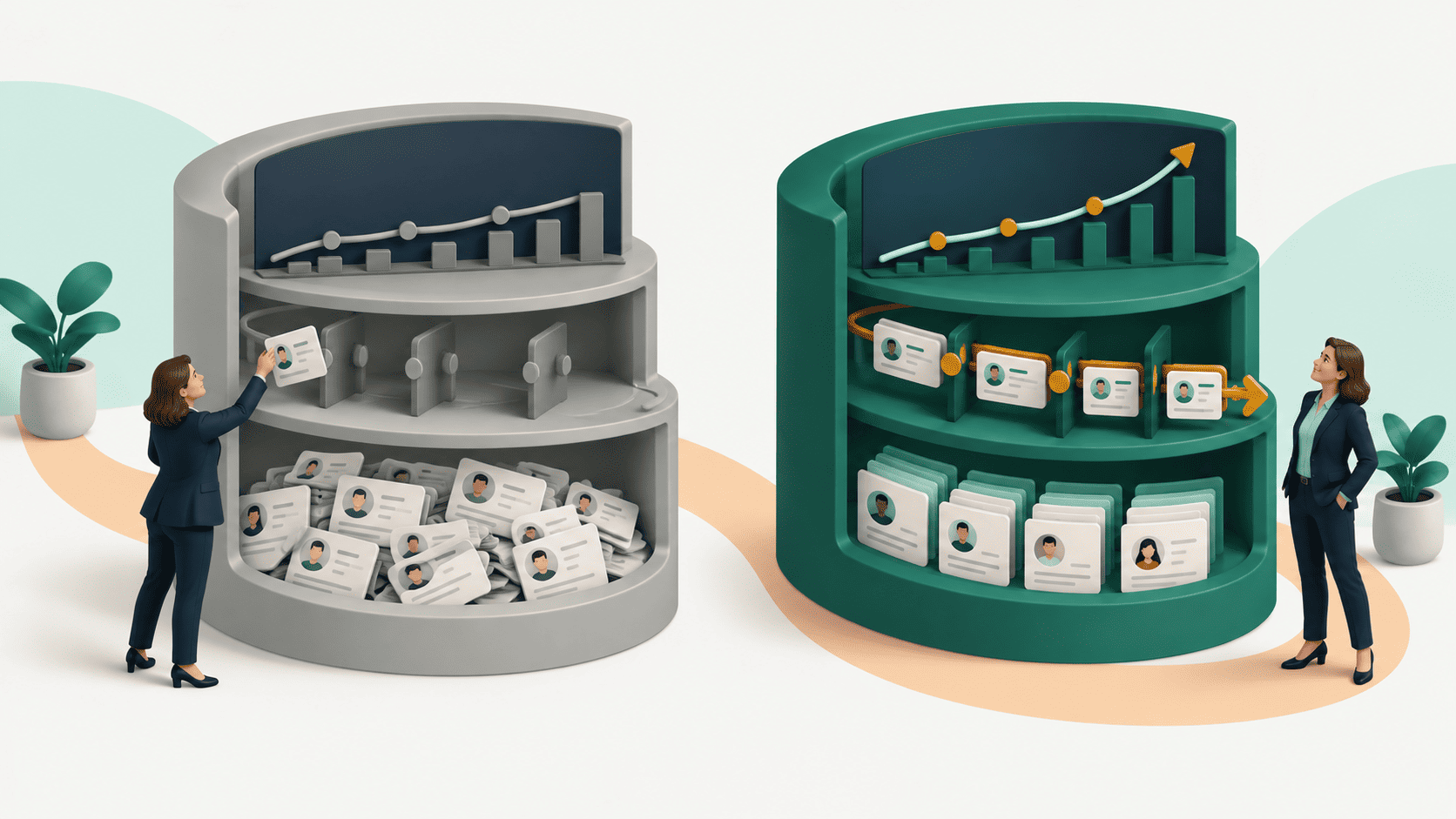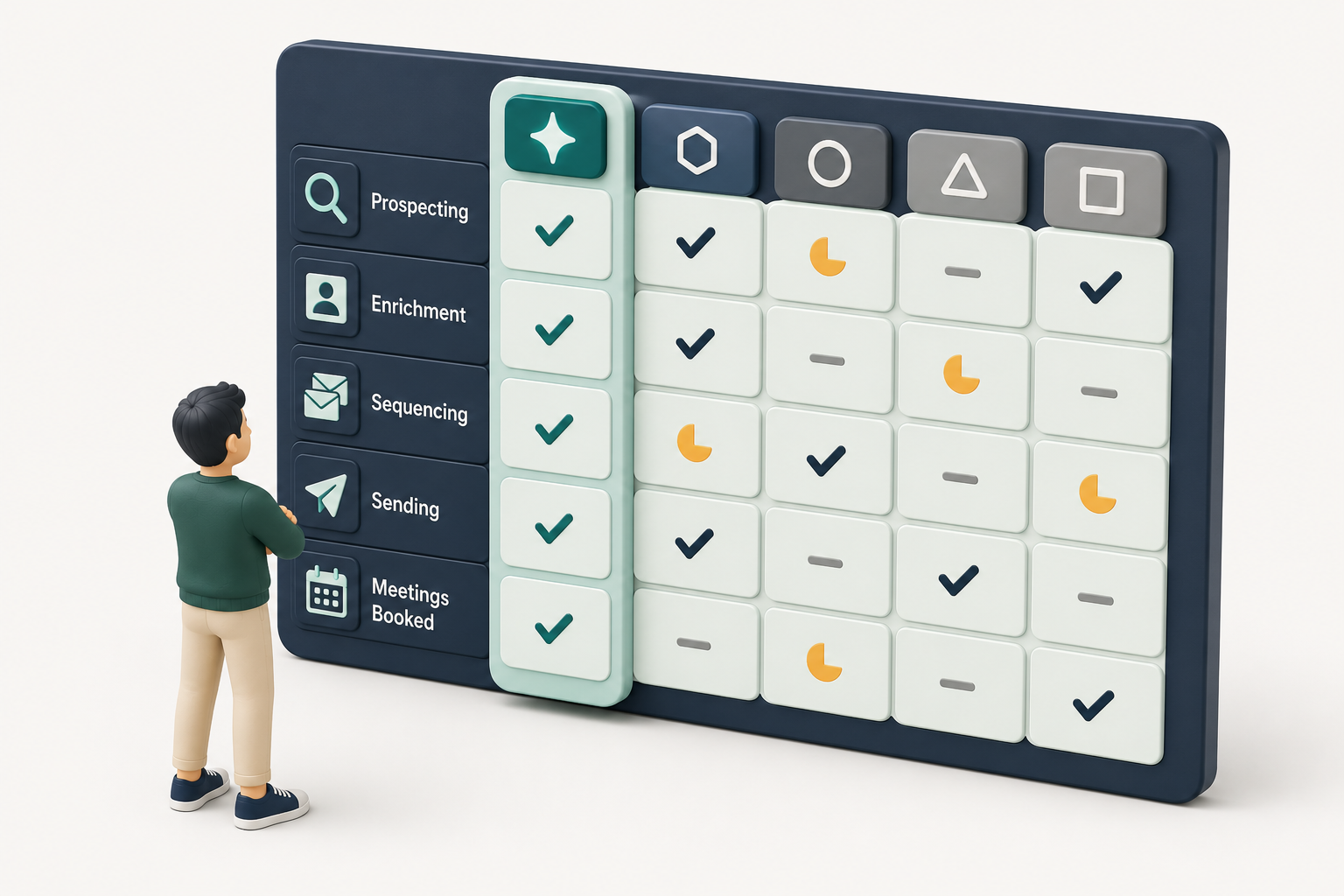

For decades, CRM software has asked for a strange bargain.
Sales teams get a central system for managing customers, opportunities, and pipelines. In return, they have to constantly feed it.
Log the call. Update the contact. Change the deal stage. Add the note. Record the next step. Correct the outdated information.
The problem is that customer relationships do not pause while someone updates a CRM. A new stakeholder joins the buying process, or a champion leaves, maybe a deal loses momentum, or a customer mentions a new requirement on a call. By the time that information makes its way into the system (if it makes its way into the system at all), the business may already have moved on.
This has always been one of CRM's central contradictions: the system that is supposed to provide a clear picture of reality depends on humans manually recreating that reality inside it.
Artificial intelligence is beginning to challenge that model.
The most important change is not that CRM software can now write emails, summarize calls, or answer questions through a chatbot. Those are useful features, but they leave the underlying problem largely intact.
The bigger shift is more fundamental: What happens when the CRM no longer depends entirely on people to keep it up to date?
That question sits at the center of AI CRM.
TL;DR
- An AI CRM uses artificial intelligence to capture, maintain, interpret, and act on customer and revenue information, reducing reliance on manual CRM updates.
- The biggest difference between traditional CRM and AI CRM is not simply AI assistance, but how deeply AI participates in maintaining the system of record, in order to add a layer of system of intelligence on top.
- AI-enabled CRM and AI-native CRM are not necessarily the same: some platforms add AI features, while others use AI to capture changes and maintain context.
What Is an AI CRM?
An AI CRM is a customer relationship management system that uses artificial intelligence to capture, update, analyze, and act on customer and revenue data.
Unlike a traditional CRM, which depends heavily on users to enter information and maintain records, an AI CRM can participate in keeping the system current. Depending on its capabilities, it can detect relevant activity, identify meaningful changes, connect information to the right records, interpret what those changes mean, and surface useful actions or insights.
The easiest way to understand the AI CRM meaning is through four connected responsibilities:
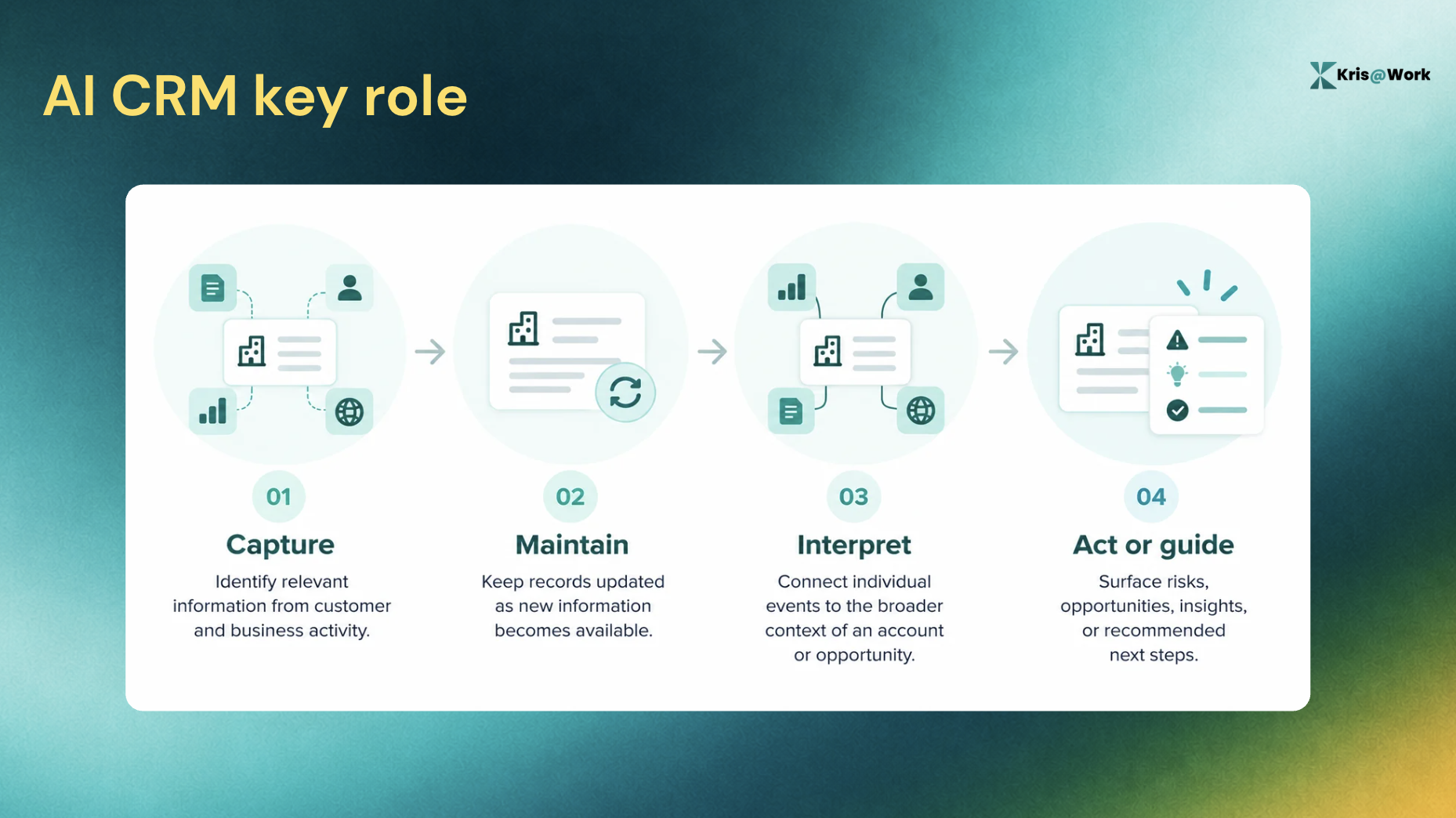
Not every platform described as an AI CRM does all four equally well. Some primarily use AI to help users with specific tasks, while others integrate AI more deeply into how customer data is captured and maintained.
But the category is moving in a clear direction.
CRM software is evolving from a place where teams store information toward a system that can increasingly understand what is happening around that information.
Why Does CRM Need AI in the First Place?
The traditional CRM model was built for a different problem.
Businesses needed a central place to store customer information. Before CRM software, important relationship context was scattered across spreadsheets, inboxes, notebooks, and individual employees' memories. The solution was straightforward: create a shared system of record.
That solved the storage problem. It did not solve the maintenance problem. For a CRM to remain useful, someone still has to ensure that it reflects reality. And reality changes constantly.
Consider how much can happen around a single sales opportunity:
- A new stakeholder enters the buying process.
- A decision-maker changes roles.
- A customer raises an objection on a call.
- The expected timeline moves.
- A competitor appears.
- A champion becomes less engaged.
- A previously inactive account starts showing renewed interest.
Each event can affect the relationship. But unless someone captures and connects that information, the CRM remains unaware.
This creates a persistent gap between two things:
What is happening in the business and what the system says is happening.
AI CRM is designed to reduce that gap.
Instead of expecting users to manually translate every meaningful interaction into structured CRM data, AI can increasingly help identify what changed, determine where that information belongs, and connect it to the wider customer context.
That is why the most significant AI CRM capabilities are not necessarily the most visible ones.
How Does an AI CRM Work?
The exact architecture of an AI CRM differs from platform to platform. Some systems connect AI to an existing CRM, while others build AI more deeply into the underlying product.
However, the fundamental workflow tends to follow the same pattern.
1. AI observes relevant activity
Customer and revenue activity happens across many different places. Relevant information may emerge through:
- Emails
- Sales calls
- Meetings
- Messages
- Customer conversations
- Account activity
- Contact changes
- Pipeline movement
In a traditional workflow, a person has to decide which of those events belong in the CRM and manually translate them into structured updates. AI can reduce part of that work by helping identify relevant activity as it occurs.
2. AI extracts useful information
Not everything in a conversation belongs in a customer record. The challenge is identifying what actually matters such as buying signals, new stakeholders, customer requirements, etc.. Depending on the system, AI can help recognize information such as:
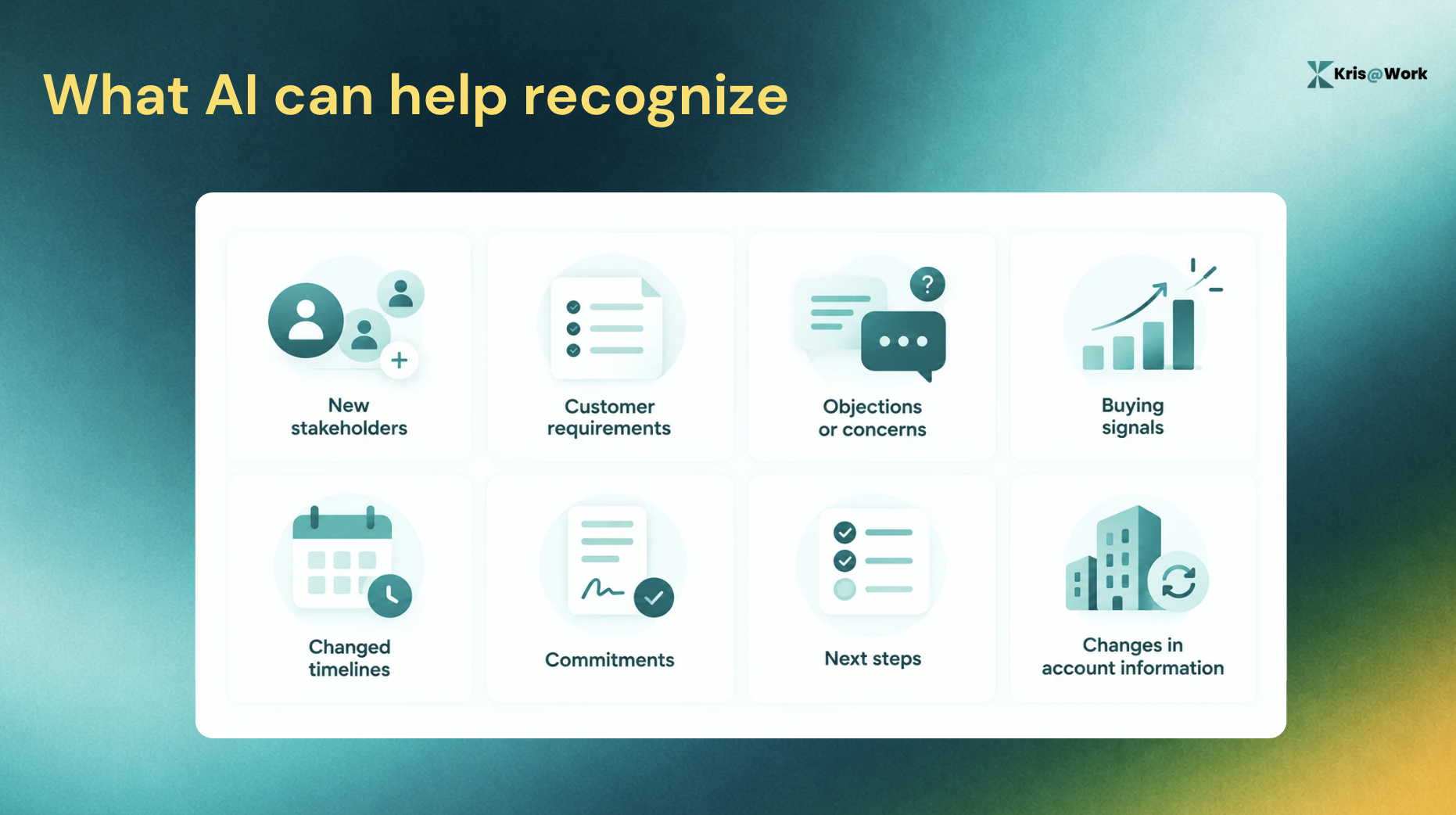
The real value comes from turning unstructured activity into useful context.
3. The system maintains relevant records
This is where the difference between an AI assistant and a deeply integrated AI CRM becomes important.
An assistant might summarize a customer call and present that summary to a sales rep. The rep still needs to decide what matters and manually update the CRM.
A more integrated AI CRM can participate in maintaining the underlying record itself, based on its capabilities, configured workflows, and permissions.
That may include:
- Updating activity history
- Enriching contact information
- Detecting changes
- Recording relevant evidence
- Updating opportunity context
- Supporting stage progression
4. AI connects information to context
Individual events rarely tell the full story. Imagine learning that a stakeholder has changed roles. On its own, that is simply a data point. But what if that stakeholder was:
- The primary champion on a large opportunity?
- The only active contact within the account?
- A key decision-maker?
- Recently involved in a stalled deal?
The meaning of the event changes when it is connected to context. AI CRM can help make those connections across accounts, contacts, opportunities, previous interactions, and other available signals.
5. The system surfaces what matters
The final step is turning information into something useful.
Instead of requiring a manager or rep to manually reconstruct the history of an account, an AI CRM can help answer questions such as:
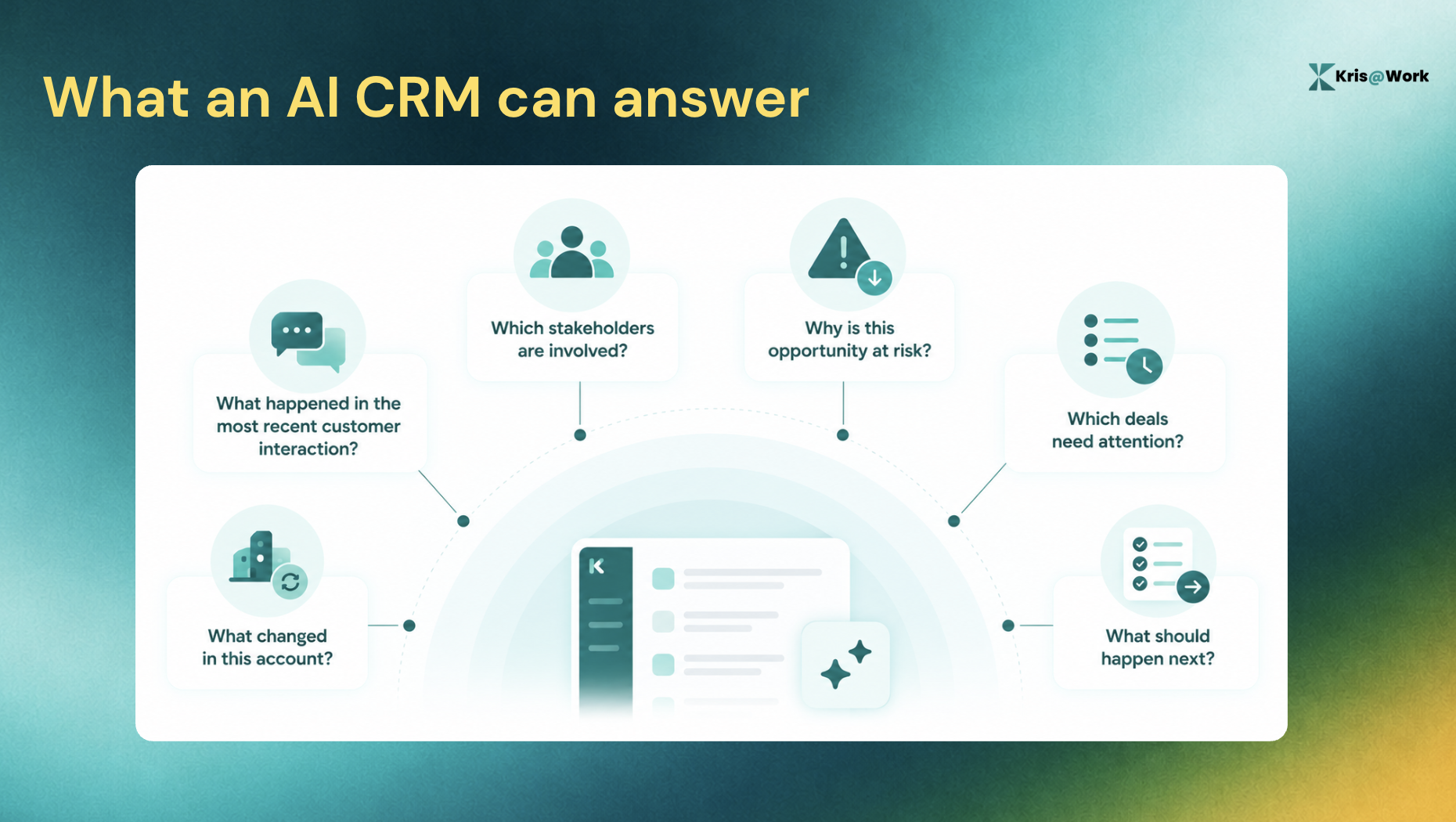
The process can be summarized as:
Activity > Information > Context > Intelligence > Action
AI CRM vs Traditional CRM: What's the Difference?
The biggest difference between traditional CRM and AI CRM is not whether artificial intelligence exists somewhere inside the product.
It is how much responsibility the system takes for maintaining and interpreting the information it contains.
Traditional CRM software gives teams a structured place to manage customer relationships, but its usefulness depends heavily on the quality of human input. AI CRM introduces the possibility of reducing that dependence.
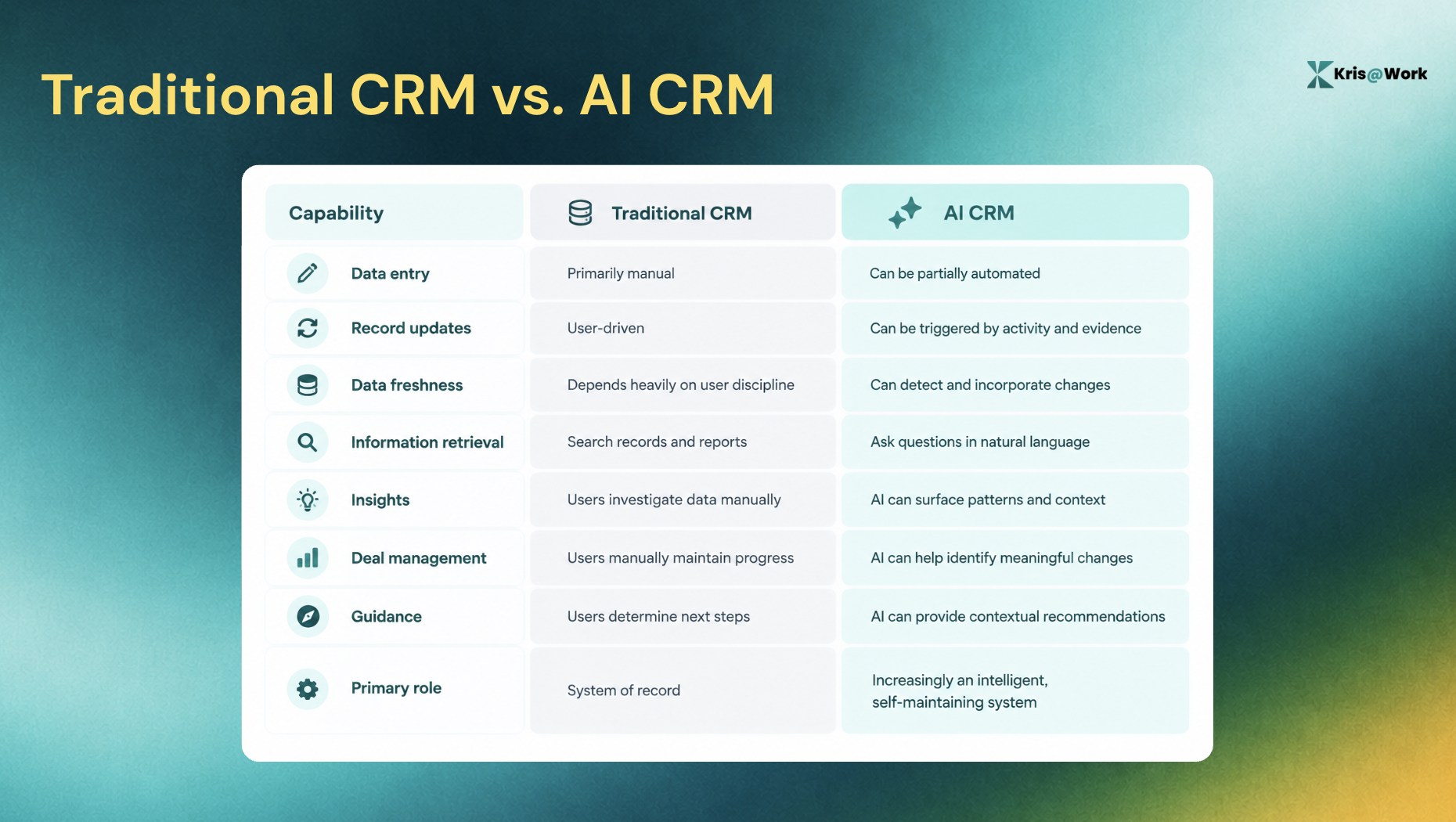
The distinction becomes important when CRM data is used for decision-making.
A traditional CRM tells you what has been recorded. An AI CRM aims to reduce the distance between what has been recorded and what is actually happening.
That does not mean humans disappear from the process. Sales, customer relationships, and strategic decisions still require judgment.
But it does mean the human role can shift away from maintaining information and toward using information.
AI CRM vs AI-Enabled CRM: Why the Distinction Matters
The market uses terms such as AI CRM, AI-powered CRM, AI-enabled CRM, and AI-native CRM loosely. As a result, two products with very different capabilities can both claim to be AI CRMs.
A useful way to understand the category is to look at how deeply AI is integrated into the underlying system.
Traditional CRM with AI features
The first category is a conventional CRM that has added AI capabilities to specific workflows.
Those features might include:
- AI-generated emails
- Call summaries
- Chat assistants
- Predictive forecasting
- Content generation
- Suggested next actions
These capabilities can make users more productive. But the underlying system may still depend heavily on people to maintain accurate records.
AI-enabled CRM
The next category integrates AI more deeply into the CRM experience. AI may help teams:
- Analyze customer behavior
- Prioritize opportunities
- Detect patterns
- Enrich data
- Recommend actions
- Automate workflows
At this stage, AI becomes a more meaningful part of how users interact with the CRM.
AI-native or self-maintaining CRM
At the deeper end of the spectrum, AI becomes part of how the system itself operates.
It can participate in:
- Capturing information
- Updating records
- Detecting changes
- Connecting context
- Interpreting evidence
- Surfacing intelligence
The objective is to make users faster at managing the CRM and reduce the amount of manual work required to keep the CRM useful.
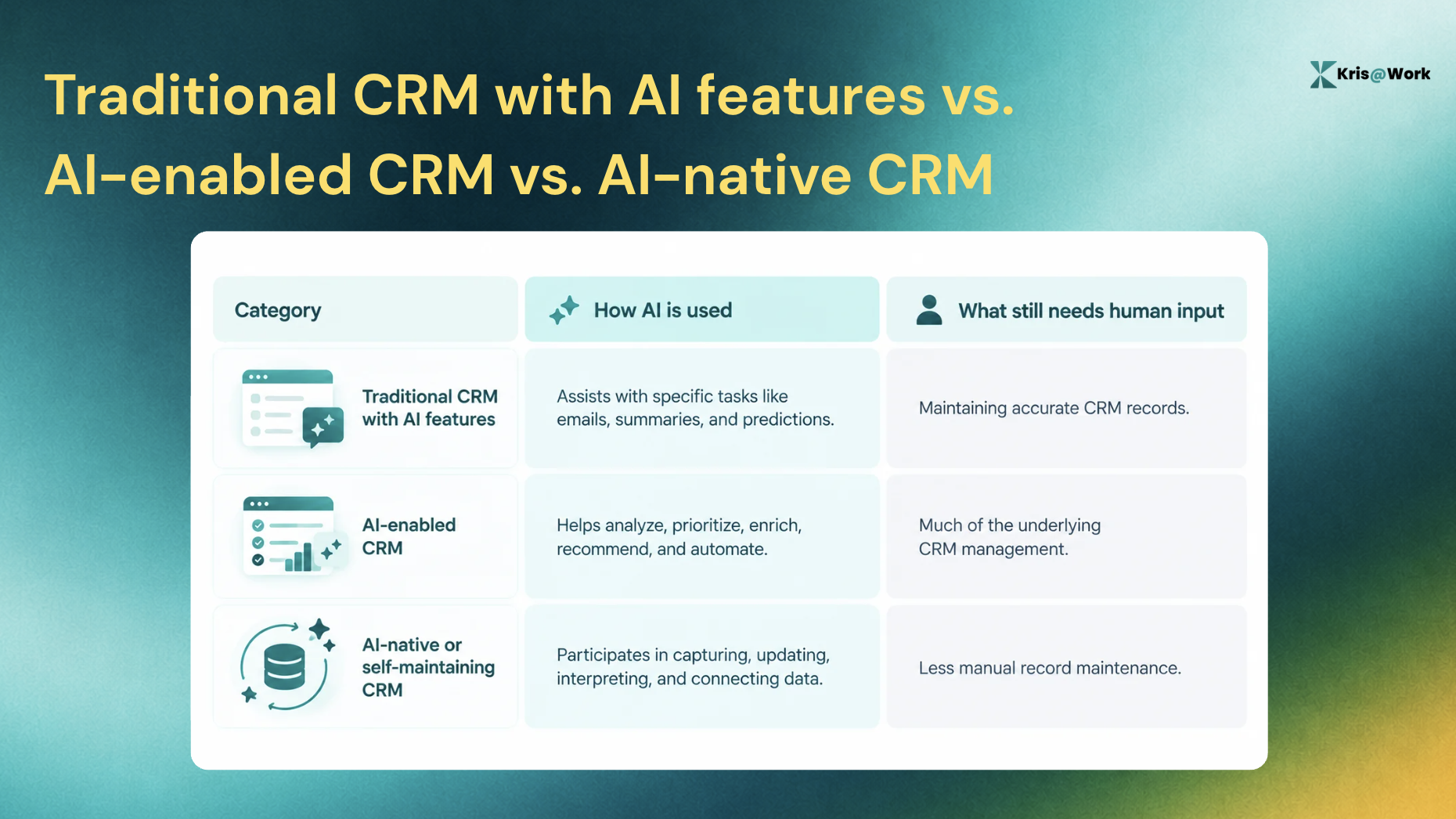
Think of AI CRM as a spectrum
AI CRM is not a binary category. Not every system needs to be fully autonomous, and not every CRM action should happen without human oversight.
The more useful question is: How deeply does AI participate in maintaining and operating the system of record?
A platform that uses AI to draft an email and a platform that uses AI to continuously capture changes across customer relationships should not be treated as equivalent simply because both use artificial intelligence.
What Can an AI CRM Do?
The capabilities of AI CRM vary by platform, but several use cases are becoming central to the category.
Automatically update customer and deal records
Manual data entry has long been one of the biggest sources of friction in CRM adoption. AI can reduce the amount of information users need to enter manually by identifying relevant details from customer activity and helping update corresponding records. The main capability is helping the system remain current as new information becomes available.
Detect changes in accounts and contacts
Customer data does not remain static.People change roles, companies restructure, new stakeholders enter buying processes, or existing relationships become inactive.
AI can help monitor available information and identify meaningful changes that may affect the account or revenue workflow. This matters because stale information is often invisible. A contact record can look complete while describing a relationship that no longer exists.
Identify risks and opportunities
CRM systems often contain useful signals that remain disconnected. For example:
- A customer has stopped responding.
- A key stakeholder has left.
- A deal has remained inactive for an extended period.
- A new executive has joined an important account.
- A customer has expressed a new requirement.
Viewed individually, these events may not reveal much. Connected to account history and opportunity context, however, they can become more meaningful. AI can help teams surface and interpret those patterns without requiring someone to investigate every account manually.
Improve pipeline visibility
Pipeline visibility depends on the quality of the information behind the pipeline. A sophisticated dashboard cannot compensate for outdated opportunity records. If the deal has changed but the CRM has not, reporting reflects what someone entered rather than what is actually happening. AI CRM can help reduce that gap by connecting ongoing activity with the underlying system of record.
Answer questions in plain language
Traditional CRM reporting often assumes users know where to look. AI introduces a different interaction model. Instead of navigating dashboards and applying filters, users can ask questions such as:
- Which opportunities changed this week?
- Why is this deal at risk?
- What is the latest activity on this account?
- Which deals need attention?
- What changed across the pipeline?
Recommend the next action
The more advanced use of AI CRM moves beyond summarizing what happened and toward helping users decide what to do next.
That creates a progression:
Data > Insight > Guidance
A CRM can tell you what happened. AI can help explain what that information means in context and identify actions worth considering. The objective is not to replace human judgment. It is to give human judgment better information to work with.
Why Traditional CRMs Struggle to Stay Accurate
The core problem with traditional CRM is not that companies lack a place to store customer information. The problem is that maintaining an accurate record requires continuous human effort.
A sales rep may have dozens of meaningful interactions in a week. Managers need reliable pipeline data. RevOps teams need consistent information for reporting and workflows. Leadership needs to understand what is changing across the business.
Yet much of the information required to support those outcomes depends on individual employees remembering to document what happened.
This creates three structural problems:
Manual data entry creates gaps
Every manual step introduces the possibility that information will not be captured. For example:
- A rep takes notes but never adds them to the CRM.
- A new stakeholder is mentioned but not added to the account.
- A deal changes direction but the opportunity stage remains unchanged.
- A customer interaction remains buried in an inbox or call recording.
The CRM can only reflect the information that makes it into the system.
Data becomes stale
Even accurate records can become outdated. Customer relationships evolve continuously, but updating CRM data requires someone to notice those changes and take action. That creates an unavoidable tension: the people responsible for maintaining the CRM are usually busy doing the work that generates the information the CRM needs.
Intelligence is limited by data quality
AI can analyze and summarize information, but useful intelligence depends partly on the quality of the underlying context. If the CRM contains incomplete or outdated information, AI-generated insights inherit those limitations. This makes data maintenance more than an administrative problem. It’s a prerequisite for meaningful CRM intelligence.
What Are the Benefits of AI CRM?
The benefits of AI CRM come primarily from changing how teams interact with customer information.
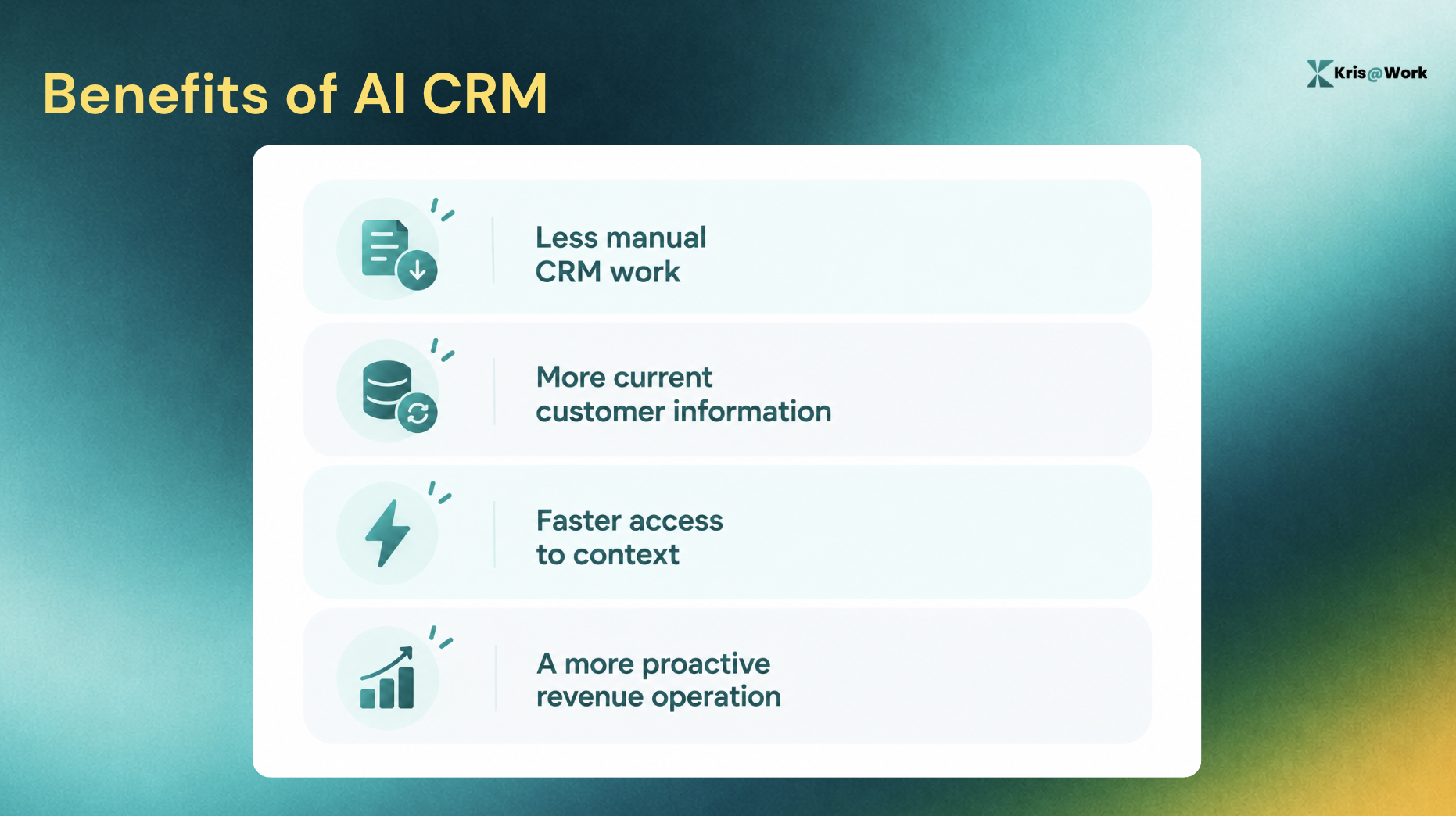
Less manual CRM work
When relevant information can be captured and structured automatically, teams spend less time turning customer interactions into administrative updates.
More current customer information
Capabilities such as automated capture, enrichment, and change detection can help reduce the gap between real-world activity and the information stored in the CRM.
Faster access to context
Important customer context is often scattered across records, conversations, notes, and reports. AI can help retrieve and connect that information, reducing the amount of manual investigation required to understand an account or opportunity.
Better prioritization
AI can help surface risks, changes, and opportunities that deserve attention. Instead of treating every account equally, teams can focus their attention where available context suggests it matters most.
A more proactive revenue operation
Traditional CRM workflows are often retrospective:
- Something happens.
- Someone records it.
- Someone reviews it later.
AI creates the possibility of a more continuous model where meaningful changes can be detected and surfaced closer to when they occur.
Who Is AI CRM For?
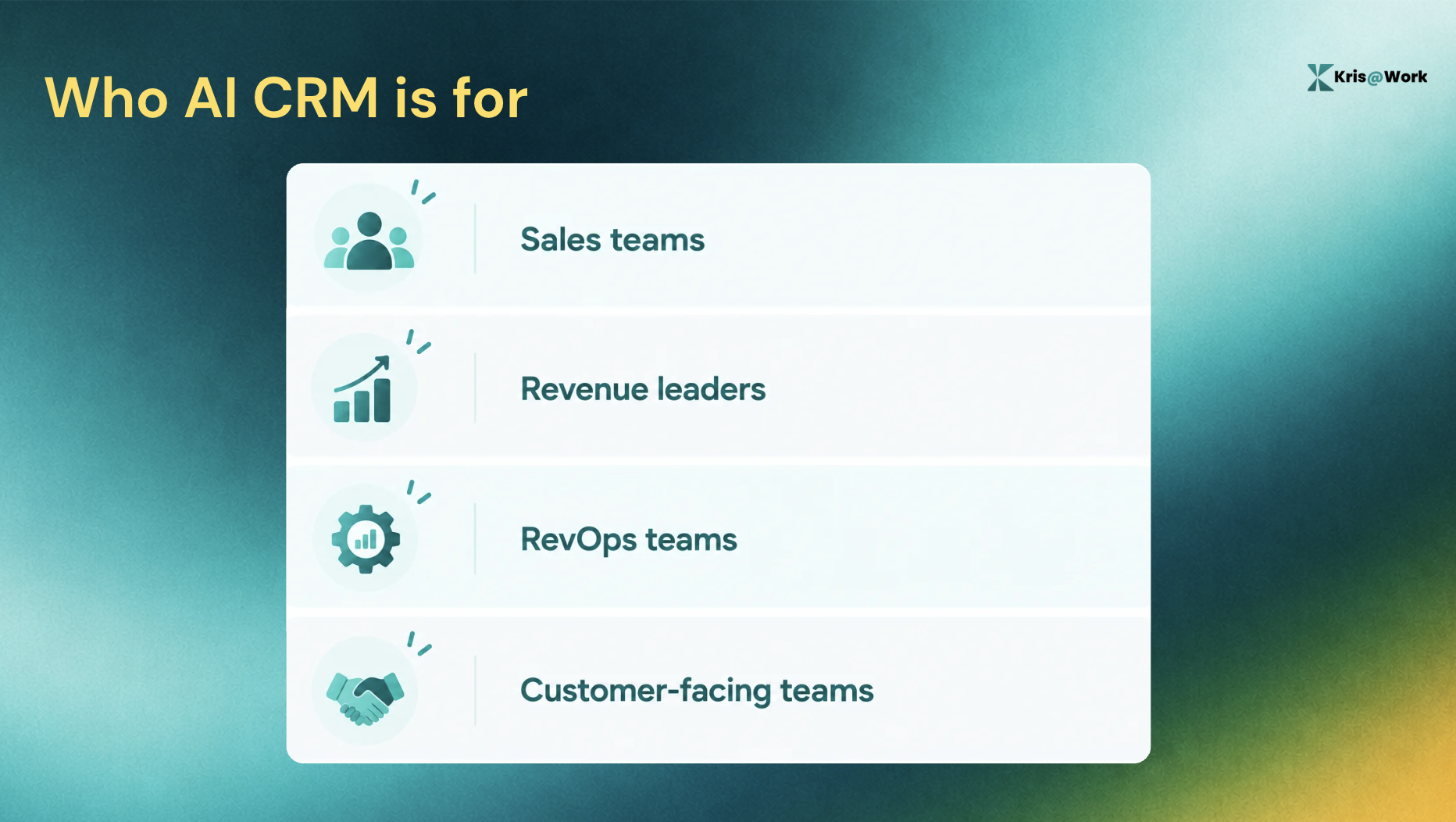
AI CRM is relevant anywhere there is a meaningful gap between customer activity and the information available about that activity.
Sales teams
Sales teams can use AI CRM to reduce manual record maintenance and make account and opportunity context easier to access.
Revenue leaders
Revenue leaders depend on CRM data to understand pipeline health and business movement. AI can help surface meaningful changes without requiring leaders to manually reconstruct the story behind every number.
RevOps teams
For RevOps teams, AI CRM represents a shift away from relying entirely on human compliance as the mechanism for maintaining data quality.
Instead of designing increasingly complex processes to ensure people update systems correctly, parts of data capture and maintenance can increasingly happen automatically.
Customer-facing teams
Customer context is frequently lost during handoffs between teams.
A more continuously maintained system of record can make it easier for different functions to understand the history of a customer relationship without relying entirely on individual memory or disconnected notes.
The common problem across these teams is the effort required to keep information current, connected, and useful.
An AI CRM in Practice: A Simple Example
Consider a sales conversation where a buyer reveals two important changes: the expected project timeline has moved, and a new executive stakeholder now needs to approve the purchase.
In a traditional CRM workflow, the salesperson would typically need to:
- Finish the meeting.
- Take notes.
- Remember to update the CRM.
- Add the new stakeholder.
- Update the expected timeline.
- Potentially change the opportunity stage.
- Add any relevant context for the rest of the team.
If some of those steps are delayed or skipped, the CRM no longer reflects the current state of the deal.
In an AI CRM workflow, depending on the platform and configured permissions, the process can increasingly work differently. AI can identify relevant information from the interaction, connect it to the appropriate account and opportunity, help maintain the corresponding records, and surface the implications within the broader deal context.
The difference is about reducing the distance between reality and the system of record. The smaller that distance becomes, the more useful the CRM becomes as a representation of the actual customer relationship.
Is AI CRM Safe to Use?
As AI becomes more deeply integrated into CRM workflows, an important question emerges: if AI can read, interpret, and potentially update customer data, how should organizations control it? The answer depends on the platform and implementation, but several principles matter.
Scoped permissions
AI should operate within clearly defined boundaries. Organizations need control over what information the system can access and what actions it is allowed to perform.
Auditability
Important AI-driven actions should be traceable. Users should be able to understand:
- What changed
- When it changed
- Why the system made the change
- What information supported the conclusion
Human oversight
Automation does not remove accountability. Organizations need to decide where AI can act independently and where human review remains necessary.
Grounded intelligence
AI-generated answers become more useful when they are grounded in relevant business context and evidence rather than presented as generic conclusions. As AI CRM becomes more capable, explainability and oversight become more important.
How Kris Approaches AI CRM
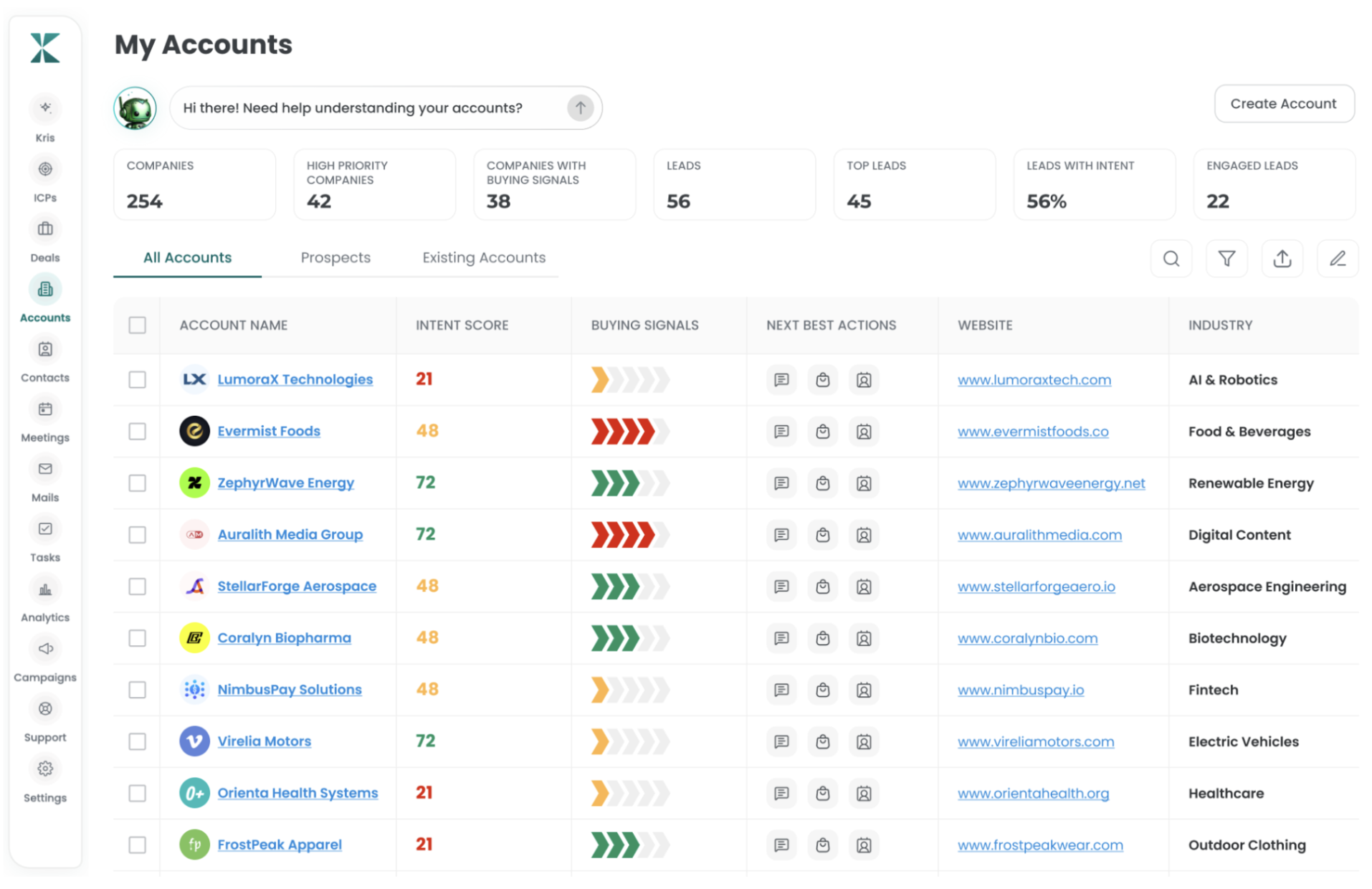
Kris AI CRM approaches this with a simple idea: the system of record should not depend on reps to keep it alive.
It is designed as a zero-touch, living record that maintains, enriches, and explains itself. Kris reads calls, emails, and meetings to autonomously update deal stages and dispositions based on what actually happened. Every change is logged with its trigger and timestamp, creating an audit trail behind the record.
The system also continuously enriches titles, firmographics, and contact information, detecting changes such as job moves or company restructuring so records do not gradually drift from reality. Users can then ask questions about individual deals, accounts, or the broader pipeline in plain language and see the evidence behind the answers.
The goal is to build a system of record that can increasingly keep itself current, explain what is happening, and give teams information they can trust.
A CRM with AI features can help users work faster. A zero-touch AI CRM aims to remove the need for users to constantly maintain the CRM in the first place.
The Future of CRM Is Less Manual Maintenance
The history of CRM software has largely been about improving how organizations store, organize, and access customer information.
AI changes the next question. The challenge is no longer only “Where should we store the data?” It is increasingly “Why should a human have to manually put all of it there?”
That does not mean every CRM task should become autonomous. Complex customer relationships still require judgment, and organizations will continue to decide where automation is appropriate. CRM systems are evolving from static databases toward systems that can:
- Observe relevant activity
- Capture useful information
- Detect changes
- Maintain records
- Connect context
- Answer questions
- Surface what matters
The best way to understand what an AI CRM is is therefore not as a checklist of AI features. It is a change in the relationship between people and the system of record. Traditional CRM asks people to maintain the system. AI CRM increasingly helps the system maintain itself.
That’s the shift.
FAQs About AI CRM
1. What is an AI CRM?
An AI CRM is a customer relationship management system that uses artificial intelligence to capture, update, analyze, and act on customer and revenue information. Depending on the platform, it can automate parts of data maintenance, detect changes, surface insights, and provide contextual guidance.
2. What does AI CRM mean?
AI CRM means using artificial intelligence within customer relationship management. The term can include capabilities such as automated data capture, data enrichment, predictive analysis, conversational interfaces, workflow automation, and AI-driven recommendations.
3. What is the difference between AI CRM and traditional CRM?
Traditional CRM relies primarily on people to enter and maintain customer information. AI CRM can reduce that manual work by capturing relevant activity, identifying changes, helping update records, and interpreting information in context.
4. Is AI CRM the same as a CRM with AI features?
Not necessarily. A traditional CRM can include AI features such as email generation, call summaries, or chat assistants without fundamentally changing how the CRM is maintained. AI CRM generally implies deeper integration of AI into data capture, maintenance, analysis, automation, and decision support.
5. Can AI automatically update a CRM?
Depending on the platform, permissions, and configured workflows, AI can help capture information from customer interactions and update relevant CRM records. Organizations should determine what information the system can access and what actions it is allowed to perform automatically.
6. Will AI replace CRM software?
AI is more likely to change how CRM software works than eliminate the need for a CRM. Organizations will still need a trusted system for managing customer, account, and revenue information. The larger change is that AI can reduce the manual effort required to maintain and use that information.