Most replies are not lost because the first email was weak. They are lost because the sales follow-up sequence stopped before it did its work. In a 2026 Belkins study of more than 7.5 million emails, follow-up messages drove 58.6% of all replies, so a rep who sends one email and moves on walks away from most of the responses still coming.
The short answer to how many follow-ups a sequence needs: three to five email steps, then a switch to another channel. Persistence is only half of it. Replies come from a sequence that changes its angle, its channel, and its timing based on what the prospect does, not from resending the same message on a schedule.
Below are seven follow-up sequences, each with a copy-paste template you can adapt today. If your single sends stall on open or reply, fix the message first, then layer these sequences on top.
TL;DR
- Follow-ups drive most replies: Don't rely on a single cold email. Use 3 to 5 well-planned touches before changing channels.
- Make every follow-up different: Step 3 should introduce a fresh angle, proof point, or hook, not just say “following up.”
- Go multi-channel: When email stalls, switch to LinkedIn, and for high-value accounts, escalate to a warm phone call.
- Use context and signals: Trigger outreach around real events like funding, hiring, or other relevant account changes.
- Adapt based on behaviour: Change the next touch based on clicks, replies, objections, intent, or silence, and stop automation when a real conversation starts.
The seven sequences at a glance
| Sequence | When to use it | Channels | The core move |
|---|---|---|---|
| 1. Three-email core | Every cold account, as the backbone | Build to a step-3 reframe, not a taper | |
| 2. Break-up email | An email thread that has gone silent | One low-pressure exit that reopens the thread | |
| 3. Email-to-LinkedIn switch | No reply after three email steps | Email, LinkedIn | Change channel instead of sending another email |
| 4. Multi-channel escalation | High-value target accounts | Email, LinkedIn, phone | Add LinkedIn, then a warm call, for named accounts |
| 5. Signal-triggered | A real account event just fired | Email, LinkedIn | Start from the event, lead with why-now |
| 6. Post-demo follow-up | After a call or meeting | Same-day recap that names the next step and date | |
| 7. Adaptive sequence | Any account, once you can branch on behaviour | Email, LinkedIn, SMS | Branch each next touch on the prospect's response |
1. The three-email core sequence that treats step 3 as the main event
The third email, not the first, is where most booked meetings come from. Belkins found that step 3 alone books more appointments than steps 1 and 2 together, and that steps 3 to 5 drive 53.5% of all email-sourced meetings.
Write step 3 as a message you would send cold: a different hook, a different proof point, or a sharper angle. Give each step room to land rather than emailing on back-to-back days, and hold the sequence to three to five steps, since returns fall away past step five.
Email 1 (Day 0)
Subject: [specific detail, for example "your Q3 hiring push"]
Hi [First name],
[One line tying a real detail about their company to a problem you solve.] Teams in [their situation] usually hit [specific problem] around this stage.
Worth a short call to see whether [outcome] fits [Company]?
[Your name]
Email 2 (a few days later, reply on the same thread)
Hi [First name],
Following my note above. One thing [comparable company] fixed first was [specific angle], and [one-line result].
Open to 15 minutes this week?
Email 3 (new subject line)
Subject: [different angle]
Hi [First name],
Different thought. If [specific pain] is on your list this quarter, [specific approach] is where most [role] teams start. Happy to show how, if useful.
Are you the right person for this, or should I speak with someone else?
2. The break-up email that reopens threads before you close the file
The break-up email does two jobs: it gives a quiet prospect one easy reason to re-engage, and it closes the thread cleanly when they do not. Frame it as a future-dated, no-obligation note, with no guilt in it. It is the last step of a stalled sequence, sent after the core three go unanswered.
Follow-ups drive most replies, so the final message is worth sending even when the earlier steps went quiet.
Subject: Should I close your file?
Hi [First name],
I have not heard back, which usually means the timing is off or this is not a priority right now. Both are completely fair.
I will close your file for now. If [problem] moves up the list next quarter, reply to this email and I will pick it straight back up.
[Your name]
3. The email-to-LinkedIn switch for prospects who stopped opening
When an email thread goes silent, changing channel beats sending another email. A cold connect-then-message workflow on LinkedIn replies at around 7 to 8% in the Belkins data, and Belkins measured LinkedIn reply rates at 14 times email once a sequence has run dry. The channel change resets the prospect's context.
Open with a connection request that references your earlier email. Including a note lowers acceptance slightly, from 27.56% to 25.31%, but among those who accept, the reply rate climbs from 5.28% to 8.18%. If booked meetings matter more than a large connection count, the note earns its place.
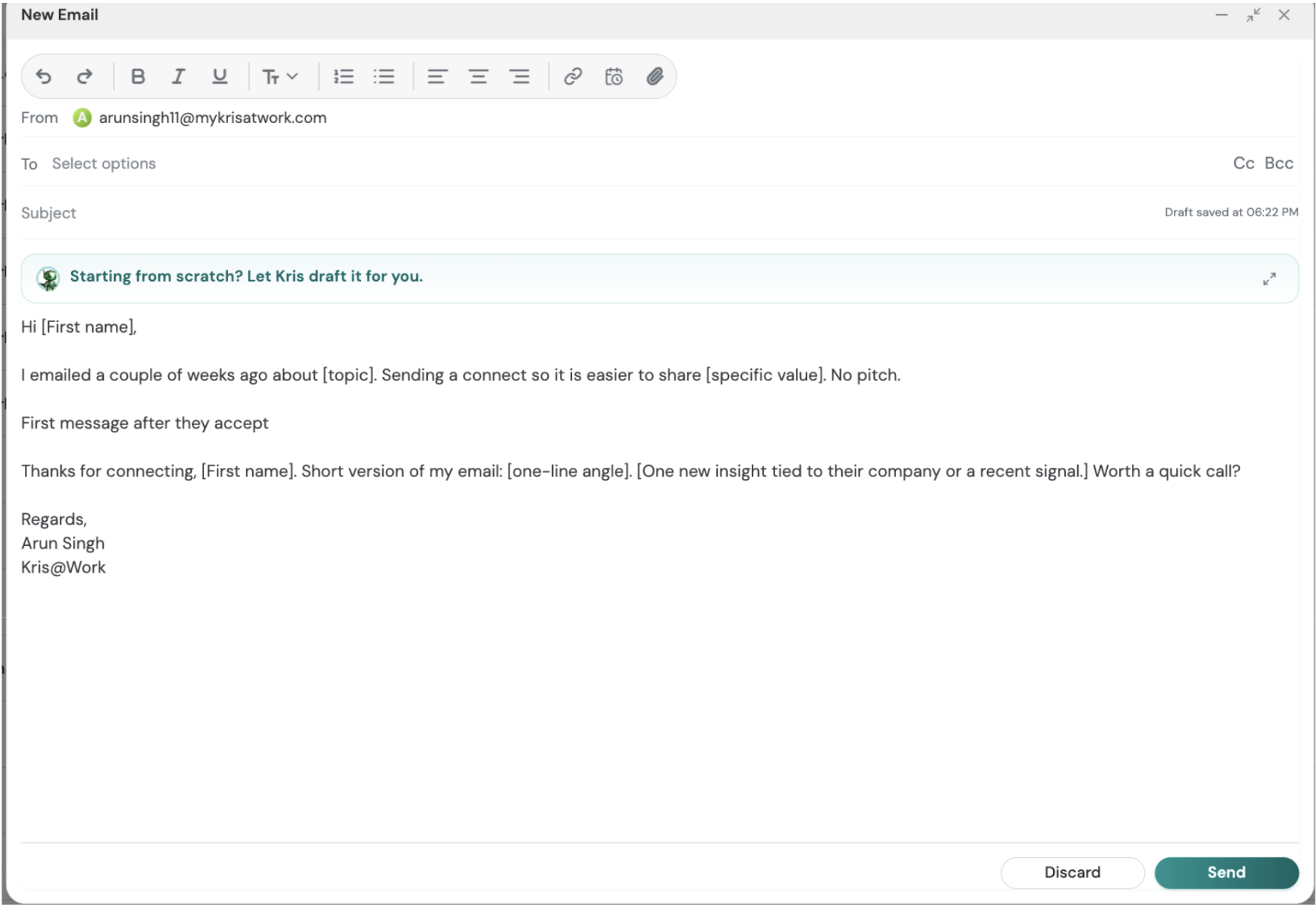
Connection request (with note)
Hi [First name], I emailed a couple of weeks ago about [topic]. Sending a connect so it is easier to share [specific value]. No pitch.
First message after they accept
Thanks for connecting, [First name]. Short version of my email: [one-line angle]. [One new insight tied to their company or a recent signal.] Worth a quick call?
4. The multi-channel escalation sequence for high-value accounts
Top accounts justify escalating from email to LinkedIn to a phone call, in that order, because each channel does a job the others cannot. Cold calling is the highest-engagement channel in the Belkins data, connecting with 18.6% of prospects reached against 5.04% for LinkedIn and 0.45% for email. It also drives 33.6% of all appointments booked, from a channel that runs at far lower volume than email.
Calling works best as an escalation, not a first touch, because the earlier email and LinkedIn steps build the recognition that turns a cold call into a warm one. Reserve it for accounts where the value justifies the rep time, and open the call by naming the touches that came before.
Call opener
"Hi [First name], it is [Your name] from [Company]. I have sent a couple of emails and connected on LinkedIn about [topic]. I am calling directly because [why-now or specific trigger]. Did I catch you at an okay moment?"
Voicemail, if no answer
"Hi [First name], [Your name] from [Company]. I sent a note on [topic] and wanted to close the loop directly. I will follow up by email. If [outcome] is useful, my number is [number]."
How the first four sequences connect into one escalation path
- Email: Steps 1 to 3, building to a step-3 reframe.
- No reply, move to LinkedIn: A connection request that references the email, then a first message.
- High-value account, add a call: A warm call that names the email and LinkedIn touches.
- Still silent, send the break-up: One low-pressure, future-dated exit.
5. The signal-triggered sequence that starts from a buying trigger
A sequence launched off a real event has a reason to exist that a scheduled send does not. New funding, a relevant hire, or a tech-stack change opens a short window where outreach reads as timely rather than random. Lead the first message with the event, then tie it to a problem the buyer is likely to face because of it.
Keep the sequence tight, since a signal loses its relevance quickly. Run the cadence below.
Email 1 (soon after the signal)
Subject: [event, for example "your Series B"]
Hi [First name], congratulations on [event]. Teams that have just [event] usually hit [specific problem] within a quarter, often around [area].
If that is on your radar, worth a short call on how [role] teams handle it?
Email 2 (a few days later)
Hi [First name], following my note on [event]. [How a comparable team handled the same moment, with a one-line result.] Open to comparing notes?
6. The post-demo follow-up sequence that keeps a live deal moving
The follow-up after a call often decides whether momentum survives, so it needs its own sequence rather than an improvised email. Send a same-day recap that restates the prospect's problem in their own words, names the next step, and puts a date on it. Speed protects the momentum a good call created.
Add a second touch soon after that brings one new proof point or resource tied to what came up on the call, not a generic check-in. When the deal needs more than one champion, loop in or name a second stakeholder.
Recap email (same day)
Subject: Recap and next step, [Company] and [Your company]
Hi [First name],
Good speaking today. To recap what you flagged: [their stated problem in their words]. The next step we agreed on is [action] by [date].
I will [your action] before then. Did I miss anything?
Follow-up
Hi [First name], one thing tied to [what surfaced on the call]: [relevant resource or proof point]. Still good for [next step] on [date]?
7. The adaptive sequence that rewrites itself as the prospect responds
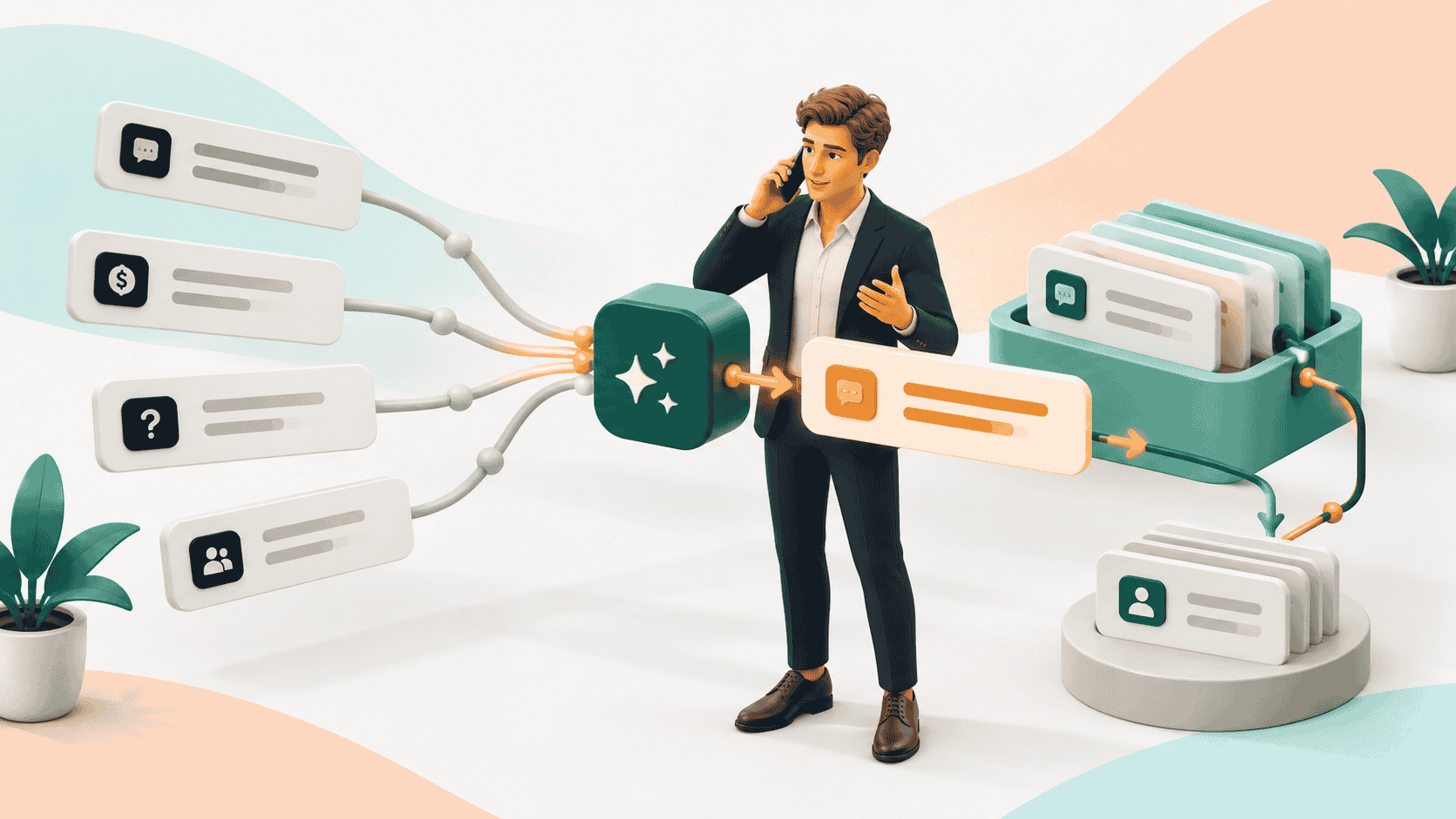
The strongest sequences branch on what the prospect actually does, changing the next touch by reply, intent, and fresh signal rather than following a fixed script. A prospect who clicks but stays quiet needs a different next step from one who raises an objection, and both differ from one who has gone silent. Building that logic in is what separates a sequence that adapts from a list of scheduled sends.
The moment a real reply arrives, the automation should stop so a person can take over the live conversation.
Adaptive branch map: match the next touch to the prospect's last move
| If the prospect | Your next move |
|---|---|
| Opens or clicks but does not reply | Advance a new value angle in the next touch |
| Replies with an objection | Pause the automation, answer it, then resume |
| Replies with buying intent | Drop a booking link in the thread and stop the sequence |
| Goes silent by step 3 | Switch to the email-to-LinkedIn sequence |
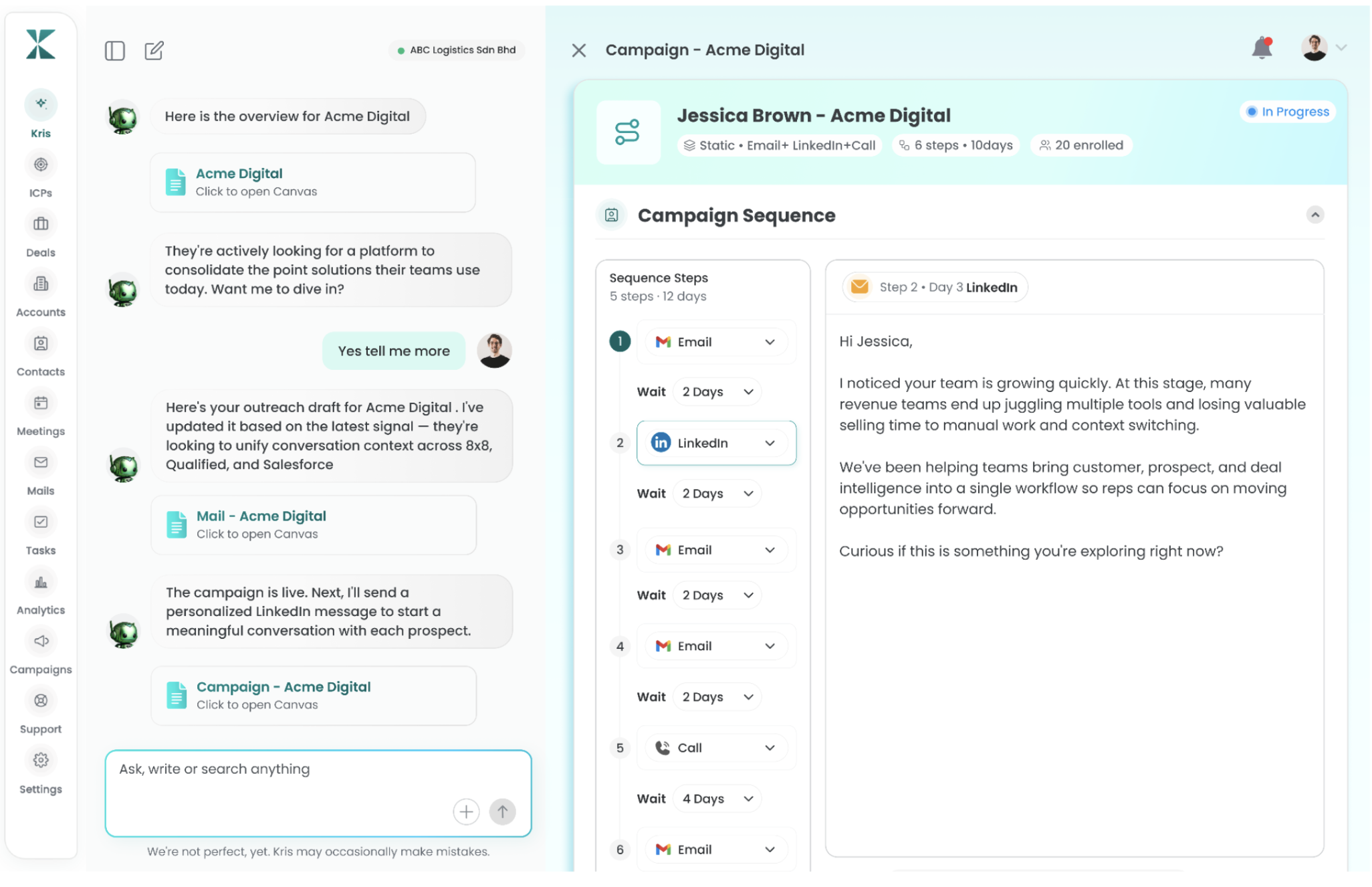
Running branches like these by hand across a full list is hard to sustain. Kris Capture builds this kind of dynamic sequence, assembling each step live and adapting as new signals fire and replies arrive across email, LinkedIn, and SMS, and pausing the sequence the moment a real reply lands. A rep runs the adaptive cadence without hand-managing every branch.
FAQs About Sales Follow-Up Sequence
1. How many follow-ups should a sales sequence have?
Three to five email steps is a practical starting range, followed by a switch to another channel. But the right number also depends on the prospect's seniority and leadership position. Senior executives require fewer, higher-value touches, while reaching broader stakeholder groups may justify a longer sequence across multiple contacts and channels.
2. How long should you wait between follow-ups?
Give each step room to land rather than emailing on back-to-back days. A short gap keeps the sequence present without crowding the inbox, and leaves you space to change the angle between touches.
3. Which follow-up channel works best when email gets no reply?
LinkedIn first, then a phone call for high-value accounts. Belkins measured LinkedIn replies around 7 to 8% and cold calling connecting with 18.6% of prospects reached, both well above the email benchmark once a sequence has stalled.
4. Do break-up emails actually work?
Yes, as a low-pressure final step rather than a last push. A future-dated, no-obligation message gives a quiet prospect an easy reason to reply and closes the thread cleanly when they do not.
5. What makes a follow-up sequence get more replies?
Changing the angle, the channel, and the timing based on what the prospect does. A sequence that reframes at step 3, switches to LinkedIn when email stalls, and pauses on a real reply keeps working where a repeated message stops.
You now have seven sequences and the copy to run each one. Pick the sequence that matches where your prospect went quiet, and send the next touch today. To see how sequences that adapt to every reply and signal work in practice, explore Kris Capture.
Related Blog Posts
13+ Best Lead Generation Software (2026)
16 July 2026