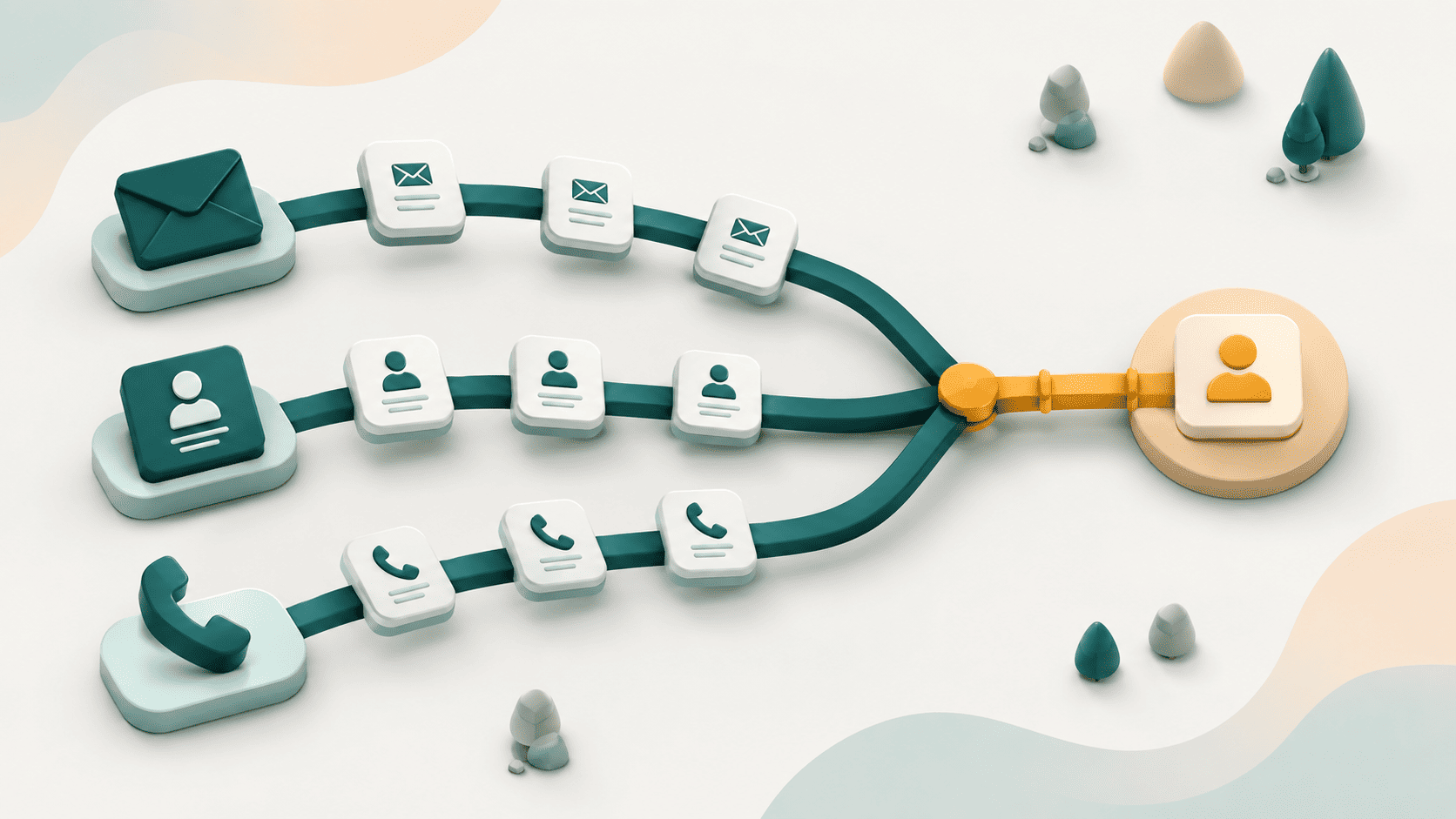
Most outbound teams do not struggle because they lack channels. They struggle to coordinate them.
An SDR might start with an email, move to LinkedIn, send a message, make a call, check whether the prospect engaged, and then figure out what to do next. When each step lives in a different tool, the rep ends up managing the process instead of selling.
The answer is not simply adding more touches. It is building a sequence where each channel has a clear role, the context carries from one touch to the next, and the next action changes based on how the prospect responds.
This guide covers nine ways to build that kind of outreach motion, from choosing the right opening channel to coordinating email, LinkedIn, calls, and messages without turning the process into a spreadsheet exercise.
What is Multichannel Outreach?
Multichannel outreach is a sales approach that uses more than one communication channel to engage the same prospect.
For B2B outbound, the most common channels are:
- Email: useful for delivering context and explaining why you are reaching out.
- LinkedIn: useful for building familiarity and reinforcing relevance.
- Calls: useful for creating a live conversation.
- Messages: useful for short, direct follow-ups when the recipient is eligible to receive them, and applicable regulations allow it.
The important part is not simply using all three. It is coordinating them around the same prospect and conversation.
A multichannel sequence can look like:
Email > LinkedIn > Call > Message > Email > LinkedIn > Call
But the sequence should not be a fixed list of activities; it should also depend on where the prospect is most active. What happens on one channel should influence what happens on the next.
9 Ways to Run Multichannel Outreach
1. Start with the strongest channel for the prospect
Do not automatically start every sequence with email.
Email is often the easiest starting point, but it is not always the best one. The right opening channel depends on factors such as the prospect's seniority, the prospect's activity on that channel, the strength of the signal, the account's value, and the amount of context you already have.
For example:
- A strong signal at a high-value account may justify a call early.
- A prospect who is active on LinkedIn may be easier to warm up there first.
- A complex business case may need email to establish enough context before a call.
The point is not to find one channel that always wins; it is to choose the channel that gives the sequence the best chance of starting a conversation.
2. Give each channel a different job
Email, LinkedIn, and calls should not all do the same thing.
Give each channel a clear role:
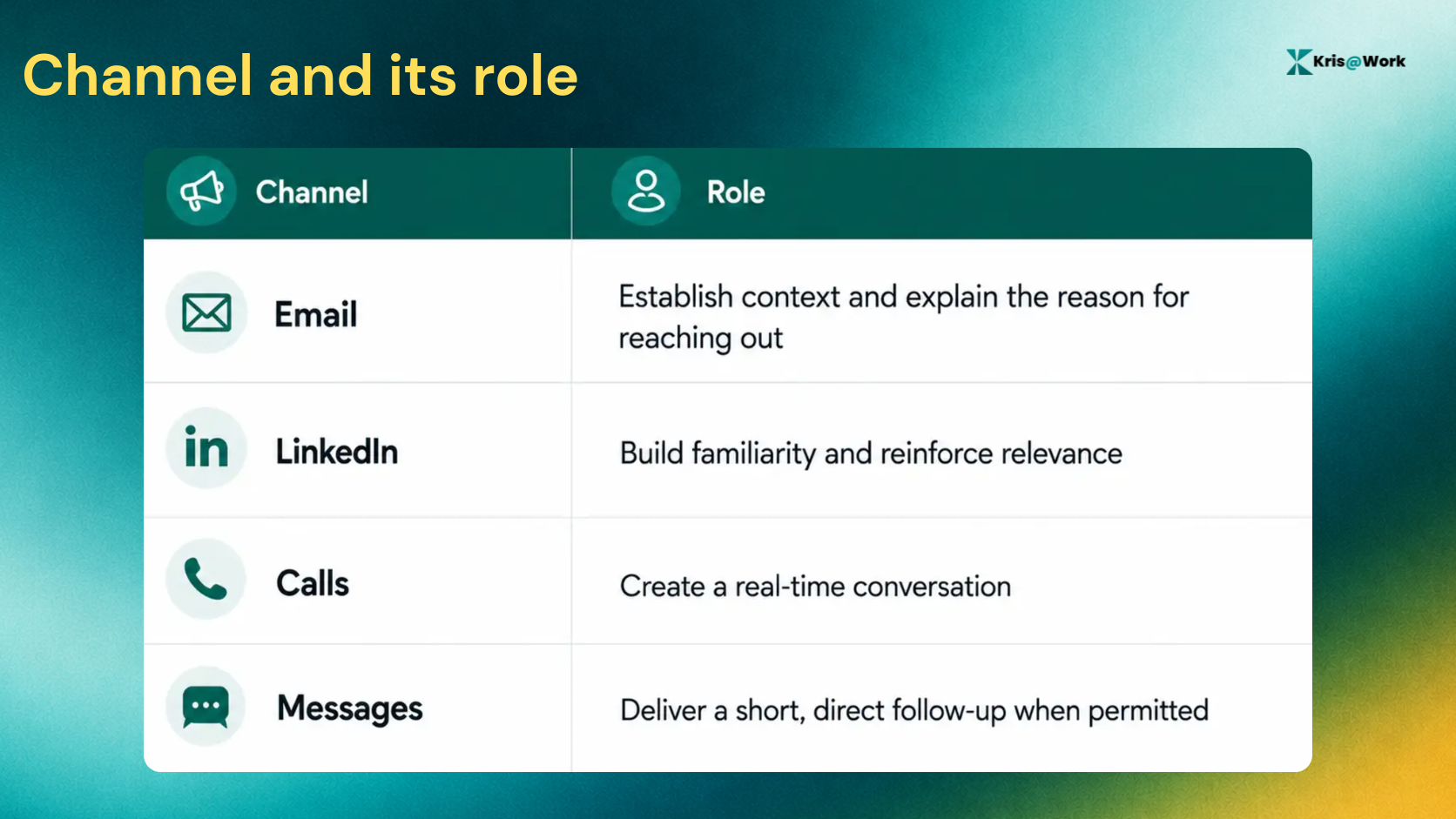
This prevents one of the most common multichannel mistakes: sending the same pitch everywhere.
If the prospect receives an email explaining the reason for your outreach, the LinkedIn touch does not need to repeat the email word for word.
The call can then use the same context to start a conversation.The channels work together, but each one contributes something different.
3. Connect the touches into one conversation
A multichannel sequence should feel like one conversation happening across different channels.
Imagine the sequence starts with an email about a company's growing SDR team.
The LinkedIn touch should not introduce an unrelated pitch. The call should not make the rep sound like they have never contacted the prospect before.
Instead, each touch should carry the thread forward.
- Email: Introduce the reason for reaching out.
- LinkedIn: Build familiarity around the same context.
- Call: Pick up the conversation and explore whether the problem is relevant.
- Follow-up email: Add another useful angle based on what happened.
This sounds obvious, but it becomes difficult when each channel is managed in a separate system.
The more disconnected the tools are, the more likely it is that the rep loses track of what the prospect has already seen.
4. Change the message, not just the channel
Changing channels does not mean changing nothing else.
A prospect who ignores an email does not need the same paragraph delivered through LinkedIn.
Instead, change the way you approach the same problem.
For example, suppose your reason for reaching out is that the prospect is expanding their SDR team.
“Saw you're hiring across the SDR team. That usually puts more pressure on research, prioritization, and keeping outbound relevant as the team scales.”
Keep the interaction lighter. Build familiarity around the same context instead of pasting the email into a LinkedIn message.
“Hey Sarah, saw you're growing the SDR team. Curious on how you're handling the extra research and outbound volume as the team scales.”
Call
"I noticed you're expanding the SDR team. I wanted to ask how you're handling the increase in outbound volume without adding more manual research."
The underlying reason is consistent but the message isn’t. That distinction matters because multichannel outreach should feel coordinated without becoming repetitive.
5. Space touches so they create momentum, not fatigue
More touches do not automatically mean better outreach.
A sequence needs enough space for the prospect to see, process, and respond to a previous touch. At the same time, too much time between touches can make the sequence lose momentum.
The right cadence depends on:
- Deal size
- Account priority
- Strength of the trigger
- Seniority of the prospect
- Channel being used
- Whether the prospect has engaged
A call immediately after an email may make sense for a highly relevant, high-priority account. It may feel excessive for a lower-priority prospect who has shown no engagement.
The goal is to maintain momentum without making the prospect feel like they are being chased by an automated system.
6. Use prospect engagement to decide the next move
A sequence should respond to what the prospect does.
A fixed cadence might say:
Day 1 email > Day 3 LinkedIn → Day 5 call → Day 7 email.
A coordinated sequence asks what happened before deciding what comes next.
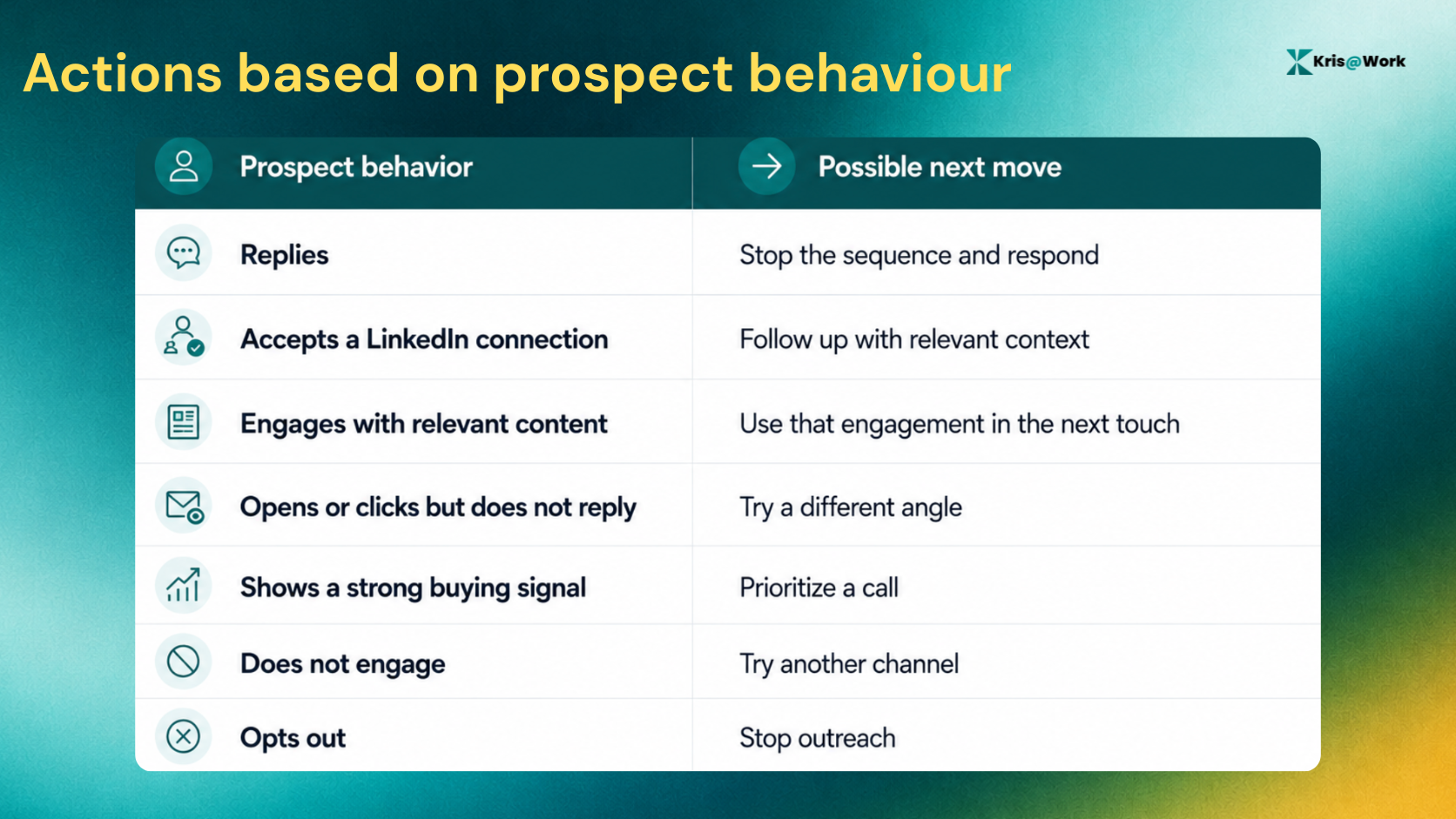
The sequence should not force every prospect through the same path.
This is important when running larger outbound motions. The more prospects a rep works, the harder it becomes to remember every interaction and manually decide what should happen next.
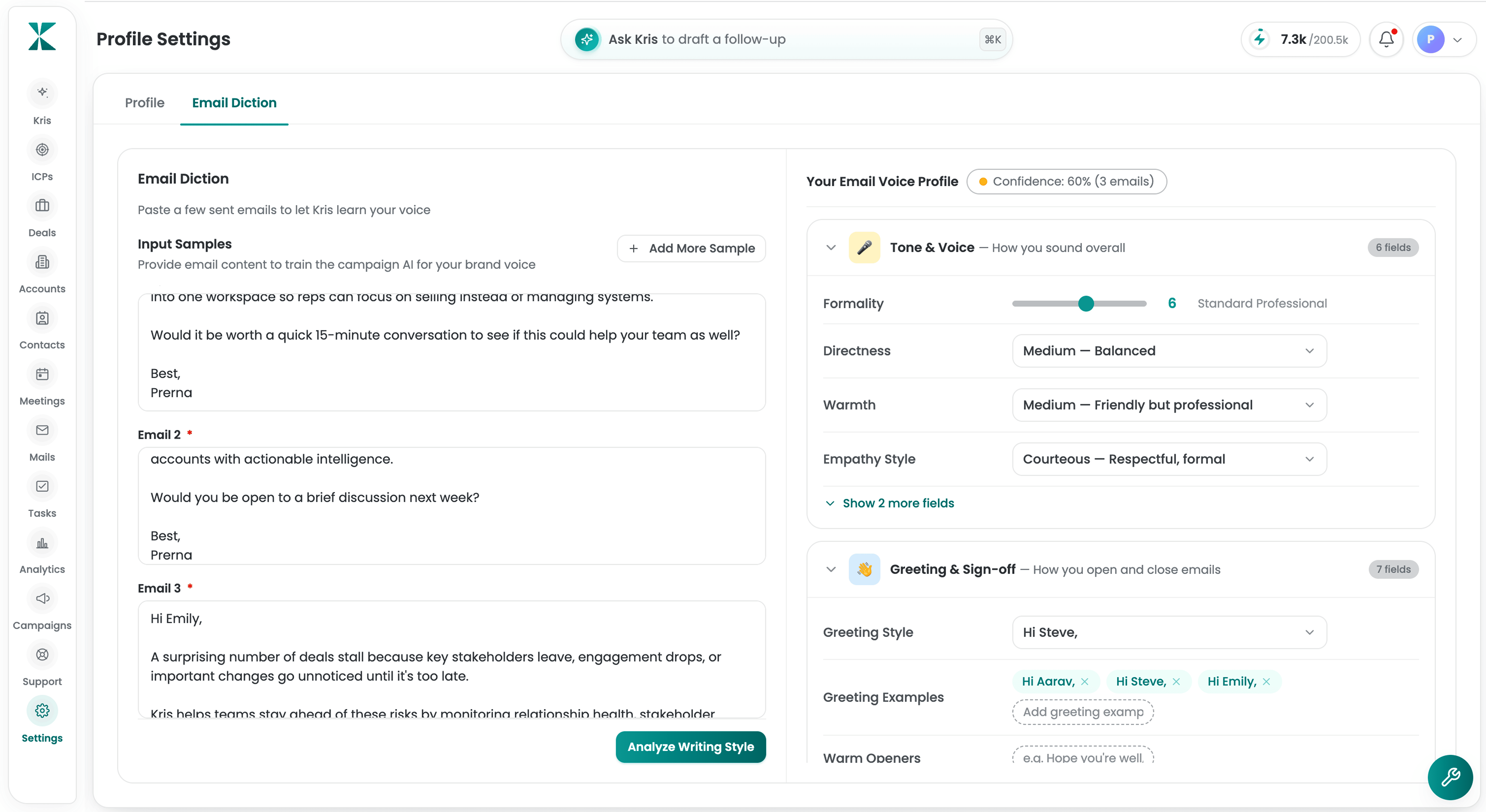
Kris Capture is built around this kind of dynamic sequence logic.
7. Bring calls into the sequence deliberately
Calls should not be added simply to increase activity. They should have a reason. A call can make sense when:
- The account is high priority.
- There is a strong signal.
- The prospect is senior.
- Previous touches have established enough context.
- A live conversation can resolve something faster than another email.
The timing can also change.
A strong signal may justify a call early in the sequence. A weaker account may benefit from an email and LinkedIn touch first.
When the rep does call, they should know what has already happened. They should not have to open the email tool, LinkedIn, CRM, and call platform separately just to reconstruct the conversation.
The call should be the next part of the sequence, not a separate workflow.
8. Keep every channel synchronized
This is where multichannel outreach becomes an operational problem. A rep running a sequence across three channels needs to know:
- What was sent
- When it was sent
- Which channel was used
- Whether the prospect engaged
- What the prospect has already seen
- What should happen next
If that information is spread across several tools, the rep becomes the system connecting everything.
That is exactly the kind of fragmentation Kris is designed to reduce.
Kris@Work offers a single intelligent window for revenue work, with the broader platform designed to replace fragmented workflows across multiple tools.
For multichannel outreach, the practical benefit is straightforward: email, LinkedIn, and calls can be treated as parts of the same outreach motion rather than separate tasks that the rep has to coordinate manually.
9. Know when to stop (or restart later)
A good sequence needs an exit condition. Stop the sequence when:
- The prospect replies.
- A meeting is booked.
- The prospect says no.
- The prospect opts out.
- The contact is no longer relevant.
- The planned sequence has run its course.
No response does not mean you should keep sending the same message forever. It could mean the account needs a different approach later.
A new signal can create a reason to restart outreach. A new executive, hiring push, product launch, or other relevant change can make a future sequence timely again.
The goal is to make each touch worth sending and not to maximize the number of touches.
What does a multichannel sales sequence look like?
There is no universal cadence. The right sequence depends on the account, prospect, signal, and sales motion.
A simple example:
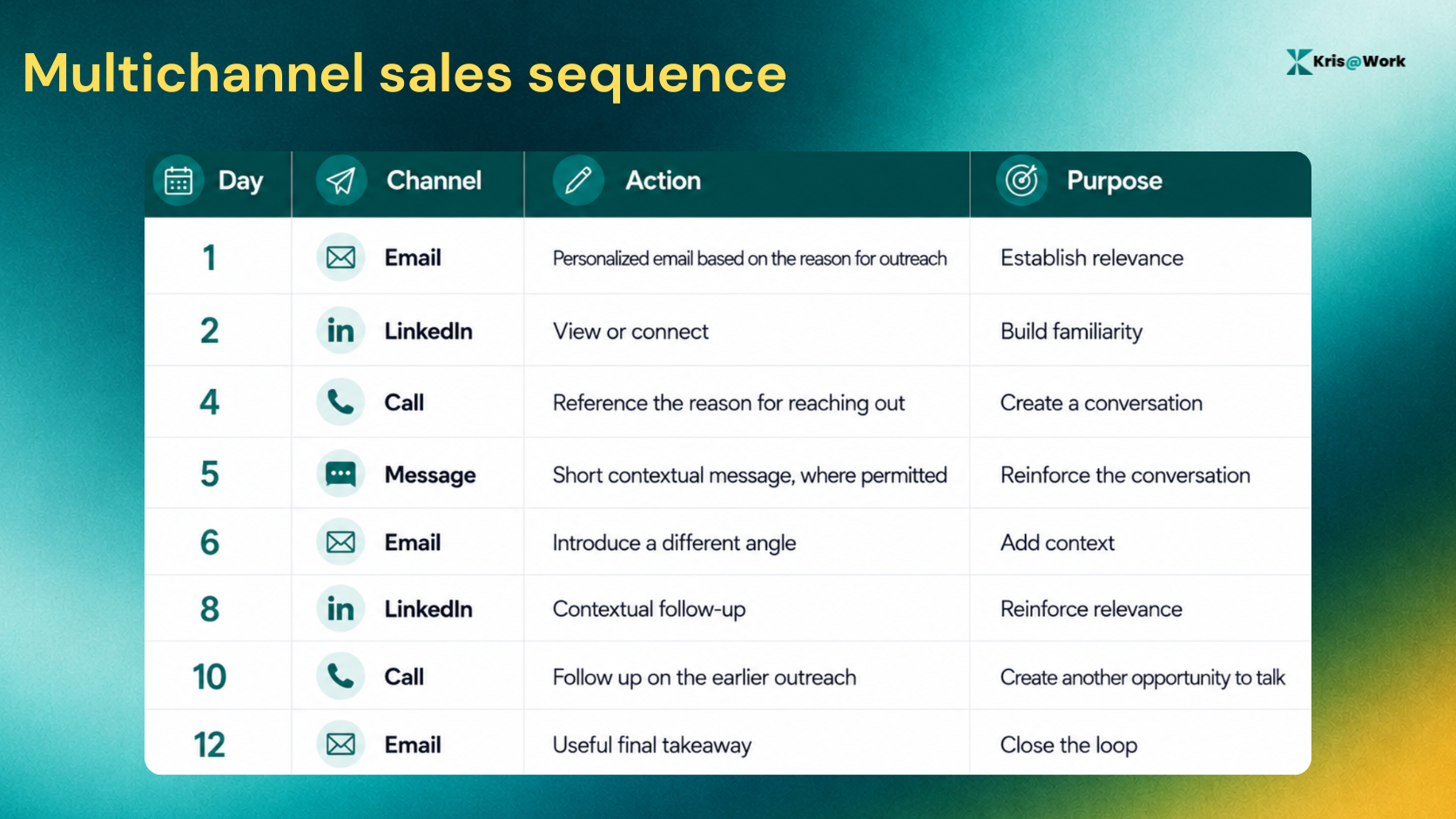
The exact timing matters less than the logic behind it.
Every touch should answer three questions:
- Why this channel?
- Why now?
- What should happen next?
If the answer is simply "because it is the next step in the sequence," the sequence probably needs work.
How Can Kris@Work Help with Multichannel Outreach?
The strategy is straightforward. The hard part is executing it without manually coordinating three channels.
Kris Capture brings together the parts of the prospecting workflow that sit around multichannel outreach: prioritization, account and contact research, and hyper-personalized outreach.
Run outreach across email, LinkedIn, calls, and messages (SMS)
Instead of building separate workflows around each channel, the rep can work from one system designed around the prospect and the next action.
Keep the context behind the outreach
Kris also provides account and one-click research that gives reps account context without tab switching or manual work. That matters when a sequence moves from email to LinkedIn to a call. The rep should not have to start their research again every time the channel changes.
Give reps the next action
Kris@Work comes with dynamic sequencing, which means the platform will decide how many touches, whom to reach out to, where, which channel, and what message based on the signals.
It helps reps identify which accounts are worth working on, understand the relevant context, and act on them. For an SDR, that is more useful than another activity dashboard.
The workflow becomes:
Who should I work? > What changed? > What do I know? > What should I do next?
Common Multichannel Outreach Mistakes
- Using the same message everywhere: A prospect should not receive the same paragraph by email, LinkedIn, and phone. Keep the reason consistent but switch up the execution.
- Adding channels without defining their roles: More channels do not automatically create better outreach. Each channel should have a purpose.
- Treating every prospect the same: A high-priority account with a strong signal should not necessarily follow the same path as a prospect who has shown no engagement.
- Continuing after a reply: Once a prospect responds, the sequence should give way to a real conversation.
- Treating every touch as a new interaction: The rep should know what has already been said before making the next touch.
- Optimizing activity instead of conversations: A higher number of emails, LinkedIn touches, or calls does not necessarily mean better outbound. Measure whether the combined motion creates more meaningful conversations.
- Adding tools without solving coordination: Three channels spread across five tools can create more work than one channel handled well.
Multichannel vs. Omnichannel Outreach: What's the Difference?
The terms are often used interchangeably, but there is a useful distinction.
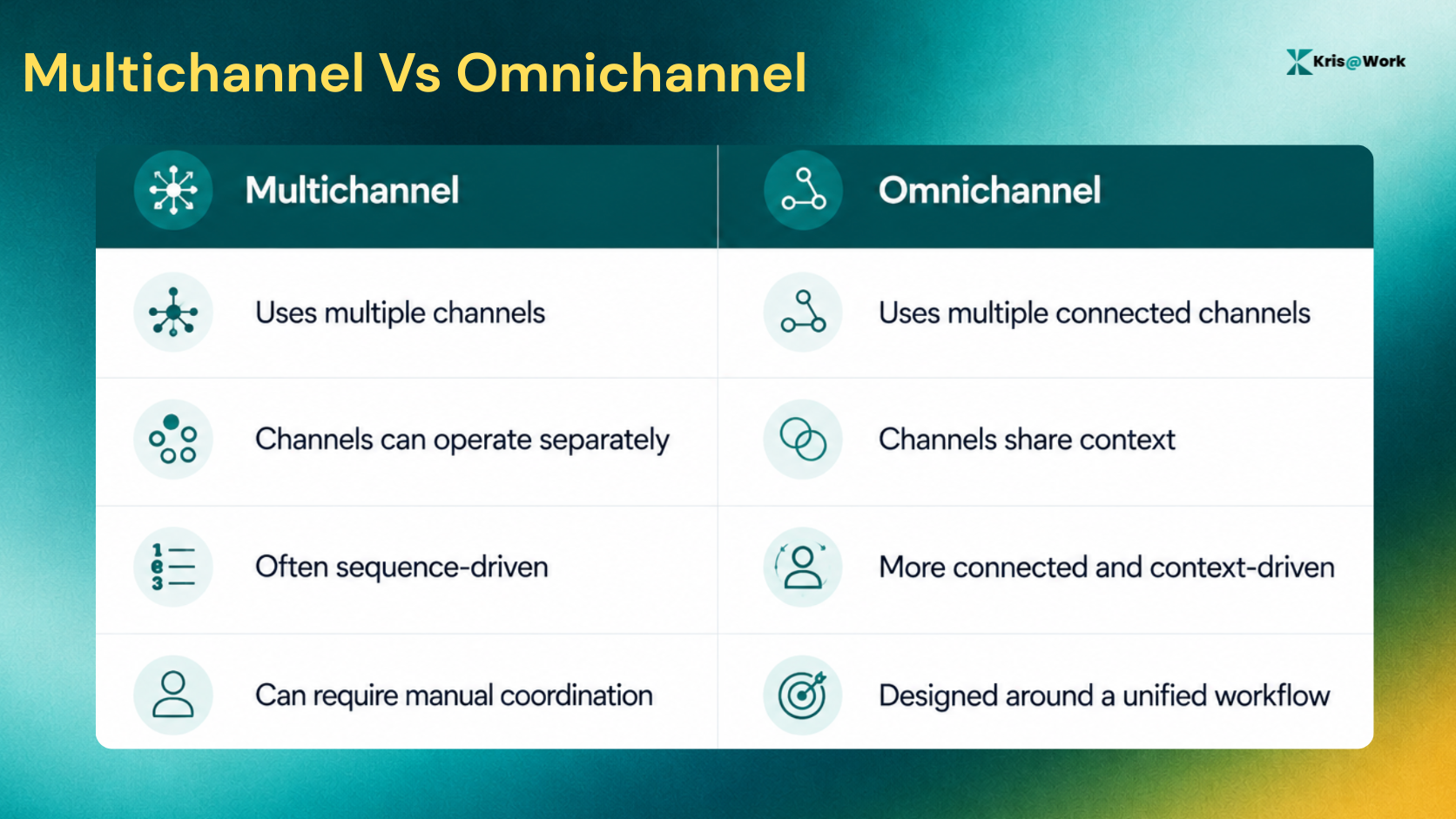
If email, LinkedIn, and calls share context and influence what happens next, you have a coordinated outreach motion.
If the rep has to manually connect the dots, you simply have several outreach channels.
Make every channel part of one conversation
Multichannel outreach works when email, LinkedIn, and calls work together and not as separate activities.
Give each channel a role, carry context between touches, adapt to prospect engagement, and know when to stop. The goal is to create better-coordinated touches that lead to more conversations.
FAQs About How to Run Multichannel Outreach
1. What is multichannel outreach?
Multichannel outreach uses multiple channels, such as email, LinkedIn, and phone, to engage the same prospect as part of a coordinated sales motion.
2. How do you do multichannel outreach?
Choose the right opening channel, give each channel a specific role, connect the touches into one conversation, adapt the sequence based on engagement, and define clear stopping points.
3. How many channels should an SDR use?
There is no universal number. Email, LinkedIn, and calls are a practical combination for B2B outbound, but the priority should be coordinating the channels well rather than adding more of them.
4. Should you combine email and LinkedIn outreach?
Yes, when each channel has a clear purpose. Email can establish context, while LinkedIn can build familiarity or reinforce the interaction. The messages should complement each other rather than repeat each other.
5. Should calls be part of a multichannel sequence?
They can be, particularly for high-priority accounts, strong signals, or situations where a live conversation can move the opportunity forward. The call should have a clear reason behind it.
6. How do you create a multichannel sales sequence?
Start by deciding which channel should open the conversation. Then define the role of each channel, the spacing between touches, the conditions that change the next action, and the point at which the sequence ends.
7. What is the difference between multichannel and omnichannel outreach?
Multichannel outreach uses multiple channels. Omnichannel outreach connects those channels so context can carry across the interactions.
8. How do you automate multichannel prospecting?
Use a system that can coordinate the sequence across relevant channels while keeping prospect context and engagement visible. Automation should reduce the work of coordinating the motion, not simply increase the number of messages sent.