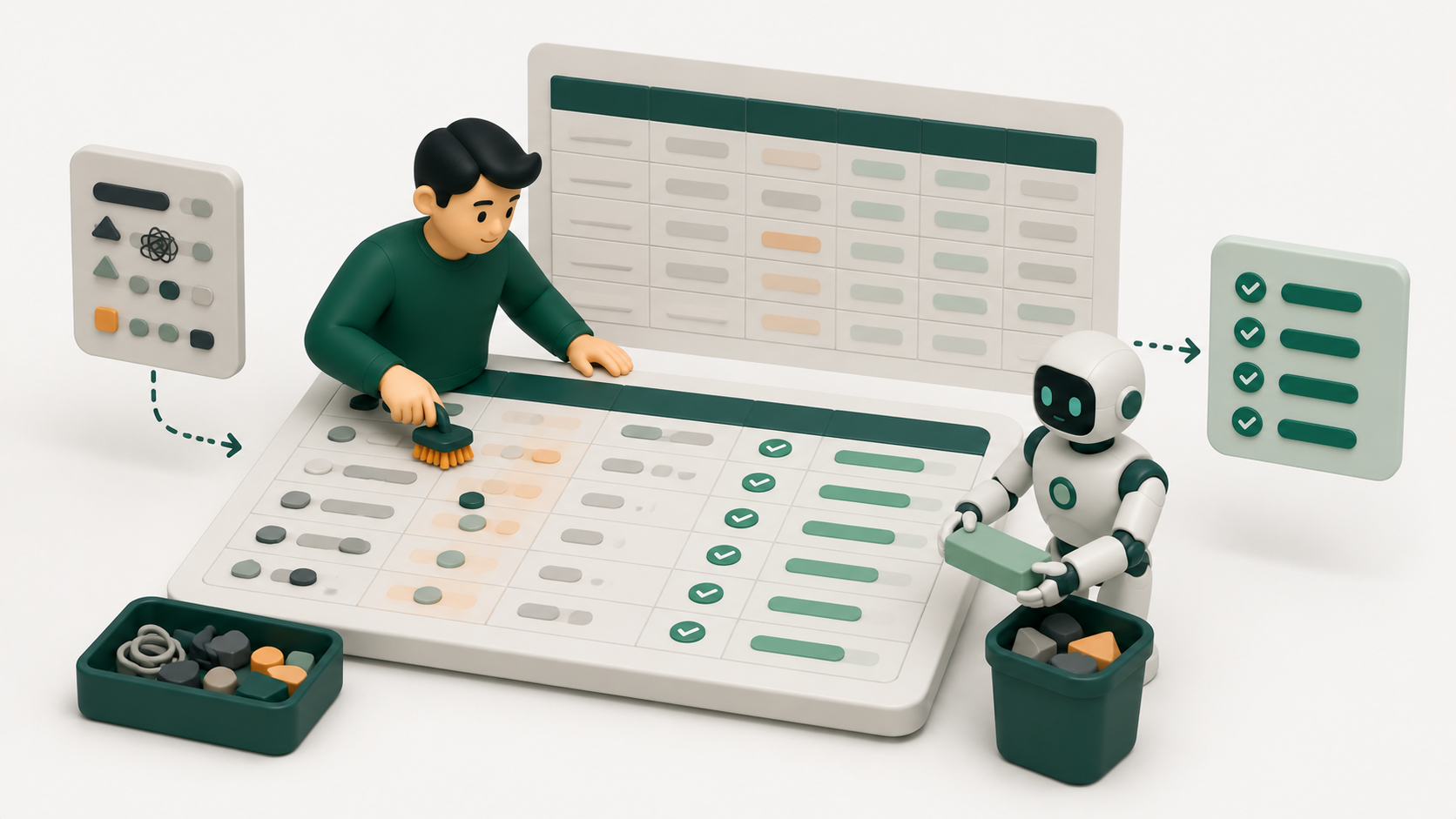

Most B2B teams do not have a lead-finding problem. They have a focus problem. There are more sources of leads than ever, and reps spread thin across all of them tend to work none of them well. Knowing how to find B2B leads in 2026 is less about where to find B2B leads than about which few sources to work, and how.
This guide covers how to find B2B leads in 2026: 13 proven B2B lead sources, the right tool for each, and how to build a mix that fits your team. The highest-yield sources are a tight ICP, live buying signals, and referrals. The highest-volume ones are contact databases and LinkedIn. Most teams need only 3 or 4 of these, chosen to fit their motion.
The 13 below are grouped by type, not ranked by yield, since the right mix depends on your motion. We start with the foundation, because every other method works better once it is in place.
TL;DR
- Use 3 to 4 focused sources: Combine 1 warm source, 1 signal source, and 1 volume source instead of spreading effort across all 13.
- Prioritize buying signals: Use intent, job changes, website visits, and other triggers to identify accounts that are more likely to be ready now.
- Activate leads with relevant outreach: Personalize messaging around a genuine reason to reach out, rather than relying on generic templates.
- Measure and optimize: Track conversion by source, cut channels that do not perform, and double down on the sources that fit your sales motion.
The 13 Sources at a Glance
The better sources surface leads closer to sales-ready, not just more names, which is why some outrank others.
It is a map, not a power ranking. The 13 cover every practical way US B2B teams source leads today, from owned data to third-party tools to inbound, chosen for how commonly they are used and how well they hold up in 2026. The right choice depends on your deal size and motion, which the final section covers.
| # | Source | Group | Best for | How Kris Capture helps | Cost |
|---|---|---|---|---|---|
| 1 | Contact databases | Data | Volume | Sources verified contacts | Paid |
| 2 | LinkedIn Sales Navigator | Data | Precision | — | Paid |
| 3 | Enrichment and waterfall | Data | Filling gaps | Enriches ICP-matched accounts | Paid |
| 4 | Intent and buying signals | Signals | Timing | Surfaces signals with the reason | Paid |
| 5 | Job-change triggers | Signals | Timing | Flags job-change triggers | Paid |
| 6 | Website visitor identification | Signals | Warm inbound | - | Freemium |
| 7 | Warm intros and referrals | Network | Conversion | - | Free |
| 8 | Communities and events | Network | Trust | - | Free/Paid |
| 9 | Partner ecosystems | Network | Warm reach | - | Freemium |
| 10 | Content and lead magnets | Inbound | Intent | - | Free/Paid |
| 11 | Review sites | Inbound | High intent | - | Freemium |
| 12 | AI lookalike modelling | Scale | Scaling a good ICP | Dual-mode lookalike | Paid |
| 13 | Paid advertising and demand gen | Paid | Reach | - | Paid |
Start With the Foundation: Your ICP
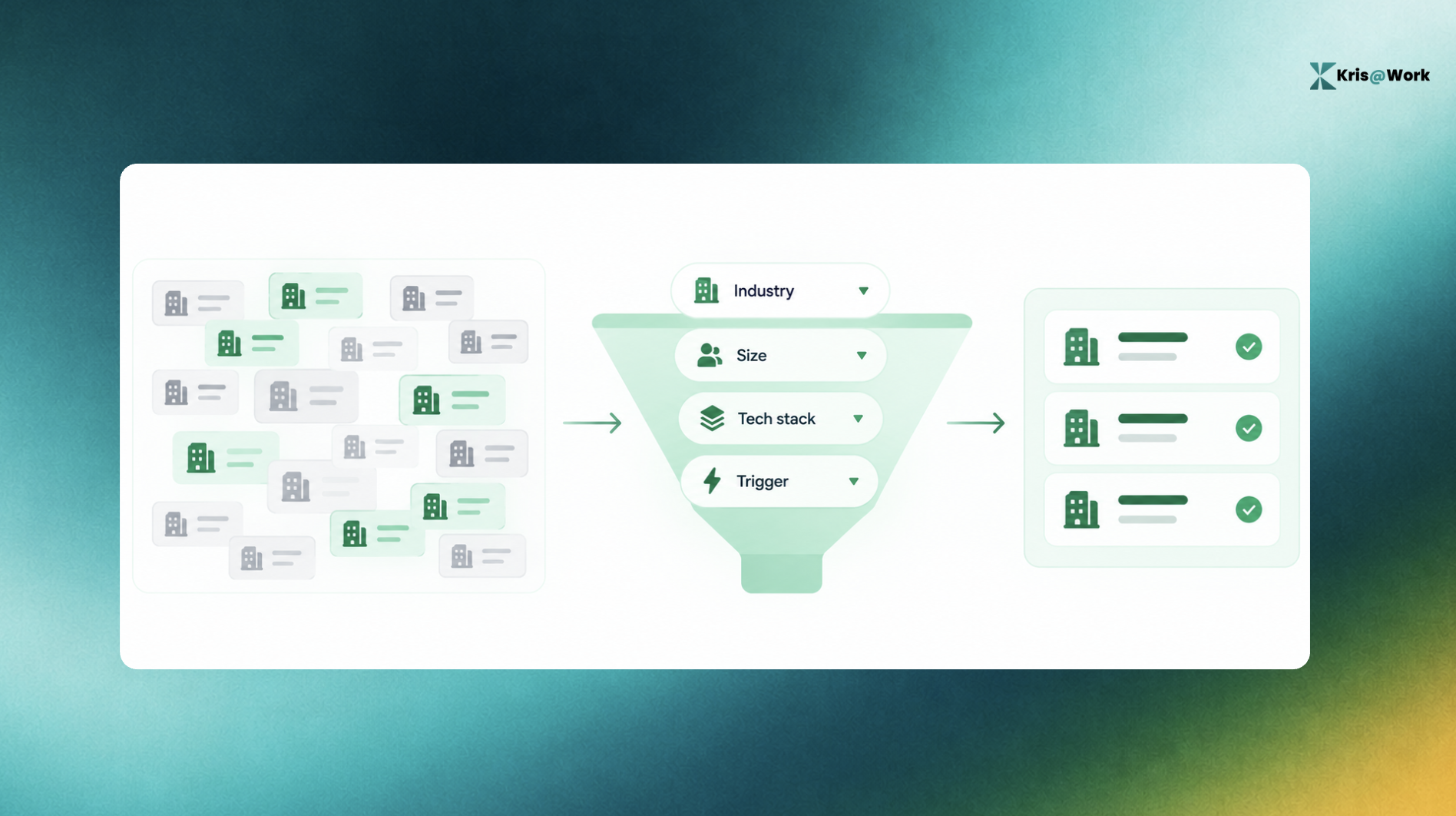
Start with the foundation, because none of the 13 sources below work without it. An Ideal Customer Profile (ICP) is the set of traits your best customers share: industry, size, revenue, tech stack, and the triggers that tend to precede a purchase. Build it from your closed-won accounts, not a guess, so it reflects who buys, not who you wish would.
The concrete step is to list your last 20 to 30 closed deals, find the traits they have in common, and turn those into filters you can search on. A clear ICP makes every source below sharper, because it tells you which names to keep and which to drop. If you want the full method, see how to build an ICP list. This is also where Kris Capture starts. It reads your own domain and closed data to recommend ICP criteria. Then it draws matching accounts from sources like LinkedIn, news, and website data, so the list begins from evidence, not a blank filter.
With your ICP set, here are the 13 sources to work it.
1. B2B Contact Databases
Contact databases are the volume play. You search by your ICP filters and export verified names, titles, and emails in bulk. ZoomInfo carries the deepest firmographic data. Apollo is cheaper and pairs its database with sequencing. Cognism and Lusha lead on European coverage and direct dials.
The concrete step is to build one saved search that matches your ICP, then export in small batches and verify before you send. Treat the database as a starting list, not a finished one. Contact data decays fast, and a stale title sinks an otherwise good message.
2. LinkedIn Sales Navigator
If databases give you volume, LinkedIn Sales Navigator gives you precision, and it is the fastest answer to how to find prospects with current, self-maintained data. Members update their own roles and companies, so the information stays fresher than most databases. You can filter by title, seniority, headcount, and recent job changes, then save searches that alert you when new people match.
The concrete step is to build a lead list from a focused title search, then watch it for changes. A new VP in your target function is a reason to reach out this week, not next quarter.
3. Data Enrichment and Waterfall
Enrichment fills the gaps in a lead record: a missing email, a direct dial, the tech stack, the firmographics. A waterfall runs several providers in sequence, so when the first misses a field, the next one tries. Clay is the popular orchestration layer for this, with FullEnrich and other providers feeding it.
The concrete step is to enrich only the accounts that already fit your ICP. Enriching everything burns credits on names you will never work. Enriching the right 200 accounts turns a thin list into a workable one.
Data tells you who fits. Signals tell you who is ready.
4. Intent and Buying Signals
A good-fit account is not the same as a ready account. Intent signals show which accounts are researching your category now, so you reach them inside a buying window rather than at random. Bombora tracks content consumption across the web, 6sense models account-level intent, and review platforms like G2 sell the intent data behind their category pages. Funding rounds, leadership hires, and tech changes all count as signals too.
The concrete step is to pick 3 signals that map to a genuine reason to buy, then work the accounts showing them first. This is also where Kris Capture adds a layer: it surfaces these signals per account and attaches the reason behind each one, so the queue reflects timing, not fit alone. For a fuller comparison of signal sources, see the best intent data providers.
5. Job-Change and Hiring Triggers
People buy when their situation changes, which makes job moves one of the most reliable timing signals in B2B. A champion who leaves for a new company is a warm lead at that new company, because they already know your product works. A team hiring 10 SDRs has a scaling problem you may solve. UserGems tracks job changes across your CRM contacts and flags them, while LinkedIn and hiring boards surface the rest.
The concrete step is to watch your closed-won and champion contacts for moves, then reach out in the first 90 days of their new role, when budgets and priorities reset.
6. Website Visitor Identification
Most of the people who visit your site never fill in a form. Visitor identification tools reveal the companies, and sometimes the individuals, browsing your pages, so you can act on interest you would otherwise miss. RB2B identifies individual US visitors, while Warmly and Dealfront identify companies and route the hot ones to a rep.
The concrete step is to install the pixel and set an alert for visits to your pricing and product pages. Someone who reads your pricing page twice in a week is warmer than any cold list you could buy.
The warmest leads, though, come through people, not tools.
7. Warm Intros and Referrals
Referrals are the highest-converting source in B2B, and the most underused. 84% of B2B buyers begin the buying process with a referral, not a salesperson, according to a 2016 Harvard Business Review article. A referred prospect arrives already half-sold, because the trust transfers through the introduction.
The concrete step is to map which of your customers and colleagues already know people at your target accounts, then ask for a pointed intro within 48 hours of spotting the fit. A vague "you two should connect" converts poorly. A framed one, "they are scaling outbound and fighting data quality, which is exactly what you fixed," converts well.
8. Communities and Events
Buyers gather where they trust the room. Slack and Discord groups, industry events, and peer networks like Pavilion put you next to in-market people without a cold open. The lead here is a relationship, not a record, so the rules are different: show up with help, not a pitch.
The concrete step is to pick 2 communities your buyers use, contribute for a few weeks before you sell anything, and track who engages. After an event, follow up within 2 days, while the conversation is still fresh.
9. Partner and Integration Ecosystems
Your partners already sell to your buyers, so their trust can become your pipeline. Co-selling and account mapping turn an integration relationship into warm introductions. Crossbeam and Reveal map the accounts you and a partner share, so you can see who they can introduce you to.
The concrete step is to pick 3 partners with the same ICP, map your overlapping accounts, and trade warm intros. A partner's customer is a warmer lead than any name on a purchased list. You can also make leads come to you.
10. Content and Lead Magnets
Inbound flips the motion: instead of chasing the lead, you give them a reason to raise their hand. A useful asset, a benchmark report, a calculator, a template, earns a contact detail in exchange. These leads carry intent, because someone chose to engage with a problem you solve.
The concrete step is to build one magnet that solves a genuine problem for your ICP, gate it behind a short form, and route every download to a fast follow-up. Speed decides the outcome here. A lead contacted while the interest is still fresh qualifies far more often than one left until the next day.
11. Review Sites
On G2 and Capterra, buyers compare tools with active purchase intent. Someone reading your category page is shopping, not browsing. Beyond the profile itself, many review platforms sell the intent data behind that activity, though the lead here is the shopper reading the page.
The concrete step is to claim and maintain your category profile, respond to reviews, and watch competitor comparison pages. A buyer comparing you to a rival is a lead worth a same-week reach.
You can also use AI to scale what already works.
12. AI Lookalike Modelling
Lookalike modelling finds new accounts that resemble the ones you already win, which lets you scale a good ICP without hand-building every list. Instead of a static filter, it learns the shape of a good customer and expands outward. Kris Capture's dual-mode lookalike works 2 ways. You can seed it from a sample set of accounts you choose, or from your closed-won data. Either way, it returns more accounts like them, depending on what you ask.
The concrete step is to seed the model with your strongest 20 to 30 customers, then review the first batch of matches before you work them. The model proposes; the rep still decides.
When you need to buy reach outright, paid media fills the top of the funnel.
13. Paid Advertising and Demand Gen
Paid media buys attention you have not earned yet, so it fits the argument of this piece only when it is pointed at a tight, ICP-matched list rather than a broad audience. LinkedIn Campaign Manager and Google Ads run the channels, and an ABM platform like RollWorks or Demandbase lets you target by account, putting your offer in front of the same ICP-matched accounts you are already working. The trade-off is cost and lower intent: you pay per impression or click, and most viewers are not in-market yet.
The concrete step is to load your ICP account list as a matched audience and retarget your site visitors, rather than spraying a broad list. Paid works best as a warm-up layer feeding your other sources, not a standalone channel. A prospect who saw a few of your LinkedIn ads before your email is warmer than a pure cold contact.
Free vs Paid B2B Lead Sources
Free sources cost time, not money. Referrals, communities, content, and your own network are free to start and slow to scale. Paid sources cost money and scale fast: databases, intent data, and enrichment. Most teams run a blend, because the paid and free sources do different jobs. The free sources build the warm pipeline that converts. The paid sources build the volume that keeps the funnel full.
A rough rule holds up well: fund the paid sources that shorten research time, and invest personal effort in the free sources that raise conversion. Buying more data does not fix a weak referral motion, and a strong referral motion will not fill a new territory fast enough on its own.
How to Find B2B Leads Without Wasting Budget: Building Your Mix
You do not need all 13. You need a mix that matches your motion, and the fastest way to waste budget is to spread reps thin across sources that do not fit it. A high-volume SMB team leans on databases, LinkedIn, and enrichment. An enterprise team leans on referrals, intent signals, and partner ecosystems, where fewer, warmer leads matter more than raw count.
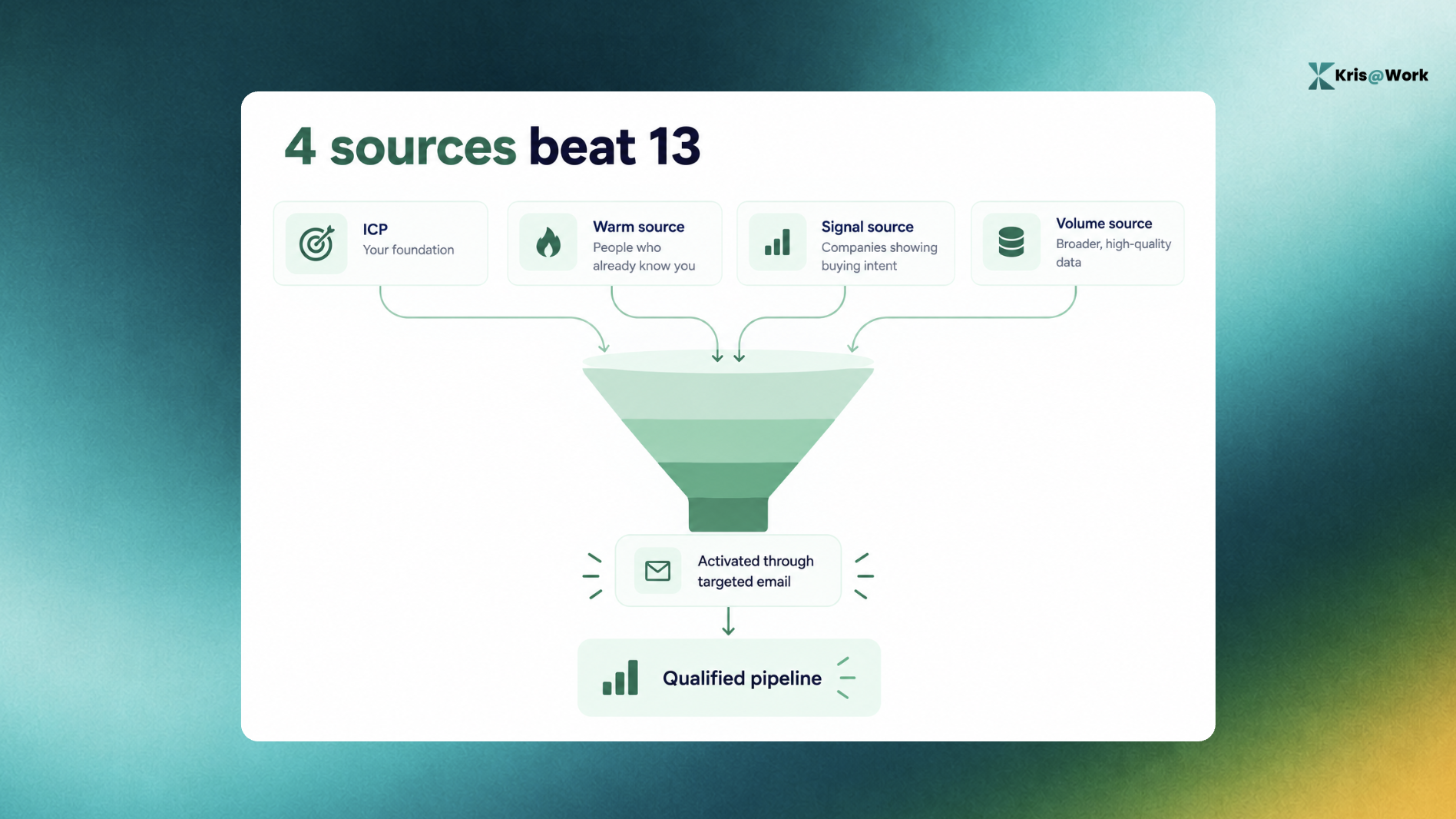
Start with your ICP, since it makes every other source sharper. Then add 1 warm source for conversion (referrals or communities), 1 signal source for timing (intent or job changes), and 1 volume source to keep the funnel full (a database or LinkedIn).That is 4 sources, not 13, and it will find more sales leads than a scattergun across all of them.
A channel note is worth adding. Whichever sources you pick, the activation that converts them still has to be disciplined. For outbound, targeted email remains the most dependable channel, as long as the message is built on a genuine signal rather than a template. That is the difference between a reply rate under 1% and one several times higher. For the mechanics of running that at scale, see how to automate prospecting, and for a wider tool comparison, the best AI sales prospecting tools.
How to Choose Where to Start
Finding B2B leads in 2026 is not about discovering a secret 14th source. Every method here is known, and your competitors use the same ones. The edge is not the source. It is the discipline to work a focused few, filtered through a clear ICP and timed with genuine signals, instead of chasing all 13 at once. Pick your 3 or 4, activate them with outreach built on a genuine reason to reach out, and you will find more and better leads than a team running everywhere at half attention.
FAQs About How to Find B2B Leads
1. Where can I find B2B leads for free?
Referrals, your own network, LinkedIn, online communities, and inbound content are all free to start. They cost time rather than money, and they tend to convert better than paid cold lists, because the leads arrive with some trust or intent already attached.
2. How do you find B2B prospects without buying a database?
Use warm intros, LinkedIn Sales Navigator, website visitor identification, and job-change triggers. These surface named people with a reason to talk, without a per-record data cost. A database adds volume later, once your motion is working.
3. What are the best B2B lead sources for high conversion?
Warm intros and referrals convert best, followed by inbound content and website visitors who reached your pricing page. Cold databases sit at the other end. Warmer sources convert several times better than cold lists, so weight your effort toward them even though they are slower to scale.
4. How many lead sources should a sales team use?
3 or 4, chosen to fit your motion, beat spreading across all 13. Pick a mix that fits your deal size and cycle, 1 foundation, 1 warm, 1 signal, 1 volume, then measure conversion by source and cut what does not pay off.