
An AI CRM does what a traditional CRM never could, it keeps itself current. Instead of waiting for a rep to log the call, the best AI CRM software reads the work that already happened and updates the record on its own. For sales teams in 2026, that one shift decides which tool actually gets used and which one quietly rots.
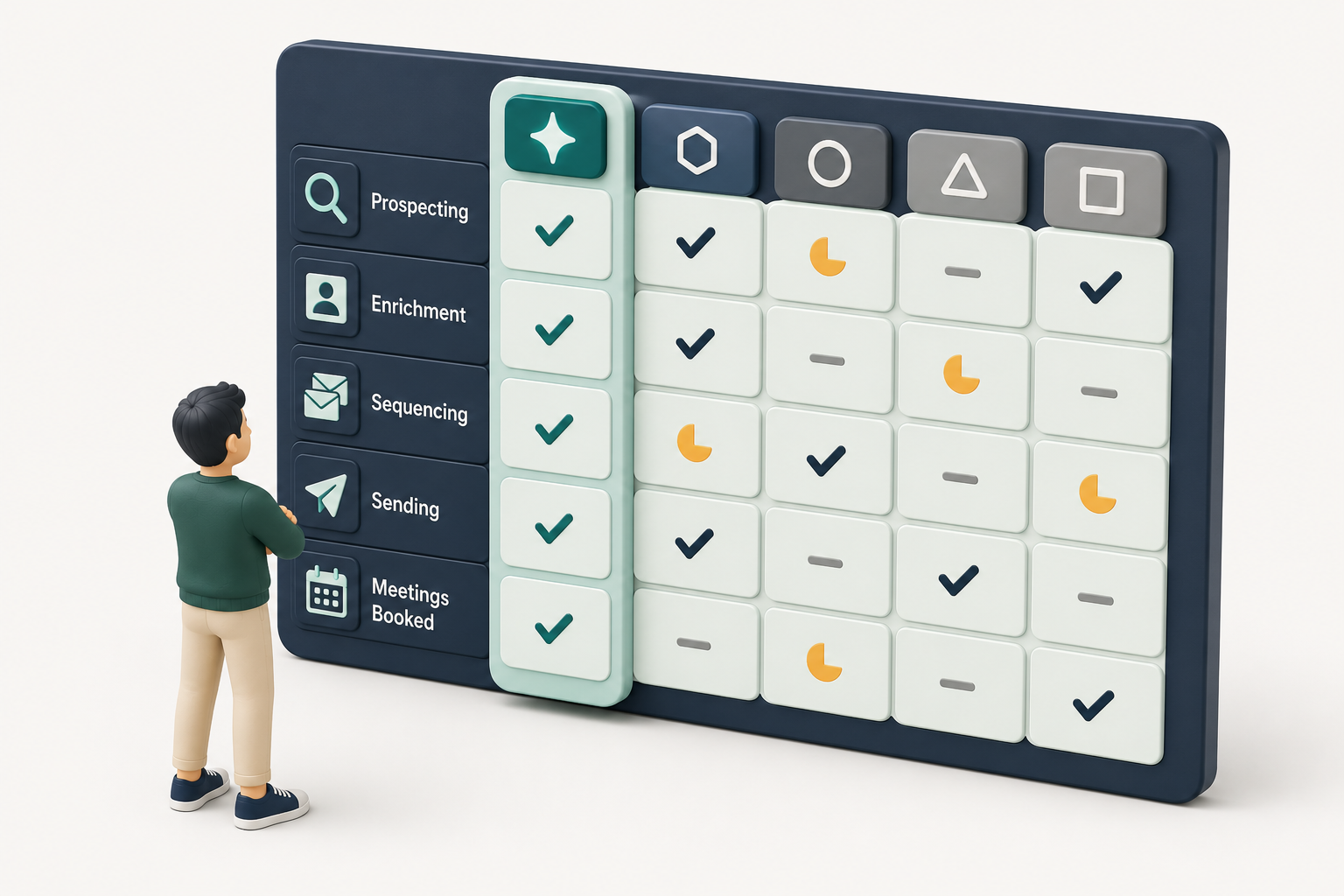
This guide ranks the 9 best AI CRMs for sales teams, from fully autonomous, zero-touch systems to AI layers added on top of mature platforms. Kris AI CRM leads for zero-touch record-keeping. Salesforce and HubSpot lead on ecosystem depth. Here is how each one fits, and who each one is for.
TL;DR
An AI CRM keeps the record current on its own instead of waiting for reps to log it. The 2026 dividing line is autonomy: most tools suggest an update a rep still approves, a few update the record themselves. Kris AI CRM leads for zero-touch, autonomous record-keeping. Salesforce and HubSpot lead on ecosystem depth.
- Kris AI CRM: best for a record that maintains itself. Reads calls, emails, and meetings, then moves stages and enriches data on its own, with a full audit trail.
- Salesforce (Agentforce): best for enterprise AI depth and customization. Heavy to implement.
- HubSpot (Breeze): best all-in-one for mid-market, with a real free tier. AI suggests, reps approve.
- Microsoft Dynamics 365 (Copilot): best for Microsoft-native enterprises living in Outlook and Teams.
- Zoho CRM (Zia): best value, broad AI bundled into the licence. Strongest if you are already on Zoho.
- Attio: best flexible, AI-native CRM for startups. Powerful but operator-driven.
- Freshsales (Freddy): best budget CRM with built-in calling and email. Deeper AI sits in paid add-ons.
- Pipedrive: best simple visual pipeline. Light AI nudges, reps still update by hand.
- Go HighLevel: best all-in-one for agencies. Broad, but shallow on complex B2B sales.
Quick pick: want the record to run itself, choose Kris AI CRM. It’s free with tons of value. Want the deepest ecosystem, choose Salesforce or HubSpot. Want the lowest bundled price, choose Zoho.
What Is An AI CRM, and How Is It Different From a Traditional CRM?
A traditional CRM is a system of entry. It only knows what a rep last typed into it, which means updating fields competes with working deals, and deals win every time. An AI CRM like Kris is a system of record that stays true. It scores leads, drafts outreach, summarises calls, and in the most advanced cases moves deal stages and enriches records without anyone touching a field.
The category splits into two camps. AI-augmented CRMs bolt intelligence onto a classic record: think Salesforce with Agentforce or HubSpot with Breeze, where the AI suggests and the human still approves. AI-native CRMs are built so the record maintains itself, with autonomy as the default rather than a feature you switch on. Knowing which camp you are buying into matters more than any single feature, because it decides how much manual upkeep your reps still own.
How Did We Choose the Best AI CRMs for Sales Teams?
We ranked each tool on the things that separate a real AI CRM from a classic CRM with a chatbot stapled on:
- Autonomy- Does the AI update the record itself, or only suggest changes a rep has to approve?
- Data freshness- Does it enrich and re-check contacts, titles, and firmographics on its own, or does the data decay the day it lands?
- Conversational access- Can a rep ask about a deal or the whole book in plain language and get an answer with the reasoning attached?
- Reporting from the live record- Do pipeline velocity, stage conversion, and forecast assemble on their own, or wait on a RevOps ticket?
- Trust and transparency- Is there an audit trail showing what changed and why?
- Fit by team size and stack- Enterprise depth, mid-market breadth, or SMB simplicity.
Capabilities were checked against each vendor's live 2026 product pages and current documentation. Positioning outcomes quoted below are vendor claims, not guarantees, and are labelled as such.
The 9 Best AI CRMs for Sales Teams in 2026 At a Glance
| CRM | Best for | How the AI works | Standout capability |
|---|---|---|---|
| Kris AI CRM | Teams that want the record to maintain itself | Autonomous: reads calls, emails, meetings, then moves stages and updates fields on its own | Zero-touch system of record with a full audit trail and bi-directional sync. Either connect your existing CRM to Kris and use it as your system of intelligence and record OR use Kris CRM from scratch for your source of truth. |
| Salesforce (Agentforce) | Enterprises wanting the deepest AI and customization | Agentic plus predictive, built on the Salesforce data model | Autonomous agents across the entire platform |
| HubSpot (Breeze) | Mid-market teams wanting one connected platform | Assistant, agents, and enrichment on the Smart CRM | Breeze agents grounded in unified CRM data |
| Microsoft Dynamics 365 Sales (Copilot) | Microsoft-native enterprises | Copilot plus autonomous sales agents inside Microsoft 365 | Context from Outlook, Teams, and Excel |
| Zoho CRM (Zia) | Cost-conscious teams already on Zoho | Predictive, generative, and no-code agents, all bundled | Breadth of AI across 55-plus Zoho apps at one price |
| Attio | Startups and modern GTM teams wanting flexibility | AI folded into a flexible data model | AI attributes and conversational query on custom objects |
| Freshsales (Freddy) | Budget SMB teams wanting built-in comms | Freddy AI for scoring, deal insight, and drafting | Affordable CRM with calling, email, and AI in one |
| Pipedrive | Small teams wanting a simple visual pipeline | AI Sales Assistant surfacing next steps | Clean pipeline UX with lightweight AI nudges |
| Go HighLevel | Agencies and SMBs wanting all-in-one GTM | AI across marketing, CRM, and messaging | Bundled marketing plus CRM automation |
Pricing shifts often and varies by tier and add-on. Verify the current figure on each vendor's pricing page before you commit.
The 9 Best AI CRMs for Sales Teams, Ranked
1. Kris AI CRM: best for a record that maintains itself
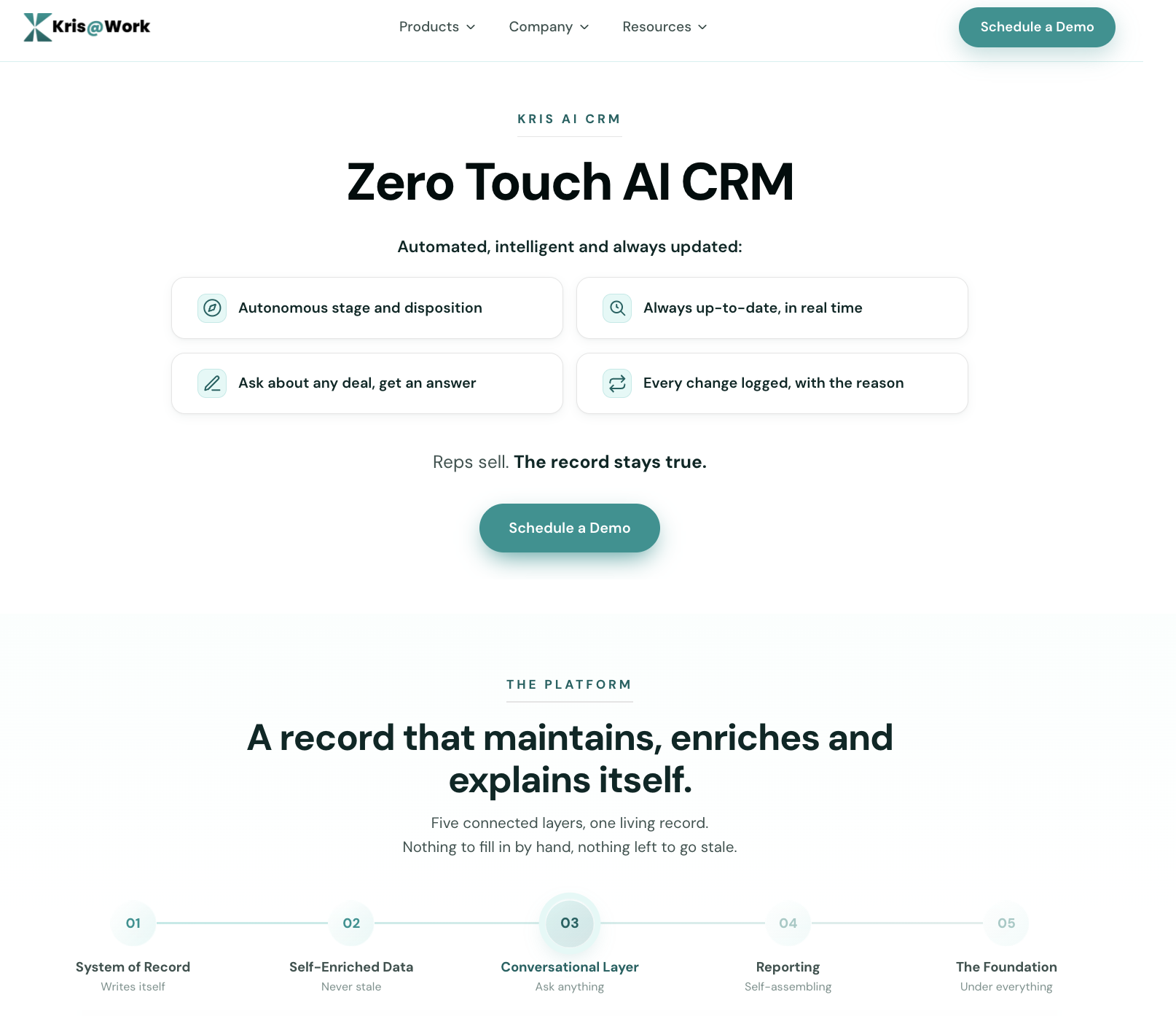
Kris AI CRM is a zero-touch system of record. It’s an autonomous CRM with always up-to-date data and real time intelligence. It reads every call, email, and meeting, then moves the deal forward or back on what the buyer actually did and disposes the activity as it lands. Titles, headcount, funding, and ownership refresh on their own, so the record you open reflects current reality rather than whatever a rep last entered. When someone changes a job or a company restructures, Kris catches it and cascades the change to every account it touches.
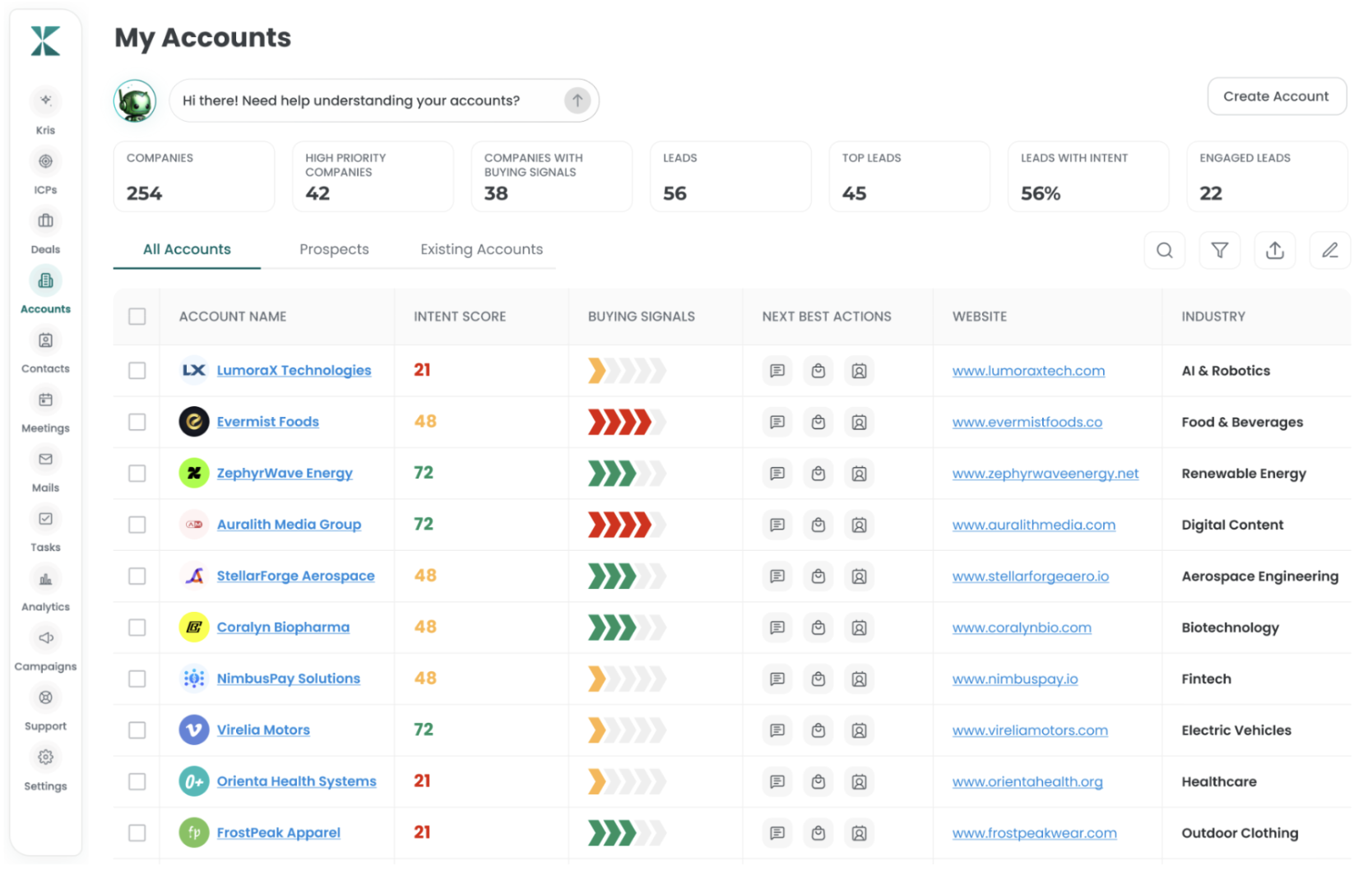
Three things make it stand out for sales teams. First, the conversational layer answers questions about any deal, account, or the whole book in plain language, and deal health grades and ARR projections come with the reasoning attached, so a number is never a black box.
Second, every change is logged with what triggered it, which gives you an audit trail that holds up the moment a forecast gets questioned. Pipeline velocity, stage conversion, and forecast against commit assemble on their own from the live record.
Third, Kris also has bi-directional sync. This means data flows from Kris to your CRM and also auto-updates from your CRM to Kris. Also, there are two ways to use Kris AI CRM:
- Connect your existing CRM to Kris and let that act as your system of intelligence and record; with bi-directional sync.
- Or, use Kris CRM from scratch for your source of truth.
Kris positions this as roughly 2 hours per rep per day reclaimed from manual entry and hygiene, with zero fields to update by hand. The AI CRM is also the single record beneath the wider Kris platform, so context travels from first touch through close without being re-keyed at handoff.
Best for: revenue teams tired of babysitting their CRM who want the record to update, enrich, and explain itself, all for free.
Tradeoff:
- Kris@Work was founded in 2024, so its ecosystem is younger than those of established incumbents.
- If you need decades of pre-built integrations, a vast app marketplace, and a large hiring pool of certified admins, Salesforce and HubSpot still win on maturity.
- Kris@Work is the better fit when you would rather have the system run the record itself than configure and maintain a sprawling platform.
2. Salesforce with Agentforce: best for enterprise depth and customization
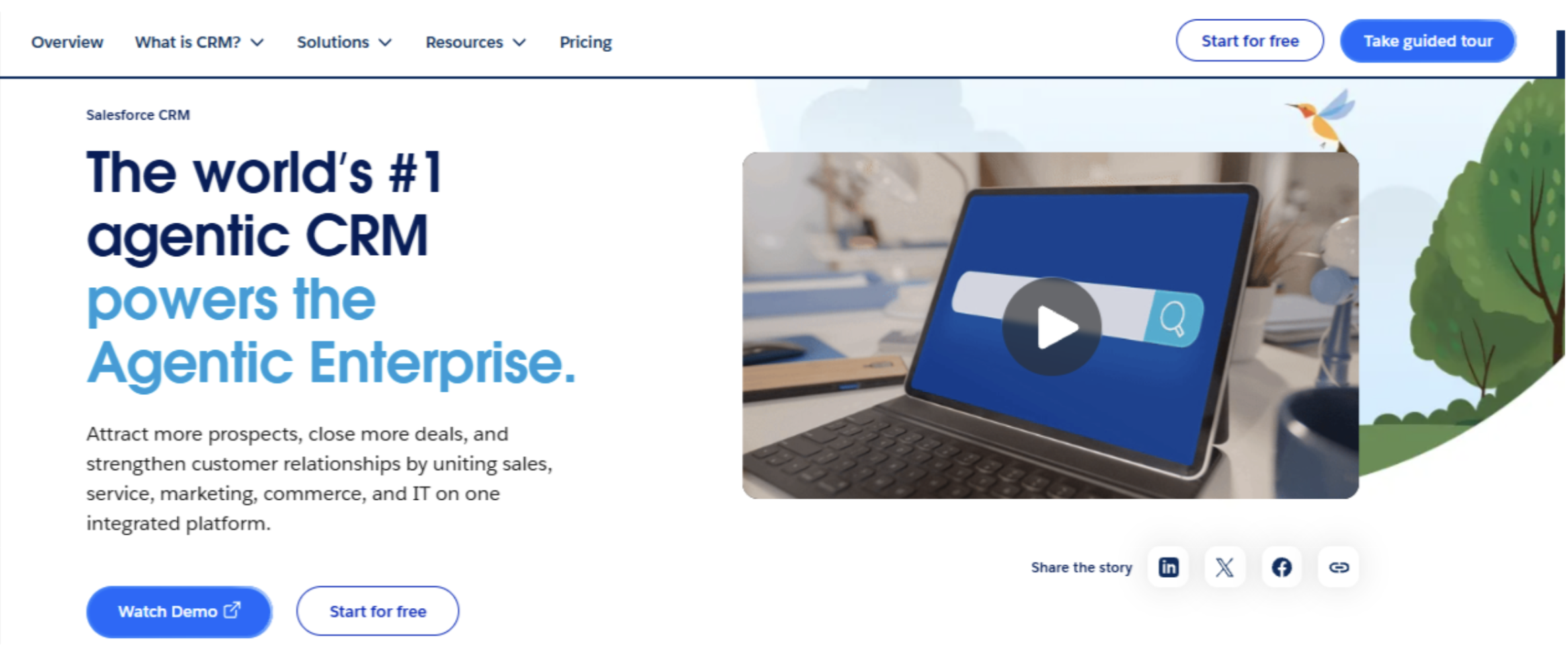
Salesforce is the most mature AI CRM on this list. Einstein has evolved into Agentforce, and the platform now spans predictive AI (lead and opportunity scoring), generative AI (email drafts, call summaries, plain-English pipeline queries through Einstein Copilot), and autonomous agents that qualify leads and take multi-step action inside your org. Because agents operate on the same data model your reps see, they can read a lead or update an opportunity without custom connectors.
Best for: enterprise and mid-market teams already on Salesforce that want AI embedded in every deal, plus maximum customization.
Tradeoff:
- Agentforce's depth comes with significant implementation, data quality, and change-management requirements.
- The total cost can climb quickly with add-ons and agent usage.
- For small teams that want value in a week rather than a major implementation, a lighter AI-native tool may move faster.
3. HubSpot with Breeze: best all-in-one for mid-market teams
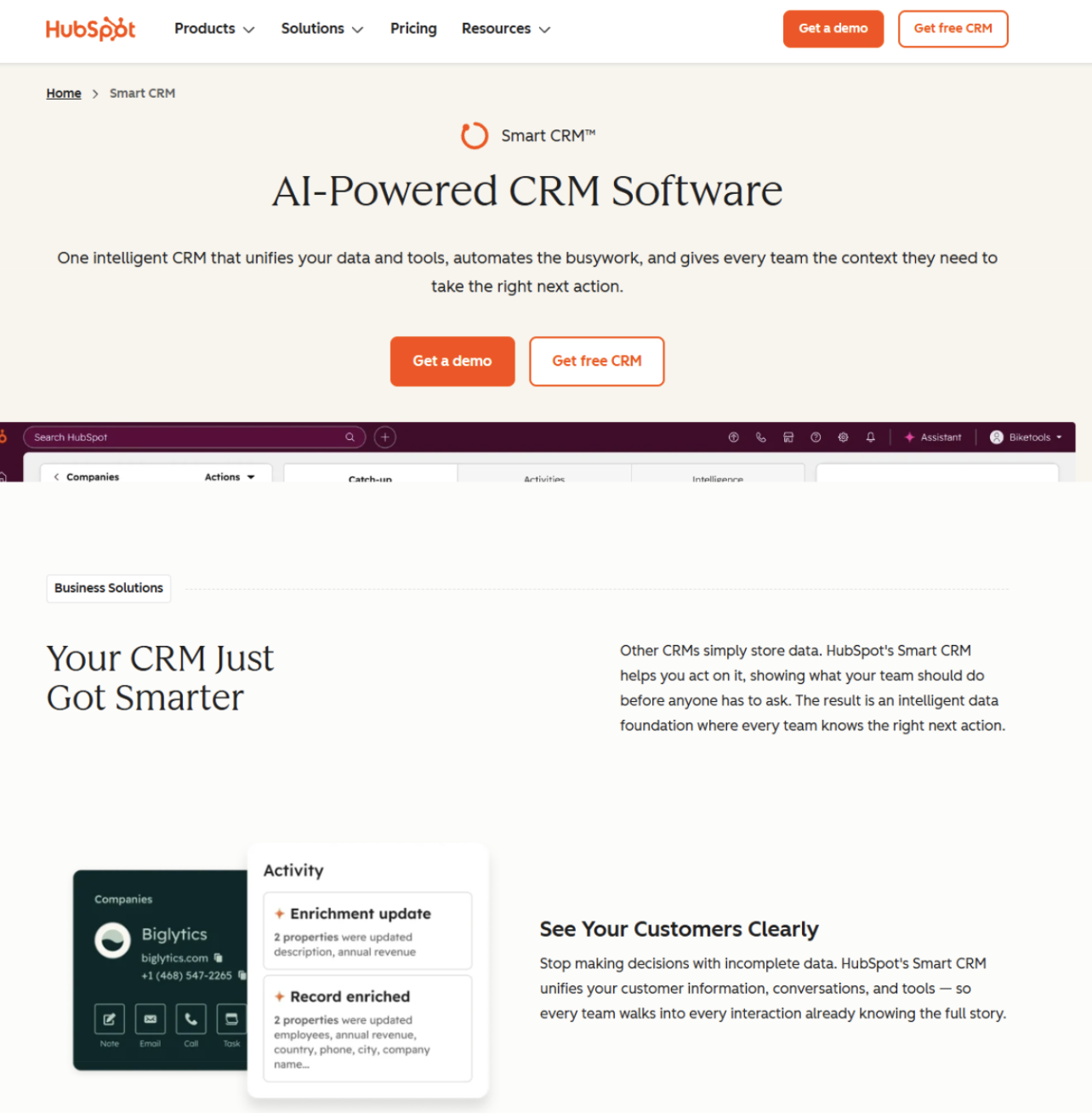
HubSpot's Breeze layers across its Smart CRM as three parts: Breeze Assistant for in-app help, Breeze Agents for prospecting, customer, and data work, and Breeze Intelligence for enrichment. Standard data enrichment is now free for core fields, the assistant is available even on the free tier, and Smart Deal Progression reads meeting transcripts to suggest stage, close date, and next steps. The unified data model means the AI is grounded in your actual business.
Best for: mid-market and growing sales teams that want marketing, sales, and service on one platform with a genuinely usable free entry point.
Tradeoff:
- Breeze can suggest CRM updates, but a rep still needs to review and apply them.
- CRM completeness therefore still depends on rep behaviour at the approval step.
- Teams that want a truly hands-off, self-maintaining record may find it a half-step short of autonomous.
4. Microsoft Dynamics 365 Sales with Copilot: best for Microsoft-native enterprises
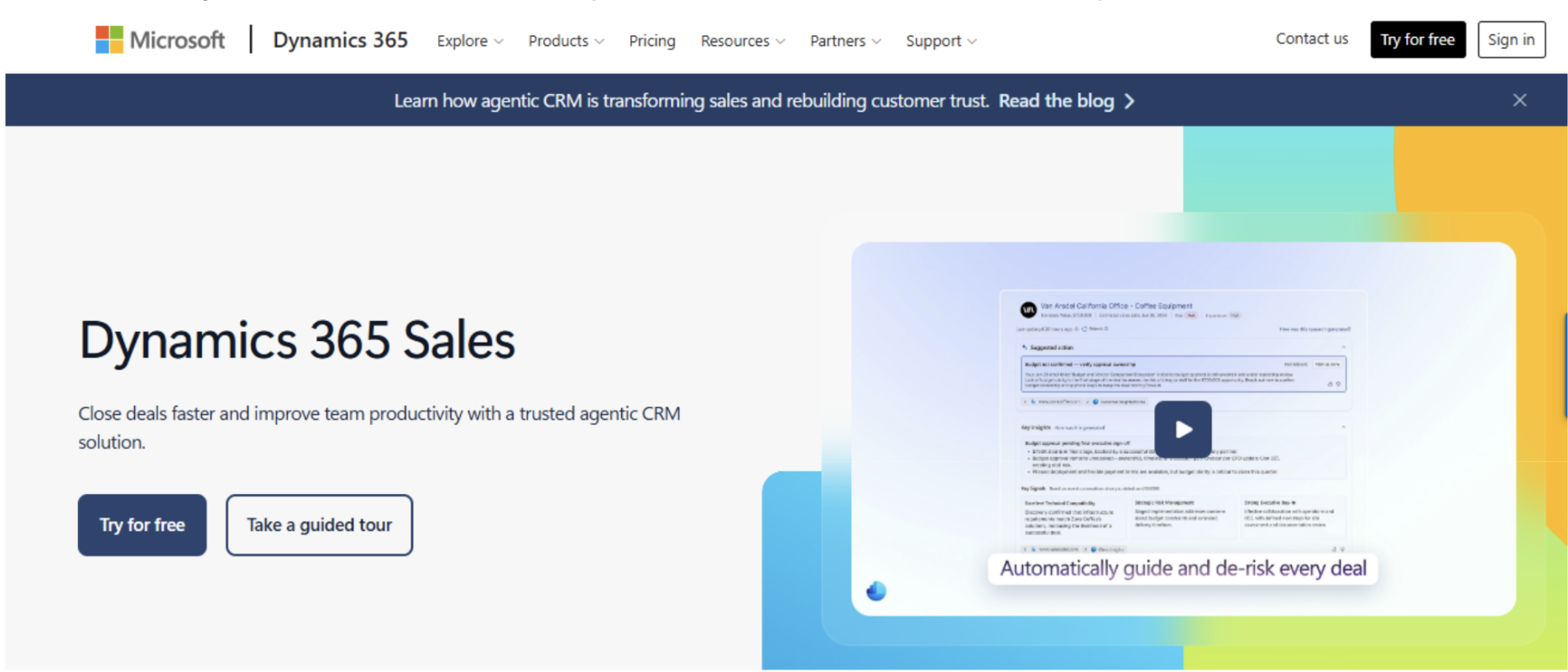
Dynamics 365 Sales pairs CRM with Copilot and a set of autonomous agents, all living inside the Microsoft 365 world. The Sales Qualification Agent researches and qualifies leads across communication history, while Copilot drafts emails, summarises meetings, and surfaces account insights directly in Outlook, Teams, and Excel.
Best for: enterprises standardised on Microsoft, where customer data living next to Outlook and Teams removes a real switching cost.
Tradeoff:
- Dynamics 365 delivers its strongest value inside the Microsoft ecosystem.
- Its native integration advantage is most compelling for teams already living in Outlook, Teams, and Microsoft 365.
- Teams running primarily on Google Workspace or a non-Microsoft stack give up much of the advantage that justifies the platform.
5. Zoho CRM with Zia: best value for teams already on Zoho
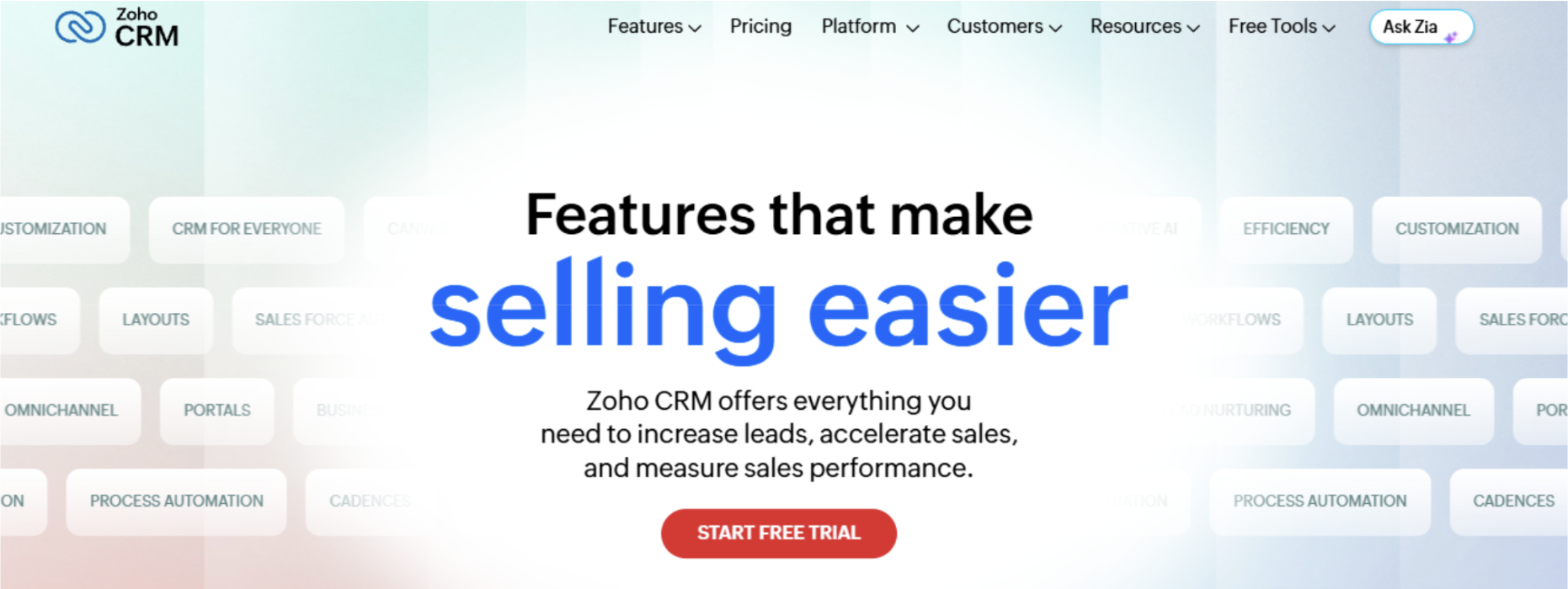
Zia is an intelligence layer woven through Zoho CRM: lead and deal scoring, forecasting, anomaly detection, generative email, and Ask Zia conversational queries. Zia Agent Studio lets non-technical users build no-code agents with access to actions across the Zoho suite, and the AI is bundled into the licence rather than priced as a separate add-on. Zia Enterprise access typically starts around 50 dollars per user per month, so confirm the current tier.
Best for: cost-conscious mid-market teams that want broad AI across CRM, support, finance, and analytics without stacking add-on fees.
Tradeoff:
- Zoho prioritises breadth over category-leading depth in individual AI capabilities.
- Individual Zia features can be less sophisticated than specialised AI platforms such as Agentforce.
- Its strongest value proposition depends on already running much of your business on the Zoho ecosystem. Outside that suite, the bundled advantage largely disappears.
6. Attio: best flexible, AI-native CRM for startups
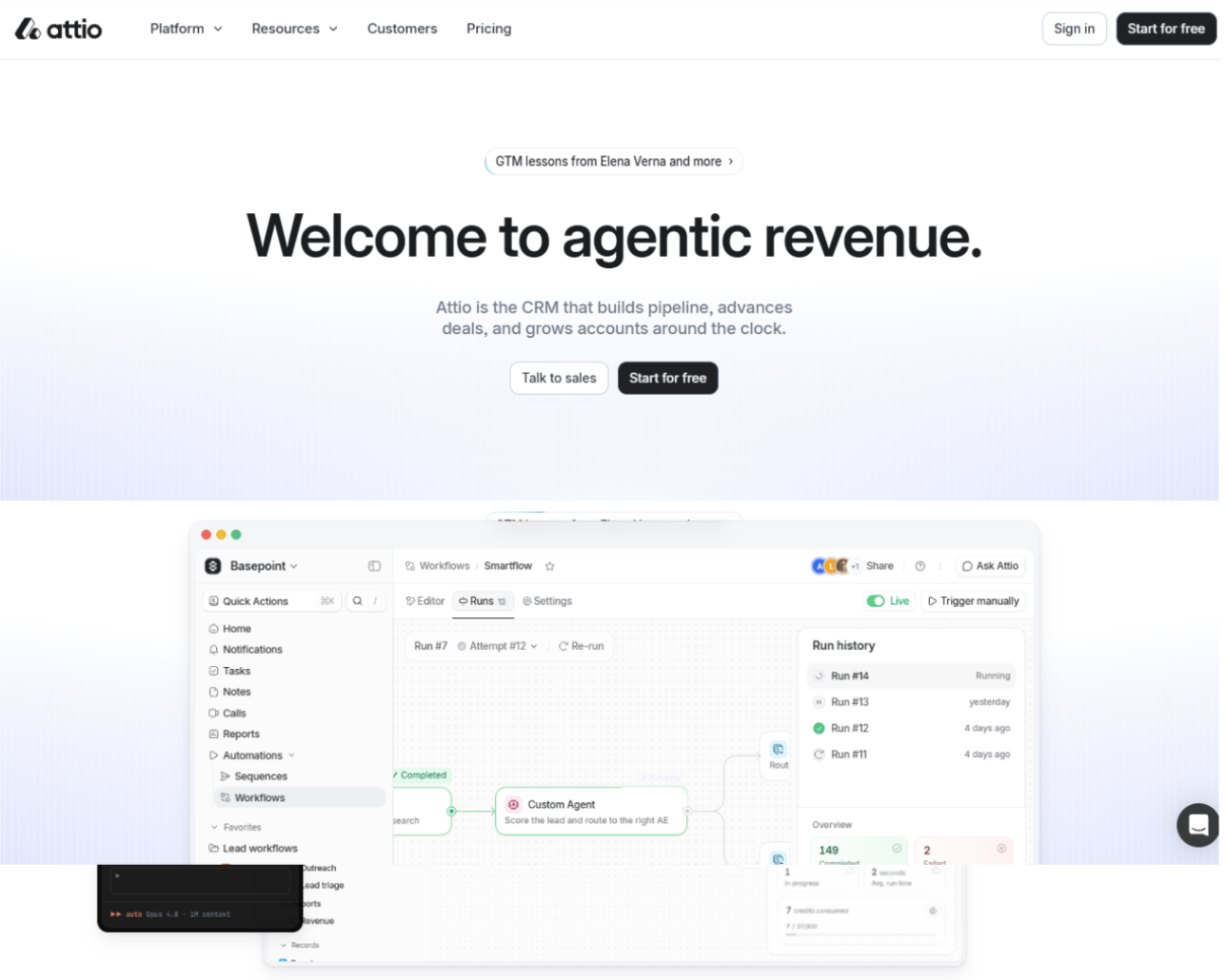
Attio is a modern, AI-native CRM built on a flexible data model, so you define your own objects and relationships rather than accept a fixed schema. AI is folded into that data layer through AI Attributes that auto-fill fields, Ask Attio for conversational queries, and Call Intelligence, alongside automatic enrichment and a genuinely usable free tier.
Best for: startups, product-led growth companies, and modern GTM teams that want a fast-syncing CRM shaped around their own process.
Tradeoff:
- Attio's AI is powerful, but more operator-driven than fully autonomous.
- Cross-system workflows often require external orchestration, and AI-filled fields may still need human verification.
- It rewards teams willing to configure and shape their CRM, but asks more of teams that simply want the record to run itself.
7. Freshsales with Freddy AI: best budget CRM with built-in communication
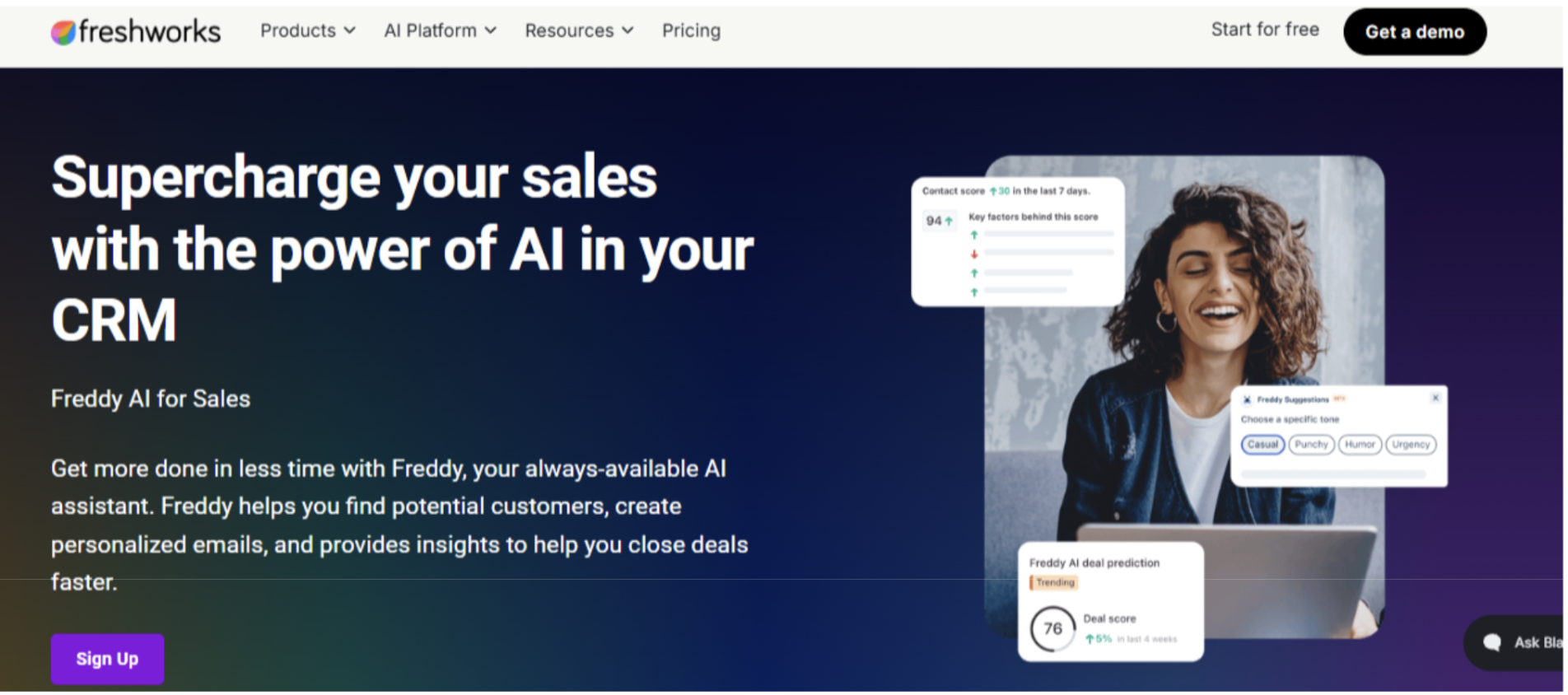
Freshsales, from Freshworks, bundles calling, email, and chat into the CRM and adds Freddy AI for contact scoring, deal insights, and email drafting. Freddy learns from your conversion data to rank leads by likelihood to close, and the free tier for up to three users is one of the more generous on the market. Freddy scoring and insights come in with the Pro tier, priced around 39 dollars per user per month.
Best for: budget-conscious SMB sales teams that want a phone, an inbox, and useful AI prediction in one affordable seat.
Tradeoff:
- Deeper Freddy Copilot AI capabilities sit behind paid add-ons, which can significantly increase the headline seat price.
- The AI sits on top of a traditional CRM that still depends on manual input.
- Freddy accelerates CRM work rather than removing the need for reps to maintain the record.
8. Pipedrive: best simple visual pipeline with AI nudges
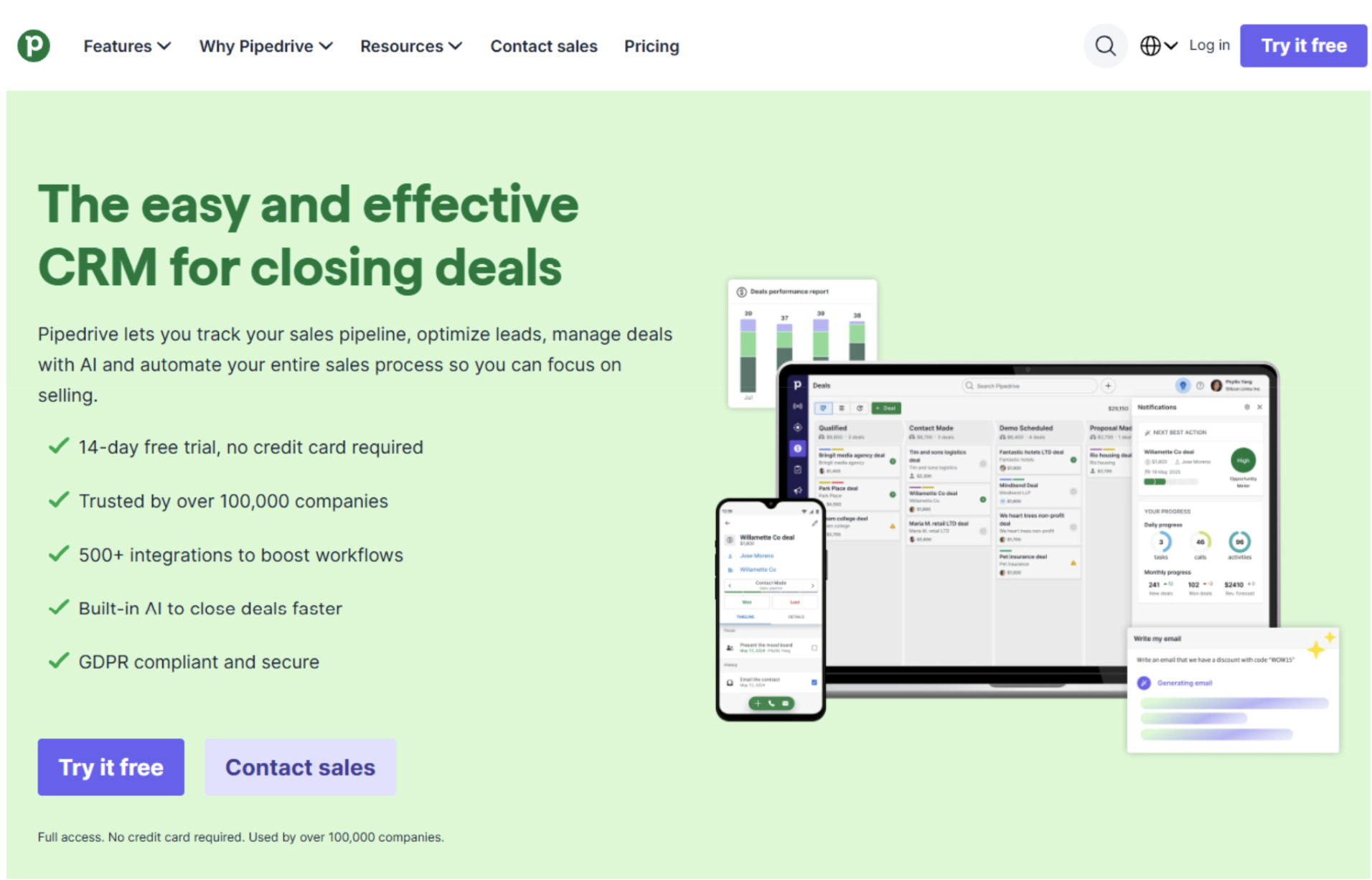
Pipedrive is the visual deal board done well. Every deal sits in a stage, carries a next activity, and gets flagged the moment it goes stale. Its AI Sales Assistant, included across plans, suggests next steps and points reps toward priority activities, and a large marketplace covers the sequencers, dialers, and data tools Pipedrive deliberately leaves out. Plans start around 14 dollars per user per month, with no free tier.
Best for: small sales teams that want pipeline clarity fast, without configuration overhead.
Tradeoff:
- Pipedrive's AI is a lightweight assistant rather than an autonomous operator.
- Reps still update deal stages manually, while heavier prospecting and enrichment require additional tools.
- Teams looking for a CRM that maintains itself will eventually outgrow the platform's AI nudges.
9. Go HighLevel: best all-in-one for agencies and SMBs
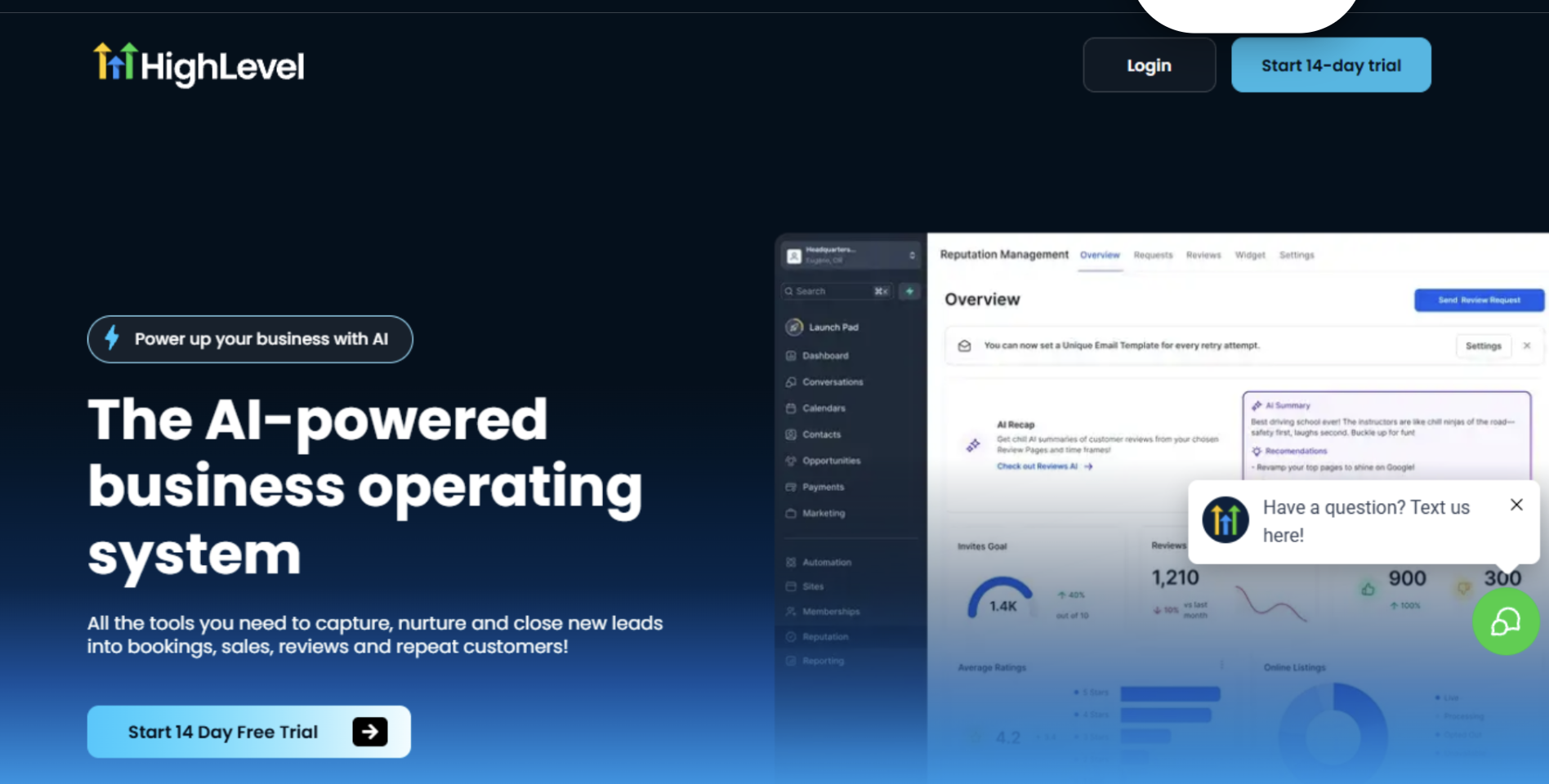
Go HighLevel bundles CRM, marketing automation, funnels, and messaging into one platform with AI across the stack, aimed largely at agencies and the SMBs they serve. For a team that wants marketing and CRM in a single subscription, the breadth is the draw.
Best for: marketing agencies and small businesses that want lead capture, nurture, and pipeline in one tool.
Tradeoff:
- Go HighLevel is built primarily around agency and marketing workflows rather than complex B2B sales operations.
- Teams needing deep deal intelligence, forecasting discipline, or enterprise-grade controls may find it limited.
- Its strength is breadth across marketing and CRM, but that breadth can come at the expense of depth on the sales side.
Which AI CRM is Right for Your Sales Team?
The right pick tracks to how much upkeep you want your reps to still own and what stack you already run:
- If you want minimal setup and a faster time-to-live (within one day), keep the CRM data up to date without relying too much on rep discipline: Kris AI CRM.
- You are an enterprise wanting the deepest AI ecosystem and customization: Salesforce with Agentforce.
- You want one connected mid-market platform with a strong free tier: HubSpot with Breeze.
- You are standardised on Microsoft: Dynamics 365 Sales with Copilot.
- You want broad AI at the lowest bundled price: Zoho CRM with Zia.
- You are a startup wanting a flexible, modern data model: Attio.
- You are a budget SMB team that wants built-in calling: Freshsales.
- You want a simple visual pipeline, fast: Pipedrive.
- You are an agency wanting marketing and CRM together: Go HighLevel.
The clearest 2026 dividing line is autonomy. Most tools here suggest, then wait for a rep to approve. If the record maintaining itself is the outcome you are buying, weigh the AI-native systems built for that from the ground up over an AI layer added to a classic CRM.
FAQs About AI CRM
1. What is the best AI CRM for sales teams in 2026?
There is no single winner for every team. For a zero-touch record that updates and enriches itself, minimal set up time, and the ability to go live in a day, choose Kris AI CRM. And even if they want to start from scratch. They can just get started in a few minutesKris AI CRM leads. For the deepest AI ecosystem and customization, Salesforce with Agentforce leads. For an all-in-one mid-market platform with a free tier, HubSpot with Breeze is the strongest pick.
2. What makes a CRM AI-native rather than AI-augmented?
An AI-augmented CRM adds intelligence on top of a classic record, and a human still approves most changes. An AI-native CRM is designed so the record maintains itself, with the AI moving stages, enriching data, and explaining numbers by default. The practical test is how much manual data entry your reps still own after the AI does its work.
3. Can an AI CRM update itself without manual data entry?
The most autonomous tools can. Kris AI CRM, for example, reads calls, emails, and meetings, then moves deal stages and dispositions activity on its own, and positions this as zero fields to update by hand. Many mainstream CRMs stop at suggesting an update that a rep approves, so confirm where each tool sits on that spectrum before you buy.
4. Are AI CRMs worth it for small sales teams?
Often yes, because small teams feel CRM admin most acutely. Kris AI CRM offers for free, which is great value. Freshsales and Pipedrive offer affordable entry points with useful AI, HubSpot has a free tier, and AI-native tools can remove the upkeep that a small team has no spare headcount to absorb. Model the full cost, including AI add-ons, before deciding.
5. How much does an AI CRM cost?
It ranges widely. Entry tools like Pipedrive start around 14 dollars per user per month, mid-market AI tiers on Zoho and Freshsales land near 40 to 60 dollars, and enterprise platforms like Salesforce and Dynamics are custom-priced with AI agents billed on top. Many vendors also meter AI usage, so the headline seat price is rarely the full bill. Verify current pricing on each vendor's page.
6. Is Kris AI CRM a standalone CRM or an add-on?
Kris AI CRM is a full system of record that can be used as both a standalone and an add-on. It is also the single living record beneath the wider Kris platform, so context travels with each account from first touch to renewal without being re-keyed at handoff.