
B2B appointment setting has three main routes: building an in-house sales development team, outsourcing outreach to an appointment setting agency, or using AI to run more of the process.
Each can generate meetings, but they differ in cost, ramp time, control, and the quality of opportunities passed to sales. The right choice depends on your sales motion, how quickly you need pipeline, and how much of the process you want to own. The key is to evaluate more than the number of meetings booked.
Overview: In-House SDRs vs Agency vs AI
| Factor | In-house SDRs | Appointment setting agency | AI-powered appointment setting |
|---|---|---|---|
| Cost | Highest fixed cost, including salary, benefits, tools, and management | Retainer or per-appointment fees | Software cost, with less dependence on additional headcount |
| Ramp time | Usually months to hire, train, and reach consistent productivity | Typically weeks for onboarding and campaign setup | Can be configured faster, depending on data, messaging, and integrations |
| Control | Highest direct control over messaging, targeting, and process | Shared control, depending on the contract and operating model | High control over targeting and rules, with configurable outreach |
| Meeting quality | Strong potential when reps understand the product and ICP | Depends on the agency's research, qualification criteria, and incentives | Depends on account prioritization, personalization, reply handling, and qualification |
| Scalability | Requires hiring and managing additional reps | Capacity can expand through the agency | Outreach can scale without increasing headcount at the same rate |
| Best for | Complex sales requiring deep product knowledge and relationship-building | Teams that need external execution without building an SDR function | Teams that want to scale targeted outreach and reduce manual work |
Costs and ramp times vary by market, seniority, and sales complexity. As a 2026 benchmark, outsourced appointment setting typically costs 3000-10,000/month, while a fully loaded US-based SDR can cost six figures annually. These are directional estimates, not fixed pricing.
1. In-House SDRs
An in-house SDR team handles prospecting, research, outreach, qualification, and meeting booking internally. SDRs work closely with sales and marketing, building deep product knowledge and refining their approach through AE feedback.
The upside is full control; the trade-off is the added cost and effort of hiring, training, tools, management, data, and building a repeatable outbound process.
Pros of In-House Appointment Setting
- Greater control over the sales process. You decide which accounts to target, how to position the product, which channels to use, and how to qualify prospects. The team can also adapt messaging quickly as positioning or product priorities change.
- Deeper product and customer knowledge. Internal SDRs can develop a better understanding of your product, customer pain points, competitive landscape, and objections. That context can be particularly valuable when selling complex B2B products to multiple stakeholders.
- Closer alignment with sales. SDRs can collaborate directly with AEs to refine qualification criteria, share prospect feedback, and improve the hand-off from initial outreach to sales conversations.
Cons of In-House Appointment Setting
- High total cost. Salary is only one part of the investment. Recruitment, benefits, sales engagement tools, contact data, management, and training all add to the cost. New hires also need time to become productive, during which the team may generate less pipeline than expected.
- Slow ramp and ongoing management. Building a team takes time, and performance depends on effective coaching, clear targets, and consistent execution. Attrition can restart the hiring and training cycle.
- Manual work can limit output. SDRs may spend substantial time researching accounts, switching between tools, writing messages, following up, and updating CRM records. Without an efficient process, adding headcount can increase activity without proportionately improving qualified meetings.
Best For
Best for companies with a proven outbound motion, budget for a dedicated team, and sales cycles requiring deep product knowledge or relationship-building. It prioritizes long-term control and internal expertise over speed.
2. Appointment Setting Agencies
A B2B appointment setting agency provides an external team to handle some or all of your outbound prospecting and meeting booking, including research, list building, email, LinkedIn, calling, qualification, and scheduling.
The main advantage is launching outbound without building an in-house SDR team. Results depend on the agency’s understanding of your ICP, product, and what qualifies as a good meeting.
Pros of Appointment Setting Agencies
- Faster access to an operating team. You do not need to recruit SDRs, build an outbound function from scratch, or source every tool independently. An established agency may already have the people, processes, and infrastructure to launch a campaign.
- Less day-to-day execution overhead. The agency handles agreed activities, while your internal team focuses on product, strategy, and closing opportunities. This can be useful when you have limited management capacity.
- Access to specialized experience. Experienced providers may bring established outreach processes, channel knowledge, and campaign management expertise. This can help companies test outbound in a new market or segment before investing in a permanent team.
Cons of Appointment Setting Agencies
- Less direct control over execution. You can define the ICP, approve messaging, and set qualification standards, but the agency still manages day-to-day interactions. If the team misunderstands your positioning or changes the message in ways you would not, the outreach may not represent your brand well.
- Meeting volume can overshadow quality. Some pricing models reward the number of appointments booked. Without clear qualification criteria, you may end up paying for meetings with poorly matched accounts, people without buying influence, or prospects who have little reason to evaluate your product.
- Product knowledge takes time to develop. External setters may work across multiple clients and need time to understand your offering, customer problems, and competitive positioning. Even a well-run agency will need feedback from your sales team to improve its targeting and messaging.
- Costs can be difficult to compare. Retainers, setup fees, per-meeting charges, and additional services make headline prices misleading. Compare the total cost against meetings that actually happen and meet your qualification criteria, not simply the number of calendar invites.
Best For
An appointment setting agency is best for companies that need to launch outbound quickly, lack internal SDR capacity, or want to test a market before hiring. It works best with a clear ICP, strong messaging, defined qualification criteria, and regular feedback.
3. AI-Powered Appointment Setting
AI-powered appointment setting uses AI to identify prospects, research accounts, prioritize leads, personalize outreach, handle replies, and book meetings. An integrated platform can connect these workflows using shared account context, reducing the need to hire more SDRs or outsource the entire process.
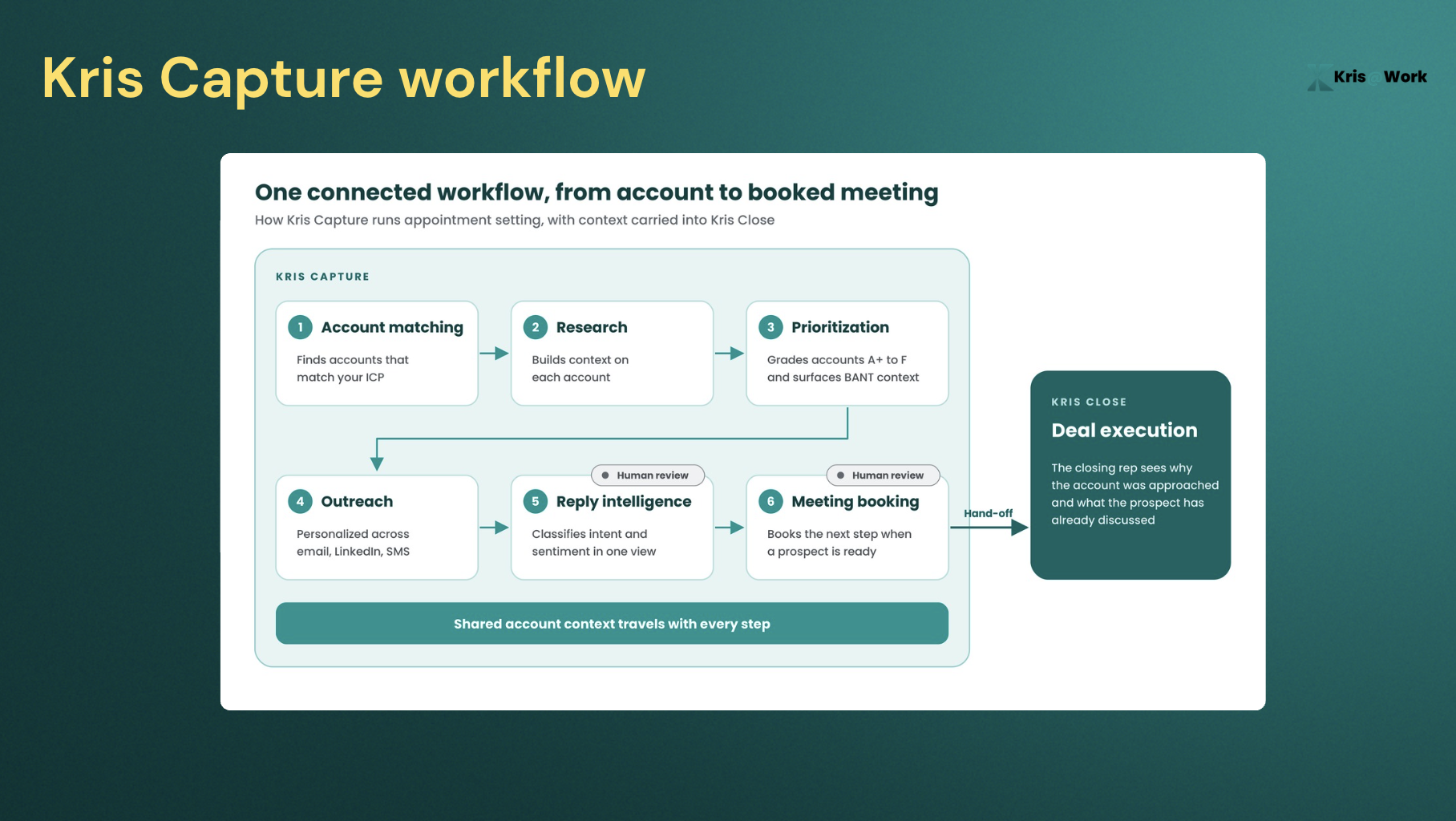
Instead, sales teams can use AI for repeatable outbound tasks while focusing on strategy, performance, and conversations that require human judgment. For example,Kris Capture connects account matching, research, prioritization, multi-channel outreach, reply intelligence, meeting booking, and hand-off in one workflow.
Pros of AI-Powered Appointment Setting
- Lower reliance on additional headcount. AI can take on repetitive tasks such as account research, drafting personalized messages, sequencing outreach, and managing routine follow-ups. Teams can expand activity without adding an SDR for every increase in volume, although software, data, setup, and oversight still have costs.
- prioritization based on fit and signals. Rather than working through a flat contact list, teams can rank accounts by ICP fit, relevant activity, and buying context. Kris Capture, for example, grades accounts from A+ to F and surfaces BANT context to help reps decide which prospects deserve attention first.
- More relevant, adaptive outreach. personalization becomes more useful when it is grounded in account research and a specific reason to engage. AI can use that context to shape outreach across channels and adjust sequences as new signals or replies arrive, rather than relying exclusively on static templates.
- Faster reply handling and booking. Appointment setting does not end when a prospect responds. Replies need to be interpreted, intent needs to be identified, and interested prospects need a clear next step. Kris Capture's reply intelligence brings email, LinkedIn, and SMS replies into one view, classifies intent and sentiment, and supports booking and hand-off when a prospect is ready.
- A more connected hand-off to sales. The context behind a booked meeting matters. When the conversation travels with the meeting, the closing rep can see why the account was approached and what the prospect has already discussed. Kris@Work connects Capture with Kris Close, helping carry the account context from prospecting into deal execution.
Cons of AI-Powered Appointment Setting
- Output still depends on the inputs. AI cannot compensate for an unclear ICP, weak positioning, poor data, or an offer that does not address a real problem. Teams still need to define their target market, messaging boundaries, qualification standards, and success metrics.
- Human oversight remains important. Automated outreach can make mistakes, misread context, or produce messaging that does not fit a sensitive or complex situation. Teams need to review performance, protect brand voice, and establish appropriate rules for escalation and human involvement.
- Meeting quality must be measured, not assumed. More automation can increase outreach volume, but volume alone does not prove that the resulting meetings are useful. Track held meetings, qualification rates, opportunities created, and pipeline progression alongside booking numbers.
- Setup and integration still require work. An AI platform needs the right account data, campaign context, and sales process to operate effectively. Teams should assess how the platform fits their existing workflows and what controls they have over targeting, messaging, and hand-offs.
Best For
AI-powered appointment setting is best for B2B teams looking to scale outbound without scaling headcount at the same rate. It’s especially useful when research, personalization, follow-ups, and reply management take up too much SDR time.
It can also complement human-led teams, letting SDRs focus on strategic accounts and nuanced conversations while AI handles repeatable research and outreach.
How to Choose the Right B2B Appointment Setting Model
There is no universal winner. The right model depends on your stage, resources, sales complexity, and ability to manage the process.
- Choose in-house SDRs if you have the budget and leadership capacity to build a long-term function, and product knowledge is central to your sales motion.
- Choose an agency if you need external execution and want to launch outbound without hiring and managing a team yourself.
- Choose AI-powered appointment setting if you want to scale targeted prospecting, reduce manual work, and connect outreach with reply handling and meeting booking.
- Consider a hybrid model if your team needs AI for research and repetitive outreach but wants humans to manage strategic accounts, sensitive replies, and complex qualifications.

Whichever route you choose, define a qualified meeting upfront: account fit, attendee role, business need, and agreed discussion. Then track cost per qualified, held meeting and the opportunities it generates.
Conclusion
B2B appointment setting works best when account selection, outreach, and meeting booking operate as one process. Kris@Work connects these stages with AI-powered account prioritization, personalized multi-channel outreach, reply intelligence, and meeting booking, with context passed into Kris Close for sales follow-up.
Kris Capture claims up to 15x more qualified meetings, though results depend on ICP, data, strategy, and execution. The goal isn’t simply to fill calendars; it’s to create more qualified conversations with the accounts your team is best positioned to win.
Sign up and get started today.
Related Blog Posts