

Enterprise sales teams have more data, more automation, and more tools than ever. Yet booking a qualified meeting with the right buyer remains frustratingly difficult.
The usual response is to increase activity. Send more emails. Make more calls. Add more prospects to sequences. Ask reps to hit higher activity targets and hope that more volume eventually produces more pipeline.
That approach is becoming less effective.
Enterprise buyers are overwhelmed with outreach. Generic sequences are easier to spot, inboxes are crowded, and buying committees are more complex. Meanwhile, sales reps spend a large part of their day researching accounts, switching between tools, updating records, and deciding which prospects deserve attention.
An effective enterprise sales playbook for 2026 needs to address these problems directly. It should help reps identify the right accounts, act on relevant buying signals, personalize outreach using genuine prospect context, engage multiple stakeholders, and coordinate communication across channels.
The goal is simple: spend less time figuring out who to contact, when to contact them, and what to say. Spend more time having conversations with buyers who have a genuine reason to listen.
This enterprise sales playbook covers seven practical ways to make that happen.
TL;DR
- Prioritize smarter: Focus on accounts based on fit, intent, and timing instead of treating every prospect equally.
- Act on real signals: Use leadership changes, funding, hiring, expansion, and other trigger events to create a timely reason for outreach.
- Personalize the problem: Connect prospect-specific context to a plausible business challenge instead of relying on superficial first-line personalization.
- Make research continuous: Keep account intelligence updated so reps don't have to start from scratch before every interaction.
- Multi-thread early: Engage multiple stakeholders across the buying committee before a deal enters the pipeline.
- Coordinate your channels: Use email, LinkedIn, calls, and warm introductions together instead of running them as disconnected activities.
- Make the next action obvious: Give reps clear Next-Best-Actions so they spend less time deciding what to do and more time talking to the right buyers.
What is an enterprise sales playbook?
An enterprise sales playbook is a repeatable framework that guides sales teams through the process of identifying, engaging, and converting high-value accounts.
A good playbook answers practical questions that reps face every day:
- Which accounts should I prioritize?
- Which contacts should I engage?
- What signals suggest an account may be ready for a conversation?
- Why should I reach out now?
- What should I say?
- Which channel should I use?
- When should I follow up?
- Who else should I involve within the account?
Traditional playbooks often rely on static account lists, predefined sequences, and activity targets. A modern enterprise sales strategy needs to be more responsive because account priorities can change quickly.
A company that showed little buying intent last month might hire a new VP of Sales today. A target account might announce an expansion, adopt a new technology, raise funding, or start hiring for a team that your product supports. Any of these events could create a timely reason for outreach.
The playbook needs to recognize those changes and help the rep act while the context is still relevant.
Why the traditional enterprise sales playbook is breaking down
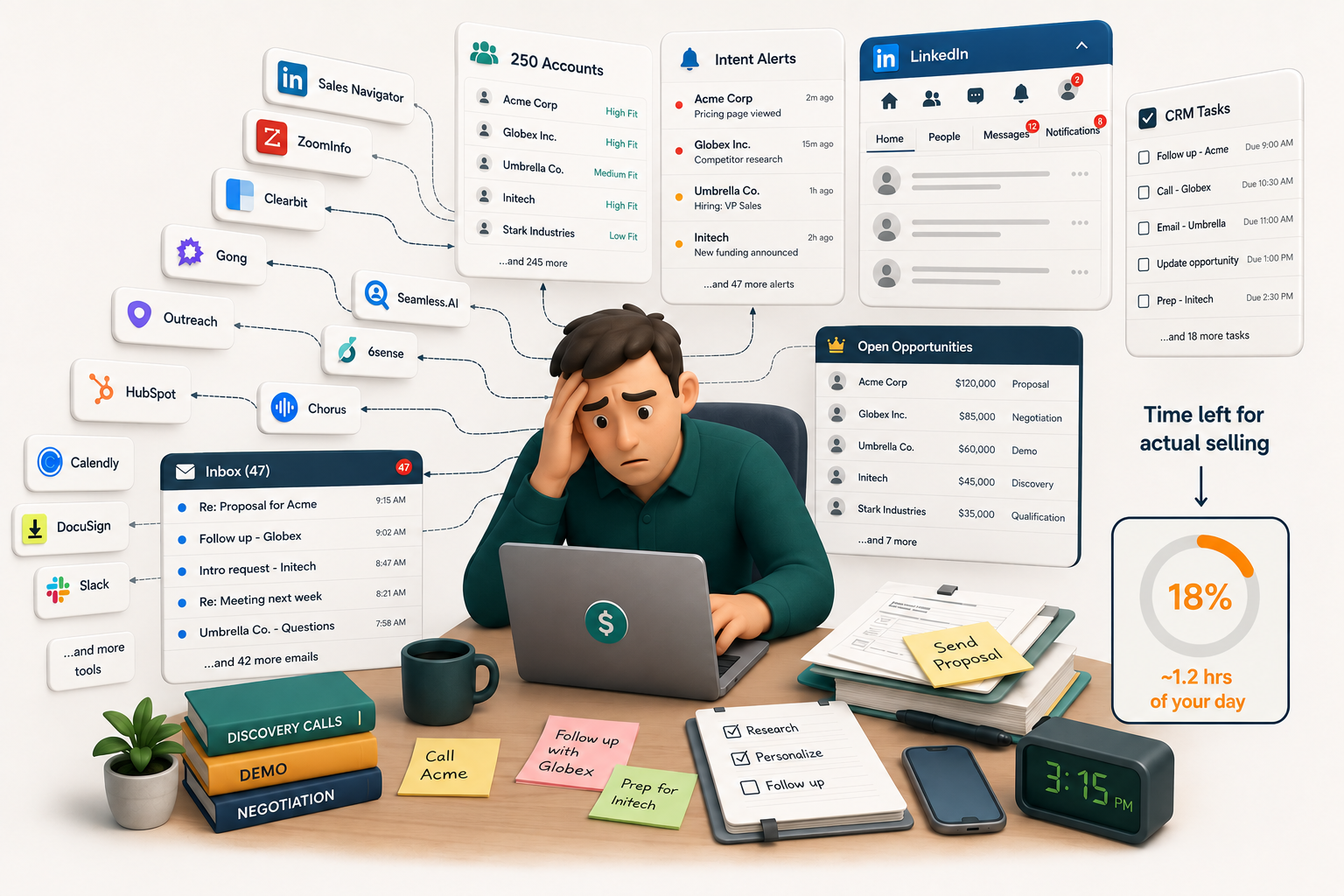
Most enterprise sales teams do not have a shortage of data. They have difficulty turning that data into useful decisions.
A rep might open the CRM in the morning and see 250 accounts. Some match the ideal customer profile closely. Others have recently shown signs of interest. A few may have undergone important leadership or business changes.
The problem is that the rep often has no easy way to tell which ten or twenty accounts deserve attention today.
So reps fall back on familiar logos, recently active accounts, alphabetical lists, or gut instinct.
Research creates another bottleneck. Before writing a meaningful message, a seller might check the CRM, company website, LinkedIn, recent news, intent data, a contact database, and previous engagement history. The research itself may be valuable, but gathering it repeatedly across disconnected tools consumes time that could have gone into actual conversations.
Then there is the outreach itself.
As sales automation became more accessible, companies dramatically increased the volume of outbound messages. Buyers adapted. They learned to recognize templates, artificial personalization, and automated follow-ups.
A first line that says, "I saw your recent LinkedIn post" is unlikely to impress anyone if the next four paragraphs could have been sent to 500 other people.
The result is a difficult cycle. Teams send more outreach because response rates are low, while buyers become less responsive because they receive more irrelevant outreach.
A better enterprise sales strategy starts by breaking that cycle.
7 enterprise sales hacks to book more meetings in 2026
Here are the top 7 sales hacks to book more meetings in 2026:
Hack #1: Stop working every account. Rank them by fit, intent, and timing
A list of 500 target accounts should not become a 500-item to-do list.
Some accounts are a better fit for your product than others. Some are actively showing interest. Some have recently experienced a change that creates an immediate reason to start a conversation.
Treating all of them equally wastes selling time.
A more useful prioritization framework looks at three factors.
Fit: How closely does the company match your ideal customer profile?
This can include company size, industry, geography, revenue, business model, technology stack, team structure, and other attributes relevant to your product.
Intent: Is there evidence that the company is researching a problem, category, or solution related to what you sell?
This could include website activity, content engagement, third-party intent data, product interactions, or previous conversations.
Timing: Has something recently happened that makes outreach particularly relevant?
Examples include:
- A new executive joining the company
- A funding announcement
- Expansion into a new market
- A major hiring push
- A product launch
- A new technology adoption
- A strategic initiative announced publicly
- Relevant social activity from a key decision-maker
Consider two companies that both match your ICP perfectly.
Company A has shown no recent activity or meaningful change.
Company B hired a new VP of Sales three weeks ago, is recruiting 20 SDRs, and recently announced plans to enter two new markets.
Both companies may be good prospects. Company B gives you a much stronger reason to start a conversation today.
That distinction matters because timing affects relevance. The closer your outreach is to a genuine business event, the easier it becomes to explain why you are reaching out.
A modern sales team should therefore prioritize accounts dynamically. The question should not simply be, "Is this company a good fit?"
It should be, "Why does this company deserve our attention right now?"
Hack #2: Build outreach around trigger events, not your sequence calendar
Most automated sales sequences operate according to a predetermined schedule.
- Day 1: Send an email.
- Day 3: Follow up.
- Day 5: Send a LinkedIn request.
- Day 8: Follow up again.
The sequence advances because time has passed, regardless of whether anything meaningful has changed for the buyer.
That is convenient for the seller, but it does not necessarily make the outreach relevant to the prospect.
Your prospect does not care that today happens to be Day 4 of your sequence.
A stronger approach uses trigger events to create a genuine reason for contact. These triggers can come from several places such as:
- People signals: This includes a new executive hire, promotion, job change, or a key stakeholder posting publicly about a relevant challenge.
- Company signals: This covers funding, acquisitions, expansion, restructuring, new product launches, or rapid hiring.
- Technology signals: This includes adopting or removing a particular tool, migrating platforms, or investing in a new technology category.
- Intent signals: This suggests that people within an account may be actively researching a problem or solution.
- Engagement signals: This covers website visits, content downloads, webinar participation, email engagement, and previous conversations.
The signal itself is only the starting point. Good sellers connect it to a plausible business implication.
A simple framework is:
Signal → Business implication → Relevant problem → Reason to talk
Suppose a company has just hired a new VP of Sales.
The signal is the executive hire.
The business implication is that a new leader may review existing processes, targets, technology, and team performance.
The relevant problem might be poor account prioritization, falling outbound performance, or low pipeline per rep.
The reason to talk is that your product helps solve one of those specific problems.
This creates a much more credible message than congratulating the executive on the new role and immediately launching into a generic pitch.
Hack #3: Personalize the problem, not just the first line
Personalization has become one of the most overused words in sales.
Adding a prospect's first name is not meaningful personalization. Neither is mentioning their university, hometown, favorite football team, or a random sentence from their latest LinkedIn post.
Those details might prove that research happened. They do not prove that the conversation is relevant.
There are three broad levels of sales personalization.
Level 1: Cosmetic personalization
This includes the prospect's name, company, role, industry, and other basic attributes.
It is better than nothing, but buyers expect it.
Level 2: Observation-based personalization
The message refers to something specific about the person or company, such as a recent post, hiring announcement, funding round, expansion, or leadership change.
This makes the message more timely, but an observation alone is not enough.
Level 3: Problem-based personalization
The seller connects a specific observation to a plausible business problem and explains why a conversation might be useful.
This is where personalization becomes commercially relevant.
For example:
Noticed you're hiring 25 SDRs across three regions. Teams scaling outbound that quickly often run into a prioritization problem before an activity problem, especially when every new rep is working from the same large account pool. Curious how you're deciding which accounts each rep should focus on first.
The message works because the personalization serves the business conversation. The hiring signal is not used as decoration. It leads directly to a relevant hypothesis.
A useful framework for personalized enterprise outreach is:
Observation → Implication → Problem hypothesis → Value → Low-friction CTA
The word "hypothesis" matters here.
Unless the prospect has explicitly told you about a problem, you should not pretend to know that they have it. Strong enterprise outreach demonstrates informed curiosity rather than false certainty.
Compare these two statements:
Your sales team is wasting hours every day researching prospects.
Versus:
With your sales team expanding across three regions, I'm curious whether reps are spending more time than you'd like researching accounts before outreach.
The second version respects the fact that you do not know everything about the prospect's internal operations. It still demonstrates relevance, but it leaves room for a genuine conversation.
Hack #4: Research accounts continuously, not five minutes before outreach
Enterprise sales research is valuable. Repeating the same research process from scratch is not.
A rep opens an account. They check the CRM. Then the company website. Then LinkedIn. Then recent news. Then a contact database. Then intent data. Then previous email activity.
They collect enough context to write one message.
Two weeks later, the account comes up again, and much of the process starts over.
This creates a hidden tax on every outbound interaction.
A better enterprise sales playbook treats account intelligence as a living resource that updates over time.
For every important account, sellers should have quick access to information such as:
- Company overview
- Strategic priorities
- Recent news and announcements
- Leadership changes
- Hiring activity
- Technology stack
- Relevant prospect activity
- Previous engagement
- Known business challenges
- Important stakeholders
- Recommended next actions
The role of AI here should be practical. It should reduce the time spent gathering and organizing information while leaving judgment with the seller.
A rep still needs to decide whether a signal is meaningful. They still need to verify context, understand nuance, and decide whether the outreach is appropriate.
What they should not need to do is open ten tabs every morning just to discover that a target account hired a new executive yesterday.
This is where tools such as Kris@Work can support the process. Kris brings account research, contact prioritization, real-time signals, personalized messaging, and Next-Best-Actions into one intelligent window. Instead of asking reps to manually reconstruct account context before every interaction, the system helps surface the information and opportunities that deserve attention.
The practical benefit is straightforward. More of the rep's limited selling time can go toward conversations rather than information gathering.
Hack #5: Multi-thread before the deal exists
Enterprise sales rarely involves a single decision-maker.
A large purchase may involve an economic buyer, functional leader, technical evaluator, champion, procurement team, end users, and other stakeholders. Each person evaluates the decision through a different lens.
Yet many sales teams still begin prospecting with a single contact.
They find one senior person, send several emails, and wait. If that person does not respond, the entire account is marked as unresponsive.
That approach leaves too much riding on one inbox.
Multi-threading should begin during prospecting, not after discovery.
Before reaching out to an enterprise account, identify the likely buying committee:
- Who owns the budget?
- Who owns the business problem?
- Who experiences the problem directly?
- Who could champion a solution internally?
- Who will evaluate the technology?
- Who might block the purchase?
The next step is crucial. Do not send the same message to everyone.
A CRO might care about cost per qualified meeting, pipeline efficiency, and revenue output from existing headcount.
A VP of Sales might care about pipeline per rep, team performance, ramp time, and consistent execution.
An AE might care about self-sourced pipeline, account research, stalled deals, and the limited time available for prospecting.
An SDR might care about knowing which accounts to work, reducing research time, improving reply rates, and booking more meetings.
The underlying product may be the same. The reason to care is different.
Good multi-threading reflects those differences.
Suppose you sell a sales intelligence platform. Sending five stakeholders the same email about "boosting sales productivity" is not true multi-threading. It is simply repeating one generic pitch five times.
Instead, each message should reflect the recipient's role, priorities, and relationship to the problem.
One account should create multiple relevant conversations, not multiple copies of the same conversation.
Hack #6: Coordinate channels instead of running them in silos
Enterprise buyers do not live exclusively in their email inboxes.
They use LinkedIn. They take calls. They attend events. They interact with content. They speak with colleagues and mutual connections.
A modern enterprise sales playbook needs to reflect that reality.
However, omnichannel outreach is often misunderstood. It does not mean copying the same pitch into email, LinkedIn, and voicemail.
Each channel has a different role.
- Email works well for explaining context and making a thoughtful business case.
- LinkedIn can help create familiarity, discover signals, and engage with a buyer's professional activity.
- Calls allow for direct, immediate conversations when the timing and context justify them.
- Warm introductions can establish trust much faster than cold outreach.
- Social activity can reveal what buyers are discussing publicly and create natural opportunities for relevant engagement.
A coordinated sequence might look like this:
- Day 1: Research the account and engage with a genuinely relevant LinkedIn post.
- Day 2: Send a personalized email connected to a specific business signal.
- Day 4: Send a LinkedIn connection request without immediately pitching.
- Day 6: Call with a clear business hypothesis based on your research.
- Day 9: Follow up with a new insight, example, or relevant observation.
- Day 14: Engage another stakeholder at the account with messaging relevant to their role.
The purpose of this sequence is not to appear everywhere until the prospect gives in.
It is to create familiarity across appropriate channels while continuing to provide a legitimate reason for engagement.
There is also a point where persistence becomes noise. Good orchestration requires knowing when another person at your company has already contacted the account, when a prospect has explicitly declined, and when further outreach is unlikely to add value.
More touches do not automatically produce better results. Better coordinated touches do.
Hack #7: Give every rep a daily Next-Best-Action list
Sales teams have no shortage of dashboards.
They have pipeline dashboards, activity dashboards, intent dashboards, engagement dashboards, forecast dashboards, and performance dashboards.
The problem is that a dashboard often creates another task for the rep: figuring out what to do with the information.
Imagine a rep starts Monday morning with 250 accounts, 40 open opportunities, several intent alerts, new LinkedIn activity, email replies, CRM tasks, and recent company news.
Where should they start?
A modern enterprise sales system should help answer that question.
Instead of simply presenting information, it should translate signals and context into specific actions:
- Contact this prospect within the next 24 hours because a relevant trigger occurred.
- Re-engage this account because a new executive joined.
- Add another stakeholder because the opportunity is currently single-threaded.
- Follow up because new buying intent has appeared.
- Pause outreach because another rep recently contacted the account.
- Prioritize this account because fit, authority, and timing are unusually strong.
This is the idea behind Next-Best-Action.
Kris@Work, for example, is designed to proactively surface what a seller should do next, when they should do it, and why. The aim is to reduce the decision-making overhead that eats into the selling day.
This matters because prioritization itself takes time.
Every hour spent deciding which account to research, which signal matters, and which prospect deserves a message is an hour unavailable for an actual buyer conversation.
The best enterprise sales playbook should therefore do more than store information. It should help turn information into action.
How to build your enterprise sales playbook step by step
The seven hacks above only become useful when they shape what reps actually do every day. Use this checklist to turn them into a repeatable sales process.
| Step | Action | Deliverables at Each Step |
|---|---|---|
| 1 | Document your ICP criteria | A documented ICP scorecard that every rep can use consistently. |
| 2 | Create an account and contact scoring model. | A transparent scoring framework for ranking accounts and contacts. |
| 3 | List the signals that should trigger outreach | A prioritized trigger library with a recommended action for each signal. |
| 4 | Map the buying committee for every priority account | A stakeholder map for every priority enterprise account. |
| 5 | Build messaging frameworks by persona and trigger | A messaging library organized by persona and trigger. |
| 6 | Define your multichannel outreach sequence | A coordinated outreach sequence with clear channel, timing, and stop rules. |
| 7 | Review performance and refine the playbook | A monthly playbook review with documented changes based on actual buyer behavior. |
Enterprise sales metrics that actually matter in 2026
Activity metrics are useful for understanding effort, but they should not be mistaken for outcomes.
Sending 2,000 emails is not a success if none of them creates a meaningful conversation.
A modern enterprise sales team should track metrics that connect activity to actual business results.
| Metric | Why it matters |
|---|---|
| Qualified meetings booked | Measures actual prospecting output |
| Positive reply rate | Shows whether messaging resonates |
| Quality conversations per rep | Measures genuine buyer engagement |
| High-priority account work rate | Shows whether reps focus on the best opportunities |
| Contacts engaged per account | Measures multi-threading depth |
| Cost per qualified meeting | Connects outbound performance to economics |
| Research time per account | Measures seller productivity |
| Meeting-to-opportunity conversion | Measures meeting quality rather than volume alone |
These metrics also help diagnose different problems.
A low reply rate may indicate weak targeting or messaging.
A strong reply rate but poor meeting-to-opportunity conversion may indicate that reps are booking conversations with the wrong prospects.
A low number of stakeholders engaged per account could reveal overreliance on single-threaded selling.
High activity combined with low meeting output may indicate that reps are spending too much effort on accounts with weak fit or poor timing.
The purpose of measurement is not simply to evaluate reps. It should help the team identify where the sales system itself is creating friction.
How Kris@Work fits into a modern enterprise sales playbook
The seven strategies in this playbook depend on a sales team being able to bring together account data, prospect research, buyer signals, prioritization, personalized messaging, and outreach execution.
Doing that manually across several disconnected tools creates friction.
Kris@Work is an AI-native GTM execution engine designed to bring these workflows into one intelligent window.
For sales teams focused on prospecting and qualification, Kris Capture helps with account and contact prioritization, real-time signals, account research, Next-Best-Actions, personalized messaging, warm introductions, and omnichannel outreach.
- Instead of opening multiple tools to decide which account deserves attention, a rep can work from a prioritized list of opportunities with the relevant context already available.
- Instead of discovering a business signal days after it happened, the rep can act while the event is still timely.
- Instead of starting every message from a blank page, the rep can review a personalized draft grounded in actual prospect and account context.
The seller still makes the final judgment. The difference is that less of the day is spent assembling information and deciding where to start.
The teams that book more qualified meetings will not necessarily be the ones that send the most emails or make the most calls.
They will be the ones who get better at deciding which accounts deserve attention, recognizing when the timing is right, understanding why a prospect might care, and turning that context into a relevant conversation.
FAQs about enterprise sales playbooks
1. What is an enterprise sales playbook?
An enterprise sales playbook is a repeatable framework that helps sales teams identify, prioritize, engage, and convert high-value accounts. It typically covers ICP definition, account prioritization, prospect research, trigger events, messaging, multichannel outreach, buying committee engagement, follow-up, and performance measurement.
2. How is enterprise sales different from SMB or mid-market sales?
Enterprise sales usually involves larger deal sizes, longer sales cycles, more stakeholders, greater procurement complexity, and higher expectations for personalization. Sellers often need to engage several people across different functions and build a business case that addresses financial, operational, technical, and strategic concerns.
3. How do you book more enterprise sales meetings?
To book more enterprise sales meetings, prioritize accounts based on fit, intent, and timing. Use genuine business signals to create a reason for outreach, personalize messages around relevant problems, engage multiple stakeholders, coordinate communication across channels, and follow up with new value rather than repeating the original pitch.
4. What are the best enterprise prospecting techniques in 2026?
Effective enterprise prospecting techniques include dynamic account prioritization, signal-based outreach, problem-focused personalization, continuous account research, early multi-threading, coordinated omnichannel engagement, warm introductions, and Next-Best-Action recommendations.
5. How many stakeholders should you contact in an enterprise account?
There is no universal number because buying committees vary by company and deal complexity. The goal should be to identify the people who own the budget, experience the problem, evaluate the solution, influence the decision, and could potentially block the purchase. For complex deals, relying on one contact creates unnecessary risk.
6. Does multichannel outreach work better than email alone?
Multichannel outreach can improve the chances of reaching a prospect because buyers engage across different platforms and prefer different forms of communication. The key is coordination. Each channel should serve a purpose rather than repeating the same sales pitch everywhere.
7. How can AI help enterprise sales teams book more meetings?
AI can help sales teams research accounts, identify relevant signals, prioritize prospects, draft personalized messages, recommend next actions, and coordinate outreach. Its greatest value comes from reducing repetitive information gathering and decision-making overhead so sellers can spend more time in conversations.
8. What metrics should an enterprise sales team track?
Important enterprise sales metrics include qualified meetings booked, positive reply rate, quality conversations per rep, high-priority account work rate, contacts engaged per account, cost per qualified meeting, research time per account, and meeting-to-opportunity conversion.