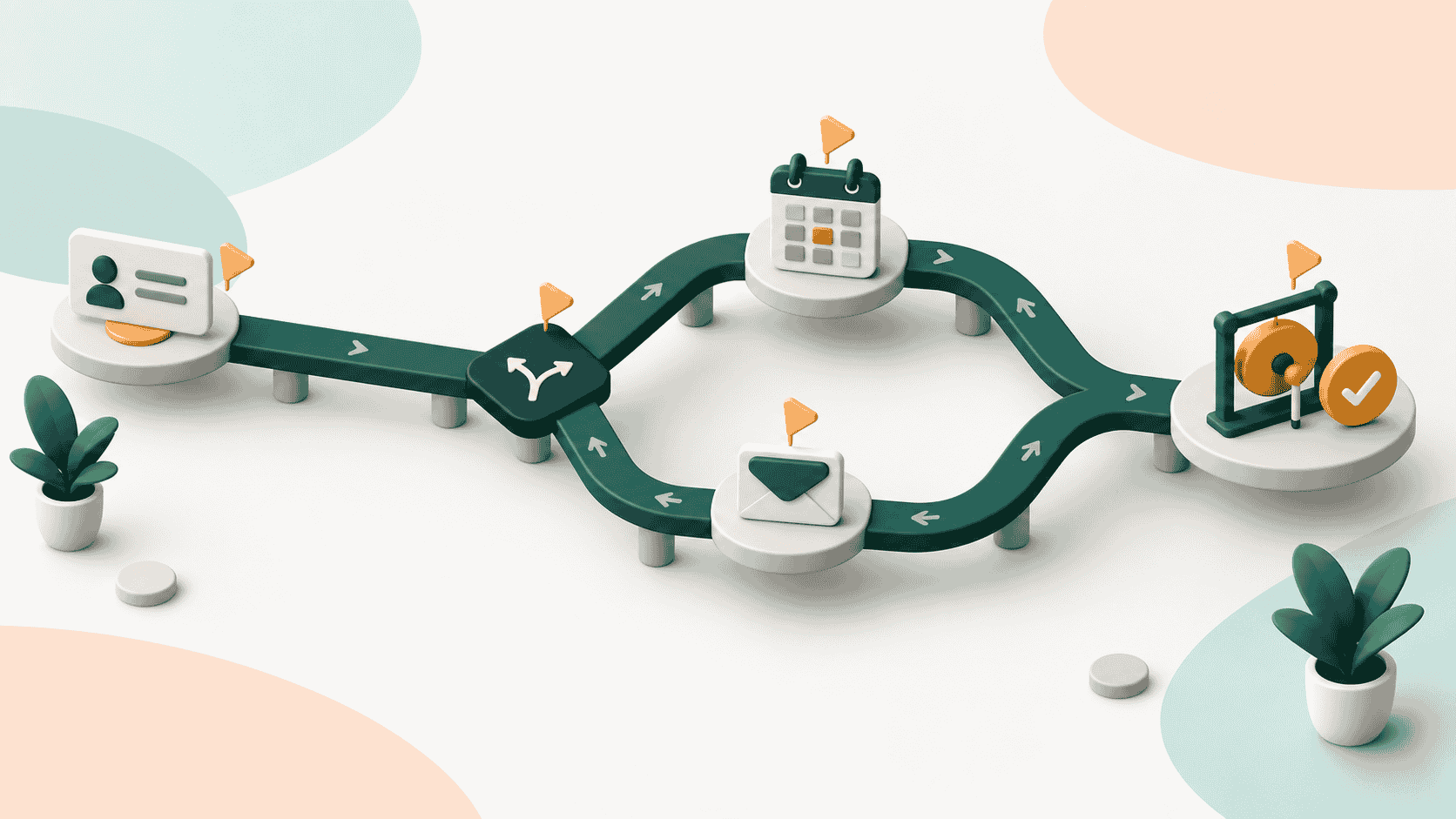

If your sales cycle is getting longer, the answer is not necessarily to make your sales team move faster. In many cases, the bigger problem is that deals are spending too much time waiting: waiting for the right stakeholder to join, waiting for a proposal, waiting for security or legal approval, or simply waiting because nobody has agreed on what happens next.
In this post we’re exploring eight ways teams can shorten the sales cycle without rushing buyers or compromising deal quality.
First, Calculate Your Sales Cycle Length
Before you try to reduce your sales cycle, make sure you know where the time is actually going.
A simple way to calculate average sales cycle length is:
Average sales cycle length = Total number of days from opportunity creation to closed-won across closed-won deals ÷ Number of closed-won deals
Average cycle length is useful, but it should not be the only number you track. A few unusually large or complex deals can distort the average, so it is also worth monitoring the median sales cycle.
You should also look at:
- Average time spent in each sales stage
- Percentage of deals that exceed your expected stage duration
- Days since the last buyer activity
- Sales cycle by segment, ACV, source, and rep
8 Ways to Reduce Your Sales Cycle Length
Once you have a benchmark in hand, here are some tactics that are sure to work:
1. Qualify Out Weak Opportunities Before They Enter the Pipeline
One of the simplest ways to reduce your average sales cycle is to stop spending months on opportunities that were never likely to close. That starts with defining what a qualified opportunity actually looks like.
“Interested” isn’t the same as qualified. A prospect can like the product, attend several meetings, and still lack the budget, authority, urgency, or internal path to a decision.
Qualification should establish whether there’s a genuine business problem, who owns it, how the decision will be made, and when the buyer needs to act. Kris Close supports MEDDPICC and BANT qualification in one click, using what buyers have said and making the underlying evidence traceable.
2. Map the Entire Buying Committee Earlier
Deals often slow down because the person your sales team has been speaking with isn’t the only decision-maker. Finance, security, IT, procurement, and executives may all need to weigh in. If these stakeholders appear late, the deal can effectively restart.
Identify the buying committee early and understand each person’s role: who owns the budget, evaluates the technology, uses the product, influences the decision, and gives final approval. Kris Close provides buyer org charts and stakeholder sentiment, helping reps see who is involved and how they’re responding so they can build broader stakeholder coverage instead of relying on one champion.
3. End Every Meeting With a Specific Next Step
“Let’s follow up next week” isn’t enough to move a deal forward. A useful next step should clarify what happens next, who needs to be involved, what each side needs to do, and when it will happen. Gong found that sellers in its fastest deals spent 53% more time discussing next steps during the first meeting than sellers in slower deals.
Taking a few extra minutes to align on the next step can prevent much bigger delays later, when everyone leaves the meeting with a different understanding of what happens next.
4. Prepare the Next Deal-Stage Deliverable Before the Buyer Asks
Deals can stall between meetings when reps need to prepare a proposal, business case, meeting brief, or answers for new stakeholders. Instead of waiting for the next stage to create a blocker, anticipate what the buyer will need and prepare it in advance.
Kris Close’s Next Best Moves generates deal-stage deliverables such as discovery questions, meeting briefs, proposals, and business cases from the deal’s existing evidence. This helps reps carry context forward and stay prepared as the deal progresses.
5. Find Bottlenecks at the Stage Level
A long sales cycle does not necessarily mean every stage is taking too long. Often, one stage is creating most of the delay. For example, discovery might move quickly while proposals consistently sit for a week. Or deals may move smoothly until procurement, where they remain stuck for several weeks.
That is why sales teams should look at time in stage rather than relying only on the overall cycle length. Track the average and median time spent in each stage, stage-to-stage conversion, deals that exceed your expected duration, and days since the last buyer activity.
This changes the question from "How can we get reps to move faster?" to "Which part of our sales process is creating the delay?"
6. Start Procurement, Security, and Legal Earlier
A buyer agreeing to purchase doesn’t mean the deal is close to closed. Security reviews, legal, procurement, vendor onboarding, and finance approvals can add weeks if discovered late.
Ask about these requirements early and, where possible, run them alongside commercial evaluation rather than treating them as a separate phase afterward. The goal is to prevent operational requirements from becoming last-minute blockers.
7. Qualify for “No Decision,” Not Just Competitive Risk
The biggest threat to a deal isn’t always a competitor. It’s often the buyer deciding that doing nothing is good enough. A prospect can agree with the problem and like your solution without having enough urgency to act.
Qualification should uncover what happens if they do nothing, why the problem needs to be solved now, who owns it, and what happens if the project is delayed. Without a compelling reason to act, deals can sit “active” for months without moving.
8. Measure Buyer Engagement, Not Just Seller Activity
Emails sent, calls made, and meetings booked measure seller activity, not necessarily deal momentum. Buyer engagement is a stronger signal: two-way communication, stakeholder participation, response speed, agreed actions, and activity between stages.
The goal isn’t to maximize the number of sales touches. It’s to create enough meaningful buyer participation to keep the deal moving.
How Kris@Work Helps Shorten Sales Cycles
Kris@Work is an AI-native GTM platform designed to help revenue teams move opportunities from qualification to closed-won with less friction between stages.
For sales-cycle reduction specifically, Kris Close brings together three relevant capabilities.
First, Deal Intelligence supports earlier qualification with MEDDPICC and BANT, using evidence from what buyers have said. It also provides stakeholder sentiment and buyer org charts to help reps understand the wider buying group.
Second, Next Best Moves provides recommended actions with the reasoning behind them, while Kris Guidance helps reps determine what to do at the point it matters.
Third, deal-stage deliverables such as meeting briefs, discovery questions, proposals, and business cases can be generated from the deal's evidence base.
Kris positions Close to cut sales cycles by up to 40%. <statistic from the provided documents>
The broader idea is straightforward: shorten the gaps between qualification, stakeholder alignment, execution, and the next buying decision.
How to Know If Your Sales Cycle Is Actually Getting Shorter
A shorter sales cycle is not automatically an improvement if win rates fall or poorly qualified deals are being pushed through the pipeline. That’s why we don’t recommend measuring the average sales cycle in isolation.
| Metric | What it tells you |
|---|---|
| Average sales cycle | Overall sales velocity |
| Median sales cycle | Whether outliers are distorting the average |
| Time in stage | Where deals are slowing down |
| Stalled deals | How much pipeline is experiencing friction |
| Days since buyer activity | Whether engagement is declining |
| Stakeholders engaged | Whether the deal is sufficiently multithreaded |
| Next-step coverage | Whether active deals have a defined path forward |
| Win rate by cycle length | Whether faster deals are actually better deals |
Conclusion
Reducing sales cycle length is less about pushing buyers to move faster and more about removing the friction that slows qualified deals down.
Better qualification, earlier stakeholder alignment, clear next steps, and fewer internal and administrative delays can make the buying process more predictable without compromising the quality of the deal. The goal is not simply a shorter cycle, but a sales process that moves the right opportunities forward with less wasted time.
Want to optimize and shorten your sales cycle? Start a free Kris@Work trial. No credit card is required.
FAQs
What is a good sales cycle length?
There is no single benchmark that applies to every business. Sales cycle length varies based on ACV, product complexity, industry, customer segment, number of stakeholders, and procurement requirements.
Should you try to shorten every sales cycle?
No. Some purchases genuinely require evaluation, security reviews, procurement, or executive alignment. The objective is to remove unnecessary delays, not pressure buyers into making decisions before they are ready.
What is the difference between sales cycle length and sales velocity?
Sales cycle length measures how long it takes an opportunity to close. Sales velocity is a broader measure of how efficiently a sales organization converts opportunities into revenue, taking factors such as opportunity volume, average deal value, win rate, and cycle length into account.
How often should sales teams review their sales cycle?
Review overall sales-cycle trends monthly or quarterly, but monitor stage-level bottlenecks and stalled opportunities as part of regular pipeline reviews. This makes it easier to identify emerging problems before they materially affect the average cycle length.
Related Blog Posts

9 Best AI CRMs for Startups & Small Business (2026)
12 September 2026