
Zoho is one of the most affordable, near complete CRMs a business can buy, and for teams already living inside the wider Zoho suite it is hard to argue with. So if you are hunting for a Zoho CRM alternative, it is rarely about price. It is about the parts that wear on you: the setup that takes weeks to feel right, the AI that sits behind the higher tiers, and the fields that only stay accurate if a rep remembers to update them.
This guide ranks eleven Zoho competitors that teams actually switch to in 2026. The list runs from simple pipeline tools to enterprise platforms, with a bias toward the modern, AI-native end of the market. We name where each one wins, where it does not, and where staying on Zoho is the better call.
TL;DR
For a B2B revenue team that wants a CRM to maintain itself, Kris@Work (Kris AI CRM) is the strongest AI-native alternative to Zoho CRM: it updates stages, enriches records and answers questions on its own, so reps stop doing data entry. If you want an all-in-one platform with a genuinely free tier, HubSpot is the safe default. If you want Zoho-style value with less complexity, Freshsales is the closest like-for-like swap. And if you are scaling up into enterprise, Salesforce is the heavyweight. The rest of this list is about matching the tool to how your team actually sells.
What We Looked For to Pick
We are a go-to-market team that writes about CRM for a living, and we evaluate these tools against the same criteria we use internally:
- Fit for the team switching. Fast to set up, usable without a small army of admins.
- AI that does real work, not a chatbot bolted onto an old data model.
- Data hygiene, because a CRM nobody updates is a spreadsheet with extra steps.
- Honest value. We weigh what you get on the plans a team can actually afford.
- Transparency about tradeoffs. Every pick below has a real one.
The order reflects fit for a team leaving Zoho, not a strict quality ranking, and the list deliberately spans simple tools and enterprise platforms. Pricing moves constantly and varies by region, so treat price notes as directional and confirm on each vendor's live pricing page before you commit.
Zoho CRM Alternatives At a Glance
| Tool | Best for | AI approach | Entry point | Main tradeoff |
|---|---|---|---|---|
| Kris@Work (Kris AI CRM) | B2B revenue teams wanting zero-touch | AI-native, self-maintaining record | Free trial, no card | Newer, B2B-sales focused |
| HubSpot | All-in-one with room to grow | Breeze AI across the suite | Free CRM tier | Meaningful AI sits on pricey tiers |
| Freshsales | Zoho-style value, less complexity | Freddy AI, from low tiers | Free tier | Best features gated to Pro |
| Pipedrive | Simple, sales-first pipelines | AI Sales Assistant | Free trial only | No free plan, add-ons stack up |
| Attio | Startups wanting a modern data model | AI-native, natural-language | Free for small teams | Thinner integrations and reporting |
| Salesforce | Teams scaling into enterprise | Agentforce agentic AI | Free suite for two users | Premium price, heavy setup |
| monday CRM | Visual, no-code flexibility | AI add-ons on a Work OS | Free trial | General-purpose roots, less sales depth |
| Salesflare | Automatic data capture | Auto-logs email and calendar | Free trial | B2B SMB sweet spot, lighter governance |
| Copper | Teams living in Google Workspace | Light AI, Gmail-native | Free trial only | Google-only, no free plan |
| Capsule CRM | Lightweight and affordable | Light AI assist | Free for a couple of users | Thin on advanced automation |
| Close | High-volume inside sales | AI assist on calls and email | Free trial only | Sales-only, no free plan |
Why Teams Leave Zoho CRM
Before the list, it helps to name the switch triggers, because they tell you what to look for in a replacement.
The first is complexity. Zoho is powerful precisely because it is deep and highly customisable, and that depth is what most reviewers flag as a steep learning curve. Teams without a dedicated admin often feel they are configuring software instead of selling.
The second is AI access. Zoho's assistant, Zia, does real work: lead and deal scoring, anomaly detection, plain-language report building. Most of it lives on the Enterprise and Ultimate tiers, so the AI you came for is not on the plan you started on.
The third is upkeep. Like most traditional CRMs, Zoho only knows what a rep last typed into it. Fields drift, titles go stale, and the record slowly stops matching reality. Across the industry, roughly seven of every ten working hours go to non-selling tasks rather than talking to buyers (Salesforce, 2023), and CRM maintenance is a big slice of that.
None of this makes Zoho a bad product. It makes it a mature, broad, value-first suite that some teams outgrow in one specific direction: they want something simpler, more modern, more specialised, or genuinely AI-native. That is what the eleven below offer.
1. Kris@Work (Kris AI CRM): the zero-touch, AI-native
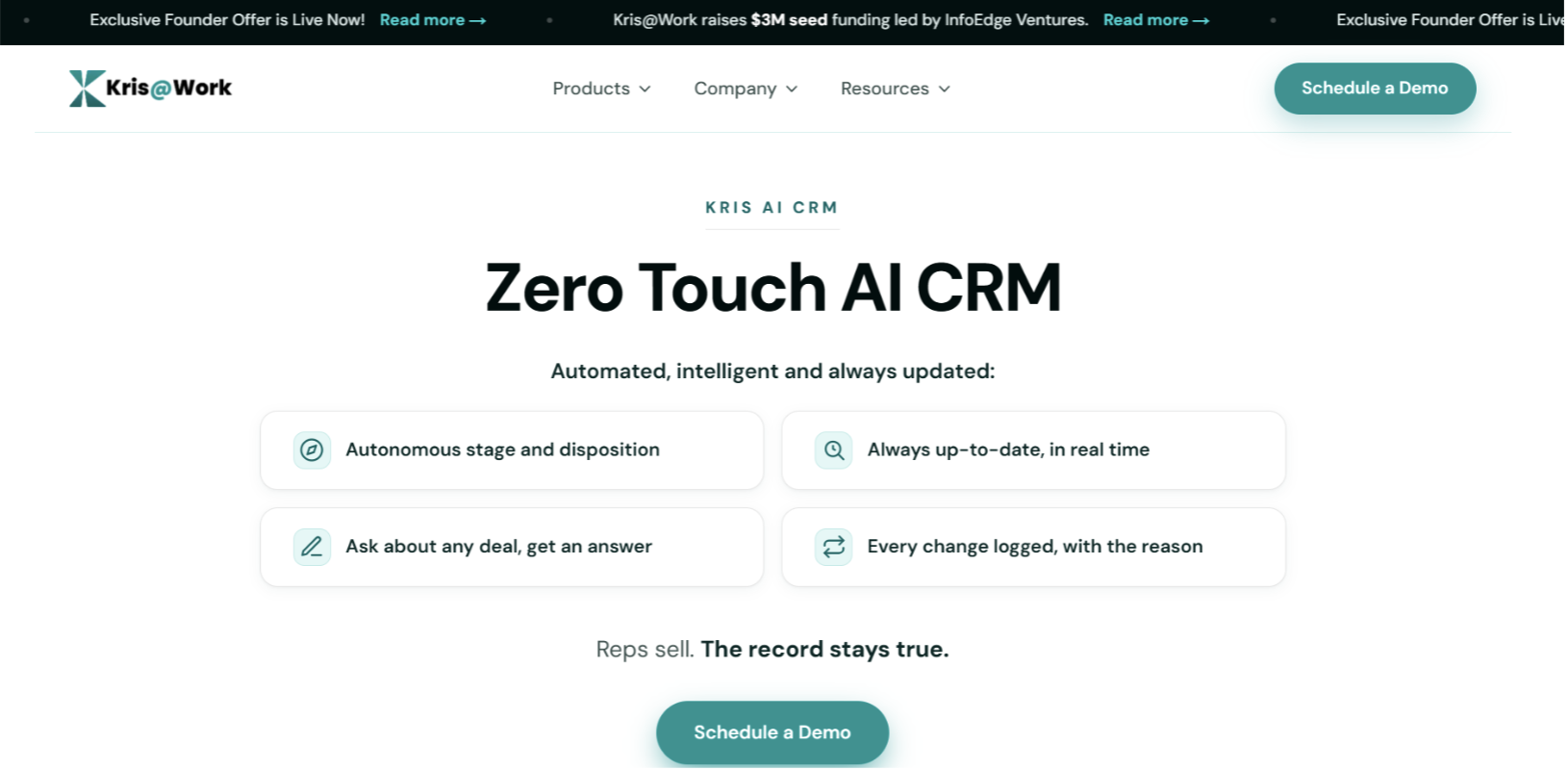
Kris@Work is an AI-native go-to-market platform for B2B revenue teams, and Kris AI CRM is the system of record underneath it. Its whole premise is the opposite of manual CRM upkeep: the record maintains itself.
In practice that means a few concrete things. Kris reads every call, email and meeting, then moves the deal stage and disposes each interaction on its own, so the pipeline reflects what the buyer actually did rather than what a rep found time to log. It enriches titles, firmographics and contacts continuously, and when someone changes a job or a company restructures, it detects the change and cascades it to every account it touches.
That is how it solves the stale-data problem. The record refreshes on its own as a deal changes state, and person-level detail stays current too, so if a contact leaves or a company reshuffles you tend to hear it from the CRM first. The point is that reps act on where the deal and the buyer are now, not on a snapshot from last quarter.
You can ask about any deal, account or the whole book in plain language and get an answer in words, with the reasoning behind each health grade and ARR projection attached. Standing reports for pipeline velocity, stage conversion and forecast against commit assemble themselves from the live record. Underneath, more than 15 tools collapse into one record, so nothing is re-keyed at handoff.
You also do not have to rip out what you already run. Kris can act as your primary system of record, or sit alongside an existing CRM as a connected layer, so you can adopt it as a base CRM or add it on as a connector to the stack you already have. The sync is bi-directional: when a deal status changes in Kris, whether from a meeting, an email or an external signal, that update flows back into Salesforce or HubSpot, and the data your team enters in the existing CRM flows into Kris. Both records stay in step.
Kris frames the payoff in three numbers: the potential to reclaim around two hours per rep per day from CRM entry and hygiene, zero fields to update by hand, and one living record beneath the platform. Those are the outcomes the design aims at rather than a guarantee for every team.
Kris is self-serve with a free trial and no credit card, and it sits under a wider platform, Kris Capture for prospecting and Kris Close for deal execution, so the CRM is not a standalone island.
Features:
- AI-Native zero-touch CRM that automatically updates, enriches, and explains your customer records, so reps can sell instead of maintaining the database.
- An inbuilt deliverability system to check mailbox and domain health, ensuring outreach is sent only from healthy inboxes.
- Lead Finder that simplifies lead discovery from 5 minutes to 5 seconds with Apollo-like filters.
- Sales Coaching that provides real-time guidance on a rep’s strengths and areas for improvement.
- Marketing Email Campaigns that let users design templates, set sequencing, and define user cohorts, similar to Mailchimp and Mailgun.
- Power Dialing that allows reps to call 100 contacts at once, drop pre-recorded voicemails in their own voice, and get notified when someone picks up.
- Follow-Exact Template that lets users define a fixed email template with placeholders, giving them complete control over the messaging sent to prospects.
Where it beats Zoho: the record maintains, enriches and explains itself, so the AI is the CRM rather than an upsell tier on top of it.
Best for: Mid-size, large enterprises and B2B sales teams that are tired of maintaining their CRM and want an AI-native one instead.
2. HubSpot: The All-in-one With a Free Tier
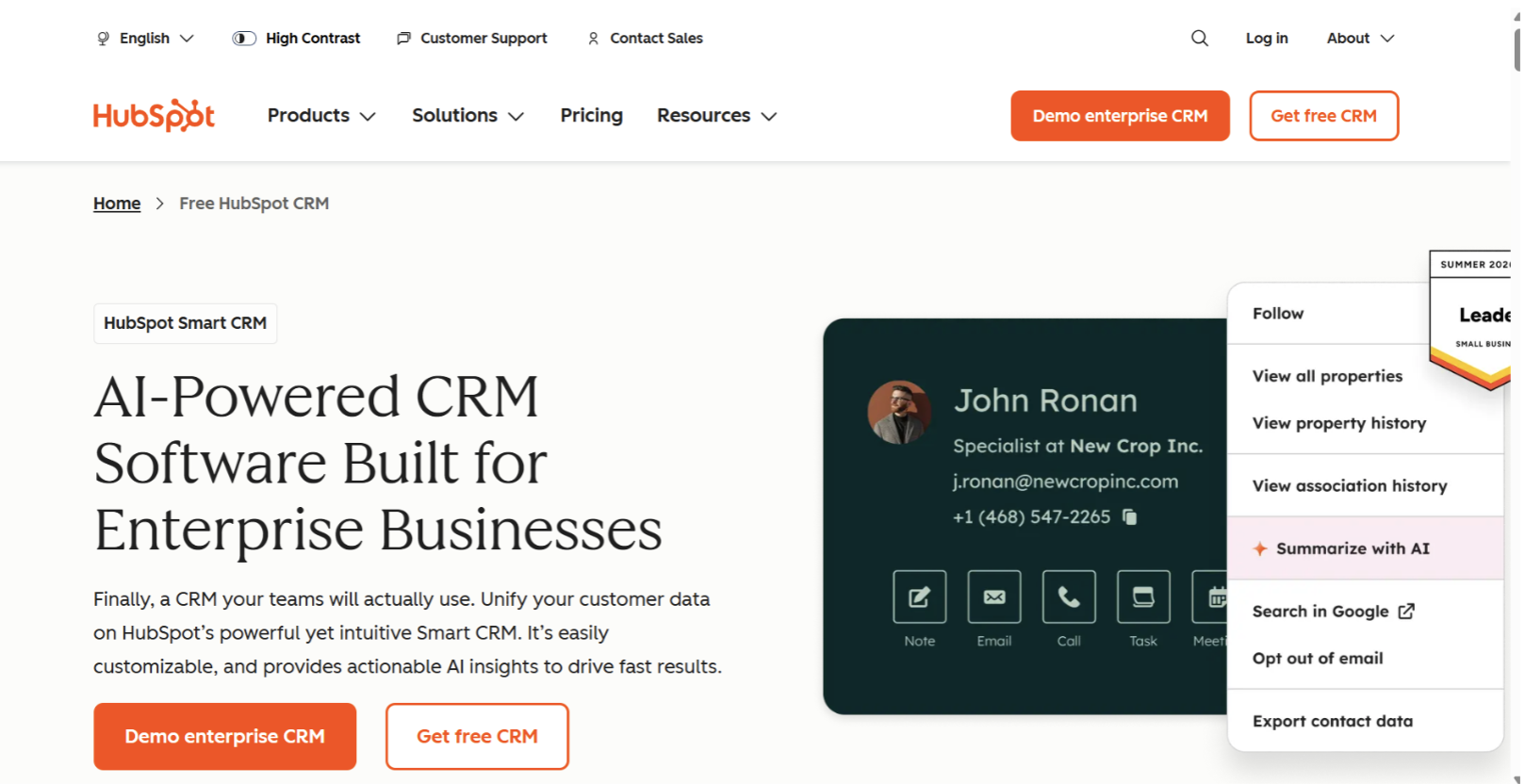
HubSpot offers free CRM, covers contacts, deals, email and basic reporting, and its Breeze AI layer now runs across the platform. Breeze Assistant is available even on the free tier, which makes it a low-friction way to try CRM-grounded AI before you spend anything.
The catch is a familiar one for anyone leaving Zoho over tier-gating: the AI and automation that actually move the needle, predictive scoring, the agents, the deeper enrichment, live on paid tiers, and HubSpot's Professional plans get expensive fast for a small team. HubSpot is the strongest fit if you want one platform for sales, marketing and service and you expect to grow into it.
Best for: teams that want breadth and a free starting point, and can budget for the upgrade later.
3. Freshsales: The Closest Zoho-style Swap
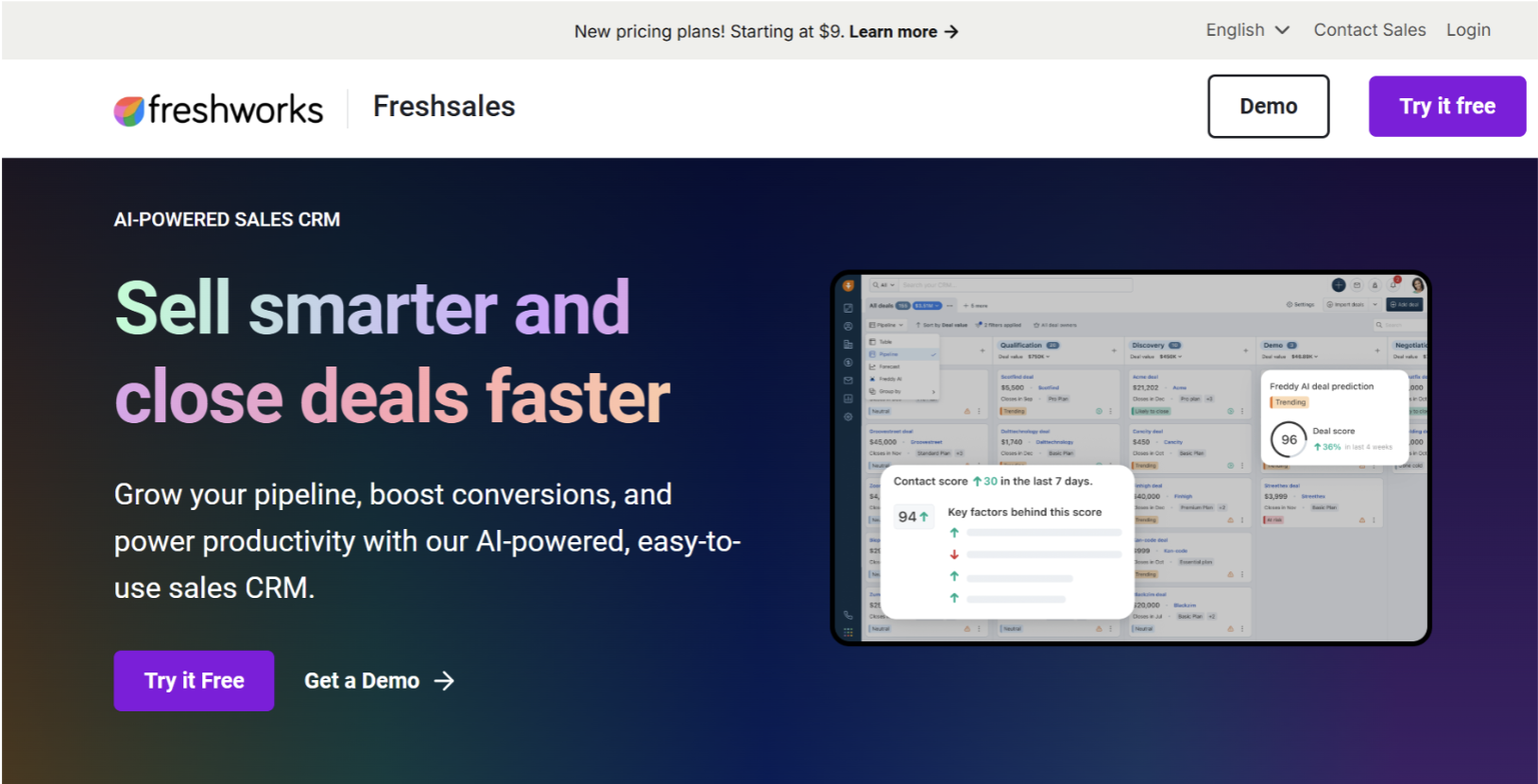
If you like Zoho's value but not its learning curve, Freshsales is the most natural like-for-like move. It comes from Freshworks, shares Zoho's affordable, SMB-first heritage, and pairs a cleaner interface with built-in phone, email and chat so you are not stitching a dialer on later. Its Freddy AI assistant handles lead scoring, deal insights and next-step suggestions, and unlike some rivals it shows up on the lower paid tiers rather than only at the top.
The tradeoffs are feature-gating and product-family confusion. The strongest Freddy features and sequences tend to sit on the Pro tier, and Freshsales, Freshsales Suite and Freshmarketer are easy to mix up when you are comparing plans. Sort out which product you are actually buying before you sign.
Best for: small sales teams that want Zoho-level affordability with a gentler setup.
4. Pipedrive: The Simplest Sales-first Pipeline
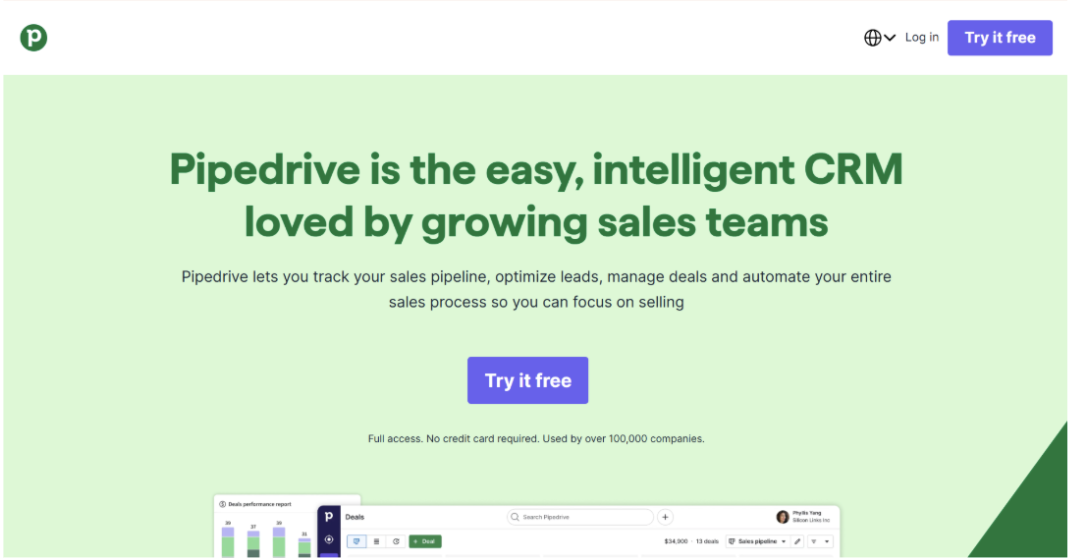
Pipedrive does one thing and does it cleanly: visual, stage-based pipeline management that reps adopt in an afternoon. Its AI Sales Assistant and email tools are useful rather than transformative, and that is the honest pitch, this is a sales CRM, not an all-in-one.
Two things to plan for. There is no free plan, so you pay from day one, and automation plus the more capable AI sit on higher tiers, while add-ons like lead tools can push the real monthly cost above the simple entry price. If your business is more than sales, you will feel the edges.
Best for: sales-led teams with a defined process who value simplicity over breadth.
5. Attio: The Most AI-native Modern CRM
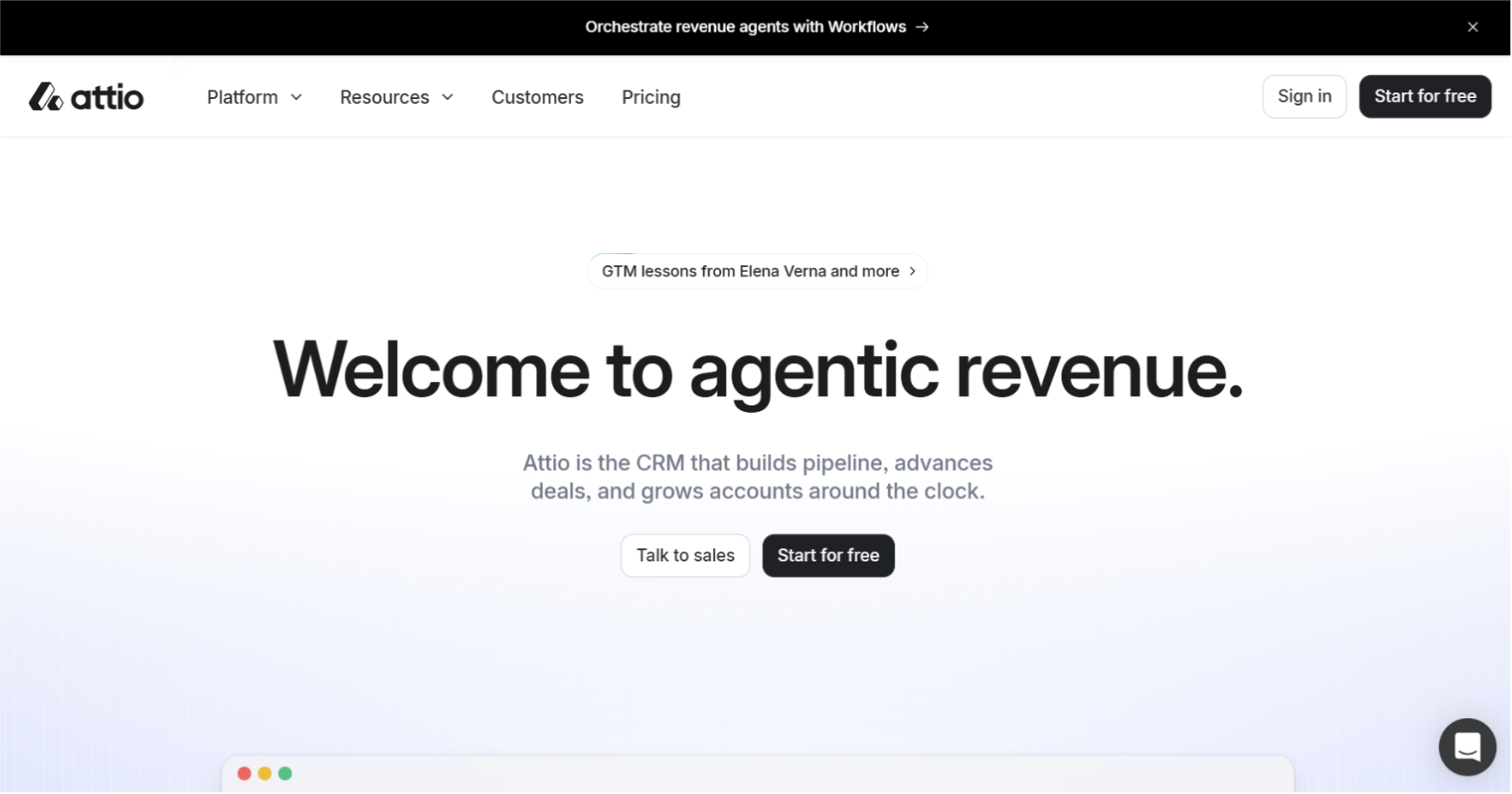
Attio is the tool startups reach for when they want something that feels built this decade. It reimagined the CRM data model from the ground up, so you shape it around how you actually sell instead of forcing everything into Contacts and Accounts. AI lives in that model: fields auto-fill, calls write their own summaries, a research agent runs live web research inside workflows, and "Ask Attio" lets you query and act on your data in natural language. It is free for small teams, adopts fast, and reviewers consistently praise how much the team actually uses it.
The honest gaps are integration depth and reporting. Its native app catalogue is thinner than HubSpot's or Salesforce's, its reporting is lighter, and the flexible data model rewards teams that invest a little design up front. Larger orgs sometimes graduate to a heavier platform as RevOps needs to mature, so factor a possible future migration into the decision.
Best for: seed-to-Series-B startups running a sales-led or product-led motion who want a modern, flexible system of record.
6. Salesforce: The Enterprise Heavyweight
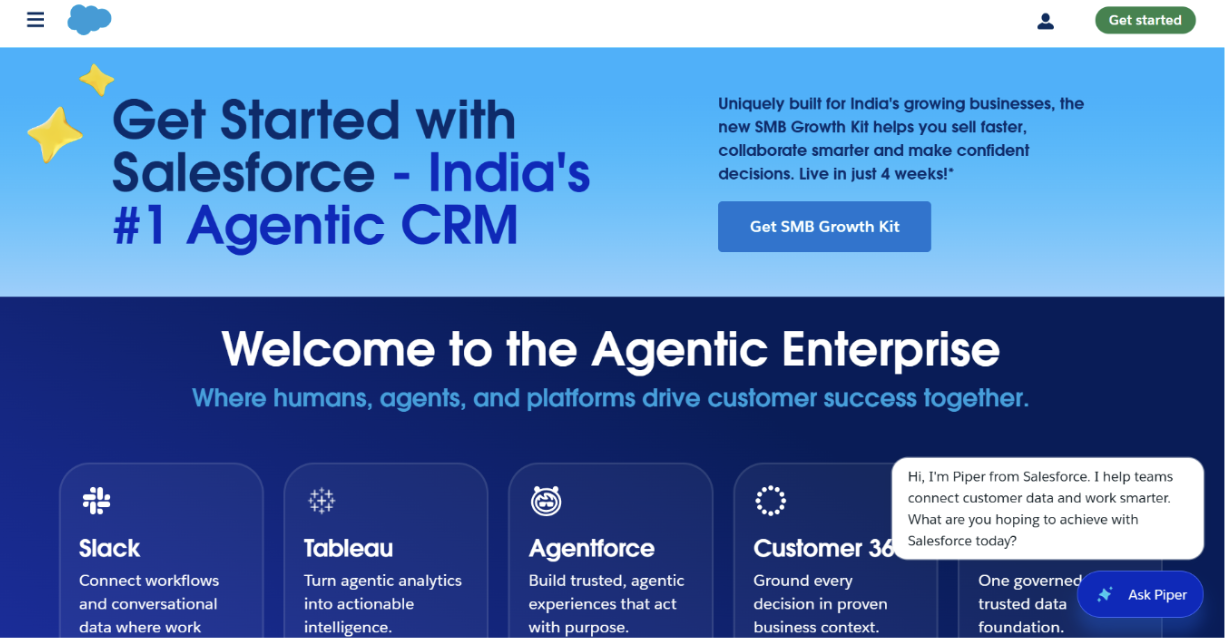
Salesforce is the one you move up to, not down to. It is the deepest, most extensible CRM on the market, with the largest integration marketplace in AppExchange and a serious agentic AI platform in Agentforce. There is a free suite for a couple of users and an entry Starter Suite for smaller teams, so it is not off-limits to a growing business, and the ceiling is effectively unlimited.
Be honest with yourself about direction, though. Most teams leave Zoho because they want something simpler, and Salesforce is the opposite: premium pricing, real implementation overhead, and its strongest AI sitting on the top tier or as a credit-based add-on, which can quietly turn a flat per-seat plan into a usage-based bill. It rewards teams that have the budget and the people to run it.
Best for: teams scaling into mid-market or enterprise that want maximum depth, governance and ecosystem, and can staff the setup.
7. monday CRM: The Flexible, Visual Option
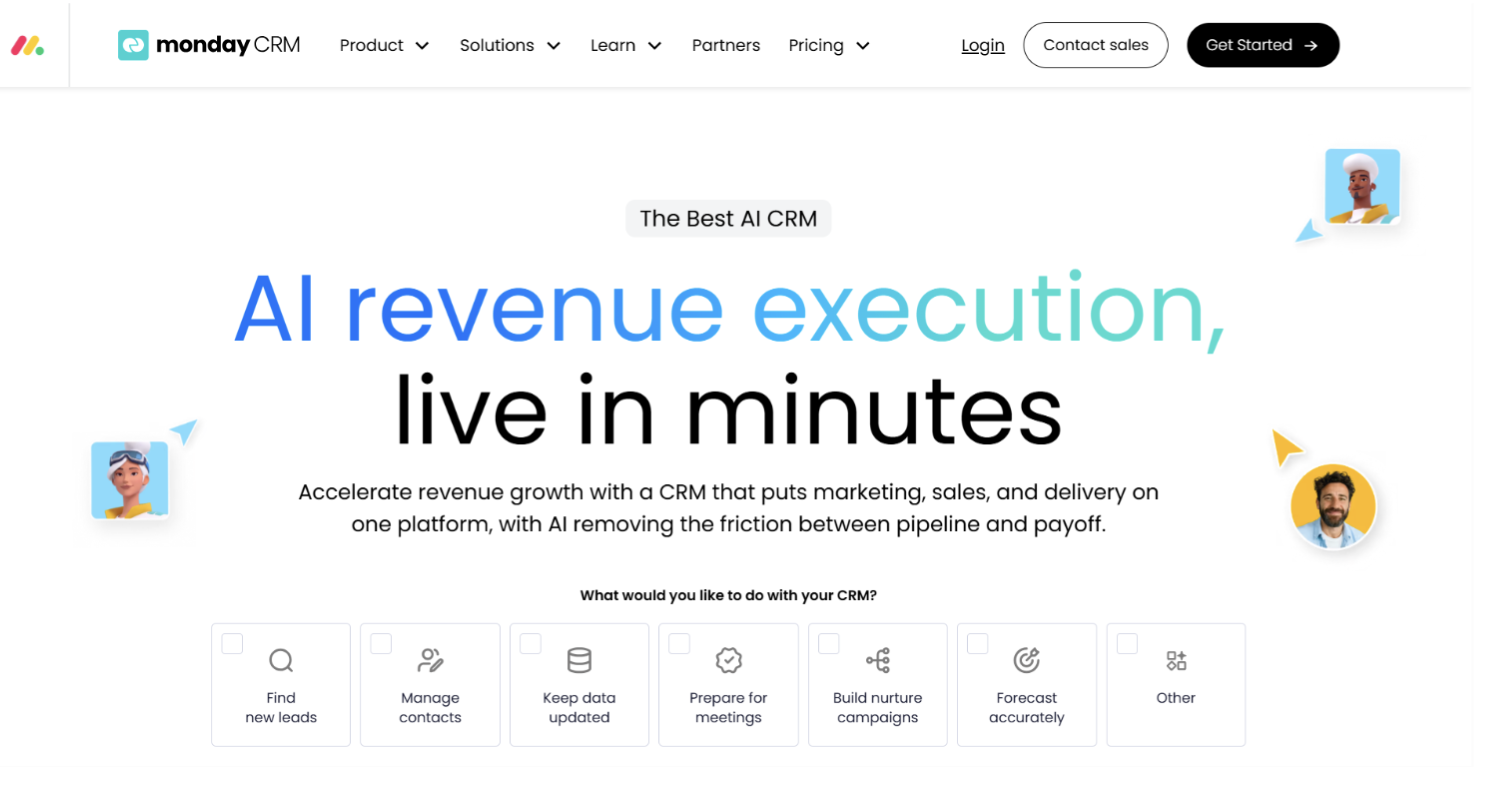
monday CRM sits on top of monday's no-code Work OS, which is its blessing and its caveat. You can mould nearly every stage of the customer journey without a developer, colour-code and automate visually, and get running within hours. Teams that already like monday for project work take to it quickly.
The flip side of that flexibility is that it started as a general work platform, not a sales tool, so it can feel shallower on native sales depth than a purpose-built CRM, and a highly customised board can sprawl if nobody owns it. Its AI arrives as add-ons rather than a native core.
Best for: teams that value visual, customisable workflows and may run more than sales inside the same tool.
8. Salesflare: The CRM That Fills Itself In
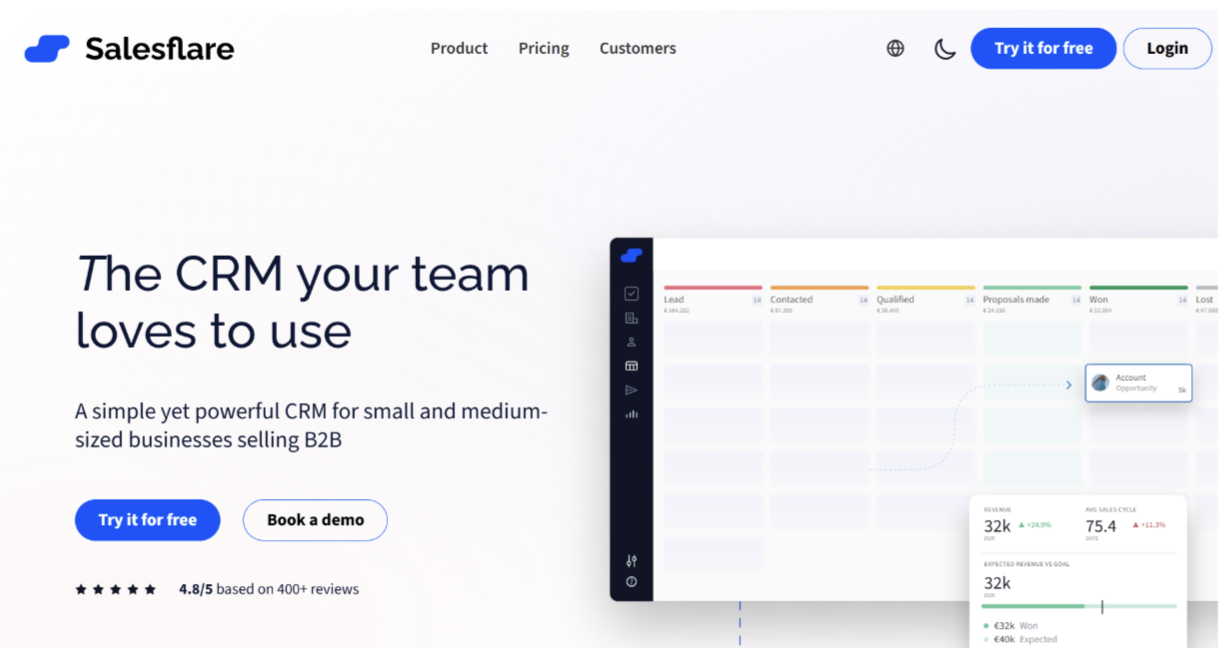
Salesflare's pitch will resonate with anyone leaving Zoho over manual upkeep: it builds and updates records for you. It pulls contact and company data from your email, calendar and social profiles, logs meetings and calls automatically, and surfaces the deals that need attention, all with very little typing. For B2B teams that live in Gmail or Outlook, the inbox sidebar is genuinely handy.
Its sweet spot is small-to-mid B2B sales teams, and that focus is also the tradeoff. It is lighter on enterprise-grade governance and deep customisation, and some users find it easy to start with but harder to grow into as needs get more complex.
Best for: small B2B teams that want automatic data capture and minimal CRM admin.
9. Copper: The Google Workspace-native CRM
If your team runs its whole day inside Gmail, Calendar and Drive, Copper is built for exactly that. It is the Google-recommended CRM, and rather than bolting Google integrations on afterwards, it lives inside your inbox: it auto-captures email and meeting activity, surfaces contact details in a Gmail sidebar, and asks for almost no manual logging. The learning curve is close to zero because it looks like the tools your team already uses.
The tradeoffs are ecosystem and scope. Copper is Google-only, so Microsoft 365 shops should look elsewhere, there is no permanent free plan, and AI is a supporting layer rather than the centre of the product. It is a relationship and pipeline CRM, not a marketing suite.
Best for: agencies, consultancies and service businesses standardised on Google Workspace.
10. Capsule CRM: Lightweight And Affordable
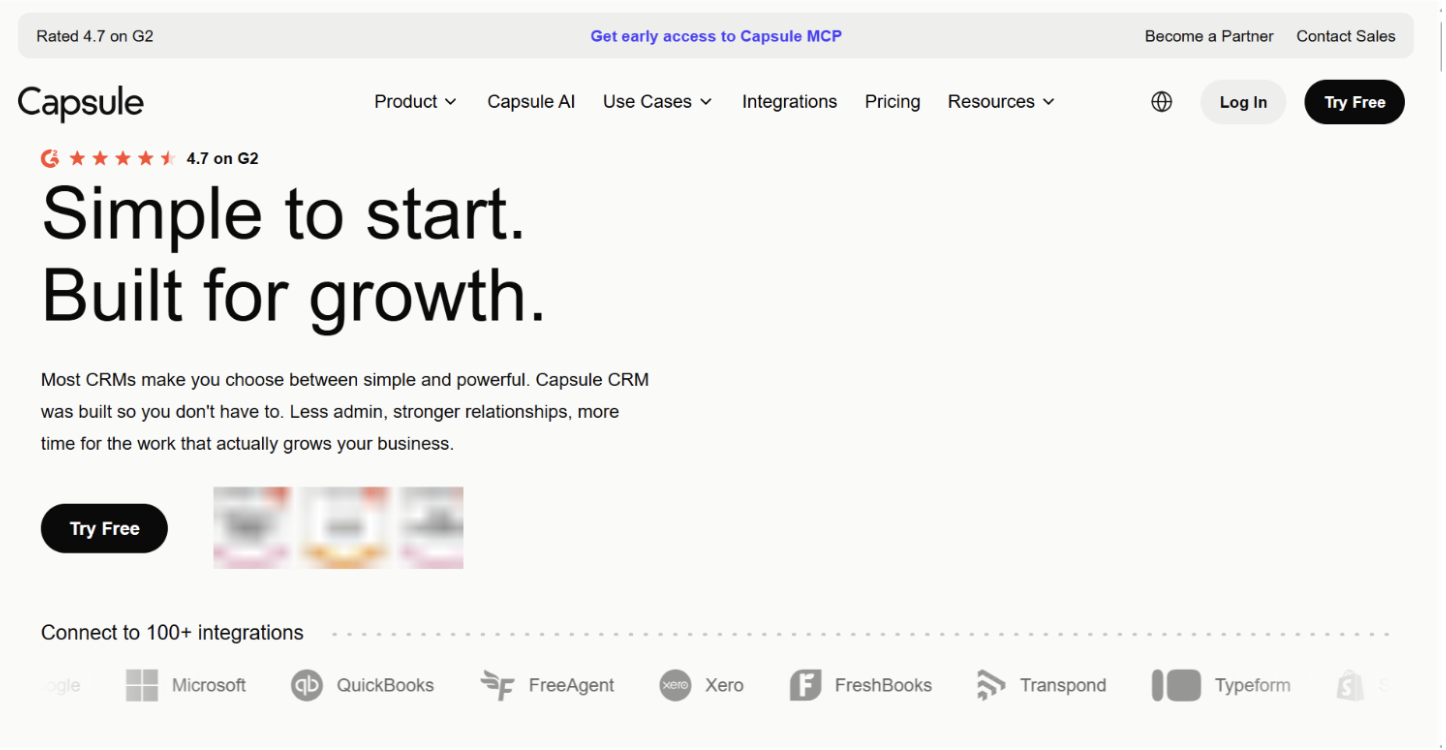
Not every business wants an AI platform. Some just want a tidy, affordable place to track contacts and deals without a learning curve, and Capsule is one of the best at exactly that. It is clean, quick to learn, free for a couple of users, and consistently rated highly for ease of use by the small businesses that run it.
Do not expect depth it does not claim: advanced automation, sophisticated AI and heavy reporting are not the point here. If your process is simple, that is a feature, not a flaw.
Best for: very small teams that want simple, cheap contact and pipeline management.
11. Close: Built For High-volume Inside Sales
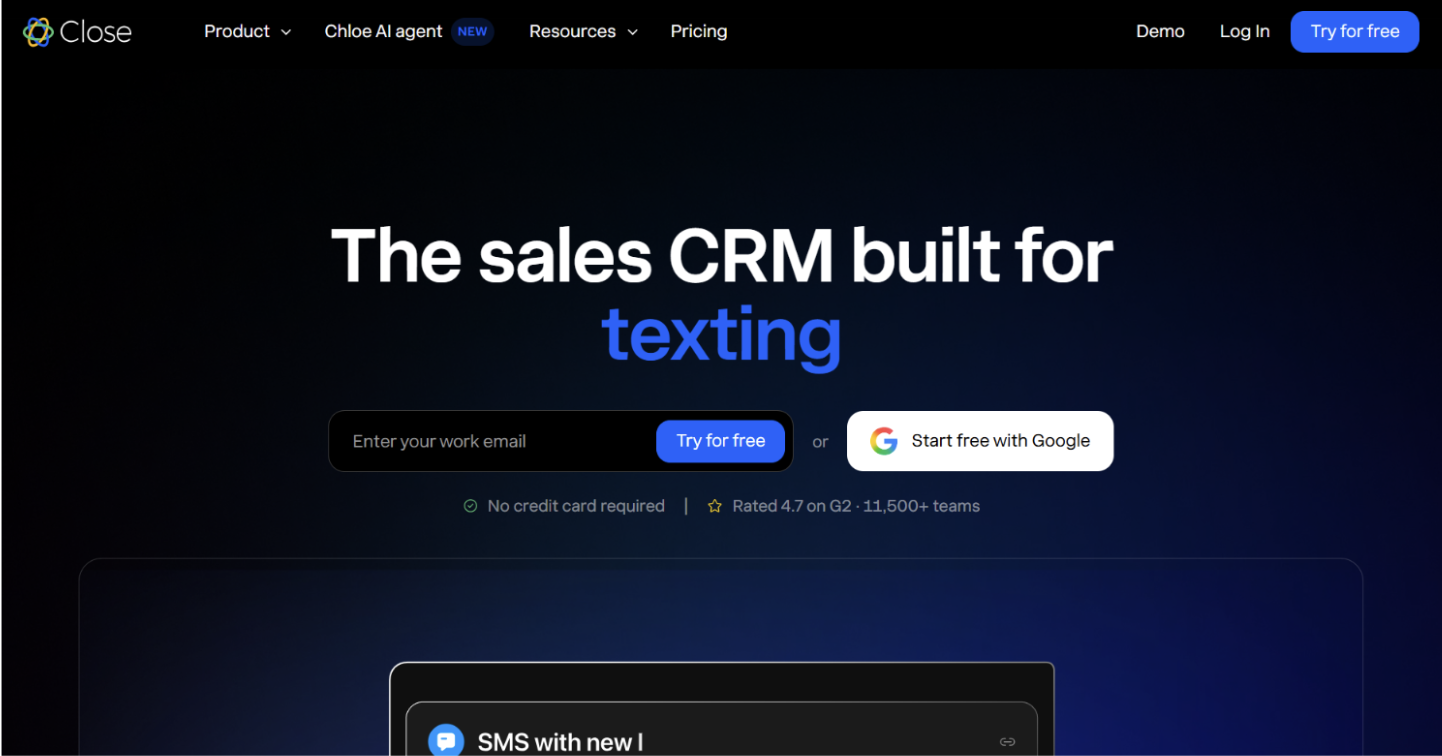
Close is a sales CRM designed around outbound and inside-sales teams, with calling and email built into the core so reps can work a list at speed without bolting on a separate dialer. If your team lives on the phones, it removes a lot of friction and its AI assists on calls and follow-ups.
The tradeoffs are scope and cost of entry. It is sales-only, so it will not serve marketing or service, and there is no free plan, only a trial. For a broad use case it is narrower than the all-in-one options above.
Best for: teams running high-volume outbound where calling is the main motion.
How to Choose a Zoho CRM Alternative
The right alternative to Zoho CRM depends less on features and more on how your team works.
- You want the AI to do the admin- Kris@Work is the AI-native pick: it maintains the record so reps do not have to and offers free AI CRM. Attio is the modern runner-up if you want to shape the data model yourself.
- You want one platform to grow into- HubSpot, with a free tier now and a paid path later.
- You want Zoho's value with less friction- Freshsales is the closest swap.
- You are scaling into enterprise- Salesforce, if you have the budget and people to run it.
- You live inside Google Workspace- Copper.
- You want dead-simple- Pipedrive for a sales pipeline, Capsule for lightweight contact management.
- You sell mostly by phone- Close.
- You want automatic data entry above all- Salesflare.
When to stay on Zoho. If you need one affordable suite spanning sales, marketing, support, finance and analytics, if regional data residency matters to you, or if you are already in the Zoho ecosystem.
Frequently Asked Questions
1. What is the best Zoho CRM alternative?
For a B2B revenue team that wants a self-maintaining CRM, Kris@Work (Kris AI CRM) is the strongest AI-native alternative, because it updates stages, enriches records and answers questions on its own. For an all-in-one with a free tier, HubSpot is safe. For Zoho-style value with less complexity, Freshsales is the closest swap. For teams scaling into enterprise, Salesforce is the heavyweight.
2. Is there a free alternative to Zoho CRM?
Yes. Kris AI CRM and HubSpot offer a free CRM, Attio and Freshsales have free tiers for small teams, Capsule is free for a couple of users, and Salesforce has a free suite for up to two users.
3. Which Zoho competitor has the best AI?
It depends on what you mean by best. Kris@Work and Attio are AI-native, meaning the AI is built into the record itself. HubSpot's Breeze and Salesforce's Agentforce are the capable AI suites on a full platform. Zoho's own Zia is broad and bundled but mostly sits on higher tiers.
4. Why do people switch from Zoho CRM?
The most common reasons are complexity and a steep learning curve, AI features being gated to the higher tiers, and the manual upkeep that traditional CRMs require to stay accurate.
5. Is Kris@Work a full replacement for Zoho CRM?
For B2B sales teams, yes: Kris AI CRM is a complete system of record with autonomous stage management, continuous enrichment of data, a conversational layer and self-assembling reporting.
Conclusion
Leaving Zoho is not about finding something cheaper. It is about finding something that fits how your team sells today. If that means a modern, AI-native CRM that keeps itself current so your reps can sell instead of update fields, start a free trial of Kris AI CRM and see what a zero-touch record feels like.
Explore Kris AI CRM · Compare platforms · More on the blog
Related Blog Posts