
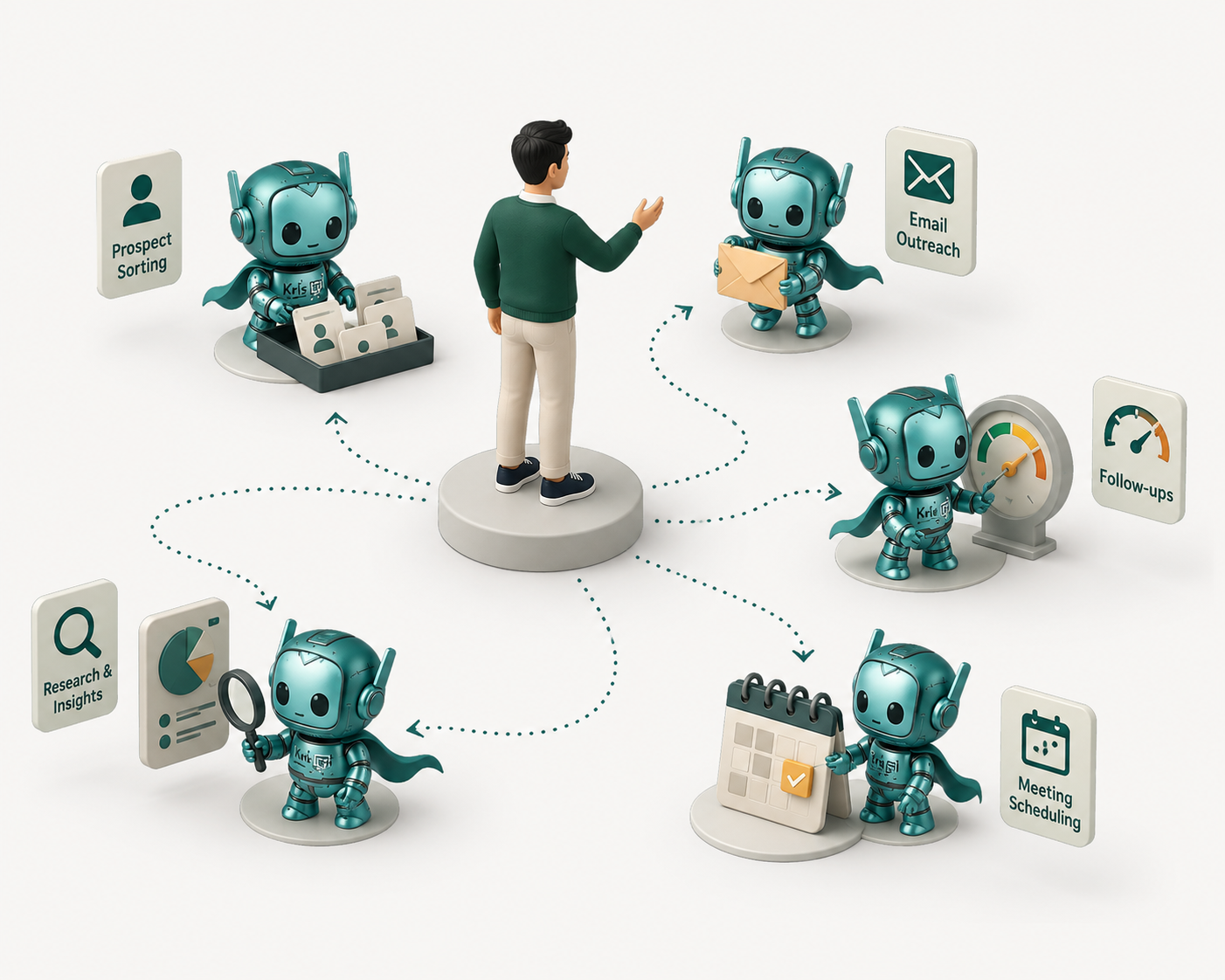
Most revenue leaders have been conditioned to look at their reps when quota are missed. As such, most revenue leaders will either retrain them, replace them, or hire even more people. However, this approach to solving quota attainment problems is nearly always incorrect. A large-scale Gong study examining millions of sales opportunities revealed an uncomfortable reality: quota attainment was falling even though core selling metrics remained stable. Reps’ win rates remained constant; additionally, reps' average deal duration remained unchanged. Rather, Gong’s analysis indicated that the total amount of time reps had available to work on sales opportunities decreased dramatically due to operational drag eating away at the time reps had available to sell. Therefore, the problem was never with the people; the problem existed with the systems from which reps were generating opportunity data. Those systems provided incomplete information relative to the actual state of each opportunity.
This understanding changes how executives view solutions to missed quota. Executives traditionally respond to missed quotas by requiring reps to be retrained; by requiring reps to be replaced; by hiring additional headcount; and/or by adjusting compensation plans. All of these approaches assume the problem resides with the individual reps. These problems reside within the systems that provide reps with opportunity data. Salesforce's sales productivity research paints a concerning picture: selling now occupies only about 28% of a rep's working week. Conversely, 17% of reps’ weekly time is lost in completing CRM-related tasks. Moreover, if you take into account all the other non-selling tasks that occur throughout a typical day (i.e., data entry; meetings; etc.), it can be estimated that reps lose at least half of their week (approximately 50%) to non-selling activities. Furthermore, when reps attempt to gather information needed to make informed decisions regarding which of their accounts require immediate action today, they typically have to search through 12+ disparate tools that are manual and only accessible by the rep on his/her own during breaks after calls. Hiring additional staff members does nothing to improve this situation. Instead, it only increases the number of people who are trying to make sense out of an inefficient system that cannot provide adequate insight.
Agentic AI is the first category of technology built to fix this at the source.
What is the real difference that matters?
Generative AI responds to questions presented in natural language. A rep presents a prompt, and the system generates output based upon that prompt. The rep then determines what action should be taken based upon the output generated by the system. There is no change in what the rep sees, nor when he/she sees it. The cognitive load remains where it originally was.
Agentic AI does not rely on input to perceive context and act appropriately.
Examples of this include: When a champion goes silent for two weeks and engagement scores decrease while the next step remains unscheduled, the agentic system identifies this sequence of events and recognizes the implications of this event on close probability. The agentic system then proactively surfaces the deal prior to the next scheduled pipeline review. If a competitor is referenced during a discovery call, the agentic system flags this reference and retrieves appropriate competitive positioning for use in preparation for follow-up communications via email. In both cases, the rep ceases to serve as the signal processor and instead serves as a decision maker based upon the signals received by the agentic system.
Gong's latest revenue AI research highlighted a clear pattern: teams embedding AI more deeply into their sales process consistently outperformed those that didn't ($100k+) compared to those teams that chose not to utilize AI-based technologies. Specifically, deep-AI-based teams produced 77% more revenue per rep than those teams that chose not to utilize AI-based technologies. For the first time in the study’s history, “increasing the efficiency of existing sales teams” represented the #1 growth strategy cited by respondents in 2026. Prior to this time, increasing efficiency of existing teams ranked #4 as a growth strategy among respondents. Revenue leaders have already identified where they believe leverage exists in the market. Agentic AI is the method through which revenue leaders realize that leverage.
A Specific Problem Inside Most SaaS Revenue Models
One specific issue within all SaaS revenue models exists, and many organizations do not measure this problem honestly because this problem grows gradually and at the same time, invisibly, exactly at those points in the revenue process where accountability typically blurs.
Each transition in the revenue funnel is a controlled information loss. The hand-off from SDR to AE. The hand-off from AE to CSM. At each point, the incoming team receives whatever made it into the notes and will spend weeks rebuilding the context the outgoing team built over months. The CSM handling expansion does not know which objections the champion raised during the discovery phase, which stakeholders pushed back on the hardest, or what ultimately persuaded the economic buyer to sign. Institutional knowledge disappears at each seam, and since institutional knowledge disappears so slowly, most organizations do not realize what is lost in terms of net revenue retention (as evidenced by a failed renewal conversation) when a rep who took a year to develop a relationship has left three months prior to the first renewal conversation.
Agentic AI views the revenue motion as one continuous flow instead of sequential steps. Context is not a document developed the day prior to a handover call. It is a continually evolving record of the account through all stages, all teams, and every person involved. Rather than what the departing sales rep remembered, context is based upon an accurate representation of the interaction history. As such, the CSM that takes on responsibility for a new account begins with a system that already understands the account’s history, open issues, champion dynamics, and the signals that would trigger an expansion opportunity. That represents what durable context means in action, and that is where agentic AI appears most clearly in the metrics a CRO cares about beyond the initial close.
What a Well-Run Revenue Organization Would Look Like Using This Type of Model
Organizations create a revenue flow that builds upon itself as opposed to starting over after each rep leaves or each team reorganizes. RevOps stops being a data-entry function and becomes a revenue systems function: the focus of the work moves to defining the logic that agents operate on, identifying which signals matter, driving actions, and establishing how the system represents true business rules versus vendor defaults. Sales rep who excel are no longer individuals capable of manually navigating multiple tools. These sales rep possess exceptional commercial acumen because it is what can’t be replaced by the system and it is what requires increased levels of commercial acumen for future success.
Additionally, there are forecasting implications associated with using agentic AI that many revenue leaders have not yet fully accounted for. While agentic AI surfaces, which deal with immediate attention today, it impacts the accuracy of all items below it: pipeline calls, headcount planning, and board-level revenue projections. Gong's forecasting research suggests that teams relying on real interaction signals instead of rep sentiment improve forecast accuracy by roughly 10-15%. For an organization carrying $40 million in pipeline, a 10% increase in forecast accuracy is not simply an improvement in reporting. It is a competitive advantage in planning that has a ripple effect in every resource decision made by the organization for the next two quarters.
The advantage created by the adoption of Agentic AI currently
In every major B2B sales technology transition there has been a long-term performance gap between those who adopted it first and those who came later. Sales methodology, sales engagement platforms, data infrastructure for enrichment, and conversation intelligence have all had early adopters create compounding advantages through improvements in process design, quality of data, and organizational capability, which took lagging firms years to attempt to catch up to (often incompletely). In each instance, as the industry caught up, the gap did not remain static; it grew wider, since the early mover continued to build on their initial advantage, while everyone else was just starting to get going.
Agentic AI represents a greater change than any previous one, because it is not merely a new application or extension of an existing notion. Instead, it represents a fundamental change to the operating model. As such, it will be measured against revenue-related metrics, and Gong’s 2026 research also points to a measurable performance gap, with revenue-focused AI adoption linked to stronger growth and higher win rates, and organizations utilizing these tools were 65% more likely to experience increased win rates. A measurable gap exists today in terms of the effectiveness of fully agentic motions vs. non-agentic motions (i.e., broken tool sets and reps relying on instinct); this gap will continue to grow over time as well as show up in quota attainment, pipeline coverage, and NRR as the competitive moat around early adapters becomes increasingly difficult to overcome.
Organizations using the next generation of tools are doing so much more than just adopting an improved platform. They are moving away from an industry that has yet to decide what direction it will take. For every three months your organization waits to make the leap, the gap grows larger with each passing day.