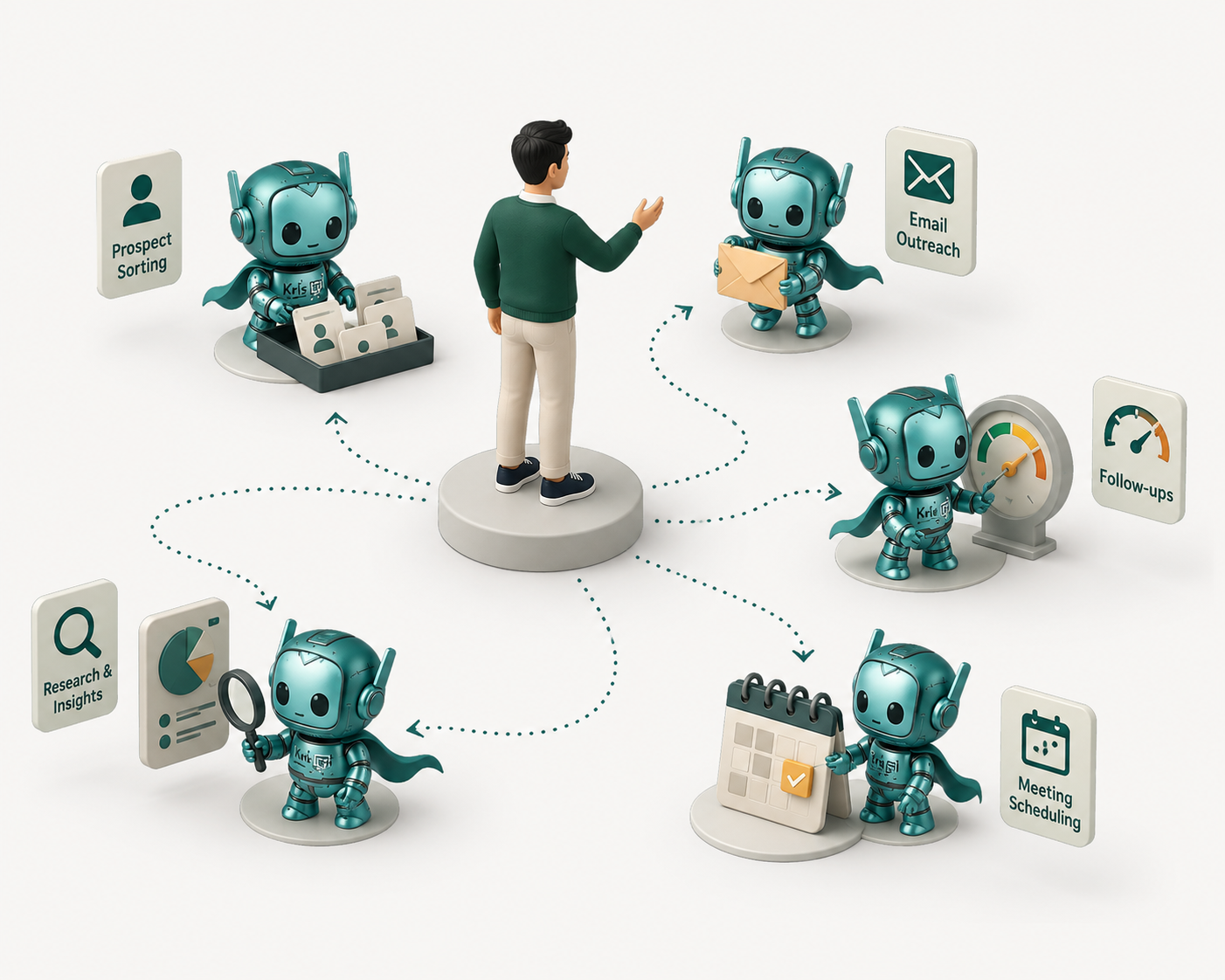

B2B prospecting tools help sales teams find target accounts, identify decision-makers, enrich contact data, prioritise prospects, run outreach, and turn responses into meetings. Kris@Work, ZoomInfo, Apollo, Clay, and LinkedIn Sales Navigator are among the strongest options, each offering different levels of coverage.
B2B prospecting is no longer just about buying a contact list. Yet many tools specialise in only one or two parts of the workflow.
This list evaluates each tool based on how much of the prospecting process it can actually support.
Quick Comparison: Best B2B Prospecting Tools
| Tool | Prospect discovery | Enrichment | Prioritisation | Outreach | Meeting booking |
|---|---|---|---|---|---|
| Kris@Work | ✓ | ✓ | ✓ | ✓ | ✓ |
| Apollo | ✓ | ✓ | ✓ | ✓ | ✓ |
| ZoomInfo | ✓ | ✓ | ✓ | ✓ | ✓ |
| LinkedIn Sales Navigator | ✓ | Partial | ✓ | Partial | - |
| Clay | ✓ | ✓ | ✓ | Via integrations | Via integrations |
| Cognism | ✓ | ✓ | ✓ | Via integrations | - |
| Lusha | ✓ | ✓ | ✓ | - | - |
| Reply.io | ✓ | ✓ | ✓ | ✓ | ✓ |
| LeadIQ | ✓ | ✓ | Partial | Via integrations | Via integrations |
| UpLead | ✓ | ✓ | Partial | - | - |
| Seamless.AI | ✓ | ✓ | Partial | Via integrations | Via integrations |
How We Evaluated the Best B2B Prospecting Tools
We scored each tool across five workflow stages because a tool that excels at one and drops the next only moves the handoff problem elsewhere.
- Find the right prospects: Can it surface ICP-matching companies, decision-makers, and fit attributes? We evaluated database coverage, search filters, discovery features, and market-entry alerts.
- Enrich prospect data: Does it add actionable context beyond basic contacts like emails, phone numbers, firmographics, tech stacks, funding, hiring signals, and news?
- Prioritise who to contact: A big list isn't useful on its own. We assessed if platforms rank best-fit accounts using buying signals, timing, and transparent lead scores (rather than unexplained numbers).
- Engage prospects: What channels are covered (email, LinkedIn, phone)? We looked at personalization, sequencing, automation, and how well messages adapt to prospect behavior.
- Turn interest into meetings: Does it detect intent in replies, trigger follow-ups, book meetings, and hand off leads with context intact?
The 11 Best B2B Prospecting Tools
Here are the best prospecting tools reviewed in detail:
1. Kris@Work
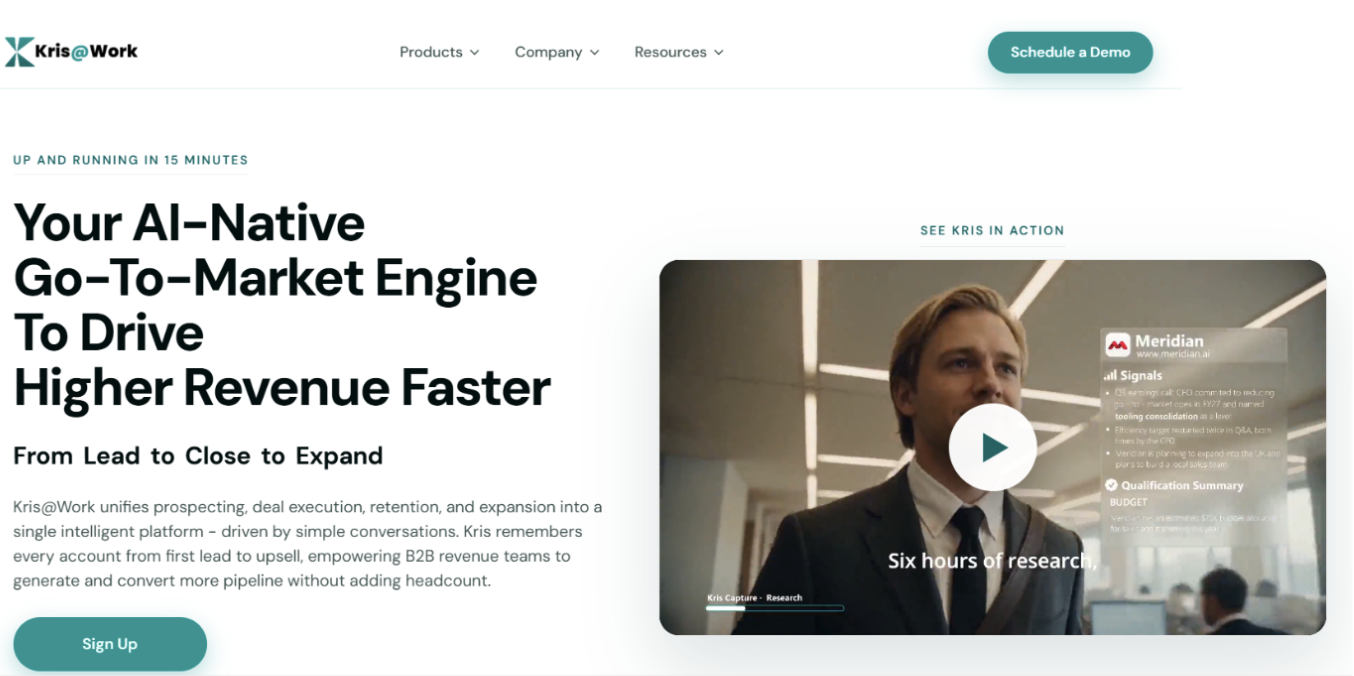
Best for: revenue teams that want to run prospecting from ICP definition to qualified meeting in one window.
Kris Capture is the prospecting module of Kris@Work, the AI-native GTM platform. Where most stacks pass a prospect from database to sequencer to inbox, Kris Capture runs five stages in one window and then carries the context into Kris Close and Kris AI CRM.
- ICP Match List: Kris starts from your ICP, not a generic contact database. It learns seller context to build lists across title, seniority, industry, revenue, headcount, and location from 200+ sources, cleaning the data on entry.
- Enrichment: Every prospect gets verified contact details, firmographics, funding, tech stack, hiring signals, news, and org structure. Kris synthesizes this into a why-now summary and an immediate outreach hook, turning raw data into actionable context.
- Prioritisation: Every record receives an A+ to F grade paired with a clear reason code so reps know why an account ranks there. BANT context is surfaced before outreach, active buying windows are flagged, and predictive scoring runs on 60+ dynamic signals to order the queue by real-world readiness.
- Outreach: Kris doesn’t hand lists off to a separate sequencer. Sequences are assembled live rather than pulled from rigid templates, executing personalized messaging in the rep's authentic voice across email, LinkedIn, and calls with power dialling.
- Meeting: Reply intelligence reads responses across email, LinkedIn, and SMS, classifying intent and sentiment, and flags high-intent signals. The booking link drops directly in-thread, sequences auto-pause upon reply, and the conversation travels straight to the call.
What makes Kris@Work different
Kris Capture handles lead to qualified meetings. Kris Close carries the deal from booked meeting toward closed-won. Kris AI CRM is the system of record beneath both. Context travels the whole revenue motion instead of being re-entered at each tool.
Customer proof
Clint Reilly Communications
Problem: Apollo-led outbound with limited account and buyer signals, plus significant manual research.
After Kris Capture: the gain wasn’t more contacts. Each rep got an industry, a territory and a why-now hook, so outreach was better targeted and better timed.
The result:
- 8.5% outbound reply rate, up from 0.8%
- 33% of conversations converted to customers, up from under 3%
- ~87% less time on outreach, from about 15 hours a week to 2
- All 7 sellers live in one window, against 5 planned
Customer proof
Gamma Analytics
Problem: A one-person GTM motion on ZoomInfo and Sales Navigator, with no live signal and sourcing, research and outreach done by hand.
After Kris Capture: Kris collapsed a four-tool workflow into one platform, so a team of one could run several campaigns at once.
The result:
- 3x increase in prospect response rate
- ~40% reduction in sales tech stack spend
- ~$150K in qualified pipeline within days of onboarding
- 4 meetings booked within a month, including Airtel, up from 0 on other platforms
2. Apollo
Best for: startups and SMB or mid-market teams that want prospect data and outbound execution in one platform.
Apollo pairs a large B2B contact database with built-in engagement, so a rep can find a prospect, pull their details, drop them into a sequence and call them from the same product. Current 2026 roundups consistently position it around that combination of data and outbound. For a team that wants to start sending quickly without buying a database and a sequencer separately, it is one of the easiest places to begin.
- Where Apollo beats Kris@Work: database breadth. If your primary requirement is a massive prospect pool to search and filter, Apollo is the stronger choice; Kris@Work doesn’t compete on raw record count.
- Where Kris@Work differs: the argument isn’t a bigger database. It’s what happens after the prospect list exists. Apollo covers outbound well, but Kris@Work keeps the workflow going from ICP matching to booked meeting, then carries it into Kris Close and Kris AI CRM.
3. ZoomInfo
Best for: large sales organizations that require extensive account intelligence and deep data coverage.
ZoomInfo is a premier enterprise sales intelligence platform. It combines company and contact data with firmographics, technographics and intent signals, and packages them for enterprise go-to-market workflows. It’s an established option for a large team that needs deep visibility into target accounts.
- Where ZoomInfo beats Kris@Work: database depth and enterprise data breadth. If your main requirement is the widest, deepest account intelligence you can buy, ZoomInfo is the stronger choice.
- Where Kris@Work differs: it is built to run the prospecting motion, not to be the static enterprise data layer. It takes the work from ICP match to booked meeting in one window.
4. LinkedIn Sales Navigator
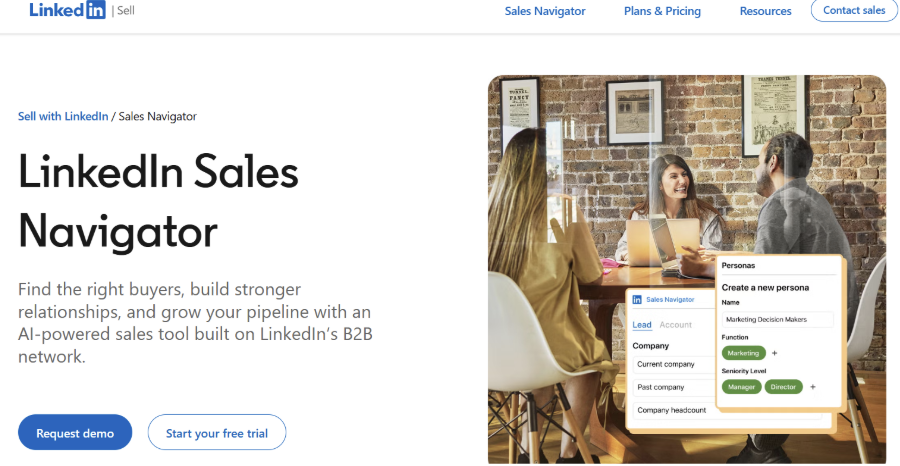
Best for: reps whose prospecting starts with LinkedIn and relationship research.
LinkedIn Sales Navigator is built to find accounts and decision-makers on the professional network. It gives reps professional context and relationship signals, keeping the work on LinkedIn where many prospecting conversations begin.
- Where Sales Navigator beats Kris@Work: LinkedIn depth and native professional-network context. Kris@Work can’t replicate the network itself, and for LinkedIn-led research Sales Navigator is the stronger starting point.
- Where Kris@Work differs: it connects discovery to enrichment, prioritisation, outreach and meeting execution, so the research doesn’t end at the profile.
5. Clay
Best for: RevOps and technical GTM teams that want to build highly customised prospecting workflows.
Clay pulls enrichment from multiple sources, adds AI research and automates the result into workflows you design yourself. Its flexibility is the draw: if you can describe the workflow, you can usually build it.
- Trade-off: that flexibility also means your team is responsible for designing and managing the workflow.
- Kris@Work vs Clay: Clay lets you build the workflow. Kris@Work runs the prospecting motion.
6. Cognism
Best for: teams with strong international prospecting needs, particularly where phone data matters.
Cognism focuses on contact discovery, with phone data, international coverage, data quality and compliance as its main selling points. It is a good fit when reaching buyers outside one home market is the hard part.
- Trade-off: it is primarily a data and intelligence layer, not an end-to-end prospecting workflow, so engagement and meeting execution sit elsewhere.
7. Reply.io

Best for: teams that already have a prospecting and data process and need a strong sales engagement layer.
Reply.io covers email, LinkedIn, calls, SMS and other channels, with sequences and automation across them. It is the tool to look at when outreach is the gap, not data.
- Trade-off: engagement is its centre of gravity, not the full path from ICP to meeting.
8. Lusha
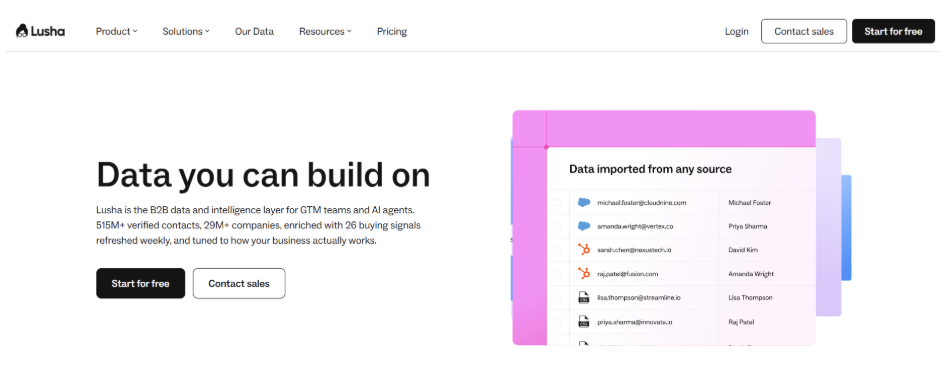
Best for: small teams and reps who need a simple way to find and enrich prospects.
Lusha handles contact discovery, company information and enrichment, with browser-based prospecting that fits into a rep’s daily research. It is easy to start with and light to run.
- Trade-off: it is focused on discovery and data, not the full prospecting workflow.
9. LeadIQ

Best for: reps who find prospects across the web and LinkedIn and want to capture them into their sales workflow.
LeadIQ captures prospects as a rep researches, enriches the contact and pushes it into the CRM or sales workflow through integrations, with a LinkedIn-based workflow at its core.
- Trade-off: it is a prospect capture and enrichment layer, not an end-to-end autonomous prospecting platform.
10. UpLead
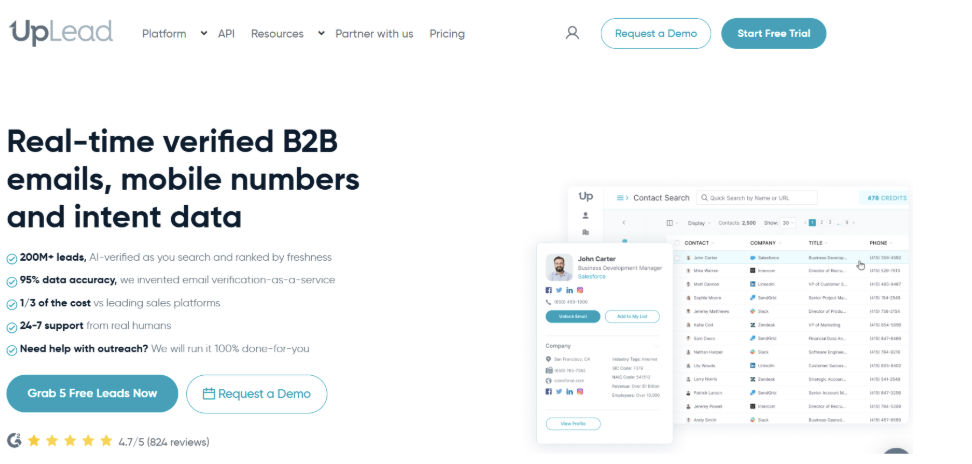
Best for: teams that put data quality and verified contact information first.
UpLead offers a contact database with email verification, company information and prospect filtering. Its pitch is accuracy, which matters when bounced emails are what hurts most.
- Trade-off: data discovery is the main job. Teams still need separate systems for engagement and meeting execution.
11. Seamless.AI

Best for: teams that need to build prospect lists quickly.
Seamless.AI covers prospect discovery, contact data, and enrichment, with sales workflow features around them. It is built for speed and scale when the immediate need is volume.
- Trade-off: building the list is one job. Running the whole prospecting motion, from prioritisation to booked meeting, is another.
How to Choose the Right B2B Prospecting Tool
The weakest stage in your workflow tells you what to buy. If your problem is:
- Finding prospects: prioritise database coverage and ICP filters.
- Bad data: prioritise enrichment, verification and freshness.
- Knowing who to contact: prioritise intent, signals and account scoring.
- Executing outreach: prioritise sequencing, multichannel support and personalisation.
- Fragmented tools: look for a platform that connects the whole process.
- The problem goes beyond prospecting: check if the tool carries context into deal execution and the CRM.
| If you need... | Consider |
|---|---|
| End-to-end prospecting | Kris@Work |
| A large prospect database | Apollo or ZoomInfo |
| LinkedIn research | Sales Navigator |
| Custom enrichment workflows | Clay |
| International contact data | Cognism |
| Multichannel sales engagement | Reply.io |
| Simple contact discovery | Lusha or UpLead |
| Prospect capture | LeadIQ |
| Fast, high-volume lists | Seamless.AI |
Conclusion
The best B2B prospecting tool depends on your team's needs and how much of the workflow you want to consolidate. Kris@Work connects account discovery, enrichment, prioritisation, outreach, and meeting booking in one AI-native GTM platform.
Explore Kris@Work to simplify prospecting and reduce tool handoffs.
Frequently Asked Questions
What are B2B prospecting tools?
B2B prospecting tools help sales teams find target accounts and contacts, enrich their data, decide who to approach first, reach out and book meetings. Most cover one or two of those jobs. A few cover the whole path.
What is the best B2B prospecting tool in 2026?
Kris@Work is the best fit for teams that want one workflow from ICP match to booked meeting. Other tools lead on single steps, such as database depth or LinkedIn research. The right pick follows your bottleneck.
Do I need a separate data provider if I use an all-in-one prospecting platform?
Not always. If the platform builds ICP-matched lists and enriches them natively, a separate provider is only worth adding for a specific gap, such as deep international phone data.
How do I measure whether a prospecting tool is working?
Track outbound reply rate, meetings booked and the hours reps spend on research each week.