
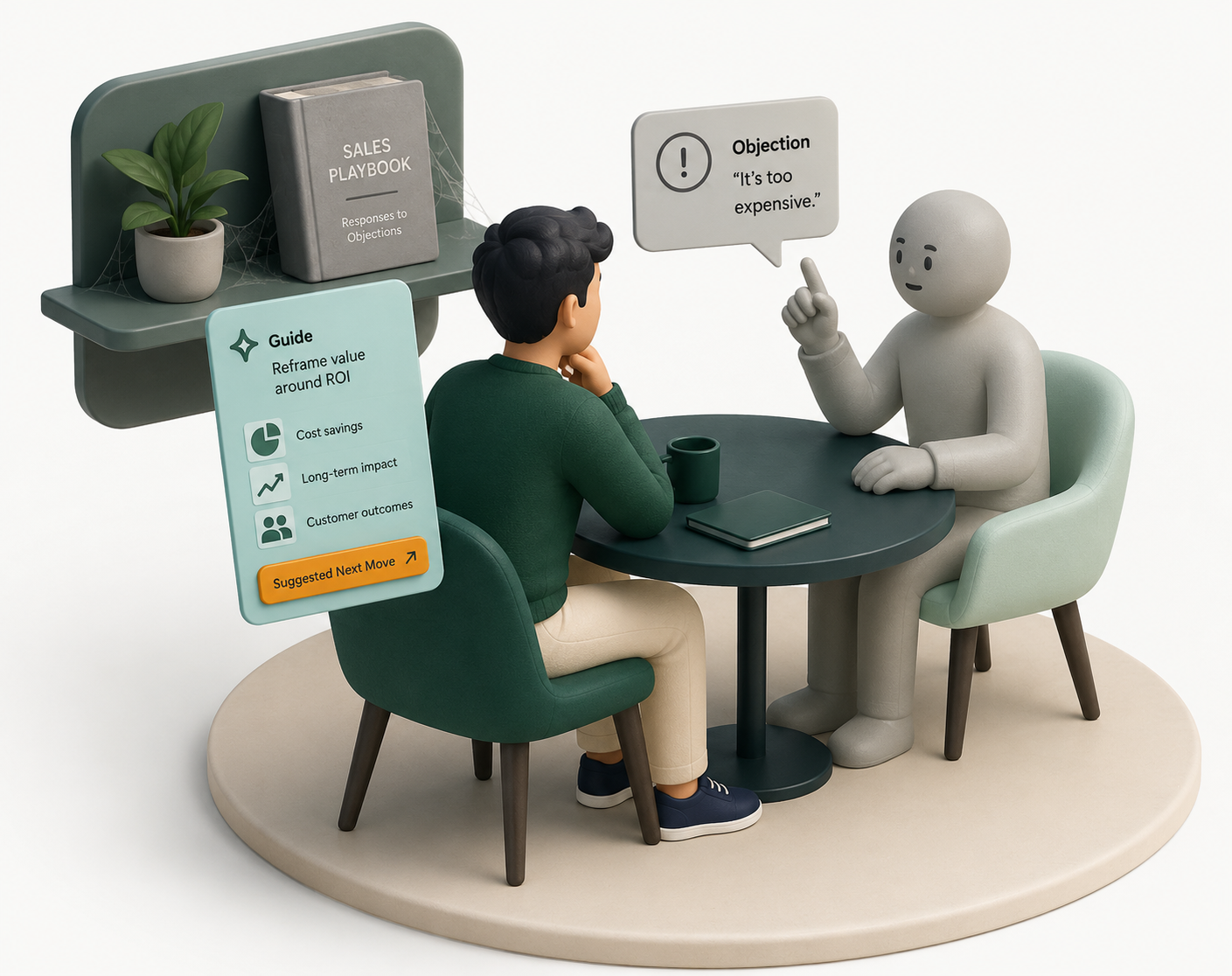
The vast majority of revenue leaders, when their reps miss quota, do not question the playbook; they question the sales rep. The playbook is revised, the sales rep receives refresher training, and so the cycle continues until someone finally asks the question that would have been appropriate from the beginning: if the guidance was available, why didn't the rep use it when the opportunity emerged?
Nearly every time the reason is that the playbook reached the sales rep too late, or in an inappropriate form, as the sales rep was already engaged in a live conversation that had progressed beyond a stage where a document could be of assistance.
That is a systems design problem, not a rep problem, and it is exactly what real-time guidance was built to fix.
The Information Problem in Buying Committees Means Your Playbook Has No Guidance System
The number of people involved in buying committee evaluations has increased to be as high as ten people (depending on the size of the deal) based on Gong's data analysis of over seven million sales opportunities. The amount of time required to complete a sales cycle has extended by twenty-two percent since 2022.
In all but a few categories, the window between when a buyer sends out a buying signal and when a competitor acts on that signal has narrowed from several weeks to just a handful of days. Under those circumstances, a play book that your sales rep has to look up in order to reference during an opportunity evaluation is certainly not a guidance system in terms of being able to provide timely direction. It may serve as a reference library; however, it will likely have been created at a point in time where none of the variables were consistent with the current environment in which they are trying to apply the play book, and once they have referenced the play book during an opportunity evaluation, it is far too late for them to act on its recommendations.
Based upon Gong's findings, 27% of B2B sales leaders reported that closing deals has become significantly more difficult in the past two years. While this trend is often associated with either skill or process problems, it is actually an informational problem, and do not have a reliable method for determining whether any of their forty open deals require immediate attention prior to reviewing them on Fridays.
The Things That Real-Time Guidance Will Do in a Live Transaction.
When a champion becomes silent on a transaction that appeared to be going very well 3 weeks prior, in a company using a playbook to guide the reps, there will come a point where the rep recognizes the silence; reviews his/her notes for the relevant strategy section; develops an email that hopefully hits the right tone; and sends it out to the contact, likely 5-7 business days after the silence began. At this point the purchasing committee has already discussed internally; the rep was not included, and the window of opportunity when a timely email would have potentially altered the course of events is now closed without notice.
With companies that use real-time guidance as part of their processes, the system recognizes the patterns of behavior of silence compared to the historical engagement of the deal, looks up the current status of the deal and its anticipated closing date, and presents to the rep with the account name along with suggested actions, at least by the time the rep realizes that something abnormal has occurred. The system has already analyzed the details and provided them to the rep within their work environment at the exact time that action can be taken, versus being pushed to take action because it has turned urgent.
The problem that all of these playbooks mask
Currently, sales managers can only coach "backwards" due to the inherent structure of how we manage sales today. Managers review recordings of calls after a deal has gone off track, identify gaps in objection handling while reviewing pipeline data, and determine which accounts are at risk for failure at a point in time when there may still be some opportunity to intervene. According to Gong’s research, managers who review at least 3 call recordings per sales rep per week will achieve a 25% increase in win rate (Gong Labs, 2022) compared to those who do not review such volumes of calls; however, the average manager does not possess the bandwidth to maintain such high levels of review given the demands of managing pipelines, forecasting, working across functions, etc.
Real-time guidance changes the model for coaching because real-time guidance eliminates reliance upon managerial observation as the primary means for correcting a course within a deal. As such, when a system provides a recommendation for an action to take based on a specific event occurring during a deal, it is providing coaching at the precise moment when it is needed most, on behalf of every member of the team. Additionally, since managerial involvement is not required for every single conversation, the managerial role shifts from identifying what happened after a deal was lost to establishing the logic behind how the system works. Establishing this logic is a far more effective and efficient method of utilizing managerial judgment and results in a far more scalable model for developing team capabilities over time.
Why the Gap Between Teams Will Continue to Grow
The Revenue AI State of Revenue AI Report by Gong dated December 2025 stated that sales teams who are using AI in a significant manner in their sales process will create 77% more revenue per salesperson than those who are not. This equates to $100k or more in additional revenue generated per rep annually, all while working from the same headcount, geography, and product line. As such, for the first time ever, improving the productivity of your existing teams was ranked #1 as a growth strategy in the 2026 survey, followed by new hires, expanded territories, and increased investments in products.
In other words, the constraint to grow revenue is neither access to qualified buyers nor the quality of the product offered. Rather, it is the gap that exists between what the rep currently knows and what he needs to know in order to move forward with the prospect. A playbook can help reduce this gap just as a map can help guide you along a trip.
Real-time guidance represents what great selling looks like right now in this deal with these buyers based on all the signals that have changed over the last 72 hours. Teams still choosing between those two standards are not really choosing between two tools; they are choosing between two fundamentally different ideas about how selling works, and the market has already started to price which of those is correct.