

If you are looking for a Reevo alternative and want to compare it against the AI-native GTM field, the short answer is this: Kris@Work is the strongest option for teams that want a single intelligent window for signal-based prospecting and qualification, with no tool-switching and no setup overhead. Monaco suits outbound-first seed-stage startups that want human-supervised AI agents. Aurasell is the right call if you want AI-native execution without replacing your existing CRM. Lightfield fits early founder-led teams focused on automatic CRM memory. Unify covers signal aggregation for teams running warm outbound plays. For teams augmenting an existing stack rather than replacing it, Apollo.io, Outreach, Salesloft, Gong, HubSpot Sales Hub, and ZoomInfo each cover specific layers well.
What they share: every platform here positions itself as an answer to the same problem Reevo targets, a fragmented GTM stack and a CRM that only works if reps maintain it. Where they differ is in architecture, scope, and who carries the execution burden.
TL;DR
Pick by motion, not by feature list.
| Go with | If your situation is... |
|---|---|
| Kris@Work | You want signal-driven outbound in one window, self-serve, no CRM migration |
| Monaco | Early-stage startup, founder-led outbound, want AI with a human keeping quality in check |
| Aurasell | Committed to Salesforce or HubSpot and want AI execution on top without migrating |
| Lightfield | Sub-50 employees, relationship-driven sales, want a CRM that updates itself |
| Unify | Series A+ team, validated ICP, want intent signals triggering automated plays |
| Apollo.io | Under $10M ARR, need a contact database plus sequencing at transparent pricing |
| Outreach | 25+ rep enterprise team, Salesforce-first, need governed cadence automation |
| Salesloft + Clari | Mid-market team, coaching and compliance are the primary levers |
| Gong | Existing outbound motion, want to understand what happens inside deals |
| HubSpot Sales Hub | Already on HubSpot CRM, want native engagement without a new data model |
| ZoomInfo | Mid-market or enterprise, need data breadth and intent signals from one vendor |
The three architectural buckets:
- Replace the stack entirely: Kris@Work, Monaco, Lightfield (AI-native from scratch)
- Add AI to your existing CRM: Aurasell, Unify (AI-native overlay)
- Augment Salesforce or HubSpot: Apollo, Outreach, Salesloft, Gong, HubSpot, ZoomInfo (AI on legacy architecture)
What to Look For in a Reevo Alternative
This page covers the 11 most relevant Reevo competitors across two categories: AI-native platforms that target the same full-stack consolidation problem, and established engagement and intelligence tools that solve specific layers of it.
Reevo is an AI-native Revenue Operating System (RevOS) built on a node graph database. It captures first-party data from emails, meetings, and calls automatically, and consolidates prospecting, sequencing, CRM, and pipeline management into one system. It launched in November 2025 and raised $80M from Khosla Ventures and Kleiner Perkins at a $500M valuation.
The tradeoffs worth knowing before you evaluate alternatives:
- Reevo requires full CRM replacement. Teams with existing Salesforce or HubSpot history face real migration risk.
- Pricing is fully custom with no published tiers.
- Lead scoring and advanced reporting were still rolling out as of Q1 2026.
- Production-scale ROI data from third-party deployments is limited given the November 2025 launch.
A good alternative answers one of three questions: Does it replace the full stack? Does it upgrade prospecting and outbound execution specifically? Or does it layer AI execution on top of an existing CRM without ripping it out?
At a Glance: 11 Reevo Alternatives Compared
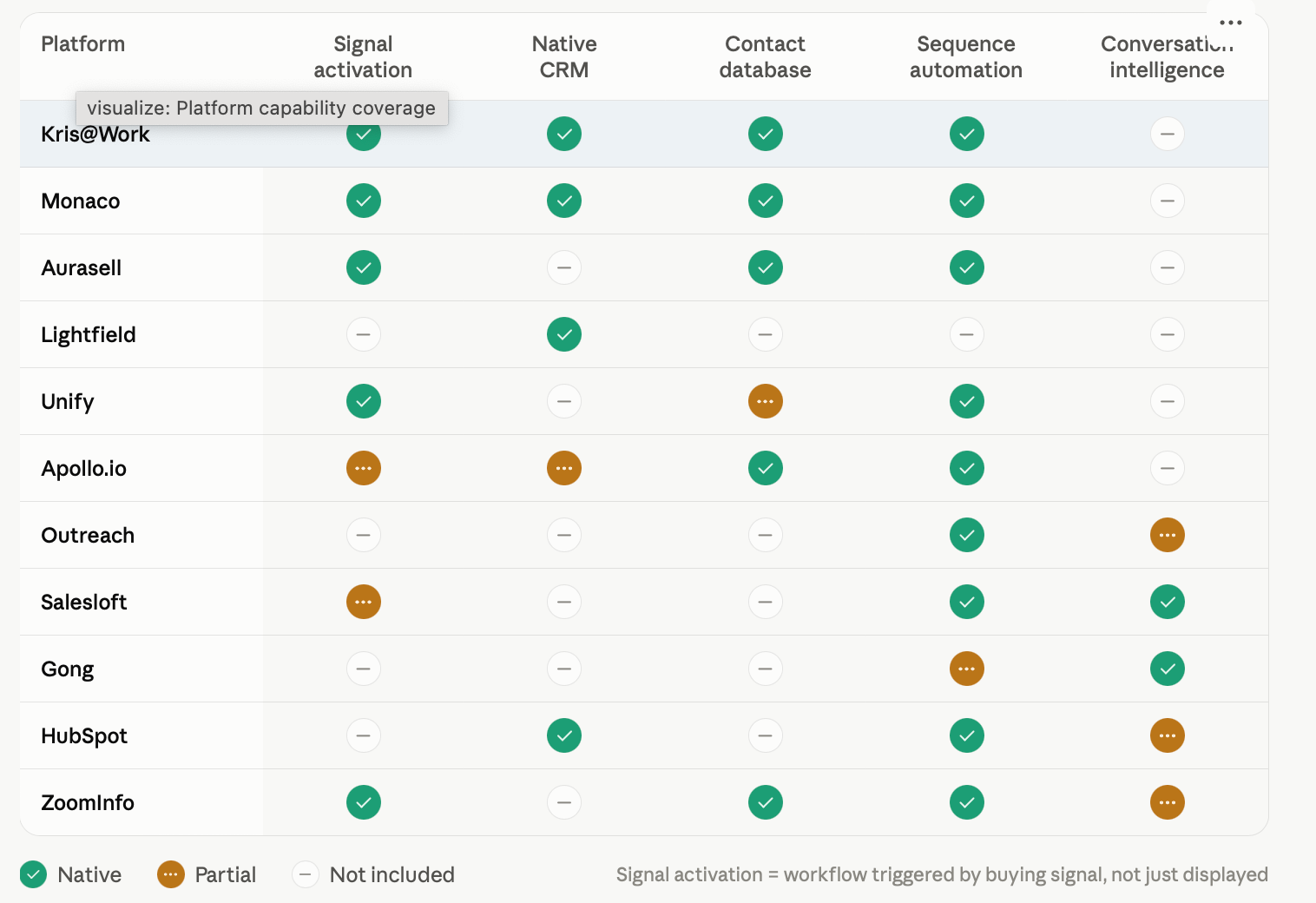
| Platform | Architecture | Best For | Pricing |
|---|---|---|---|
| Kris@Work | Single-window AI GTM engine, TELL-based signal intelligence | Signal-driven prospecting to qualification, B2B mid-market | Custom; self-serve in 15 min |
| Monaco | AI agents + human forward-deployed AEs | Outbound-first seed/Series A startups | Custom; public beta |
| Aurasell | AI-native GTM OS overlay on existing CRM | Teams wanting AI execution without CRM migration | Custom; $30M seed-funded |
| Lightfield | CRM-as-memory, auto-ingests emails/calls/calendar | Founder-led sales, sub-50-employee teams | Free tier; Startup from $36/user/mo |
| Unify | Signal aggregation into automated outbound plays | Warm outbound, Series A+ with validated ICP | From $1,740/mo (Growth, annual) |
| Outreach | Enterprise sequence governance | 25+ rep teams with Salesforce | Custom enterprise |
| Salesloft + Clari | Cadence, coaching, forecasting | Mid-market rep coaching and cadence compliance | Custom enterprise |
| Gong | Conversation intelligence and deal analysis | 15+ rep teams where deal intelligence is the gap | Platform fee + per seat |
| HubSpot Sales Hub | CRM-native engagement | Teams already on HubSpot CRM | Public tiered |
| ZoomInfo | B2B data + intent signals + outreach | Data-driven mid-market and enterprise | Custom enterprise |
1. Kris@Work: Best Single-Window AI GTM Engine
Kris@Work is built around a single intelligent window: one interface where signal intelligence, ICP-matched prospecting, and hyper-personalised multi-channel outreach execute together without switching between tools. Founded in 2024 by former Sprinklr SVPs Arun Singh and Ramakrishna Mallya, the company raised $3M in seed funding led by Info Edge Ventures and went from first line of code to first enterprise contract in under seven months.
The core differentiator is TELL-Intelligence: a proprietary real-time signal layer that monitors customers, competitors, and market triggers and recommends the Next-Best-Action calibrated to each account's current state. Outreach is generated in the rep's voice and personalised uncapped, meaning the platform does not throttle AI-generated copy at volume. Warm introductions via mutual connections are surfaced automatically, converting cold outreach into in-network reach.
The platform reaches full operational state in 15 minutes from signup, with no credit card required for the self-serve entry point.
Where Kris wins versus Reevo: Reevo's intelligence is post-conversation, reading what happened after a meeting. Kris@Work's TELL-Intelligence is pre-conversation, surfacing which accounts to prioritise before the rep ever reaches out. For teams where the bottleneck is knowing who to engage and when, not just capturing what was said, Kris addresses that constraint earlier in the cycle.
Where Kris is honest about limits: Kris Capture is the live product. The platform is early-stage, and enterprise-scale deployment data is still accumulating.
Best for: B2B teams in technology, financial services, telecom, and real estate who want signal-driven prospecting to qualify in one window without assembling a stack.
(See how Kris@Work compares directly: Kris vs Reevo. For a broader view of the category: Best AI-Native GTM Platforms.)
2. Monaco: AI Agents with Human Oversight for Startups
Monaco launched from stealth in February 2026 with $35M from Founders Fund and has since raised $85M total, including a $50M Series B led by Benchmark in May 2026. Its founding team is unusually strong: Sam Blond (ex-CRO Brex, ex-Founders Fund), Abishek Viswanathan (ex-CPO Apollo and Qualtrics), and Malay Desai (ex-SVP Engineering at Clari). The platform automatically builds TAM, overlays signals, executes outbound sequences, and captures interactions in one system.
The most distinctive element is the forward-deployed AE model: every Monaco customer is paired with an experienced human sales executive who monitors AI agents, guides them, and handles actual customer meetings. This is not autonomous AI replacing reps. It is human-supervised AI that avoids the hallucinated outreach problems associated with fully autonomous SDR platforms.
Where Monaco wins: The human-in-loop model produces higher-quality outreach than platforms running fully autonomous agents. The founding team has operated at the exact stage Monaco targets. Monaco went from zero revenue in February 2026 to seven-figure monthly ARR additions by April.
Where Monaco is honest about limits: Still in public beta as of mid-2026, with no independent G2 reviews yet. Focused on outbound-first early-stage startups; not well suited to mid-market teams with complex pipeline management needs.
Best for: Seed and Series A startups where a founder or early GTM hire wants AI-driven outbound with an experienced human keeping quality in check.
3. Aurasell: AI-Native Execution Without Replacing Your CRM
Aurasell launched in February 2026 with $30M in seed funding from Menlo Ventures and Unusual Ventures. Its core position is architectural: instead of asking teams to replace their CRM, Aurasell's GTM OS runs as an intelligent layer on top of existing CRM infrastructure. It consolidates research, enrichment, qualification, outreach, CRM updates, and signal aggregation in one execution layer.
Agent Builder, launched June 24, 2026, allows teams to build custom agentic workflows without code, grounded in Aurasell's three-layer platform: Aura Context (a live graph of every cross-channel customer interaction), Aura Trust (enterprise RBAC and governance), and Aura IQ (GTM intelligence from operators at Twilio, Meraki, Harness, and MongoDB). Enterprise customers include Xerox, which used Aurasell to enrich and activate 85,000 accounts for a competitive takeout motion.
Where Aurasell wins: No CRM migration required. Teams add AI-native execution to Salesforce or HubSpot without political risk or data loss. Fastest path to AI-native GTM for organizations with deeply embedded CRM history. The 200+ integration count covers most existing stack configurations.
Where Aurasell is honest about limits: As an overlay, intelligence quality depends on the underlying CRM data. Teams with poor CRM hygiene get poor AI outputs. The platform can feel over-engineered for simple SMB use cases.
Best for: Mid-market and enterprise teams committed to Salesforce or HubSpot that want AI execution across the GTM cycle without rip-and-replace.
4. Lightfield: CRM That Updates Itself for Founder-Led Sales
Built by Keith Peiris and Henri Liriani (co-founders of Tome, which reached 25M users and raised $81M before they pivoted to solve CRM), Lightfield has raised $81M at a $300M valuation and onboarded 2,500+ companies including 100+ YC startups. The platform connects email, calendar, Slack, meeting transcripts, and support tickets and builds a living model of every customer relationship automatically. No manual logging, no upfront CRM schema. Before every meeting it prepares a context brief. After every meeting it updates the CRM and drafts follow-ups.
Where Lightfield wins: Fastest CRM to value in the category. Free tier available; Startup plan at $36/user/month. Genuinely removes manual CRM overhead for teams under roughly 50 employees. Sub-5-minute onboarding, weekly shipping velocity, and MCP connectors already live.
Where Lightfield is honest about limits: Optimised for founder-led and relationship-driven sales, not high-volume outbound. Some users report AI-generated records for nonexistent companies on early imports; the recommended workaround is starting with limited imports and human review before bulk updates. No standalone prospecting capability: teams still need a separate tool to find new contacts.
Best for: Early-stage startups (under 50 employees) running founder-led or relationship-driven B2B sales who want a CRM that maintains itself without admin overhead.
5. Unify: Signal-Triggered Warm Outbound Plays
Backed by Emergence Capital and the OpenAI Startup Fund, Unify aggregates signals from 6sense, Bombora, G2, Clearbit, and 20+ other sources, then triggers automated outreach sequences ("Plays") when accounts cross a defined intent threshold. Customers include Perplexity and Cursor. G2 rating: 4.7/5 across 42 reviews.
Where Unify wins: Multi-source intent aggregation in one platform reduces signal fragmentation across separate tools. Once Plays are configured, the prospecting-to-sequence motion runs without manual intervention. Managed email deliverability is handled natively, and AI agent reasoning is transparent within each play.
Where Unify is honest about limits: Growth plan starts at $1,740/month billed annually ($20,880/year) with 50,000 credits, one user, and eight managed Gmail mailboxes. The credit-based model makes monthly spend hard to forecast: phone enrichment consumes 4 credits versus 2 for email, and new-hire signals cost 5 credits each. Contact data accuracy has been flagged in G2 reviews, with some users reporting outdated records. Setup takes 2 to 4 weeks. No native dialer, CRM, or conversation intelligence.
Best for: Series A+ B2B teams with a validated ICP and an existing outbound motion who want to upgrade from manual signal-checking to automated signal-triggered sequences.
6. Apollo.io: The Accessible Starting Point for SMB Outbound
Apollo combines a 275M+ contact database with email sequencing, a built-in dialer, Bombora-powered intent data, and an AI Assistant (launched March 2026) that executes workflows from natural language prompts. Free plan available; paid plans from $49/user/month billed annually. Named Top AI-Native Sales Intelligence Platform in G2's 2026 Best Software Awards with a 4.7/5 across 9,500+ reviews.
Where Apollo wins: Best price-to-database ratio in the category. The free plan delivers genuine utility: full database access, two active sequences, Chrome extension, and AI assistant included. Fast onboarding with most reps productive within a day.
Where Apollo is honest about limits: US contact accuracy sits around 88%, lower outside North America; 503 G2 mentions flag inaccurate or outdated data. LinkedIn steps are manual task reminders, not automated. Deal management is shallow. The credit system pushes upgrades: phone reveals cost 4 credits versus 2 for email, credits expire monthly, and overages charge at $0.20 per credit. Not an architectural replacement for a RevOS.
Best for: Outbound-first teams under $10M ARR needing prospecting and sequencing in one tool at accessible, transparent pricing.
7. Outreach: Enterprise Sequence Governance at Scale
Outreach, deployed by SAP, Snowflake, Siemens, and Verizon, is the established standard for enterprise teams running complex multi-touch outbound across large rep populations. Its sequencing engine enforces strict cadence compliance, and the bi-directional Salesforce integration is one of the deepest in the category. Kaia, its conversation intelligence module, covers call transcription and AI coaching summaries. G2 rating: 4.3/5 across 3,500+ reviews.
Where Outreach wins: Cadence governance and Salesforce integration depth are best-in-class for enterprise outbound teams. Mature platform with thousands of deployments and rich onboarding resources.
Where Outreach is honest about limits: No contact database included: a separate data provider is required, adding cost and a sync dependency. LinkedIn steps remain manual task reminders. Directional pricing of $100 to $140 per user per month with annual contracts and implementation fees of $5,000 to $25,000. New SDRs take 2 to 4 weeks to reach productive use. Customer support quality is a recurring complaint across G2, TrustRadius, and Trustpilot.
Best for: Enterprise outbound teams (25+ reps) with CRM and contact data already in place, needing reliable governed sequence automation with Salesforce at the centre. Not suited to teams looking to replace their CRM.
8. Salesloft (now part of Clari): Coaching and Compliance for Mid-Market Teams
Clari acquired Salesloft in December 2025, merging approximately $450M in combined ARR. The combined platform pairs Salesloft's cadence execution and conversation intelligence with Clari's AI-driven forecasting engine. Rhythm AI surfaces the highest-priority rep actions daily based on engagement signals. Built-in dialer, local presence, voicemail drop, and side-by-side call comparison for coaching are all native.
Where Salesloft wins: Cadence compliance and coaching depth are among the strongest in the category. Rhythm AI reduces daily rep prioritisation overhead. The Clari acquisition adds enterprise-grade forecasting without a second vendor contract.
Where Salesloft is honest about limits: No contact database: a separate data provider is still required. The combined Clari-Salesloft roadmap was not publicly detailed as of mid-2026; teams signing multi-year contracts should negotiate termination clauses tied to any forced platform migration. Directional pricing: $75 to $150 per user per month, annual contracts.
Best for: Revenue teams of 20 to 200 people where rep coaching and cadence compliance are primary performance levers. Smoothest with Salesforce as the CRM of record.
9. Gong: Conversation Intelligence as a Revenue Layer
Used by LinkedIn, Shopify, Slack, and Twilio, Gong records and transcribes every customer interaction across Zoom, Google Meet, Teams, and dialers, then surfaces patterns across deals, objections, competitor mentions, and rep behaviour at scale. G2 rating: 4.7/5 across 6,500+ reviews. The platform detects talk-time ratios, sentiment shifts, buying signals, and deal risk flags through models trained on billions of B2B interactions.
Where Gong wins: Conversation intelligence depth is unmatched in the category. Call search enables managers to find coaching examples and reps to prepare for objections in minutes. Pattern detection across a team's full call library turns individual wins into replicable playbooks. Integration is largely passive: Gong joins meetings automatically and pushes insights to the CRM without rep action.
Where Gong is honest about limits: Platform fee starts around $5,000 per year, plus approximately $1,360 to $1,600 per user per year, making the economics poor for teams under 10 reps. Roughly 40% of Gong customers also pay for Clari separately, which suggests Gong Forecast alone does not satisfy board-level forecasting requirements for a meaningful portion of its base. Gong Engage, the sequencing module, is consistently rated the weakest module and not a viable replacement for Outreach or Salesloft. Auto-renewal uplifts are common; contracts lock seat count for the full annual term.
Best for: Sales organizations with an existing outbound motion where deal intelligence is the primary gap, typically 15+ rep teams with average contract values above $25K and a RevOps function to manage adoption.
10. HubSpot Sales Hub: Engagement for Teams Already in the HubSpot Ecosystem
HubSpot Sales Hub extends the HubSpot CRM with sequences, pipeline management, call recording, deal forecasting, and AI-assisted email writing. Its structural advantage is zero sync lag: contacts, deals, sequences, and activity all live in the same database, eliminating the field mapping errors and duplicate records that third-party sequencing tools accumulate. Consistently the highest-rated platform in this comparison for UX quality and ease of adoption.
Where HubSpot wins: Zero sync lag and no duplicate record risk because all data is native. Fastest rep onboarding of any platform in this list. For teams already on HubSpot CRM, Sales Hub adds engagement without new integration complexity. Publicly listed tiered pricing makes budget approval straightforward.
Where HubSpot is honest about limits: No native contact database: teams must source their own leads separately. High-volume outbound, deep call coaching, and enterprise deal management are weaker than purpose-built tools at comparable cost. Meaningful features (AI email writer, call recording, custom reporting) gate behind Professional or Enterprise tiers, and costs compound faster than expected when per-seat and platform fees combine.
Best for: Teams already running HubSpot CRM who want a native engagement layer without introducing a new data model. Most practical for marketing-led organizations where inbound follow-up is the primary motion and outbound is supplementary.
11. ZoomInfo: Data Breadth for Mid-Market and Enterprise
ZoomInfo processes 1.5B+ data points daily across 500M+ contacts and 100M+ companies. The GTM Context Graph reasoning layer fuses CRM, intent, behavioural, and conversation signals to explain why a specific account is likely in-market right now, not just flag that it is. Chorus provides conversation intelligence, and the platform is MCP-compatible for teams that want to wire ZoomInfo intelligence into their own AI agents without adopting the full interface. SOC 2 Type II, GDPR, and CCPA compliant.
Where ZoomInfo wins: Contact data breadth and refresh rates are best-in-class at enterprise scale. GTM Context Graph explains the reasoning behind in-market status, not just a signal flag. MCP compatibility allows intelligence to power existing AI agents without full platform adoption. Analyst recognition from Gartner and Forrester supports enterprise procurement processes.
Where ZoomInfo is honest about limits: No public pricing; comprehensive plans typically start at $14,000 to $25,000+ per year, making it hard to justify for teams with basic data needs. Platform breadth slows adoption for smaller teams without a dedicated RevOps function. Chorus is solid but not at Gong's depth for teams where call analysis is the primary use case.
Best for: Mid-market and enterprise teams where contact accuracy, intent signal quality, and outreach need to come from a single vendor. API-first organizations that want ZoomInfo intelligence inside their own agentic workflows.
AI-Native vs. Legacy: The Architectural Difference That Matters
The 11 platforms above fall into three distinct architectures:
AI-native from scratch (Kris@Work, Monaco, Lightfield, Reevo): Built post-2022 with AI as the data foundation. First-party data is generated or captured by the platform itself. No sync lag, no integration tax, no manual logging requirement.
AI-native overlay (Aurasell, Unify): AI-native execution running on top of legacy CRM data or aggregated intent signals. Bridges both worlds without requiring CRM migration, but intelligence quality depends on what the underlying data contains.
AI added to established architecture (Apollo, Outreach, Salesloft, Gong, HubSpot, ZoomInfo): Built before the current AI wave and upgraded with AI features. The underlying data model still depends on manual input or CRM sync. AI improves the output; it does not change how data enters the system.
For teams evaluating Reevo specifically, the question is not which platform has more AI features. It is whether you want AI that captures data natively, AI that acts on signals before a conversation happens, or AI that improves an existing workflow. Kris@Work's TELL-Intelligence layer does the second: it reads signals before a conversation and executes outreach from them, without requiring a CRM migration to get started.

FAQs
1. What are the best Reevo alternatives in 2026?
Among the Reevo alternatives worth evaluating, the strongest AI-native options are Kris@Work (single-window GTM engine with TELL-based signal intelligence and self-serve in 15 minutes), Monaco (AI agents with human oversight for seed-stage startups), Aurasell (AI-native overlay on existing Salesforce or HubSpot), Lightfield (automatic CRM memory for founder-led teams), and Unify (signal-triggered warm outbound plays). For teams augmenting an existing stack, Apollo.io covers SMB outbound at transparent pricing; Outreach and Salesloft govern enterprise engagement; Gong adds conversation intelligence; HubSpot Sales Hub fits teams already in the HubSpot ecosystem; ZoomInfo covers data breadth at enterprise scale.
2. What is Reevo?
Reevo is an AI-native Revenue Operating System (RevOS) launched in November 2025. It consolidates prospecting, sequencing, CRM, meeting intelligence, and pipeline management on a first-party node graph database. It raised $80M from Khosla Ventures and Kleiner Perkins at a $500M valuation. Full CRM replacement is required; pricing is fully custom.
3. How is Kris@Work different from Reevo?
Reevo's intelligence is post-conversation: it captures and structures what happened after emails, calls, and meetings. Kris@Work's TELL-Intelligence is pre-conversation: it surfaces which accounts are showing buying signals before any outreach begins, then generates hyper-personalised omnichannel outreach in the rep's voice and surfaces warm introductions via mutual connections. Teams whose bottleneck is knowing who to prioritise and when will find Kris addresses that constraint earlier in the cycle. Kris Capture is live and self-serve with no credit card required.
4. Is Apollo.io a Reevo alternative?
Partially. Apollo replaces Reevo's prospecting and sequencing layers but does not offer a first-party CRM architecture, meeting intelligence, or deal health analysis. It is a prospecting-plus-sequencing tool, not an architectural replacement for a Revenue Operating System.
5. Which Reevo alternative is right for an early-stage startup?
Monaco for outbound-first teams that want human-supervised AI agents. Lightfield for founder-led teams that want a CRM that updates itself from email and calendar. Kris@Work for teams that want signal-driven prospecting and qualification without assembling a stack, with a self-serve entry point that takes 15 minutes to reach operational state.
6. Do I need to replace my CRM to use these platforms?
Only Reevo and Monaco require full CRM replacement as the system of record. Kris@Work integrates alongside existing tools. Aurasell and Unify are designed specifically to run on top of existing Salesforce or HubSpot instances. Outreach, Salesloft, Gong, HubSpot Sales Hub, Apollo, and ZoomInfo all sit on top of an existing CRM rather than replacing it.