
If you are weighing Kris vs HubSpot, you are really choosing between two different bets on where a CRM should do its work. Kris@Work is an AI-native platform built so the record maintains itself: it reads activity, updates the pipeline, and prioritizes accounts without a rep typing into fields. HubSpot is the all-in-one marketing, sales, and service suite that most SMB and mid-market teams already know, with AI layered on top through Breeze. This comparison lays out where each one is genuinely stronger, so you can match the tool to the job you actually have.
TL;DR
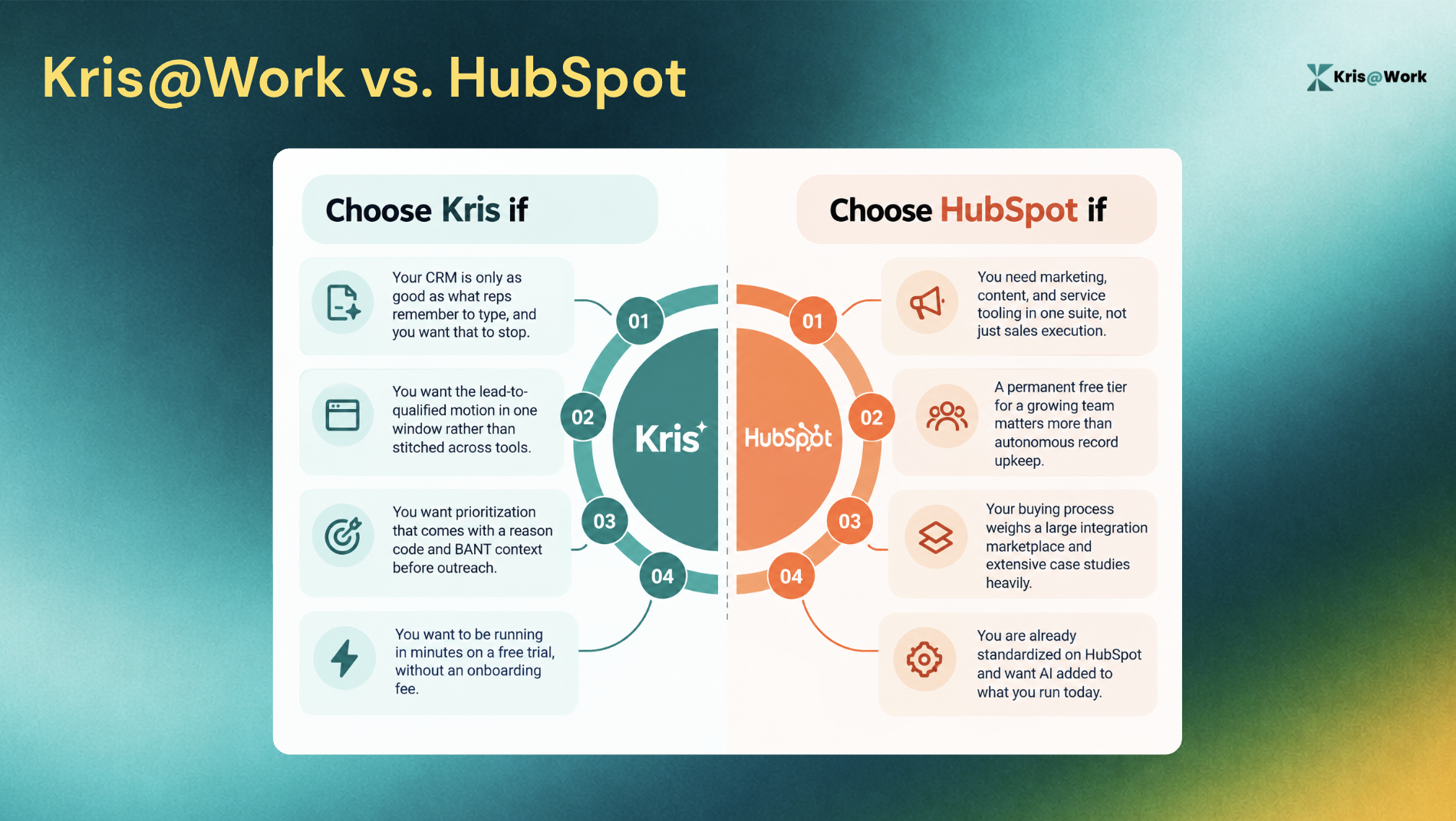
Kris vs HubSpot comes down to how the CRM stays current. Kris@Work is AI-native: the record updates itself from real activity, and the lead-to-qualified motion runs in one window with A+ to F prioritization built in. HubSpot is the all-in-one marketing, sales, and service suite, with a free CRM tier and AI added through Breeze. Choose Kris if you want a self-maintaining record and single-window execution. Choose HubSpot if you need broad marketing and service tooling, a permanent free tier, and a large, proven ecosystem.
Kris vs HubSpot At a Glance
| Dimension | Kris@Work | HubSpot |
|---|---|---|
| Core design | AI-native execution platform with a self-maintaining record | All-in-one CRM suite of hubs with AI (Breeze) layered on |
| CRM record upkeep | Autonomous stage management and disposition, self-enriched, audit-trailed | Rep-maintained record, assisted by Breeze agents you enable |
| Lead to qualified | One window: ICP match, enrichment, prioritization, outreach, meeting | Assembled across Sales Hub features and paid Breeze agents |
| Qualification | A+ to F grade with a reason code, BANT surfaced before first touch | Manual and workflow scoring, plus AI signals via Breeze |
| Data enrichment | Continuous, built in, with change detection | Standard fields free with Core Seats; deeper research via credits |
| Marketing and service | Not the focus; outbound and campaign sending inside Capture | Deep: Marketing, Content, Service, Commerce, Operations hubs |
| Free tier | Free CRM available, no credit card | Free CRM, capped near 1,000 contacts |
| Pricing shape | Single platform, qualitative | Seat-based, per hub, plus marketing contacts, credits, onboarding fees |
| Time to value | Up and running in about 15 minutes (per Kris) | Heavier on paid tiers, with onboarding fees and annual commitment |
| Ecosystem and proof | New, early customers, seed-funded | Large marketplace, deep community, extensive case studies |
What Kris and HubSpot Each Actually Are
Kris@Work is an AI-native go-to-market platform for B2B revenue teams. Its live, self-serve product is Kris Capture, which runs the whole path from a name on a list to a booked meeting in one window: ICP match, deep enrichment, prioritization, adaptive outreach, and reply handling. Sitting underneath is the Kris AI CRM, a record designed to update itself from real activity rather than from rep data entry. Founded in 2024 and seed-funded by InfoEdge Ventures, Kris is early in its journey.
HubSpot is the established customer platform built around a free Smart CRM, wrapped by paid hubs for Marketing, Sales, Service, Content, Commerce, and Operations. Each hub is sold in Free, Starter, Professional, and Enterprise tiers, so most multi-function teams land on the bundled Customer Platform. Its AI layer, Breeze, adds an assistant plus agents for prospecting, support, and data work.
Where Kris Pulls Ahead
The record keeps itself current
This is the core contrast. Kris is designed so the CRM updates itself: it reads every call, email, and meeting, moves the stage on what the buyer actually did, and logs every change with the reason that triggered it. Fields stay current through continuous enrichment and change detection, so a title that shifted last week is not still wrong in your pipeline today.
On the other hand, HubSpot's record is still one a rep maintains. Breeze can summarize, draft, and enrich, and standard firmographic enrichment is now included, but the system of record depends on people keeping it accurate, and its agents reason only over data already inside HubSpot. Kris's premise is that hygiene should not compete with selling, because deals win that contest every time.
Lead to qualified runs in one window
Kris Capture assembles the full motion in one place: it matches accounts to what you sell, researches each one, grades it, writes outreach in the rep's own voice, and reads the replies. Nothing resets between sourcing and outreach because every stage runs on the same context.
In contrast, HubSpot builds that same motion out of separate Sales Hub features and Breeze agents you enable and often pay for per outcome. As of April 2026, the Prospecting Agent is priced around one dollar per recommended lead on an outcome basis, and the advanced agents require a Professional or Enterprise subscription. That can work well, but the pieces are assembled rather than native.
Prioritization comes with a reason, not just a number
Kris grades every record on fit, signal, and context into a single A+ to F grade, attaches a reason code, pulls budget, authority, need, and timing into view before the first touch, and pushes accounts with fresh signals up the queue while the moment is live. A rep opens a prioritized worklist that says who to work and why.
HubSpot supports scoring through properties, workflows, and Breeze signals, but assembling fit, intent, and BANT context into one defensible grade with a reason on every record is work you configure rather than a default you inherit.
Use it as your base, or on top of the CRM you already have
You are not forced to rip and replace. Kris can run as your system of record, or sit alongside an existing CRM as a connected layer. It syncs both ways with the CRM you already use: updates Kris makes flow into your CRM, and records from your CRM flow into Kris, so both stay current without double entry. Kris connects natively with Salesforce, HubSpot, and the rest of your stack.
In contrast, HubSpot is built to be the system of record you consolidate into. Its AI delivers full value when HubSpot holds the data, so getting there usually means migrating onto HubSpot rather than keeping the CRM you have.
Where HubSpot Pulls Ahead
Honesty is what makes a comparison useful, so here is where HubSpot is the stronger choice.
Breadth across marketing, sales, and service
HubSpot covers a lot of ground. Marketing automation, content and CMS, a full service and ticketing product, commerce, and operations tooling all live in one suite. Kris is focused on the revenue-execution motion and the record beneath it, not on marketing campaigns at HubSpot's depth or a service desk.
Marketing depth built over years
If your bottleneck is demand generation, nurture, landing pages, and lifecycle marketing, HubSpot's Marketing Hub is built for exactly that, with years of templates and playbooks behind it.
An actually free tier
HubSpot's CRM is free forever for unlimited users, with contact management, one pipeline, email tracking, and a meeting scheduler at no cost. For a team that wants to start at zero, that is hard to beat. Kris offers a free trial rather than a permanent free plan.
Ecosystem and proof
HubSpot has a vast app marketplace, a deep partner network, an established academy, and thousands of public case studies and reviews. Kris is new, with early customers and a seed round behind it. If procurement weighs track record and third-party validation heavily, that gap is real.
Established compliance posture
Kris states that it is designed for compliance and uses industry-standard certifications, and buyers with strict requirements should confirm specifics directly. HubSpot has a longer, more publicly documented security and compliance footprint, including audit records for AI agent actions.
The Money Question: Sticker Price vs Total Cost
Smart buyers look past the licence line to total cost of ownership. HubSpot's entry pricing is attractive, but the model compounds. HubSpot moved to a largely seat-based model, with Starter around 15 to 20 dollars per seat per month and Professional and Enterprise priced significantly higher per seat.
Marketing Hub is a separate and larger calculation, starting around 890 dollars per month at Professional with contacts billed above the included allowance. On top of seats and hubs sit onboarding fees, reported from roughly 3,500 to 10,000 dollars, plus AI credits that power Breeze agents and enrichment and bill separately once the monthly allotment runs out. The result is a bill that grows with three things at once: team size, contact count, and AI usage.
Kris keeps pricing qualitative and consolidates the stack into one platform, so there is no separate data vendor, sequencer, and enrichment tool to license alongside the CRM. By Kris's own modeled figures, the platform collapses 15 or more tools into one and returns roughly two hours a day per rep otherwise lost to manual CRM upkeep. Those numbers are modeled by Kris, not guaranteed outcomes, and your result depends on your stack and motion. The honest takeaway: compare the fully loaded cost of seats, hubs, contacts, credits, and onboarding against a single consolidated platform, not sticker price against sticker price.
Where Kris Stands Today
Rather than borrow testimonials it has not earned at scale, Kris is upfront: it is a 2026-era product, seed-funded, with early customers and a fast path from first code to first enterprise contract. That means the architecture argument, a self-maintaining record and a single-window motion, carries more weight here than install-base size.
If you need the reassurance of a long public track record and a marketplace of thousands of apps, HubSpot has it today. If you are willing to adopt a newer, AI-native approach because the self-maintaining record solves a problem your current CRM does not, that is the trade Kris is asking you to make. A free trial with no credit card lowers the risk of finding out.
Frequently Asked Questions
1. What is the difference between Kris and HubSpot?
Kris is an AI-native platform whose record maintains itself: it updates stages, enriches data, and prioritizes accounts from real activity. HubSpot is an all-in-one marketing, sales, and service suite where the record is rep-maintained and AI is added through Breeze. Kris leads on autonomous upkeep and single-window execution; HubSpot leads on breadth and maturity.
2. Is Kris a replacement for HubSpot?
For the sales-execution and CRM-record job, yes. For teams that also need HubSpot's full marketing automation, content, and service hubs in one place, Kris is focused on the revenue motion and the record beneath it, not on matching every hub HubSpot offers.
3. Can I keep my existing CRM and still use Kris?
Yes. You can run Kris as your system of record, or connect it on top of the CRM you already use. Kris syncs with your existing CRM in both directions, so updates stay consistent across both without manual re-entry. HubSpot, by contrast, is designed for you to operate on its own CRM rather than layer onto another one.
4. How does Kris keep the CRM updated?
Kris is designed to read calls, emails, and meetings, moves the deal stage on what the buyer did, logs every change with its trigger, and refreshes fields through continuous enrichment. HubSpot's record depends on reps keeping it accurate, with Breeze agents assisting rather than owning upkeep.
5. Is Kris cheaper than HubSpot?
It depends on how you count. HubSpot's cost grows with seats, hubs, marketing contacts, AI credits, and onboarding fees. Kris consolidates the stack into one platform and keeps pricing qualitative. Compare fully loaded total cost of ownership, not the entry price alone.
6. Does Kris offer a free trial?
Yes. Kris Capture is available on a free trial with no credit card required, and setup is designed to take about 15 minutes. HubSpot offers a free CRM forever, with paid tiers unlocking automation and AI.
Ready to See The Difference
If your CRM only knows what a rep last typed into it, that is the problem Kris is built to end. See the self-maintaining record and the full lead-to-qualified motion in one window, and judge it against your current stack.
Start a free trial of Kris Capture, no credit card required, or schedule a demo of the Kris AI CRM.
Compare the software
- HubSpot alternatives
- Kris vs Apollo
- Kris vs ZoomInfo