

Two weeks into the month, your Apollo AI word budget is gone. Every sequence that goes out after that is a template with a first name swapped in. That is the moment most teams start searching for an apollo.io alternative, and it is also the moment most of them make the wrong choice.
The dominant advice is to find a database with more contacts. That advice misreads the problem. Apollo does not fail teams because its data is thin. It fails them because it was built as a database first and bolted AI on top, which means its outreach depth is rationed by a monthly word cap, its LinkedIn execution depends on a Chrome extension staying active, and its signal engine serves every customer the same generic intent data rather than learning from each team's own closed-won patterns.
Switching to another database-first tool does not fix any of those three things.
This post compares 11 Apollo alternatives in 2026, ranked on execution architecture rather than data coverage alone. Each tool is evaluated on the capabilities that matter most for teams actively replacing Apollo.
TL;DR
- Kris@Work — best for teams that need uncapped AI personalisation, native LinkedIn execution, and signal-led outreach
- ZoomInfo — best for teams whose primary constraint is database breadth and intent data coverage
- Clay — best for technically capable RevOps teams building custom enrichment workflows
- The right choice depends on whether your bottleneck is execution quality, data volume, or workflow flexibility
Why Teams Look for an Apollo.io Alternative
Apollo is not failing teams on data. It is failing them on execution architecture, and that distinction is what most teams miss when they go looking for a replacement.
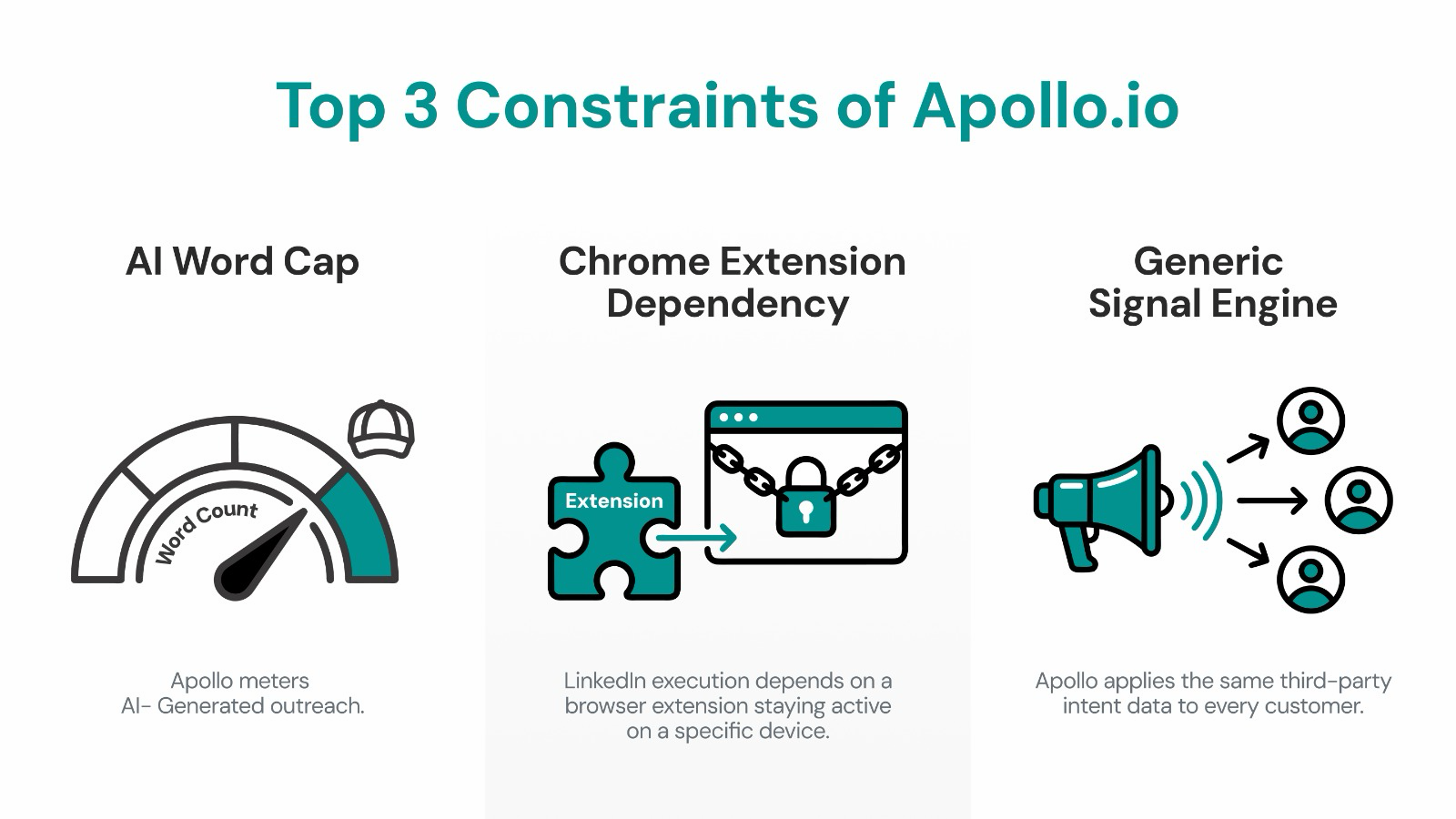
1. Apollo's AI word cap kills personalisation at scale.
Apollo.io meters AI-generated outreach at 800,000 words per month at the Pro tier, which sounds large until a team is running 500 outbound prospects per week and discovers that personalisation depth and send volume are in direct competition. By week three, messages are shortened. By week four, they are templates with a first name inserted.
2. LinkedIn execution breaks the moment your browser does.
Apollo's LinkedIn integration runs through a Chrome extension, which means it depends on that extension being active in the correct browser on the correct device. For teams with managed devices or salespeople working across multiple machines, that dependency creates workflow friction that compounds over time, and for organisations with IT policies that restrict browser extensions entirely, it is not friction but a blocked channel.
3. Its signal engine doesn't know your ICP — it knows everyone's
Apollo applies the same third-party intent data to every customer. There is no mechanism that learns which account signals correlate with closed-won deals for a specific team's ICP. Every salesperson gets the same companies flagged as in-market, regardless of whether those companies ever convert for that business. The result is high outreach volume against targets with no particular relevance to the seller's own win patterns.
These are architectural constraints, not product gaps that a future update will close. The teams that find the best Apollo alternatives are the ones that identify which of these three constraints is costing them the most pipeline and choose the replacement accordingly.
The 11 Best Apollo.io Alternatives, Reviewed
Each review covers what the tool does well, where it falls short, and who it is for. Pricing reflects only what each vendor publicly confirms.
| # | Tool | Best For | Standout Capability | Pricing |
|---|---|---|---|---|
| 1 | Kris@Work | All-in-one signal-led execution | No AI word cap, conversation intelligence, native LinkedIn, warm intros, single intelligent window | Public pricing, free trial |
| 2 | ZoomInfo | Largest B2B contact database | Website visitor ID, Bombora intent, broadest data coverage | Contact for pricing |
| 3 | Clay | Custom enrichment workflows | Multi-provider waterfall enrichment, public usage-based pricing | Public pricing (usage-based) |
| 4 | Lemlist | Personalised multichannel outreach | Automated LinkedIn sequences, dynamic image and video personalisation, built-in email deliverability | Public pricing, free trial |
| 5 | 11x.ai | Autonomous multi-channel AI SDR | Native LinkedIn, phone dialler, uncapped AI words, all at full support | Contact for pricing |
| 6 | Unify GTM | Signal-based account-led GTM | Full website visitor ID, intent aggregation, public pricing | Public pricing |
| 7 | Salesloft | Enterprise revenue workflow | Full conversation intelligence, pipeline management, coaching | Contact for pricing |
| 8 | Gong | Conversation intelligence | Call recording, real-time coaching, revenue forecasting | Contact for pricing |
| 9 | Clari | Revenue forecasting and pipeline | Revenue intelligence, deal health scoring, pipeline stage gating | Contact for pricing |
| 10 | Reevo | Full-funnel AI GTM platform | Native CRM, conversation intelligence, meeting intelligence | Contact for pricing |
| 11 | Monaco AI | Full-funnel AI sales platform with native CRM | Conversation intelligence, AI-native architecture, native CRM | Contact for pricing |
| 12 | Aurasell | Autonomous AI outbound with full GTM coverage | Autonomous AI agents, revenue intelligence, native CRM | Public pricing |
| 13 | Lightfield | AI-native full-funnel platform with public pricing | Native CRM, conversation intelligence, AI-native architecture | Public pricing |
Reply rate benchmarks vary by source, but the numbers
1. Kris@Work
Best all-in-one Apollo alternative for autonomous, signal-led outreach
Kris@Work is the only tool in this list that addresses all three core Apollo constraints simultaneously: it removes the AI word cap entirely, runs LinkedIn natively inside sequences without a Chrome extension, and trains its signal engine on buyer and seller context. So the system knows who you are before marrying that to which customer to reach out to.
Features
Kris@Work is built on three capabilities no other tool in this list offers together: an uncapped AI personalisation engine, native LinkedIn execution without a browser extension, and a signal engine trained on buyer and seller context.
- Single intelligent window with no tab-switching, the only tool in this comparison with this capability
- Autonomous AI outreach agents that research each prospect individually and write 1-to-1 messages with no monthly word ceiling
- Native LinkedIn in sequence with no Chrome extension dependency
- Warm intros via mutual connections, the only tool in this entire comparison with this capability
- ICP-trained signal engine calibrated to each team's own closed-won patterns, not generic third-party intent data
- AI-Native zero-touch CRM that automatically updates, enriches, and explains your customer records, so reps can sell instead of maintaining the database
- An inbuilt deliverability system to check mailbox and domain health, ensuring outreach is sent only from healthy inboxes.
- Lead Finder that simplifies lead discovery from 5 minutes to 5 seconds with Apollo-like filters.
- Sales Coaching that provides real-time guidance on a rep’s strengths and areas for improvement.
- Marketing Email Campaigns that let users design templates, set sequencing, and define user cohorts, similar to Mailchimp and Mailgun.
- Power Dialing that allows reps to call 100 contacts at once, drop pre-recorded voicemails in their own voice, and get notified when someone picks up
- Follow-Exact Template that lets users define a fixed email template with placeholders, giving them complete control over the messaging sent to prospects.
Pros
- Only tool in this list with uncapped AI personalisation words, removing the monthly ceiling Apollo imposes
- Only tool in this comparison with warm intros via mutual connections
- Native LinkedIn execution with no browser extension dependency
- ICP-trained signal engine learns from each team's own win data, not universal intent signals
- Native CRM eliminates the need for a separate CRM tool at the Capture stage
Cons
- Enrichment credits at Growth tier (1,250) are lower than Apollo Pro (2,000), high-enrichment-volume teams should weigh this
- A/B testing for sequences is not currently available
- TAM sourcing is partial support rather than full
Why Kris@Work Earns the #1 Position
The case for Kris as the top Apollo alternative comes down to architecture rather than feature count. Apollo rationed its AI personalisation by the month. Kris removed the ceiling. Apollo required a browser extension to touch LinkedIn, and Kris made it a native sequence step.
Apollo applied the same signals to every customer. Kris trains its signal engine on each team's own closed-won history. Those three changes address the three reasons most teams leave Apollo in the first place.
The Unique Capability: Warm Intros via Mutual Connections
Of every tool reviewed here, Kris is the only one that maps a team's shared network to surface a warm path into target accounts. No other tool in this list, including Apollo, offers warm intros via mutual connections. That capability sits on top of the uncapped AI personalisation and native LinkedIn execution to create a prospecting motion that is structurally different from any database-plus-sequences approach.
The Honest Trade-offs
Apollo has more enrichment credits at its Pro tier, full A/B testing for sequences, full TAM sourcing, and full website visitor identification. These are real advantages on specific dimensions. Teams whose primary need is database depth and enrichment volume at scale may find Apollo a better fit. Teams whose primary constraint is personalisation depth, LinkedIn reliability, and signal relevance to their own ICP will find the trade-offs worth making.
Here’s the full breakdown of Kris vs. Apollo.
2. ZoomInfo
Best for enterprise teams that need maximum B2B contact database depth
ZoomInfo's differentiation is data coverage, not execution. It holds the largest B2B contact and company database of any tool in this list, integrates third-party intent data from Bombora, G2, and 6sense, and covers website visitor identification, a capability where Kris only has partial coverage.
Teams choose ZoomInfo when raw contact breadth is the binding constraint, understanding they need a separate outreach and sequencing stack to act on that data.
Features
- Largest B2B contact and company database in this list
- Full website visitor identification
- Full intent data aggregation: Bombora, G2, and 6sense
- Full contact and account intelligence
- Full data enrichment for contact and company records
- CRM integration with Salesforce and HubSpot at full support
Pros
- Broadest database coverage and intent data depth in this list
- Full website visitor identification, strongest signal for inbound-influenced accounts
- Full third-party intent integration across Bombora, G2, and 6sense
Cons
- Pricing not publicly disclosed, high procurement friction for SMB buyers
- No PLG self-serve free trial
- No autonomous AI outreach agents
- No native LinkedIn in sequence
- No ICP-trained signal engine
- Not built as an AI-native platform
- No email sequence automation or A/B testing
- Requires a separate outreach and sequencing tool to act on the data
3. Clay
Best for technical RevOps teams building custom enrichment workflows
Clay does one thing better than any other tool in this list: it lets a technical team pull data from multiple enrichment providers in a single waterfall workflow and build custom prospecting logic without writing code. Its public usage-based pricing means costs scale with enrichment volume rather than seat count. It is a workflow builder rather than an execution engine, which means teams without a RevOps resource to configure and run it will find it demanding before they find it useful.
Features
- Full data enrichment across multiple providers in a single waterfall workflow
- Public usage-based pricing
- CRM integration with Salesforce and HubSpot at full support
- Partial autonomous AI outreach capability
- Partial ICP signal engine for account scoring
- Partial email sequence automation and A/B testing
Pros
- Most flexible enrichment tool in this list, widest provider coverage
- Usage-based public pricing makes cost predictable at volume
- CRM integration at full support
Cons
- No native LinkedIn in sequence
- No phone dialler
- Not an execution engine, requires a separate outreach tool to act on enriched data
- Requires a RevOps resource to configure and maintain workflows
- No built-in native contact database at full support
- No self-serve free trial
4. Lemlist
Best for teams that want personalised multichannel outreach with strong email deliverability
Lemlist is a multichannel outreach platform that trades Apollo's database breadth for execution depth, with automated LinkedIn sequences, dynamic image and video personalisation per prospect, and a built-in email deliverability tool included on every plan.
Features
- Dynamic personalisation: custom images, videos, and landing pages generated per prospect
- Automated LinkedIn sequences including profile visits, connection requests, and direct messages
- Built-in Lemwarm email deliverability and warm-up tool on all paid plans
Pros
- Strongest personalisation depth in this comparison, with dynamic images and video per prospect
- Automated LinkedIn sequences, not manual task reminders like Apollo
- Built-in email deliverability tooling without a separate tool purchase
Cons
- Per-seat pricing scales linearly
- Enrichment credits and additional sender mailboxes charged separately, headline price understates real cost at volume
- No ICP-trained signal engine calibrated to each team's own closed-won patterns
- No warm intros via mutual connections
- No native CRM, requires a separate integration
5. 11x.ai
Best for autonomous multi-channel AI SDR outreach across email, LinkedIn, and phone
11x.ai shares Artisan's fully autonomous AI SDR model but adds native LinkedIn execution and a phone dialler with AI scripts, making it the stronger choice for teams that need autonomous outreach across all three channels simultaneously. Its AI-native architecture, multi-agent design, and uncapped AI words all operate without the limitations that constrain Apollo.
Features
- Autonomous AI outreach agents at full support
- Native LinkedIn in sequence at full support
- Phone dialler with AI scripts at full support
- Uncapped AI words at full support
- AI-native and multi-agent architecture, both at full support
- Full email sequence automation
- Full ICP-to-TAM auto-build and data enrichment
Pros
- Full native LinkedIn execution without a Chrome extension
- Full phone dialler coverage alongside email, strongest multi-channel autonomous coverage in this list
- Uncapped AI words and AI-native architecture both at full support
Cons
- Pricing not publicly disclosed
- No self-serve free trial
- No warm intros via mutual connections
- Partial ICP-trained signal engine rather than training on each team's own win data
- No meeting intelligence, conversation intelligence, or CRM module
- No pipeline management or deal health features
6. Unify GTM
Best for account-based GTM teams that trigger outreach on real-time account signals
Unify GTM is differentiated by its signal layer. It covers website visitor identification, company signal detection, contact signal and buying intent detection, and third-party intent aggregation from Bombora, G2, and 6sense. For account-based GTM teams that want to trigger outreach on real-time account behaviour, it has the most complete signal stack of any tool in this comparison outside of Kris, with public pricing to match.
Features
- Full website visitor identification
- Full company and contact signal detection
- Full intent aggregation: Bombora, G2, and 6sense
- Full contact and account intelligence
- Full built-in contact database and data enrichment
- Full ICP-to-TAM auto-build
- Full email sequence automation and A/B testing
- AI-native architecture at full support
- Public pricing
Pros
- Most complete signal stack in this list for account-based outreach triggering
- Full intent aggregation across Bombora, G2, and 6sense alongside full website visitor identification
- Public pricing
Cons
- Autonomous AI outreach agents at partial support only
- LinkedIn execution is partial rather than native full support
- No phone dialler
- No meeting intelligence or conversation intelligence
- No native CRM module
- No warm intros via mutual connections
7. Salesloft
Best for enterprise revenue teams that need mature cadence, coaching, and pipeline infrastructure
Salesloft is the most comprehensive enterprise revenue platform in this list. It covers conversation intelligence, call recording and transcription, real-time call coaching, pipeline management, deal health by customer sentiment, revenue intelligence and forecasting, and MEDDIC scorecards. Of every tool reviewed here, it has the strongest multi-persona coverage across SDR, AE, Manager, and CRO roles. A Salesloft buyer is typically a 200-plus salesperson enterprise organisation with the IT and RevOps capacity to implement and maintain a platform of this complexity.
Features
- Full conversation intelligence and real-time call coaching
- Full pipeline management and deal health by customer sentiment
- Full revenue intelligence and forecasting
- Full MEDDIC scorecards and coaching infrastructure
- Strongest multi-persona coverage in this comparison, spanning SDR, AE, Manager, and CRO roles
- Full CRM integration with Salesforce and HubSpot
- Full email sequence automation and A/B testing
- Full phone dialler with AI scripts
Pros
- Strongest enterprise revenue workflow coverage in this list
- Strongest multi-persona support in this comparison, covering SDR, AE, Manager, and CRO
- Full conversation intelligence alongside full coaching and pipeline management
Cons
- Pricing not publicly disclosed
- No self-serve free trial
- Not built as a fully AI-native platform
- No autonomous AI outreach agents
- No warm intros via mutual connections
- No built-in contact database or uncapped AI personalisation words
- Configuration overhead makes it a poor fit for teams under 100 salespersons
8. Gong
Best for teams whose constraint is conversation intelligence and call coaching, not prospecting
Gong does not compete with Apollo in the prospecting category. It competes with the revenue visibility problem that emerges after the prospecting motion is running but pipeline accuracy and call coaching remain weak. Meeting intelligence, call recording and transcription, real-time call coaching, conversation intelligence, and revenue intelligence and forecasting are all fully covered. Teams searching for a tool to replace Apollo's contact database and sequencing capabilities should not end up here.
Features
- Full meeting intelligence across Zoom, Meet, Teams, and Dialler
- Full call recording, transcription, and real-time coaching
- Full conversation intelligence with deal signals
- Full revenue intelligence and forecasting
- MEDDIC scorecards and coaching at full support
- Full CRM integration
Pros
- Strongest call coaching and conversation intelligence tool in this list
- Full revenue intelligence and forecasting
- Full MEDDIC infrastructure for structured sales methodology
Cons
- Pricing not publicly disclosed
- No self-serve free trial
- No email sequence automation
- No contact database
- No LinkedIn in sequence
- No autonomous AI outreach agents
- Not built as a fully AI-native platform
- Not an Apollo alternative for prospecting; solves a downstream revenue accuracy problem
9. Clari
Best for CROs and revenue leaders who need forecasting accuracy and pipeline visibility
Clari's value proposition is pipeline integrity, not outbound execution. It has full support for revenue intelligence and forecasting, pipeline management and stage gating, and conversation intelligence. Like Gong, it does not address the Apollo constraints that send most teams searching. Teams that choose Clari are solving a revenue forecasting problem, not an outbound quality problem. It belongs in a shortlist alongside Gong and Salesforce, not alongside Apollo.
Features
- Full revenue intelligence and forecasting
- Full pipeline management and stage gating
- Full conversation intelligence
- Full AI CRM updates from conversations
- Full multi-persona coverage across the revenue team
- Full CRM integration with Salesforce and HubSpot
Pros
- Strongest revenue forecasting and pipeline visibility tool in this list
- Full conversation intelligence alongside full pipeline stage management
- Full multi-persona coverage across all revenue roles
Cons
- Pricing not publicly disclosed
- No self-serve free trial
- No contact database or data enrichment
- No email sequence automation
- No LinkedIn execution
- No autonomous AI outreach agents
- Not a prospecting or outreach tool
10. Reevo
Best for teams that want a full-funnel AI platform with a native CRM included
Reevo is the closest architectural comparison to Kris@Work in this list. It is a full-funnel AI platform with a native CRM, full conversation intelligence, full meeting intelligence, call recording, a phone dialler, data enrichment, a contact database, and pipeline management. Where Reevo differs from Kris: it does not run LinkedIn natively in sequence, does not offer an ICP-trained signal engine calibrated to each team's own win data, and does not surface warm intros via mutual connections.
Features
- Native CRM built in at full support
- Full meeting intelligence and call recording
- Full conversation intelligence with deal signals
- Full pipeline management and stage gating
- Full revenue intelligence and forecasting
- Full data enrichment and contact database
- Full ICP-to-TAM auto-build
- Phone dialler at full support
- Full CRM overlay integration
Pros
- Most complete full-funnel platform in this list alongside Kris
- Native CRM eliminates a separate CRM tool for the full GTM motion
- Full conversation intelligence, meeting intelligence, and pipeline management in one platform
Cons
- No native LinkedIn in sequence
- No ICP-trained signal engine calibrated to each team's own win data
- No warm intros via mutual connections
- No real-time proactive intelligence
- Autonomous AI outreach is partial rather than full agent execution
- Pricing not publicly disclosed
- No self-serve free trial
How to Choose the Right Apollo.io Alternative
The choice depends on which of the three Apollo constraints is most expensive for your business.
distinction is what most teams miss when they go looking for a replacement.
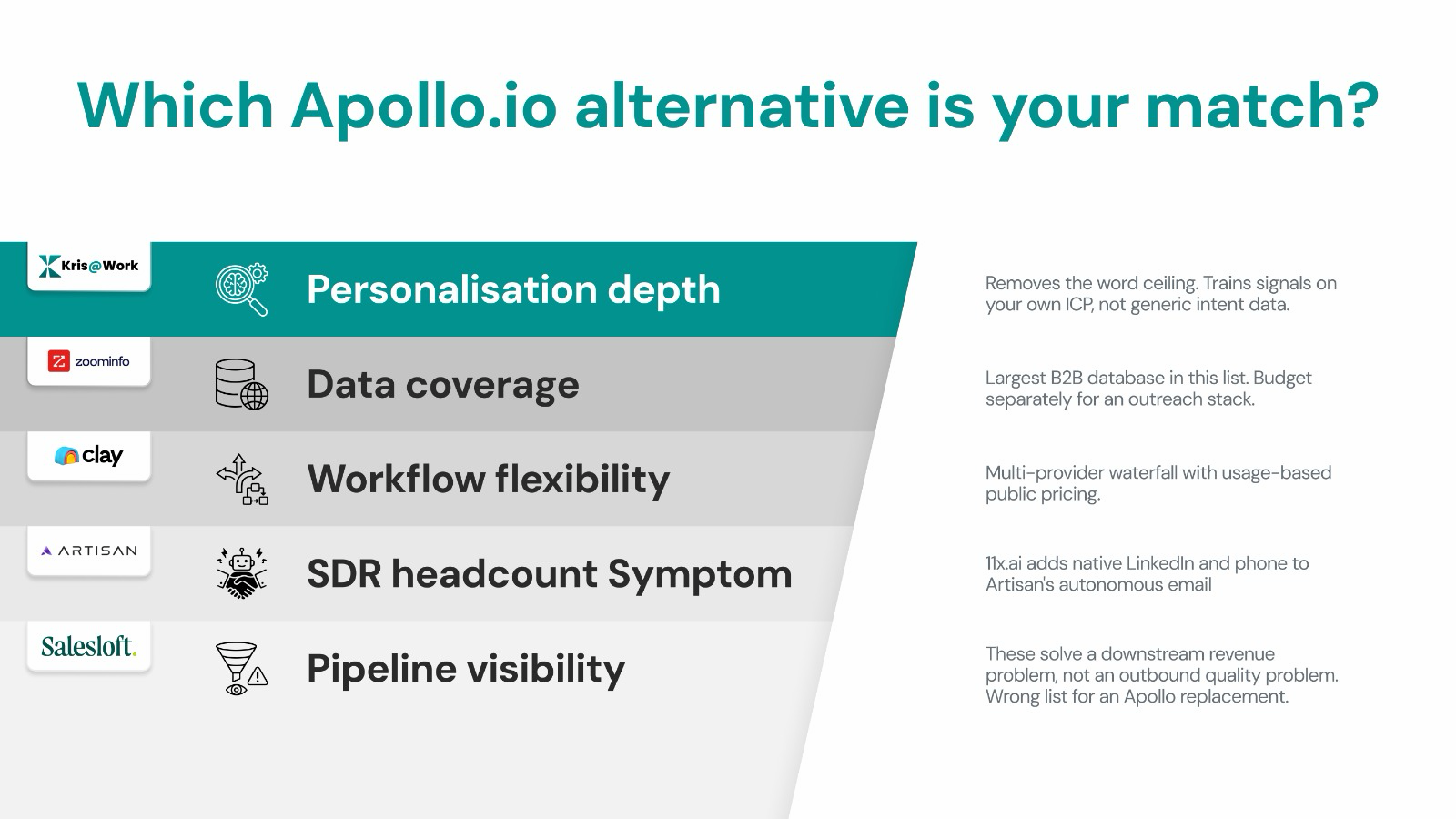
1. If your constraint is personalisation depth
The architecture you are looking for removes the word cap and runs research at the prospect level rather than the template level. Kris@Work is the only tool in this list that does both with full support.
2. If your constraint is data coverage
For teams running high-volume outbound across broad markets where contact quality is the binding variable, ZoomInfo's database depth and intent integration are the benchmark. Budget for a separate outreach stack alongside it.
3. If your constraint is workflow flexibility
If you have a RevOps function that wants to build custom enrichment logic across multiple data providers, Clay's waterfall model at public usage-based pricing is the right starting point.
4. If your constraint is SDR headcount
Artisan and 11x.ai are the two fully autonomous AI SDR models in this list. 11x.ai adds native LinkedIn and phone coverage that Artisan does not fully support. Both remove the salesperson from day-to-day outbound management.
5. If your constraint is downstream pipeline visibility
Gong, Clari, and Salesloft are purpose-built for revenue forecasting, call coaching, and pipeline management. They are in this list for completeness but they solve a different constraint from the one that sends most teams searching for an Apollo alternative.
For a broader view of AI sales tools not limited to Apollo alternatives, see Best AI Sales Prospecting Tools.
The Bottom Line
Most teams searching for an Apollo alternative are not searching for more data. They are searching for a way to maintain outreach quality at volume without rationing AI words, manage LinkedIn execution without extension dependencies, and get signals that reflect their own win patterns rather than everyone else's intent data. A different database does not solve any of those three things.
If those constraints map to your situation, see how Kris compares to Apollo feature by feature at Kris vs Apollo. If you are not ready for a direct comparison yet, start the platform with no credit card at krisatwork.com. The teams that stay on Apollo longest are usually the ones who never ran the side-by-side.
Frequently Asked Questions
1. What is the best Apollo.io alternative for AI-powered personalised outreach?
Kris@Work removes the monthly AI word cap that Apollo imposes at the Pro tier (800,000 words per month), trains its signal engine on each team's own closed-won ICP patterns rather than applying generic intent data, and runs LinkedIn natively inside sequences without a Chrome extension. Of every tool reviewed here, it is the only one with warm intros via mutual connections.
2. Does switching from Apollo to a bigger database actually fix the problem?
For most teams, no. The common failure mode is recognising that Apollo has a monthly AI word cap and switching to a tool with more contacts rather than a tool with a better execution architecture. If the root cause is that personalisation quality degrades as monthly word usage grows, moving to a database with more contacts does not change that. The constraint is how outreach is generated, not how many records are available to generate it from.
3. Can I run Apollo.io and Kris@Work at the same time?
Technically yes, through CRM integration. In practice, most teams that evaluate both replace Apollo rather than run both in parallel, because Kris includes a built-in contact database and full outreach execution, which removes the primary reasons to maintain an Apollo subscription alongside it.