
When revenue teams start evaluating ZoomInfo alternatives, Kris comes up quickly. But comparing the two directly can feel like comparing a library to a workflow system. They solve adjacent problems but operate at different layers of the sales stack.
This comparison is for teams that have already shortlisted both and want a clear-eyed look at where each one fits, where each falls short, and which makes sense given how your team actually works.
TL;DR- Comparison At a Glance
| Dimension | Kris | ZoomInfo |
|---|---|---|
| Primary category |
GTM execution platform | B2B data & intelligence |
| Database coverage |
Signal-based ICP matching | 260M+ contacts, 100M+ companies |
| Outreach capabilities |
Native, omnichannel, in-rep voice |
Requires add-on (ZoomInfo Engage) or separate tool |
| AI layer | Agentic architecture, contextual guidance |
GTM Copilot, intent signals, GTM Context Graph |
| Pricing model | Transparent, subscription-based |
Custom quote |
| Contract flexibility |
Available | Annual contracts required; strict auto-renewal |
| Best for | Teams wanting full GTM execution in one platform |
Teams prioritizing the deepest B2B contact database |
What These Tools Actually Are
Before getting into features, it's worth being precise about the category each product belongs to, because the comparison only makes sense once that's clear.
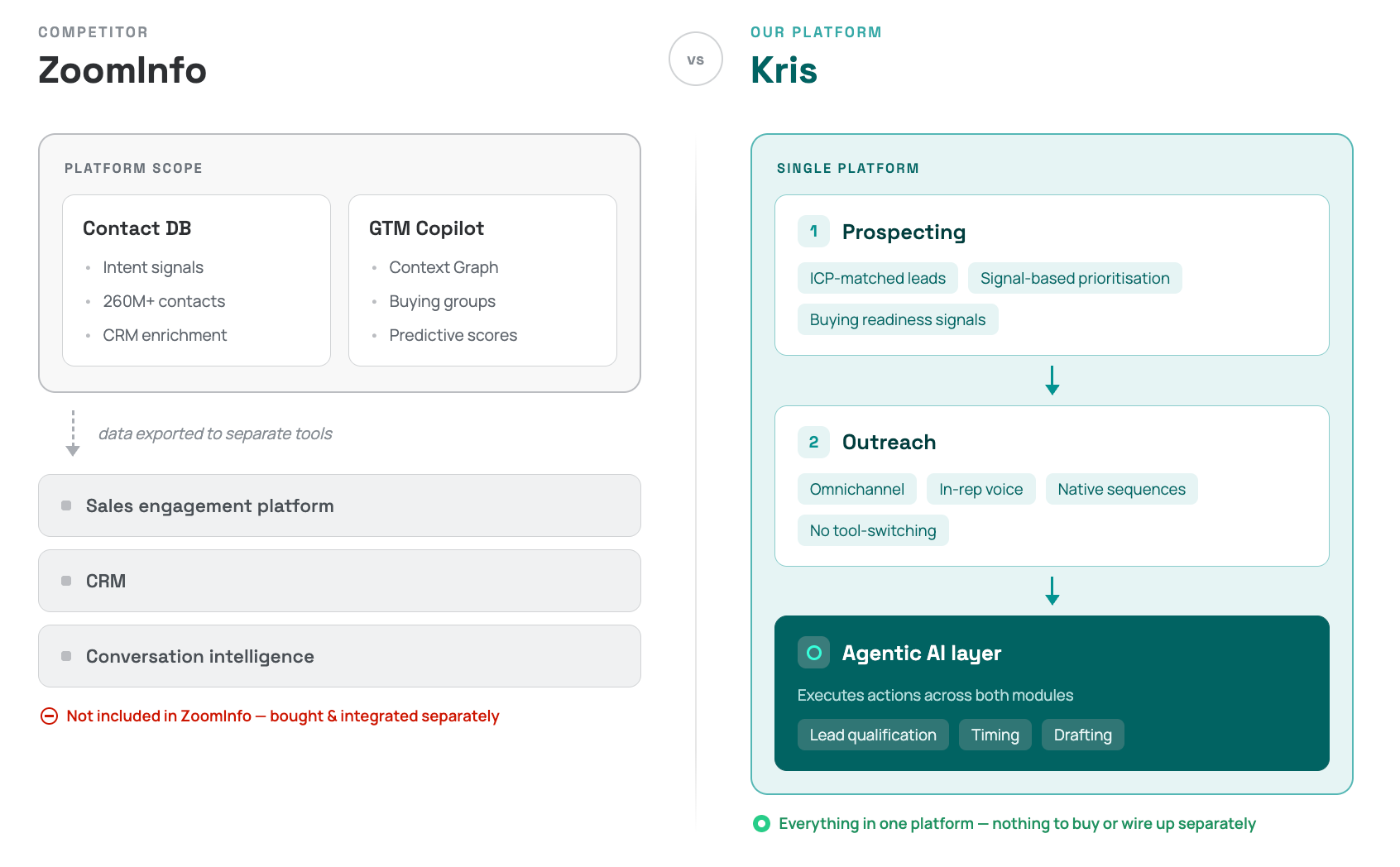
ZoomInfo is a B2B data and intelligence platform. Its core value is the depth and scale of its contact and company database: over 260 million contacts, 100 million companies, and more than 200 million verified business email addresses, processed through what it calls the GTM Context Graph. Teams use ZoomInfo to find who to call, verify contact information, track buying intent signals, and enrich CRM records. It does not manage outreach, coach reps, or orchestrate deal cycles. For that, users typically layer on ZoomInfo Engage or a separate sales engagement tool.
Kris (by Kris@Work) is an AI-native GTM execution platform. It is built to bring prospecting, prioritization, and outreach into a single interface, powered by contextual AI and agentic automation. Rather than being a data vendor, Kris is the operational layer where revenue teams execute work. It raised $3M in seed funding in February 2026, led by Infoedge Ventures, and is backed by an experienced SaaS founding team.
The distinction matters: ZoomInfo tells you who to reach and when they might be ready. Kris is where the actual reaching happens, with its own signal and intelligence layer built in.
How the Platforms Differ, Theme-by-Theme
1. Data and prospecting depth
ZoomInfo's core advantage is data scale. With over 260 million contacts and more than 1.5 billion data points processed daily, it offers the broadest B2B coverage on the market. Intent data (powered partly through its Bombora acquisition) lets teams identify accounts actively researching relevant topics. For enterprise teams that need to prospect into very large TAMs across multiple industries and geographies, this breadth is genuinely difficult to match.
Kris approaches prospecting differently. Rather than maintaining a static database at scale, it surfaces ICP-matched accounts with signal-based prioritization, showing buying readiness rather than handing reps a list to work through manually. The outreach layer is native: hyper-personalized, omnichannel, and written in the rep's own voice. Reps aren't stitching ZoomInfo data into a separate sequence tool; they're working inside a single interface.
The practical tradeoff: ZoomInfo wins on raw data breadth and is better suited for teams that need to reach very specific contacts across a wide set of accounts. Kris wins on workflow integration: the signal-to-outreach path is shorter, and less rep time is lost switching between tools.
2. Execution layer: where the real gap appears
This is the clearest structural difference between the two platforms.
ZoomInfo is an intelligence and enrichment tool. Once you know who to target and you have their contact details, you leave ZoomInfo to execute, opening your sales engagement platform for sequencing, your CRM for notes, your conversation intelligence tool for call analysis. That's the standard enterprise stack, and ZoomInfo integrates with all of it. But those integrations mean context lives in multiple systems, and reps spend meaningful time navigating between them.
Kris is designed to eliminate that fragmentation. Prospecting, outreach, and the agentic AI layer that ties them together all live in the same interface. The platform can take action, not just surface information, automating steps that currently require manual work across disconnected tools.
For teams tired of managing five to eight SaaS tools just to run a standard outbound motion, that consolidation is the core value proposition.
3. AI and automation
ZoomInfo's AI layer centers on the GTM Context Graph, a reasoning system that fuses proprietary B2B data with CRM records, conversation intelligence from Chorus, buyer intent signals, and behavioral data. ZoomInfo Copilot sits on top of this to surface account summaries, buying group identification, and predictive signals. It's powerful for analysis and prioritization, especially at enterprise scale.
Kris uses agentic AI architecture, meaning the AI doesn't just surface insights. It can execute actions within the platform. This includes automated lead qualification, prioritizing outreach timing based on signals, and drafting omnichannel messages personalized to the rep's voice. The difference is behavioral: ZoomInfo Copilot is an intelligence layer you act on; Kris is closer to a working co-pilot that takes action alongside the rep.
Both approaches involve real tradeoffs. ZoomInfo's AI is trained on a larger proprietary dataset, which gives it stronger grounding for intent interpretation. Kris's agentic model is more operationally integrated, but as a newer platform, its AI capabilities are still maturing.
4. Pricing and total cost of ownership
ZoomInfo pricing is quote-based and not publicly disclosed. Based on verified buyer data and third-party pricing trackers, the Professional plan starts around $14,995 per year for three seats with 5,000 credits. Most mid-market teams end up on the Advanced plan once they need intent data and deeper filtering. But for teams of five or more reps, per-seat add-ons of $1,500–$2,500 per user push real annual spend into the $30,000–$60,000 range, and enterprise contracts often exceed $100,000 when Chorus, Copilot, ABM features, and worldwide data are included.
The structural friction compounds at renewal: ZoomInfo contracts typically include auto-renewal clauses with 10–20% annual price increases, and the cancellation window is often 60–90 days before the renewal date. Users on community forums consistently flag missed cancellation windows as a significant pain point.
Kris operates on a transparent subscription model without the credit-based overage system that creates surprise costs in ZoomInfo. Pricing is available directly from the platform without engaging a sales rep. For teams consolidating from a multi-tool stack (data vendor + engagement tool + conversation intelligence + CRM enrichment), the total cost comparison often shifts significantly in Kris's favor.
5. Integration depth and stack fit
ZoomInfo has deep integrations with Salesforce, HubSpot, and Microsoft Dynamics, including bi-directional sync. For enterprises with complex, established tech stacks, this is a genuine advantage: ZoomInfo can plug into existing workflows without displacing them.
Kris is designed to reduce the number of tools a team runs, not add to the existing stack. Its integration philosophy is the opposite: it connects to your CRM and communication tools, but the execution work happens inside Kris itself. This makes it a better fit for teams willing to consolidate their workflow, and a harder sell for large enterprises deeply invested in their existing toolchain.
What each platform does well
Where Kris Works Best
Kris fits teams that are feeling the operational cost of tool fragmentation, where reps spend more time navigating between systems than actually selling. It's particularly suited to technology, financial services, telecom, and automotive companies with moderate to complex GTM motions where deal guidance and account expansion logic add real value. Teams that want AI to actively assist with execution, not just inform it, will find the agentic model more aligned with how they want to work.
As a seed-stage company, Kris's platform is still completing development across its four planned phases. Buyers should evaluate current capabilities directly rather than buying on roadmap.
Where ZoomInfo Works Best
ZoomInfo earns its position at the top of the data vendor category for enterprise teams that need the widest possible contact coverage, reliable intent signals at scale, and deep CRM enrichment. If your primary bottleneck is finding the right contacts across a large and varied TAM, ZoomInfo's database depth is hard to replace. It's also the safer choice for large enterprises with established workflows where adding an execution platform wholesale would create more disruption than value.
The price works in ZoomInfo's favoWIPr when the team is large enough that the per-contact cost becomes efficient and when the data is used daily across many reps. When the team is smaller or the database is underutilized, the cost structure quickly becomes difficult to justify.
To Enable Decision-making, in Plain Terms
If your sales team's primary constraint is contact data (finding verified emails and direct dials for a broad and diverse prospect universe), ZoomInfo is the established choice and its coverage advantage is real.
If your team's primary constraint is execution (reps spending too much time across too many tools, deals slipping without guidance, no visibility into churn risk until it's too late), Kris is built for that problem. It brings prospecting, outreach, deal management, and account expansion into a single interface, with AI that assists at each step rather than requiring the rep to connect the dots manually.
The comparison ultimately comes down to where your revenue team is losing time and money: before the outreach (data and targeting) or during the cycle (execution and follow-through). Most teams that seriously evaluate both already know which problem is bigger.
FAQs
1. Is Kris a ZoomInfo alternative, or a different kind of tool?
They're different categories. ZoomInfo is a data and intelligence vendor; Kris is a GTM execution platform with its own intelligence layer. Most teams that switch from ZoomInfo to Kris aren't just replacing their data source. They're consolidating several tools into one. If you only need contact data and intent signals to feed into your existing stack, Kris isn't a like-for-like replacement. If you want to reduce the number of tools your reps touch while maintaining signal-based prospecting and execution, Kris is built for that.
2. Does Kris have a B2B contact database comparable to ZoomInfo?
No. Kris focuses on signal-based account discovery and ICP-matched lead identification rather than maintaining a broad contact database at ZoomInfo's scale. Teams that need to prospect into very wide TAMs with highly specific contact criteria may still need a dedicated data source alongside Kris. However, for teams whose bottleneck is execution rather than finding contacts, this distinction is less material.
3. How does ZoomInfo pricing actually work for a team of 10 reps?
At ten seats on the Advanced plan, total annual cost including per-seat fees typically lands in the $40,000–$55,000 range before add-ons. Intent data, Chorus (conversation intelligence), and Copilot are often quoted separately. Teams that need these features (and most do) should request an all-in quote that includes every module they were shown in the demo, not just the base platform.
4. Which platform has better AI capabilities?
They use AI for different things. ZoomInfo's GTM Copilot and Context Graph are strong on intent analysis and account intelligence: they tell you what's happening with a given account and who the likely buyers are. Kris's agentic AI is oriented toward execution, automating steps in the outreach and deal cycle rather than just surfacing information. The right answer depends on whether your team's gap is knowing what to do or actually doing it.
5. Can Kris and ZoomInfo be used together?
Yes, and some teams do. ZoomInfo can serve as the data and intent layer feeding into Kris's execution environment. Whether that combination is worth the cost depends on how much of ZoomInfo's database breadth your team actively uses. For many mid-market teams, Kris's built-in signal layer is sufficient and the combined cost of both platforms is hard to justify.